-
Articles/Ads
Article THE THEATRES. Page 1 of 1 Article THE THEATRES. Page 1 of 1
Note: This text has been automatically extracted via Optical Character Recognition (OCR) software.
The Theatres.
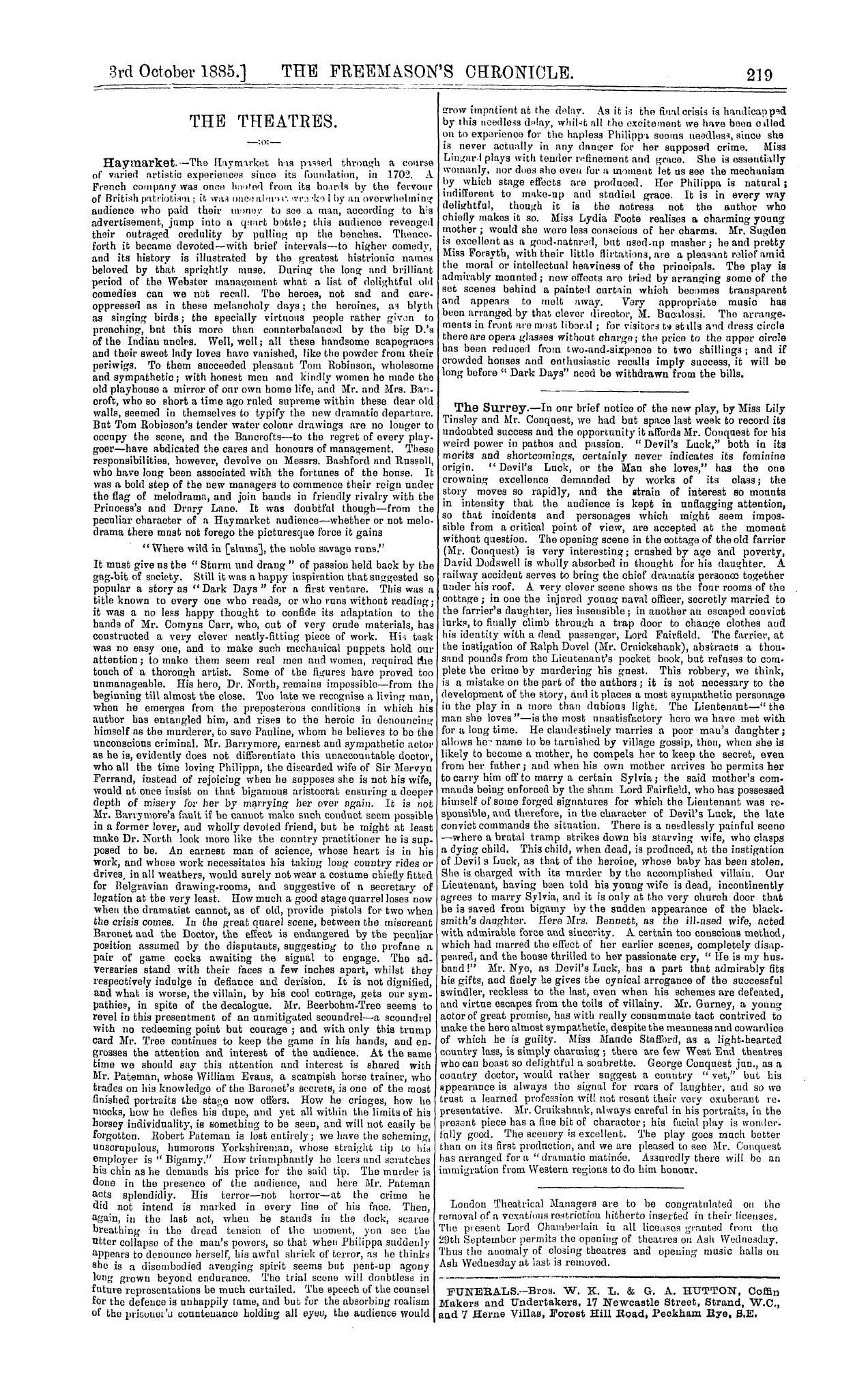
THE THEATRES .
— : o : — Hay market- —The Hay market has passed through a course of varied artistic experiences since its foundation , in 1702 . A French company was once hooted from its boards by tho fervour of British patriotism ; it was once al urn ' , ivryko I by an overwhelming
audience who paid their monoy to see a man , according to his advertisement , jump into a quart bottle ; this audience revenged their outraged credulity by pulling np the benches . Thenceforth it became devoted—with brief intervals—to higher comedy , and its history is illustrated by the greatest histrionic names
beloved by that sprightly muse . During the long and brilliant period of the Webster management what a list of delightful old comedies can we not recall . Tho heroes , not sad and careoppressed as in these melancholy days ; the heroines , as blyth as singing birds ; the specially virtuous people rather given to
preaching , bnt this more than counterbalanced by the big D . s of the Indian uncles . Well , well ; all these handsome scapegraces and their sweet lady loves have vanished , like the powder from their periwigs . To them succeeded pleasaut Tom Robinson , wholesome and sympathetic ; with honest men and kindly women he made the
old playhouse a mirror of our own home life , and Mr . and Mrs . Ban . oroft , who so short a time ago ruled supreme within these dear old walls , seemed in themselves to typify the new dramatic departure . But Tom Robinson's tender water colonr drawings are no longer to occupy the scene , and the Bancrofts—to the regret of every
playgoer—have abdicated the cares and honours of management . These responsibilities , however , devolve on Messrs . Bashford and Russell , who have long been associated with the fortunes of the honse . It was a bold step of the new managers to commence their reign under
the flag of melodrama , and join hands in friendly rivalry with the Princess ' s and Drnry Lane . It was doubtful though—from the peculiar character of a Haymarket audience—whether or not melodrama there mnst not forego the picturesque force it gains
"Where wild in [ slums ] , the noble savage runs . " It must give us the " Sturm und drang " of passion held back by the gag-bit of society . Still it was a happy inspiration that suggested so popular a story as " Dark Days " for a first venture . This was a title known to every one who reads , or who runs without reading ;
it was a no less happy thought to confide its adaptation to the hands of Mr . Comyns Carr , who , out of very crude materials , has constructed a very clover neatly-fitting piece of work . His task was no easy one , and to make such mechanical puppets hold our attention ; to make them seem real men and women , reqaired tbe
touch of a thorough artist . Some of the figures have proved too unmanageable . His hero , Dr . North , remains impossible—from the beginning till almost the close . Too late we recognise a living man , when he emerges from the preposterous conditions in which his author has entangled him , and rises to the heroic in denouncing
himself as the murderer , to save Pauline , whom he believes to be the unconscions criminal . Mr . Barrymore , earnest and sympathetic actor as he is , evidently does not differentiate this unaccountable doctor , who all the time loving Philippn , the discarded wife of Sir Mervyn Ferrand , instead of rejoicing when he supposes she is not his wife ,
would at once insist on that bigamous aristocrat ensuring a deeper depth of misery for her by marrying her over again . It is not Mr . Barry more ' s fault if ho cannot make such conduct seem possible in a former lover , and wholly devoted friend , but he might at least make Dr . North look more like the country practitioner he is
supposed to be . An earnest man of science , whose heart is in his work , and whose work necessitates his taking long countiy rides or drives , in all weathers , would surely not wear a costume chiefly fitted for Belgravian drawing-rooms , and suggestive of a secretary of legation at the very least . How much a good stage quarrel loses now
when the dramatist cannot , a 8 of old , provide pistols for two when the crisis comes . In the great quarel scene , between the miscreant Baronet and the Doctor , the effect is endangered by the peculiar position assumed by the disputants , suggesting to the profane a pair of game cocks awaiting the signal to engage . The
adversaries stand with their faces a few inches apart , whilst they respectively indulge in defiance and derision . It is not dignified , and what is worse , the villain , by his cool courage , gets our sympathies , in spite of the decalogue . Mr . Beerbohm-Tree seems to revel in this presentment of an unmitigated scoundrel—a scoundrel
with no redeeming point but courage ; and with only this trump card Mr . Tree continues to keep the game in his hands , and engrosses the attention and interest of the audience . At the same time we should say this attention and interest is shared with Mr . Pateman , whose William Evans , a scampish horse trainer , who
trades on his knowledge of the Baronet ' s secrets , is one of the most finished portraits the stage now offers . How he cringes , how he mocks , how he defies his dupe , and yet all within the limits of his horsey individuality , is something to be seen , and will not easily be forgotten . Eobert Pateman is lost entirely ; we have the scheming ,
unscrupulous , humorous Torkshireman , whose straight tip to his employer is " Bigamy . " How triumphantly he leers and scratches his chin as he demands his price for the said tip . The murder is done in the presence of the audience , and here Mr . Pateman acts splendidly . His terror—not horror— -at the crime he
did not intend is marked in every line of his face . Then , again , in the last act , wheu he stands iu the dock , scarce breathing in the dread tension of the moment , yon see the utter collapse of the man ' s powers , so that when Philippa suddenly appears to denounce herself , his awfnl shriek of terror , as he thinks
she is a disembodied avenging spirit seems but pent-up agony long grown beyond endurance . The trial scone will donbtless in future representations be much curtailed . The speech of the counsel for the defence is unhappily tame , and but for the absorbing realism of the priGouer'iJ countenance holding all eyeu , the audience would
The Theatres.
grow impatient at the delay . As it is the final crisis is handicapped by this needless delay , whiNt all the excitement we have been cdled on to experience for the hapless Philippi soorns needles * , since she is never actually in any danger for her supposed crime . Mis 3 Lingarl plays with tender refinement and grace . She is essentially
womanly , nor does she eveu for a moment let us see the mechanism by which stage effects are produced . Her Philippa is natural ; indifferent to make-up and studied grace . It i 3 in every way delightful , though it is the actress not the author who chiefly makes it so . Miss Lydia Foote realises a charming young
mother ; would she woro less conscious of her oharms . Mr . Sugden is excellent as a good-natnred , but nsod-np masher ; he and pretty Miss Forsyth , with their little flirtations , are a pleasant relief amid the moral or intellectual heaviness of the principals . The play ia admirably mounted ; new effects aro tried by arranging some of the
set scenes behind a painted curtain whioh becomes transparent and appears to molt away . Very appropriate music haa been arranged by that clever director , M . Bucalo 33 i . Tho arrangements in front are most liberal ; for visitors U st ills and dress circle
there are opera glasses without charge ; the price to the upper circle has been reduced from two-and-sixponoe to two shillings ; and if crowded houses and enthusiastic recalls imply success , it will be long before " Dark Days" need be withdrawn from the bills .
The Surrey . —In onr brief notice of the new play , by Miss Lily Tinsley and Mr . Conqaest , we had but space last week to record its undoubted success aud the opportunity it affords Mr . Conquest for his weird power in pathos and passion . " Devil's Luck , " both in it 3 merits and shortcomings , certainly never indicates its feminine
origin . " Devil ' s Luck , or the Man she loves , " has the one crowning excellence demanded by works of its class ; the story moves so rapidly , and the strain of interest BO mounts in intensity that the audience is kept in unflagging attention , so that incidents and personages which might seem
impossible from a critical point of view , are accepted at the moment without question . The opening scene in the cottage of the old farrier ( Mr . Conquest ) is very interesting ; crushed by age and poverty , David Dodswell is wholly absorbed in thought for his daughter . A railway accident serves to bring the chief dramatis personoo together
under his roof . A very clever scene shows us the four rooms of the cottage ; in one the injnred young naval officer , secretly married to the farrier's daughter , lies insensible ; in another an escaped convict lurks , to finally climb through a trap door to change clothes and his identity with a dead passenger , Lord Fairfield . The farrier , at
the instigation of Ralph Dovel ( Mr . Cruickshank ) , abstracts a thousand pounds from the Lieutenant's pocket book , but refuses to complete the crime by murdering his guest . This robbery , we think , is a mistake on the part of the authors ; it is not necessary to the development of the story , and it places a most sympathetic personage
iu the play in a more than dubious light . The Lieutenant— " the man she lovea "—is the most unsatisfactory hero we have met with for a long time . He clandestinely marries a poor mau ' s daughter ; allows he ? name to be tarnished by village gossip , then , when she is likely to become a mother , ho compels her to keep the secret , even
from her father ; and when his own mother arrives ho permics her to carry him off to marry a certain Sylvia ; the said mother ' s commands being enforced by the sham Lord Fairfield , who has possessed himself of some forged signatures for which the Lientenant was responsible , and therefore , in the character of Devil ' s Luck , the late
convict commands the situation . There is a needlessly painful scene —where a brutal tramp strikes down his starving wife , who clasps a dying child . This child , when dead , is produced , at the instigation of Devil s Luck , as that of the heroine , whose baby has been stolen . She is charged with its murder by the accomplished villain . Our
Lieutenant , having been told his young wife is dead , incontinently agrees to marry Sylvia , and it is only at tho very church door that be is saved from bigamy by the sudden appearance of the blacksmith's daughter . Here Mrs . Bennett , as the ill-used wife , acted with admirable force and sincerity . A certain too conscious method
which had marred the effect of her earlier scenes , completely disappeared , and the house thrilled to her passionate cry , " He is my husband ! " Mr . Nye , as Devil ' s Luck , has a part that admirably fits his gifts , and finely he gives the cynical arrogance of the successful swindler , reckless to the last , even when his schemes are defeated
and virtue escapes from the toils of villainy . Mr . Gurney , a young actor of great promise , has with really consummate tact contrived to make the hero almost sympathetic , despite the meanness and cowardice of which he is guilty . Miss Maude Stafford , as a light-hearted country lass , is simply charming ; there are few West End theatres
who can boast so delightful a soubrette . George Conquest jun ., as a coantry doctor , would rather suggest a country " vet , " but his appearance is always tho signal for roars of laughter , aud so wo trust a learned profession will not resent their very exuberant representative . Mr . Cruikshank , always careful in his portraits , in the
present piece has a fine bit of character ; his facial play is wonderfully good . The scenery is excellent . The play goes much better than on its first production , and we are pleased to see Mr . Conquest has arranged for a " dramatic matinee . Assuredly there will bo an immigration from Western regions to do him honour .
London Theatrical Managers are to be congratulated on tho removal of a vexatious restriction hitherto inserted in their licenses . Tbe present Lord Chamberlain iu all licenses grautad from the 29 th September permits the opening of theatres on Ash Wednesday . Thus the auomaly of closing theacres and opening music halls ou Ash Wednesday at last is removed .
FUNERAIiS .-Bros . W . K . L . & G . A . HUTTON , Coffin Makers and Undertakers , 17 Newcastle Street , Strand , W . C ., and 7 Heme Villas , Forest Hill Road , Peekham Eye , S . E .




Note: This text has been automatically extracted via Optical Character Recognition (OCR) software.
The Theatres.
THE THEATRES .
— : o : — Hay market- —The Hay market has passed through a course of varied artistic experiences since its foundation , in 1702 . A French company was once hooted from its boards by tho fervour of British patriotism ; it was once al urn ' , ivryko I by an overwhelming
audience who paid their monoy to see a man , according to his advertisement , jump into a quart bottle ; this audience revenged their outraged credulity by pulling np the benches . Thenceforth it became devoted—with brief intervals—to higher comedy , and its history is illustrated by the greatest histrionic names
beloved by that sprightly muse . During the long and brilliant period of the Webster management what a list of delightful old comedies can we not recall . Tho heroes , not sad and careoppressed as in these melancholy days ; the heroines , as blyth as singing birds ; the specially virtuous people rather given to
preaching , bnt this more than counterbalanced by the big D . s of the Indian uncles . Well , well ; all these handsome scapegraces and their sweet lady loves have vanished , like the powder from their periwigs . To them succeeded pleasaut Tom Robinson , wholesome and sympathetic ; with honest men and kindly women he made the
old playhouse a mirror of our own home life , and Mr . and Mrs . Ban . oroft , who so short a time ago ruled supreme within these dear old walls , seemed in themselves to typify the new dramatic departure . But Tom Robinson's tender water colonr drawings are no longer to occupy the scene , and the Bancrofts—to the regret of every
playgoer—have abdicated the cares and honours of management . These responsibilities , however , devolve on Messrs . Bashford and Russell , who have long been associated with the fortunes of the honse . It was a bold step of the new managers to commence their reign under
the flag of melodrama , and join hands in friendly rivalry with the Princess ' s and Drnry Lane . It was doubtful though—from the peculiar character of a Haymarket audience—whether or not melodrama there mnst not forego the picturesque force it gains
"Where wild in [ slums ] , the noble savage runs . " It must give us the " Sturm und drang " of passion held back by the gag-bit of society . Still it was a happy inspiration that suggested so popular a story as " Dark Days " for a first venture . This was a title known to every one who reads , or who runs without reading ;
it was a no less happy thought to confide its adaptation to the hands of Mr . Comyns Carr , who , out of very crude materials , has constructed a very clover neatly-fitting piece of work . His task was no easy one , and to make such mechanical puppets hold our attention ; to make them seem real men and women , reqaired tbe
touch of a thorough artist . Some of the figures have proved too unmanageable . His hero , Dr . North , remains impossible—from the beginning till almost the close . Too late we recognise a living man , when he emerges from the preposterous conditions in which his author has entangled him , and rises to the heroic in denouncing
himself as the murderer , to save Pauline , whom he believes to be the unconscions criminal . Mr . Barrymore , earnest and sympathetic actor as he is , evidently does not differentiate this unaccountable doctor , who all the time loving Philippn , the discarded wife of Sir Mervyn Ferrand , instead of rejoicing when he supposes she is not his wife ,
would at once insist on that bigamous aristocrat ensuring a deeper depth of misery for her by marrying her over again . It is not Mr . Barry more ' s fault if ho cannot make such conduct seem possible in a former lover , and wholly devoted friend , but he might at least make Dr . North look more like the country practitioner he is
supposed to be . An earnest man of science , whose heart is in his work , and whose work necessitates his taking long countiy rides or drives , in all weathers , would surely not wear a costume chiefly fitted for Belgravian drawing-rooms , and suggestive of a secretary of legation at the very least . How much a good stage quarrel loses now
when the dramatist cannot , a 8 of old , provide pistols for two when the crisis comes . In the great quarel scene , between the miscreant Baronet and the Doctor , the effect is endangered by the peculiar position assumed by the disputants , suggesting to the profane a pair of game cocks awaiting the signal to engage . The
adversaries stand with their faces a few inches apart , whilst they respectively indulge in defiance and derision . It is not dignified , and what is worse , the villain , by his cool courage , gets our sympathies , in spite of the decalogue . Mr . Beerbohm-Tree seems to revel in this presentment of an unmitigated scoundrel—a scoundrel
with no redeeming point but courage ; and with only this trump card Mr . Tree continues to keep the game in his hands , and engrosses the attention and interest of the audience . At the same time we should say this attention and interest is shared with Mr . Pateman , whose William Evans , a scampish horse trainer , who
trades on his knowledge of the Baronet ' s secrets , is one of the most finished portraits the stage now offers . How he cringes , how he mocks , how he defies his dupe , and yet all within the limits of his horsey individuality , is something to be seen , and will not easily be forgotten . Eobert Pateman is lost entirely ; we have the scheming ,
unscrupulous , humorous Torkshireman , whose straight tip to his employer is " Bigamy . " How triumphantly he leers and scratches his chin as he demands his price for the said tip . The murder is done in the presence of the audience , and here Mr . Pateman acts splendidly . His terror—not horror— -at the crime he
did not intend is marked in every line of his face . Then , again , in the last act , wheu he stands iu the dock , scarce breathing in the dread tension of the moment , yon see the utter collapse of the man ' s powers , so that when Philippa suddenly appears to denounce herself , his awfnl shriek of terror , as he thinks
she is a disembodied avenging spirit seems but pent-up agony long grown beyond endurance . The trial scone will donbtless in future representations be much curtailed . The speech of the counsel for the defence is unhappily tame , and but for the absorbing realism of the priGouer'iJ countenance holding all eyeu , the audience would
The Theatres.
grow impatient at the delay . As it is the final crisis is handicapped by this needless delay , whiNt all the excitement we have been cdled on to experience for the hapless Philippi soorns needles * , since she is never actually in any danger for her supposed crime . Mis 3 Lingarl plays with tender refinement and grace . She is essentially
womanly , nor does she eveu for a moment let us see the mechanism by which stage effects are produced . Her Philippa is natural ; indifferent to make-up and studied grace . It i 3 in every way delightful , though it is the actress not the author who chiefly makes it so . Miss Lydia Foote realises a charming young
mother ; would she woro less conscious of her oharms . Mr . Sugden is excellent as a good-natnred , but nsod-np masher ; he and pretty Miss Forsyth , with their little flirtations , are a pleasant relief amid the moral or intellectual heaviness of the principals . The play ia admirably mounted ; new effects aro tried by arranging some of the
set scenes behind a painted curtain whioh becomes transparent and appears to molt away . Very appropriate music haa been arranged by that clever director , M . Bucalo 33 i . Tho arrangements in front are most liberal ; for visitors U st ills and dress circle
there are opera glasses without charge ; the price to the upper circle has been reduced from two-and-sixponoe to two shillings ; and if crowded houses and enthusiastic recalls imply success , it will be long before " Dark Days" need be withdrawn from the bills .
The Surrey . —In onr brief notice of the new play , by Miss Lily Tinsley and Mr . Conqaest , we had but space last week to record its undoubted success aud the opportunity it affords Mr . Conquest for his weird power in pathos and passion . " Devil's Luck , " both in it 3 merits and shortcomings , certainly never indicates its feminine
origin . " Devil ' s Luck , or the Man she loves , " has the one crowning excellence demanded by works of its class ; the story moves so rapidly , and the strain of interest BO mounts in intensity that the audience is kept in unflagging attention , so that incidents and personages which might seem
impossible from a critical point of view , are accepted at the moment without question . The opening scene in the cottage of the old farrier ( Mr . Conquest ) is very interesting ; crushed by age and poverty , David Dodswell is wholly absorbed in thought for his daughter . A railway accident serves to bring the chief dramatis personoo together
under his roof . A very clever scene shows us the four rooms of the cottage ; in one the injnred young naval officer , secretly married to the farrier's daughter , lies insensible ; in another an escaped convict lurks , to finally climb through a trap door to change clothes and his identity with a dead passenger , Lord Fairfield . The farrier , at
the instigation of Ralph Dovel ( Mr . Cruickshank ) , abstracts a thousand pounds from the Lieutenant's pocket book , but refuses to complete the crime by murdering his guest . This robbery , we think , is a mistake on the part of the authors ; it is not necessary to the development of the story , and it places a most sympathetic personage
iu the play in a more than dubious light . The Lieutenant— " the man she lovea "—is the most unsatisfactory hero we have met with for a long time . He clandestinely marries a poor mau ' s daughter ; allows he ? name to be tarnished by village gossip , then , when she is likely to become a mother , ho compels her to keep the secret , even
from her father ; and when his own mother arrives ho permics her to carry him off to marry a certain Sylvia ; the said mother ' s commands being enforced by the sham Lord Fairfield , who has possessed himself of some forged signatures for which the Lientenant was responsible , and therefore , in the character of Devil ' s Luck , the late
convict commands the situation . There is a needlessly painful scene —where a brutal tramp strikes down his starving wife , who clasps a dying child . This child , when dead , is produced , at the instigation of Devil s Luck , as that of the heroine , whose baby has been stolen . She is charged with its murder by the accomplished villain . Our
Lieutenant , having been told his young wife is dead , incontinently agrees to marry Sylvia , and it is only at tho very church door that be is saved from bigamy by the sudden appearance of the blacksmith's daughter . Here Mrs . Bennett , as the ill-used wife , acted with admirable force and sincerity . A certain too conscious method
which had marred the effect of her earlier scenes , completely disappeared , and the house thrilled to her passionate cry , " He is my husband ! " Mr . Nye , as Devil ' s Luck , has a part that admirably fits his gifts , and finely he gives the cynical arrogance of the successful swindler , reckless to the last , even when his schemes are defeated
and virtue escapes from the toils of villainy . Mr . Gurney , a young actor of great promise , has with really consummate tact contrived to make the hero almost sympathetic , despite the meanness and cowardice of which he is guilty . Miss Maude Stafford , as a light-hearted country lass , is simply charming ; there are few West End theatres
who can boast so delightful a soubrette . George Conquest jun ., as a coantry doctor , would rather suggest a country " vet , " but his appearance is always tho signal for roars of laughter , aud so wo trust a learned profession will not resent their very exuberant representative . Mr . Cruikshank , always careful in his portraits , in the
present piece has a fine bit of character ; his facial play is wonderfully good . The scenery is excellent . The play goes much better than on its first production , and we are pleased to see Mr . Conquest has arranged for a " dramatic matinee . Assuredly there will bo an immigration from Western regions to do him honour .
London Theatrical Managers are to be congratulated on tho removal of a vexatious restriction hitherto inserted in their licenses . Tbe present Lord Chamberlain iu all licenses grautad from the 29 th September permits the opening of theatres on Ash Wednesday . Thus the auomaly of closing theacres and opening music halls ou Ash Wednesday at last is removed .
FUNERAIiS .-Bros . W . K . L . & G . A . HUTTON , Coffin Makers and Undertakers , 17 Newcastle Street , Strand , W . C ., and 7 Heme Villas , Forest Hill Road , Peekham Eye , S . E .