Note: This text has been automatically extracted via Optical Character Recognition (OCR) software.
Is Our Masonry A Descendent Of The Old Pagan Mysteries?
IS OUR MASONRY A DESCENDENT OF THE OLD PAGAN MYSTERIES ?
BY BUO . JACOB NORTON .
THE author of the Halliwell poem introduced his Euclid thus : — Whose wol bothe red and loke , He may fyncl wryte yn old boke . Of course , the name of the " olde boke " was not given .
In like manner , a New York Memphis Rite luminary , who claims that his Egyptian Kite was four thousand years old , referred to ancient history as his authority , without naming the . special history where that information
could be found . Well , for some months past I tried to collect information from the best writers of Egyptian history . I found , indeed , that the Egyptian priests had mysteries , initiation , & c , but I could nowhere learn what
the Egyptian mysteries were about , or that they had anything to do with Masonry or Masons . It is claimed , however , that the Egyptians had grouped some of the gods into threes , or as they are called " Triads ;"
hence it was inferred that the Egyptians believed in the doctrine of the Trinity , and as some of our virtues are divided in our ritual into threes , such as " Brotherly Love , Relief , and Truth , " " Virtue , Honour , and Mercy , " & c ,
aud as our ancient ceremonies consist of three degrees ; all which , according to our theological luminaries , were undoubtedly designed to symbolize the Trinity ; hence , it was claimed that the doctrine of the Trinity formed a
connecting link between our Masonry and the Egyptian mysteries . But the orthodox G . Rawlinson , in his "Religions of the Ancient World , " smashes that theory into atoms . He says :
" It has been maintained that the relie ; ion of the educated
Egyptians comprised a recognition of the doctrine of the Trinity . The learned Cudworth , of the 17 th century , undertook to prove that a doctrine closely resembling the Christian had been taught by the Egyptian priests many
centuries before Christ , and some moderns have caught at the statement and laid it down that the doctrine of the Trinity may be traced to an Egpytian source . But there is really not the slightest ground for this assertion ,
Cudworth s arguments were long ago met aud refuted by Mosheim , and modern investigation of the Egyptian remains has but confirmed Mosheim ' s conclusions . The Egyptians held the unity of God ; bnt their unity had
within it no Trinity ; God with them was absolutely one iu essence , and when divided up , was divided , not into three , but into a multitude of aspects . It is true that they had a fancy for triads , but a triad is not a Trinity . The triads
are not groups of persons , but of attributes ; the three are not co-equal , but distinctly the reverse , the third in the triad being always subordinate ; nor is the division regarded in any case exhaustive of the divine nature , or exclusive of
other divisions . Moreover , as already observed , the triad is frequently enlarged b y the addition " of a fourth person or character , who is associated as closely with the other three as they are with each other . Cud worth ' s view must
therefore be set aside as altogether imaginary , and the encomiast of Egyptian religion must content himself with pointing out that a real monotheism underlies the superficial
polytheism without requiring us to believe that even the wisest of the priests had any knowledge of the greatest of all Christian mysteries . "
' But , ' says our Masonic luminary , "the monotheistic doctrine at least , which is part of our Masonry , was certainly taught by the Egyptian priests in their mysteries to the initiated only , hence there is a connection between
our Masonry and the old mysteries . But Dr . C . P . Tiele , iu his 'History of the Egyptian Religion , ' published by Trubner and Co ., in IS :- ' : ? , shows clearly that the
monotheistic doctrine was no mystery ;\ t all in Egypt , that the same people who worshipped ami sacrificed to a multiplicity of gods were also taught the dod rinc of onl y one God . He says : —
' The explanation of these phe . nomeni has been sought in the supposition of a double theology among the E ^ ypiians—an esoteric and exoteric—the one being'intended ftn die learned , ami known io them alone , and " to the chosen
: ew , but kept carefully concealed (' rem the multitude ; the ) ther being intended for the people , who ! hus hud the msk given to them , while the kernel was kept out of theii each . Or , in |; lain words , the priests allowed the plain
Is Our Masonry A Descendent Of The Old Pagan Mysteries?
multitude to persevere iu their superstitions , while they themselves knew better , and attached not the slightest value to all the sensuous representations and usages . This is , however , an utterly baseless opinion , a mere fancy of
modern times . In Egypt , as everywhere else , and in all periods , there were cultured aud uncultured , educated and uneducated people . The latter never got beyond the visible symbol , and were , as a rule , satisfied with the
external form ; the former penetrated deeper , and followed up the thoughts that were latent in the symbols . Yet they too attached a certain value to the visible symbolisms , to the forms of religion , to its ceremonies and customs . They
valued the forms because of the ideas to which they gave outward expression , but they were not in a condition to emancipate themselves from these form 3 . There ia no trace of their having designedly kept their deeper
interpretations hidden ; the contrary is the case . The hieroglyphic writing , though as plain as the Roman alphabet , was not a mode of secret writing . All the pictures with which the walls of the public buildings were covered were
accompanied by texts explanatory of the subjects depicted ; the books in which they published their religious speculations could be obtained by anv one , and it was even considered a
necessary condition of future blessedness , that one should know the sacred text by heart . In short , the only limit set to the spread of their teachings was the believer ' s intellectual capacity . "
I confess that I am not quite satisfied with the reasoning of our Egyptologists , for I cannot understand how a man could believe in one unbegotten God , and at the same time pray to each of his attributes , as if each attribute was a distinct God . Renouf , in his Hibbert Lectures , says : —
" The Egyptian deities were innumerable . There were countless gods in heaven and below the earth . Every town and village had its local patron . Every month of the year , every day of the month , every hour of the day , and
of the night , had its presiding divinity , and all these gods had to be propitiated b y offerings . I several times made the attempt to draw up an index of the divine names occurring in the texts , but found it necessary to abandon the enterprise . What can all these gods mean ?"
It is true that an Egyptian god proclaimed himself ( so says an inscription ) as " I am what is , what shall be , and what has been , " and a god was st yled " the creator of the universe . " But somehow , their gods not onl y had wives and children , but fathers and mothers too . And sometimes
a goddess was as much flattered as a god . Thus , from Tiele ' s "Egyptian Religion , " I learn that the goddess Neith was styled " Commandress of all gods , " and " there is no second beside her . " I confess , therefore , that the
Egyptian teachings of monotheistic reli gion is a puzzle . But any how it is certain that whatever importance the , Egyptians attached to monotheism , that doctrine did not
form part of their mysteries , and , therefore , monotheism does not connect our Masonry with the Egyptian mysteries .
But here is something very curious . In a work called " Custom and M yth , " by Andrew Lang , published in Loudon in 1884 , I find that an instrument called
"Bullroarer , ' was us d in various parts of the world for initiations into sacred mysteries , and the same instrument is still used by the Australians . Mr . Lang says :
" The bull-roarer has been , and is , a sacred and magical instrument in many and widely separated lauds . It is found always as a sacred instrument , employed ia relio-ioas
mysteries , m New Mexico , in Australia , in New Zealand , in ancient Greece , and in Africa ; while in Euglaud it is a peasant boy ' s plaything .
In Amlmlin it is called a " Turndum , " which is strictly concealed from the sight of women . Indeed , if a woman is unfortunate to get a sight of a lunidum , she suffers death at once . This wonderful instrument is made
of a thin piece of hoard , about a sixth of an inch in fchickne .-s , about eight inches long , and three inches wide , and is formed thu .- , <> . To ono end of it a strong string of about thirt y inches long is fastened , and b y taking a firm
grasp ot the other end of the string , and by twirling round find round a number of times , after many such turnings , a ¦ dight noise begins to be beard , which gradually increases into "a mghly rushing noise , as if some supernatural
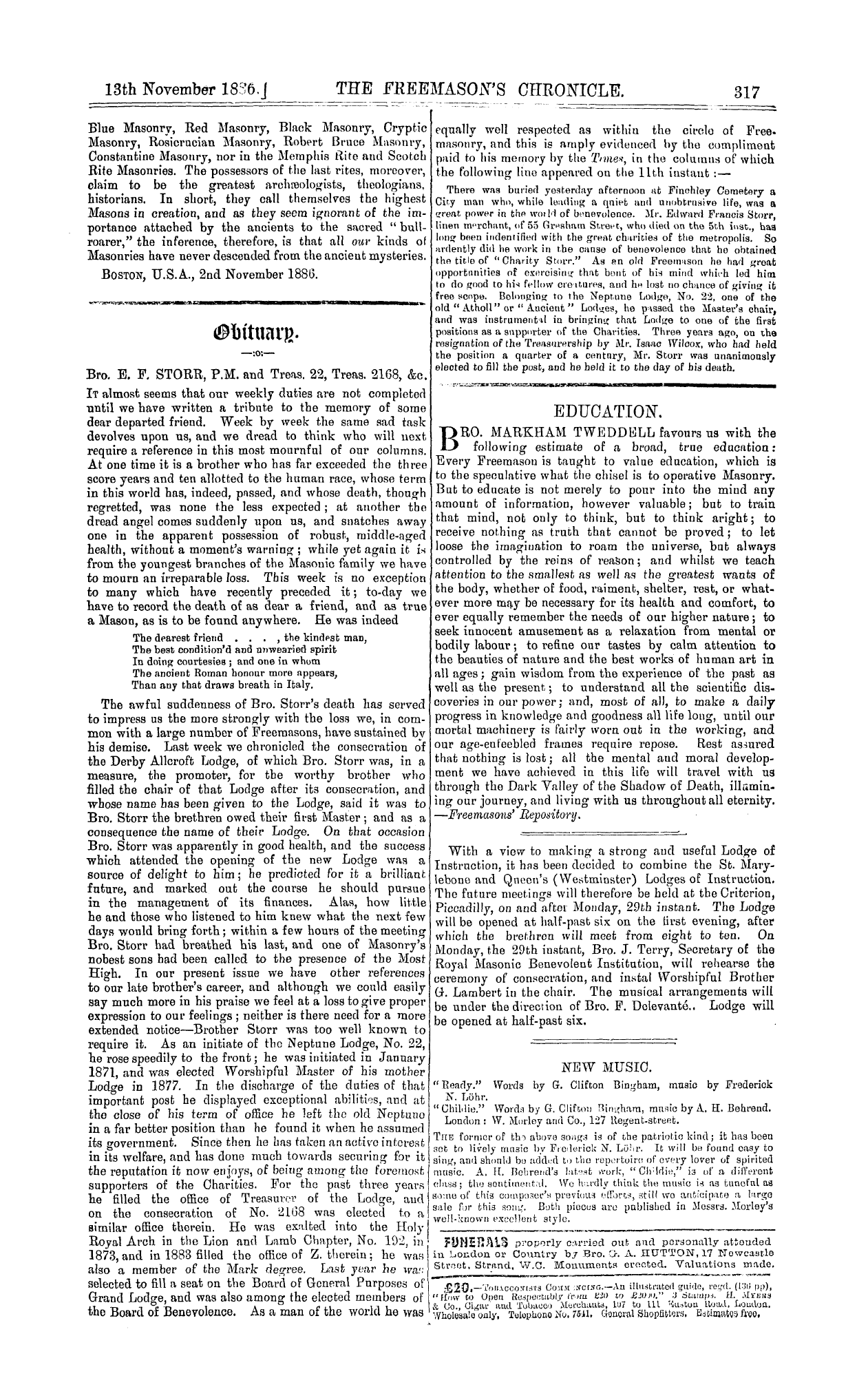
being fluttered and buzz .-d his wings with a fearful roar . " Now , Masons of all grades claim to have strictly adhered to all the ancient landmarks iu their respective forms and ceremonies ; aud no "Bull-roarer" ( as far as we know ) has ever been used either in the mysteries of


Note: This text has been automatically extracted via Optical Character Recognition (OCR) software.
Is Our Masonry A Descendent Of The Old Pagan Mysteries?
IS OUR MASONRY A DESCENDENT OF THE OLD PAGAN MYSTERIES ?
BY BUO . JACOB NORTON .
THE author of the Halliwell poem introduced his Euclid thus : — Whose wol bothe red and loke , He may fyncl wryte yn old boke . Of course , the name of the " olde boke " was not given .
In like manner , a New York Memphis Rite luminary , who claims that his Egyptian Kite was four thousand years old , referred to ancient history as his authority , without naming the . special history where that information
could be found . Well , for some months past I tried to collect information from the best writers of Egyptian history . I found , indeed , that the Egyptian priests had mysteries , initiation , & c , but I could nowhere learn what
the Egyptian mysteries were about , or that they had anything to do with Masonry or Masons . It is claimed , however , that the Egyptians had grouped some of the gods into threes , or as they are called " Triads ;"
hence it was inferred that the Egyptians believed in the doctrine of the Trinity , and as some of our virtues are divided in our ritual into threes , such as " Brotherly Love , Relief , and Truth , " " Virtue , Honour , and Mercy , " & c ,
aud as our ancient ceremonies consist of three degrees ; all which , according to our theological luminaries , were undoubtedly designed to symbolize the Trinity ; hence , it was claimed that the doctrine of the Trinity formed a
connecting link between our Masonry and the Egyptian mysteries . But the orthodox G . Rawlinson , in his "Religions of the Ancient World , " smashes that theory into atoms . He says :
" It has been maintained that the relie ; ion of the educated
Egyptians comprised a recognition of the doctrine of the Trinity . The learned Cudworth , of the 17 th century , undertook to prove that a doctrine closely resembling the Christian had been taught by the Egyptian priests many
centuries before Christ , and some moderns have caught at the statement and laid it down that the doctrine of the Trinity may be traced to an Egpytian source . But there is really not the slightest ground for this assertion ,
Cudworth s arguments were long ago met aud refuted by Mosheim , and modern investigation of the Egyptian remains has but confirmed Mosheim ' s conclusions . The Egyptians held the unity of God ; bnt their unity had
within it no Trinity ; God with them was absolutely one iu essence , and when divided up , was divided , not into three , but into a multitude of aspects . It is true that they had a fancy for triads , but a triad is not a Trinity . The triads
are not groups of persons , but of attributes ; the three are not co-equal , but distinctly the reverse , the third in the triad being always subordinate ; nor is the division regarded in any case exhaustive of the divine nature , or exclusive of
other divisions . Moreover , as already observed , the triad is frequently enlarged b y the addition " of a fourth person or character , who is associated as closely with the other three as they are with each other . Cud worth ' s view must
therefore be set aside as altogether imaginary , and the encomiast of Egyptian religion must content himself with pointing out that a real monotheism underlies the superficial
polytheism without requiring us to believe that even the wisest of the priests had any knowledge of the greatest of all Christian mysteries . "
' But , ' says our Masonic luminary , "the monotheistic doctrine at least , which is part of our Masonry , was certainly taught by the Egyptian priests in their mysteries to the initiated only , hence there is a connection between
our Masonry and the old mysteries . But Dr . C . P . Tiele , iu his 'History of the Egyptian Religion , ' published by Trubner and Co ., in IS :- ' : ? , shows clearly that the
monotheistic doctrine was no mystery ;\ t all in Egypt , that the same people who worshipped ami sacrificed to a multiplicity of gods were also taught the dod rinc of onl y one God . He says : —
' The explanation of these phe . nomeni has been sought in the supposition of a double theology among the E ^ ypiians—an esoteric and exoteric—the one being'intended ftn die learned , ami known io them alone , and " to the chosen
: ew , but kept carefully concealed (' rem the multitude ; the ) ther being intended for the people , who ! hus hud the msk given to them , while the kernel was kept out of theii each . Or , in |; lain words , the priests allowed the plain
Is Our Masonry A Descendent Of The Old Pagan Mysteries?
multitude to persevere iu their superstitions , while they themselves knew better , and attached not the slightest value to all the sensuous representations and usages . This is , however , an utterly baseless opinion , a mere fancy of
modern times . In Egypt , as everywhere else , and in all periods , there were cultured aud uncultured , educated and uneducated people . The latter never got beyond the visible symbol , and were , as a rule , satisfied with the
external form ; the former penetrated deeper , and followed up the thoughts that were latent in the symbols . Yet they too attached a certain value to the visible symbolisms , to the forms of religion , to its ceremonies and customs . They
valued the forms because of the ideas to which they gave outward expression , but they were not in a condition to emancipate themselves from these form 3 . There ia no trace of their having designedly kept their deeper
interpretations hidden ; the contrary is the case . The hieroglyphic writing , though as plain as the Roman alphabet , was not a mode of secret writing . All the pictures with which the walls of the public buildings were covered were
accompanied by texts explanatory of the subjects depicted ; the books in which they published their religious speculations could be obtained by anv one , and it was even considered a
necessary condition of future blessedness , that one should know the sacred text by heart . In short , the only limit set to the spread of their teachings was the believer ' s intellectual capacity . "
I confess that I am not quite satisfied with the reasoning of our Egyptologists , for I cannot understand how a man could believe in one unbegotten God , and at the same time pray to each of his attributes , as if each attribute was a distinct God . Renouf , in his Hibbert Lectures , says : —
" The Egyptian deities were innumerable . There were countless gods in heaven and below the earth . Every town and village had its local patron . Every month of the year , every day of the month , every hour of the day , and
of the night , had its presiding divinity , and all these gods had to be propitiated b y offerings . I several times made the attempt to draw up an index of the divine names occurring in the texts , but found it necessary to abandon the enterprise . What can all these gods mean ?"
It is true that an Egyptian god proclaimed himself ( so says an inscription ) as " I am what is , what shall be , and what has been , " and a god was st yled " the creator of the universe . " But somehow , their gods not onl y had wives and children , but fathers and mothers too . And sometimes
a goddess was as much flattered as a god . Thus , from Tiele ' s "Egyptian Religion , " I learn that the goddess Neith was styled " Commandress of all gods , " and " there is no second beside her . " I confess , therefore , that the
Egyptian teachings of monotheistic reli gion is a puzzle . But any how it is certain that whatever importance the , Egyptians attached to monotheism , that doctrine did not
form part of their mysteries , and , therefore , monotheism does not connect our Masonry with the Egyptian mysteries .
But here is something very curious . In a work called " Custom and M yth , " by Andrew Lang , published in Loudon in 1884 , I find that an instrument called
"Bullroarer , ' was us d in various parts of the world for initiations into sacred mysteries , and the same instrument is still used by the Australians . Mr . Lang says :
" The bull-roarer has been , and is , a sacred and magical instrument in many and widely separated lauds . It is found always as a sacred instrument , employed ia relio-ioas
mysteries , m New Mexico , in Australia , in New Zealand , in ancient Greece , and in Africa ; while in Euglaud it is a peasant boy ' s plaything .
In Amlmlin it is called a " Turndum , " which is strictly concealed from the sight of women . Indeed , if a woman is unfortunate to get a sight of a lunidum , she suffers death at once . This wonderful instrument is made
of a thin piece of hoard , about a sixth of an inch in fchickne .-s , about eight inches long , and three inches wide , and is formed thu .- , <> . To ono end of it a strong string of about thirt y inches long is fastened , and b y taking a firm
grasp ot the other end of the string , and by twirling round find round a number of times , after many such turnings , a ¦ dight noise begins to be beard , which gradually increases into "a mghly rushing noise , as if some supernatural
being fluttered and buzz .-d his wings with a fearful roar . " Now , Masons of all grades claim to have strictly adhered to all the ancient landmarks iu their respective forms and ceremonies ; aud no "Bull-roarer" ( as far as we know ) has ever been used either in the mysteries of