-
Articles/Ads
Article LODGE HISTORIES. ← Page 2 of 2 Article MASONIC FRUITS ESSENTIAL. Page 1 of 2 Article MASONIC FRUITS ESSENTIAL. Page 1 of 2 →
Note: This text has been automatically extracted via Optical Character Recognition (OCR) software.
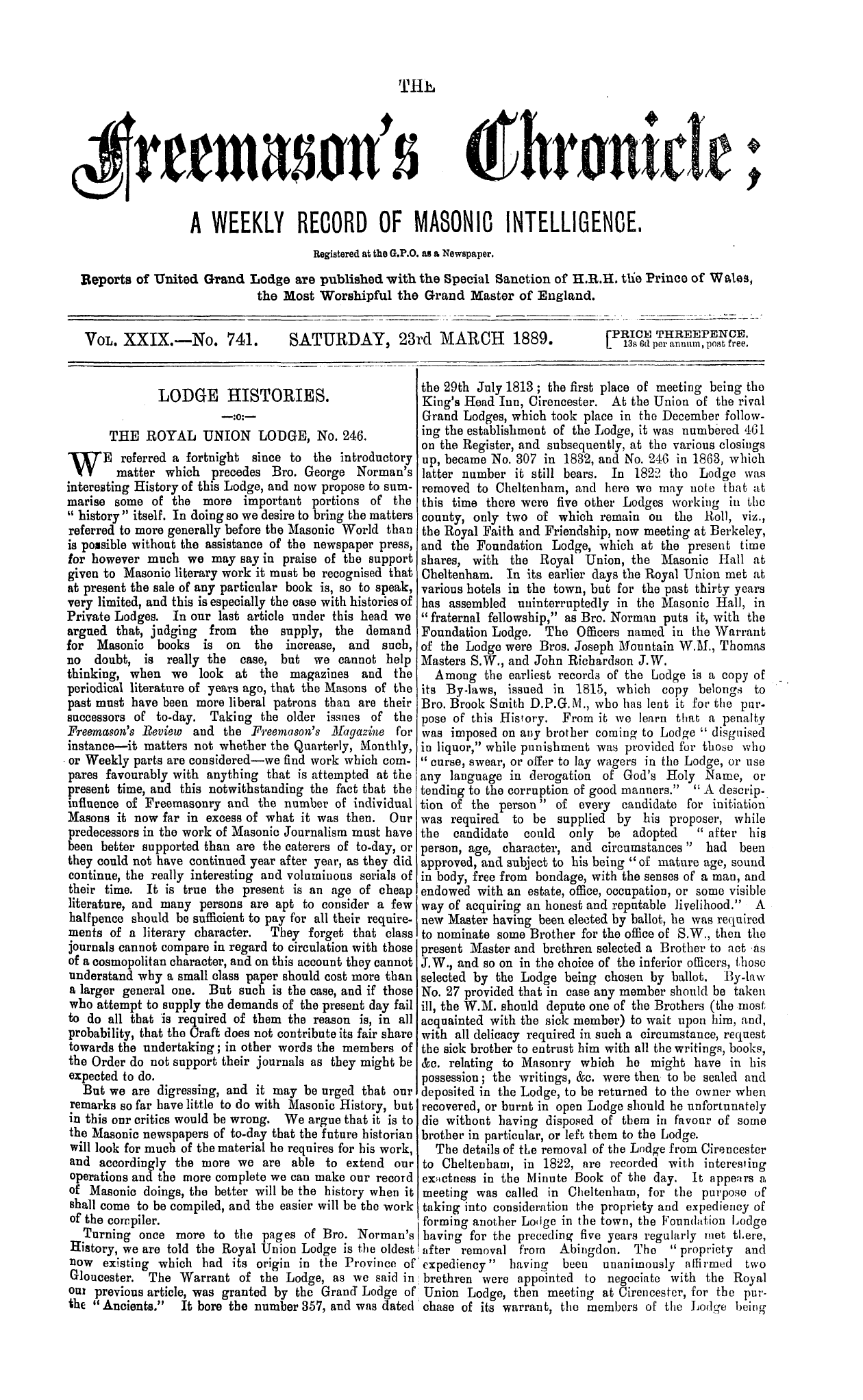
Lodge Histories.
reported as willing to part with it , while two others were deputed to wait on some of the members of the Foundation Lodge , to " request their assistance and advice . " At a subsequent meeting—on the 7 th January 1822—it was
communicated that the Foundation Lodge unanimously approved of the formation of another Lodge in Cheltenham , when sanctioned by such respectable names as were on the list presented to them . At the same time the older
Lodge advisod those who were working to establish the second Lodge in the town to be very circumspect in the admission of members , so as to keep tho Lodge as respectable as possible , that the interest of the
Craft , might be preserved , and Masonry not brought into disrepute . The necessary preliminaries involved communication with the then Grand Secretary , who discouraged tho acquisition of a dormant warrant , as likely
to involve considerable delay , trouble , and expense , but at the same time he gave the necessary directions for the transfer . A difficulty arose at the time of the transfer in consequence of none of the new members having served the
office of Warden , thereby qualifying for the position of Master , but this was obviated by the Cirencester Master retaining office , he appointing Bro . Moss , the Cheltenham S . W ., to act in his stead . All the necessary arrangements
having been completed , the Lodge was formally removed to the Fleece Inn , Cheltenham , on the 2 nd April 1822 , on which occasion eleven brethren were present , including Bro . Richardson , the W . M ., with Bros . Watkins and
Bowley , two of the Past Masters from Cirencester . A payment of £ 35 was made in settlement for the Warrant , Furniture , & c , & c ., in accordance with the transfer
arrangement . Four candidates for initiation were proposed and , the Lodge having been closed , the brethren appear to have spent the remainder of the day in celebrating the removal —" great harmony and brotherly love " prevailing .
We have now reached a point in the history of this Lodge which may be said to mark a most important epoch in its career , but we propose to break off our narrative
for the present , reserving for some future occasion the later doings of the Royal Union Lodge , as recorded in its "History . "
Masonic Fruits Essential.
MASONIC FRUITS ESSENTIAL .
FREEMASONRY MUST STAND OR FALL WITH RELIGION . An Address before Monroe City Lodge , No . 64-, F . and A . M . of Missouri , 27 th December 1888 , by Brother William Allen Hatch .
INSTITUTIONS of a Divine origin , or presumably Divine , may be safely entrusted to Divine protection , whatever may become of the individuals connected therewith at any given time , but we are concerned , my brethren ,
with an Institution which , though not pretending to Divine origin , has , under God's permission , an existence of hundreds , if not thousands of years , and is in fact the most venerable of all human Institutions . And while we are
considering our individual relations to this cherished Institution , we may , I think , profitably consider the relations of Freemasonry to the Church and to the State ,
particularly in the respect of a common conservative interest in the face of a common danger which threatens every establishment .
Praise , defence of , and apology for this Institution are out of place in a public address , for they are not only un-Masonic but to true Freemasons needless , and the outside world will pay little attention to what we say of ourselves ,
but will rather judge us , as in fact they must , by what we are aud what we do . Yet , in deference to a certain class of objectors , who are , perhaps , well meaning , for the most part honest , and , in some cases God-fearing men , it may be
allowed me to say that Freemasonry has been on trial for centuries , that it has as few blots on its history as any human institution , and that it has exhibited enduring
monuments of its usefulness , to say nothing of what has been done for the distressed , for the widow and the fatherless , which was of necessity kept from the view of the
world . We must admit , however , that Freemasonry has not done
all that it ought to have done , and is not doing all that it might be doing , and for this reason , if no other , " boasting ia excluded . "
Masonic Fruits Essential.
An objection is raised , and sometimes with apparent force , by some good citizens and good Christians , that Freemasonry is a secret society and therefore inimical to the state—to free institutions especially—and comes in couflict with the rules of the Church .
I do not know that this objection deserves an answer , but , lest I be accused of treating it too cavalierly , having brought it out , I will say that in the sense in which a secret society may be hostile to the state or lead its members into
violation of any but the purely arbitrary rules of the Church , Freemasonry is not a secret society . There is nothing in its plans , purposes , or pretences but what is open
to the world , nothing in its obligations which can by any construction bring any man into the least violation of his highest and most sacred duties . It is no more a secret society than a business partnership , a family , a club , or even a church organization , and the
secrets we have are exactly parallel with those of the firm , the household , or the club , of no consequence to those not directly concerned , or of such a nature that those outside have no right to know them . I have no right to know or at least to publish the merchant ' s costmark . I have no right to draw the veil which conceals the skeleton which
every household is supposed to contain . I have no right to inquire into any ecclesiastical business which does not concern my welfare or endanger my peace , nor do I acknowledge any right for myself to intrude upon sacred mysteries in
my own headstrong way , and so I say of the secrets of Freemasonry that there is nothing in them that it would hurt or help the outside world to know , and , therefore , nothing that they have a right to know . One of our most important secrets concerns the ballot , and this secret is not
so much for our own protection as for the benefit of him who is so unfortunate as to be rejected , in consequence not always of his own demerit , but , alas ! of that frailty of human nature which may be exhibited anywhere , in revenge , in pique , and in envy . Another secret of considerable importance is the guard we place at our doors , and this includes not only the sentinel at his post but the whole system of signs and marks by
which a brother may be known , and by which intruders may be kept at a distance . This is like the cry of the prophetess before the sacred shrine , " Procul ! 0 ! Procul este
Profani , " or like the warning of the Deacons of the early Church , when even the catechumens were dismissed before the celebration of the most sacred mysteries , and , on a lower plane , this is exactly in keepiug with ordinary social
usages . 1 doubt if any one would question my right to invite whom I please to a party at my own house . I have a right to stipulate how my guests shall come—that they shall
present cards of invitation or come iu costume , and I may even consult the wishes of my guests as to those who would be agreeable associates . No one can rightly complain
of my action or interfere with my liberty in this regard , provided there are in these assemblies no plots or conspiracies against the government , or violations of good morals , or disturbance of the peace .
Masonry , considered in its social aspects , presents an exact parallel . No Masonic assembly could be concerned in plots against the government , violation of good morals , or disturbance of the peace , without forfeiting its charter ,
belying its professions , and transgressing all its laws and obligations . Plots and conspiracies there may have been in which individual Freemasons were concerned—immoralities and disturbances for which they as individuals were responsible .
A Freemason , moved by lofty principle , may rightly strike a blow at tyranny , and may consort with others to bring about needed relief , in ways that are not ordinarily justifiable . History affords numerous instances of acts
which have heen justified by subsequent events , and none of us , whether Masons or not , are inclined to condemn the plots hatched between Paul Revere , Dr . Joseph Warren and others , in the old Green Dragon Tavern , the
headquarters of Colonial Freemasonry in New England , because these plots were inspired by lofty purpose aud the results not only justified them but crowned these heroes with glory , and there is not one of you who thinks any less of
George Washington as a man , or as a Mason , because he drew his sword against his mother country . These patriots simply transferred their allegiance from the
distant and not overkind mother to the struggling infant ; the infant who has become a giant , loving the mother even more than if still tied to her apron string .


Note: This text has been automatically extracted via Optical Character Recognition (OCR) software.
Lodge Histories.
reported as willing to part with it , while two others were deputed to wait on some of the members of the Foundation Lodge , to " request their assistance and advice . " At a subsequent meeting—on the 7 th January 1822—it was
communicated that the Foundation Lodge unanimously approved of the formation of another Lodge in Cheltenham , when sanctioned by such respectable names as were on the list presented to them . At the same time the older
Lodge advisod those who were working to establish the second Lodge in the town to be very circumspect in the admission of members , so as to keep tho Lodge as respectable as possible , that the interest of the
Craft , might be preserved , and Masonry not brought into disrepute . The necessary preliminaries involved communication with the then Grand Secretary , who discouraged tho acquisition of a dormant warrant , as likely
to involve considerable delay , trouble , and expense , but at the same time he gave the necessary directions for the transfer . A difficulty arose at the time of the transfer in consequence of none of the new members having served the
office of Warden , thereby qualifying for the position of Master , but this was obviated by the Cirencester Master retaining office , he appointing Bro . Moss , the Cheltenham S . W ., to act in his stead . All the necessary arrangements
having been completed , the Lodge was formally removed to the Fleece Inn , Cheltenham , on the 2 nd April 1822 , on which occasion eleven brethren were present , including Bro . Richardson , the W . M ., with Bros . Watkins and
Bowley , two of the Past Masters from Cirencester . A payment of £ 35 was made in settlement for the Warrant , Furniture , & c , & c ., in accordance with the transfer
arrangement . Four candidates for initiation were proposed and , the Lodge having been closed , the brethren appear to have spent the remainder of the day in celebrating the removal —" great harmony and brotherly love " prevailing .
We have now reached a point in the history of this Lodge which may be said to mark a most important epoch in its career , but we propose to break off our narrative
for the present , reserving for some future occasion the later doings of the Royal Union Lodge , as recorded in its "History . "
Masonic Fruits Essential.
MASONIC FRUITS ESSENTIAL .
FREEMASONRY MUST STAND OR FALL WITH RELIGION . An Address before Monroe City Lodge , No . 64-, F . and A . M . of Missouri , 27 th December 1888 , by Brother William Allen Hatch .
INSTITUTIONS of a Divine origin , or presumably Divine , may be safely entrusted to Divine protection , whatever may become of the individuals connected therewith at any given time , but we are concerned , my brethren ,
with an Institution which , though not pretending to Divine origin , has , under God's permission , an existence of hundreds , if not thousands of years , and is in fact the most venerable of all human Institutions . And while we are
considering our individual relations to this cherished Institution , we may , I think , profitably consider the relations of Freemasonry to the Church and to the State ,
particularly in the respect of a common conservative interest in the face of a common danger which threatens every establishment .
Praise , defence of , and apology for this Institution are out of place in a public address , for they are not only un-Masonic but to true Freemasons needless , and the outside world will pay little attention to what we say of ourselves ,
but will rather judge us , as in fact they must , by what we are aud what we do . Yet , in deference to a certain class of objectors , who are , perhaps , well meaning , for the most part honest , and , in some cases God-fearing men , it may be
allowed me to say that Freemasonry has been on trial for centuries , that it has as few blots on its history as any human institution , and that it has exhibited enduring
monuments of its usefulness , to say nothing of what has been done for the distressed , for the widow and the fatherless , which was of necessity kept from the view of the
world . We must admit , however , that Freemasonry has not done
all that it ought to have done , and is not doing all that it might be doing , and for this reason , if no other , " boasting ia excluded . "
Masonic Fruits Essential.
An objection is raised , and sometimes with apparent force , by some good citizens and good Christians , that Freemasonry is a secret society and therefore inimical to the state—to free institutions especially—and comes in couflict with the rules of the Church .
I do not know that this objection deserves an answer , but , lest I be accused of treating it too cavalierly , having brought it out , I will say that in the sense in which a secret society may be hostile to the state or lead its members into
violation of any but the purely arbitrary rules of the Church , Freemasonry is not a secret society . There is nothing in its plans , purposes , or pretences but what is open
to the world , nothing in its obligations which can by any construction bring any man into the least violation of his highest and most sacred duties . It is no more a secret society than a business partnership , a family , a club , or even a church organization , and the
secrets we have are exactly parallel with those of the firm , the household , or the club , of no consequence to those not directly concerned , or of such a nature that those outside have no right to know them . I have no right to know or at least to publish the merchant ' s costmark . I have no right to draw the veil which conceals the skeleton which
every household is supposed to contain . I have no right to inquire into any ecclesiastical business which does not concern my welfare or endanger my peace , nor do I acknowledge any right for myself to intrude upon sacred mysteries in
my own headstrong way , and so I say of the secrets of Freemasonry that there is nothing in them that it would hurt or help the outside world to know , and , therefore , nothing that they have a right to know . One of our most important secrets concerns the ballot , and this secret is not
so much for our own protection as for the benefit of him who is so unfortunate as to be rejected , in consequence not always of his own demerit , but , alas ! of that frailty of human nature which may be exhibited anywhere , in revenge , in pique , and in envy . Another secret of considerable importance is the guard we place at our doors , and this includes not only the sentinel at his post but the whole system of signs and marks by
which a brother may be known , and by which intruders may be kept at a distance . This is like the cry of the prophetess before the sacred shrine , " Procul ! 0 ! Procul este
Profani , " or like the warning of the Deacons of the early Church , when even the catechumens were dismissed before the celebration of the most sacred mysteries , and , on a lower plane , this is exactly in keepiug with ordinary social
usages . 1 doubt if any one would question my right to invite whom I please to a party at my own house . I have a right to stipulate how my guests shall come—that they shall
present cards of invitation or come iu costume , and I may even consult the wishes of my guests as to those who would be agreeable associates . No one can rightly complain
of my action or interfere with my liberty in this regard , provided there are in these assemblies no plots or conspiracies against the government , or violations of good morals , or disturbance of the peace .
Masonry , considered in its social aspects , presents an exact parallel . No Masonic assembly could be concerned in plots against the government , violation of good morals , or disturbance of the peace , without forfeiting its charter ,
belying its professions , and transgressing all its laws and obligations . Plots and conspiracies there may have been in which individual Freemasons were concerned—immoralities and disturbances for which they as individuals were responsible .
A Freemason , moved by lofty principle , may rightly strike a blow at tyranny , and may consort with others to bring about needed relief , in ways that are not ordinarily justifiable . History affords numerous instances of acts
which have heen justified by subsequent events , and none of us , whether Masons or not , are inclined to condemn the plots hatched between Paul Revere , Dr . Joseph Warren and others , in the old Green Dragon Tavern , the
headquarters of Colonial Freemasonry in New England , because these plots were inspired by lofty purpose aud the results not only justified them but crowned these heroes with glory , and there is not one of you who thinks any less of
George Washington as a man , or as a Mason , because he drew his sword against his mother country . These patriots simply transferred their allegiance from the
distant and not overkind mother to the struggling infant ; the infant who has become a giant , loving the mother even more than if still tied to her apron string .