-
Articles/Ads
Note: This text has been automatically extracted via Optical Character Recognition (OCR) software.
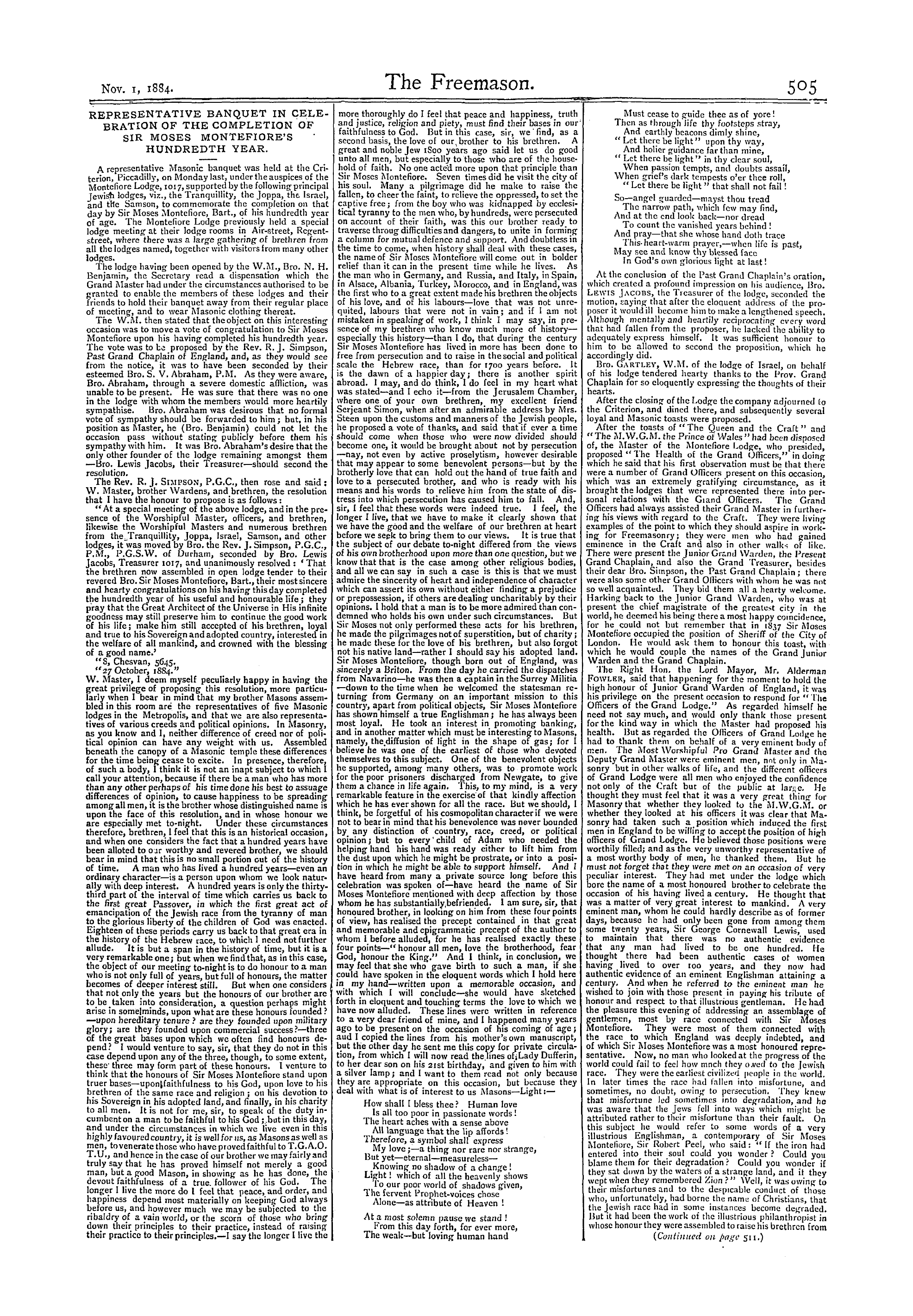
Representative Banquet In Celebration Of The Completion Of Sir Moses Montefiore's Hundredth Year.
REPRESENTATIVE BANQUET IN CELEBRATION OF THE COMPLETION OF SIR MOSES MONTEFIORE'S HUNDREDTH YEAR .
A representative Masonic banquet was held at the Criterion , Piccadilly , on Monday last , under the auspices of the Montefiore Lodge , 1017 , supported by the following' principal Jewish lodges , viz ., the Tranquillity , the Joppa , the Israel ,
and tile Samson , to commemorate the completion on that day by Sir Moses Montefiore , Bart ., of his hundredth year of age . The Montefiore Lodge previously held a special lodge meeting at their lodge rooms in Air-street , Regentstreet , where there was a large gathering of brethren from all the lodges named , together with visitors from many other lodges . The lodge having been opened by the W . M ., Bro . N . H .
Benjamin , the Secretary read a dispensation which the Grand Master had under the circumstances authorised to be granted to enable the members of these lodges and their friends to hold their banquet away from their regular place of meeting , and to wear Masonic clothing thereat . The W . M . then stated that the object on this interesting occasion was to move a vote of congratulation to Sir Moses Montefiore upon his having completed his hundredth year .
The vote was to be proposed by the Rev . R . J . Simpson , Past Grand Chaplain of England , and , as they would see from the notice , it was to have been seconded by their esteemed Bro . S . V . Abraham , P . M . As they were aware , Bro . Abraham , through a severe domestic affliction , was unable to be present . He was sure that there was no one in the lodge with whom the members would more heartily sympathise . Bro . Abraham was desirous that no formal
vote of sympathy should be forwarded lo him ; but , in his position as Master , he ( Bro . Benjamin ) could not let the occasion pass without stating publicly before them his sympathy with him . It was Bro . Abraham ' s desire that the only other founder of the lodge remaining amongst them —Bro . Lewis Jacobs , their Treasurer—should second the resolution . The Rev . R . J . SIMPSON , P . G . C , then rose and said :
W . Master , brother Wardens , and brethren , the resolution that I have the honour to propose is as follows : "At a special meeting of the above lodge , and in the presence of the Worshipful Master , officers , and brethren , likewise the Worshipful Masters and numerous brethren from the _ Tranquillity , Joppa , Israel , Samson , and other lodges , it was moved by Bro . the Rev . J . Simpson , P . G . C , P . M ., P . G . S . W . of Durham , seconded by Bro . Lewis
J acobs , Treasurer 1017 , and unanimously resolved : 'That the brethren now assembled in open lodge tender to their revered Bro . Sir Moses Montefiore , Bart ., their most sincere and hearty congratulations on his having this day completed the hundredth year of his useful and honourable life ; they pray that the Great Architect of the Universe in His infinite goodness may still preserve him to continue the good work of his life ; make him still accepted of his brethren , loyal
and true to his Sovereign and adopted country , interested in the welfare of all mankind , and crowned with the blessing of a good name . ' "S , Chesvan , 5645 . " 27 October , 1 SS 4 . " W . Master , I deem myself peculiarly happy in having the great privilege of proposing this resolution , more particularly when I bear in mind that my brother Masons
assembled in this room are the representatives of five Masonic lodges in the Metropolis , and that we are also representatives of various creeds and political opinions . In Masonry , as you know and I , neither difference of creed nor of political opinion can have any weight with us . Assembled beneath the canopy of a Masonic temple these differences for the time being cease to excite . In presence , therefore , of such a body , I think it is not an inapt subject to which I
call your attention , because if there be a man who has more than any other perhaps of his time done his best to assuage differences of opinion , to cause happiness to be spreading among all men , it is the brother whose distinguished name is upon the face of this resolution , and in whose honour we are especially met to-night . Under these circumstances therefore , brethren , I feel that this is an historical occasion , and when one considers the fact that a hundred years have
been alloted to oar worthy and revered brother , we should bear in mind that this is no small portion out of the history of time . A man who has lived a hundred years—even an ordinary character—is a person upon whom we look naturally with deep interest . A hundred years is only the thirtythird part of the interval of time which carries us back to the first great Passover , in which the first great act of emancipation of the Jewish race from the tyranny of man
to the glorious liberty of the children of God was enacted . Eighteen of these periods carry us back to that great era in the history of the Hebrew race , to which I need not further allude . It is but a span in the history of time , but it is a very remarkable one ; but when we find that , as in this case , the object of our meeting to-night is to do honour to a man who is not only full of years , but full of honours , the matter becomes of deeper interest still . But when one considers
that not only the years but the honours of our brother are to be taken into consideration , a question perhaps might arise in somelminds , upon what are these honours founded ? —upon hereditary tenure ? are they founded upon military glory ; are they founded upon commercial success?—three of the great bases upon which we often find honours depend ? I would venture to say , sir , that they do not in this case depend upon any of the three , though , to some extent ,
these' three may form part of these honours . I venture to think that the honours of Sir Moses Montefiore stand upon truer bases—uponjfaithfulness to his God , upon love to his brethren of the same race and religion ; on his devotion to his Sovereign in his adopted land , and finally , in his charity to all men . It is not for me , sir , to speak of the duty incumbent on a man to be faithful to his God ; ,. but in this day , and under the circumstances in which we live even in this
highly favoured country , it is well for us , as Masons as well as men , to venerate those who have proved faithful to T . G . A . O . T . U ., and hence in the case of our brother we may fairly and truly say that he has proved himself not merely a good man , but a good Mason , in showing as he has done , the devout faithfulness of a true follower of his God . The
longer I live the more do I feel that peace , and order , and happiness depend most materially on keeping God always before us , and however much we may be subjected to the ribaldry of a vain world , or the scorn of those who bring down their principles to their practice , instead of raising their practice to their principles . —I say the longer I live the
Representative Banquet In Celebration Of The Completion Of Sir Moses Montefiore's Hundredth Year.
more thoroughly do I feel that peace and happiness , truth and justice , religion and piety , must find their bases in our ' faithfulness to God . But in this case , sir , we find , as a second basis , the love of our , brother to his brethren . A great and noble Jew 1 S 00 years ago said let us do good unto all men , but especially to those who are of the household of faith . No one acted more upon that principle than Sir Moses Montefiore . Seven times did he visit the city of
his soul . Many a pilgrimage did he make to raise the fallen , to cheer the faint , to relieve the oppressed , to set the captive free ; from the boy who was kidnapped by ecclesitical tyranny to the men who , by hundreds , were persecuted on account of their faith , was this our brother ready to traverse throug difficulties and dangers , to unite in forming a column for mutual defence and support . And doubtless in the time to come , when history shall deal with these cases ,
the name of Sir Moses Montefiore will come out in bolder relief than it can in the present time while he lives . As the man who in Germany , and Russia , and Italy , in Spain , in Alsace , Albania , Turkey , Morocco , and in England , was the first who to a great extent made his brethren the objects of his love , and of his labours—love that was not unrequited , labours that were not in vain ; and if 1 am not mistaken in speaking of work , I think I may say , in
presence of my brethren who know much more of historyespecially this history—than 1 do , that during the century Sir Moses Montefiore has lived in more has been done to free from persecution and to raise in the social and political scale the Hebrew race , than for 1700 years before . It is the dawn of a happier day ; there is another spirit abroad . I may , and do think , I do feel in my heart what was stated—and I echo it—from the Jerusalem Chamber ,
where one of your own brethren , my excellent friend Serjeant Simon , when after an admirable address by Mrs . Steen upon the customs and manners of the Jewish people , he proposed a vote of thanks , and said that if ever a time should come when those who were now divided should become one , it would be brought about not by persecution —nay , not even by active proselytism , however desirable that may appear to some benevolent persons—but by the
brotherly love that can hold out the hand of true faith and love to a persecuted brother , and who is ready with his means and his words to relieve him from the state of distress into which persecution has caused him to fall . And , sir , I feel that these words were indeed true . I feel , the longer I live , that we have to make it clearly shown that we have the good and the welfare of our brethren at heart before we seek to bring them to our views . It is true that
the subject of our debate to-night differed from the views of his own brotherhood upon more than one question , but we know that that is the case among other religious bodies , and all we can say in such a case is this is that we must admire the sincerity of heart and independence of character which can assert its own without either finding a prejudice or prepossession , if others are dealing uncharitably by their opinions . I hold that a man is to be more admired than
condemned who holds his own under such circumstances . But Sir Moses not only performed these acts for his brethren , he made the pilgrimages not of superstition , but of charity ; he made these for the love of his brethren , but also forgot not his native land—rather I should say his adopted land . Sir Moses Montefiore , though born out of England , was sincerely a Briton . From the day he carried the dispatches from Navarino—he was then a captain in the Surrey Militia
—down to the time when he welcomed the statesman returning from Germany on an important mission to this country , apart from political objects , Sir Moses Montefiore has shown himself a true Englishman ; he has always been most loyal . He took an interest in promoting banking , and in another matter which must be interesting to Masons , namely , the . diffusion of light in the shape of gas ; for I believe he was one of the earliest of those who devoted
themselves to this subject . One of the benevolent objects he supported , among many others , was to promote work for the poor prisoners discharged from Newgate , to give them a chance in life again . This , to my mind , is a very remarkable feature in the exercise of that kindly affection which he has ever shown for all the race . But we should , I think , be forgetful of his cosmopolitan character if we were not to bear in mind that his benevolence was never bounded
by any distinction of country , race , creed , or political opinion ; but to every' child of Adam who needed the helping hand his hand was ready cither to lift him from the dust upon which he might be prostrate , or into a position in which he might be able to support himself . And I have heard from many a private source long before this celebration was spoken of—have heard the name of Sir Moses Montefiore mentioned with deep affection by those am
whom he has substantially ^ efnended . 1 sure , sir , that honoured brother , in looking on him from these four points of view , has realised the precept contained in that great and memorable and epigrammatic precept of the author to whom I before alluded , for he has realised exactly these four points— " honour all men , love the brotherhood , fear God , honour the King . " And I think , in conclusion , we may feel that she who gave birth to such a man , if she
could have spoken in the eloquent words which 1 hold here in my hand—written upon a memorable occasion , and with which I will conclude—she would have sketched forth in eloquent and touching terms the love to which we have now alluded . These lines were written in reference to a very dear friend of mine , and I happened many years ago to be present on the occasion of his coming of age ;
aud I copied the lines from his mother ' s own manuscript , but the other day he sent me this copy for private circulation , from which I will now read the . lines ofjLady Dufferin , to her dear son on his 21 st birthday , and given to him with a silver lamp ; and I want to them read not only because they are appropriate on this occasion , but because they deal with what is of interest to us Masons—Light : —
How shall I bless thee ? Human love Is all too poor in passionate words ! The heart aches with a sense above AH language that the lip affords ! Therefore , a symbol shall express
My love;—a thing nor rare nor strange , But yet—eternal—measureless—Knowing no shadow of a change ! Light ! which of all the heavenly shows To our poor world of shadows given , The fervent Prophet-voices chose Alone—as attribute of Heaven !
At a most solemn pause we stand . ' From this day forth , for ever more , The weak—but loving human hand
Representative Banquet In Celebration Of The Completion Of Sir Moses Montefiore's Hundredth Year.
Must cease to guide thee as of yore ! Then as through life thy footsteps stray , And earthly beacons dimly shine , " Let there be light" upon thy way , And holier guidance far than mine , " Let there be light" in thy clear soul , When passion tempts , and doubts assail , When grief ' s dark tempests o ' er thee roll ,
" Let there be light " that shall not fail ! So—angel guarded—mayst thou tread The narrow path , which few may find , And at the end look back—nor dread To count the vanished years behind 1 And pray—that she whose hand doth trace This-heart-warm prayer , —when life is past , May see and know thy blessed face In God ' s own glorious light at last !
At the conclusion of the Past Grand Chaplain ' s oration , which created a profound impression on his audience , Bro . LEWIS J ACOBS , the Ticasurer of the lodge , seconded the motion , saying that after the eloquent address of the proposer it would ill become him to make a lengthened speech . Although mentally and heartily reciprocating every word
that had fallen from the proposer , he lacked the ability to adequately express himself . It was sufficient honour to him to be allowed to second the proposition , which he accordingly did . Bro . GARTLEY , W . M . of the lodge of Israel , on behalf of his lodge tendered hearty thanks to the Prov . Grand Chaplain for so eloquently expressing the thoughts of their hearts .
After the closing of the Lodge the company adjourned to the Criterion , and dined there , and subsequently several loyal and Masonic toasts were proposed . After the toasts of "The Queen and the Craft" and "The M . W . G . M . the Prince of Wales " had been disposed of , the Master of the Montefiore Lodge , who presided , proposed " The Health of the Grand Officers , " in doing which he said that his first observation must be that there
were a number of Grand Officers present on this occasion , which was an extremely gratifying circumstance , as it brought the lodges that were represented there into personal relations with the Giand Officers . The Grand Officers had always assisted their Grand Master in furthering his views with regard to the Craft . They were living examples of the point to which they should aspire in working for Freemasonry ; they were men who had gained
eminence in the Craft and also in other walks of like . There were present the Junior Grand Warden , the Present Grand Chaplain , and also the Grand Treasurer , besides their dear Bro . Simpson , the Past Grand Chaplain ; there were also some other Grand Officers with whom he was not so well acquainted . They bid them all a hearty welcome . Harking back to the Junior Grand Warden , who was at present the chief magistrate of the greatest city in the
world , he deemed his being there a most happy coincidence , for he could not but remember that in 1 S 37 Sir Moses Montefiore occupied the position of Sheriff of the City of London . He would ask them to honour this toast , with which he would couple the names of the Grand Junior Warden and the Grand Chaplain . The Right Hon . the Lord Mayor , Mr . Alderman FOWLER , said that happening for the moment to hold the
high honour of Junior Grand Warden of England , it was his privilege on the present occasion to respond for " The Officers of the Grand Lodge . " As regarded himself he need not say much , and would only thank those present for the kind way in which the Master had proposed his health . But as regarded the Officers of Grand Lodge he had to thank them on behalf of a very eminent body of men . The Most Worshipful Pro Grand iMaster and the
Deputy Grand Master were eminent men , nnt only in Masonry but in other walks of life , and the different officers of Grand Lodge were all men who enjoyed the confidence not only of the Craft but of the public at large . He thought they must feel that it was a very great thing for Masonry that whether they looked to the M . W . G . M . or whether they looked at his officers it was clear that Masonry had taken such a position which induced the first
men in England to be willing to accept the position of high officers of Grand Lodge . He believed those positions were worthily filled ; and as the very unworthy representative of a most worthy body of men , he thanked them . But he must not forget that they were met on an occasion of very peculiar interest . They had met under the lodge which bore the name of a most honoured brother to celebrate the occasion of his having lived a century . He thousrht that
was a matter of very great interest to mankind . A very eminent man , whom he could hardl y describe as of former days , because he had onl y been gone from among them some twenty years , Sir George Cornewall Lewis , used to maintain that there was no authentic evidence that any man had lived to be one hundred . He thought there had been authentic cases of women having lived to over 100 years , and they now had
authentic evidence of an eminent Englishman attaining a century . And when he referred to the eminent man he wished to join with those present in paying his tribute of honour and respect to that illustrious gentleman . He had the pleasure this evening of addressing an assemblage of gentlemen , most by race connected with Sir Moses Montefiore . They were most of them connected with the race to which England was deeply indebted , and
of which Sir Moses Montefiore was a most honoured representative . Now , no man who looked at the progress of the world could fail to feel how much they o . ved to the Jewish race . They were the earliest civilized people in the world . In later times the race had fallen into misfortune , and sometimes , no doubt , owing to persecution . They knew that misfortune led sometimes into degradation , and he was aware that the Jews fell into ways which might be
attributed rather to their misfortune than their fault . On this subject he would refer to some words of a very illustrious Englishman , a contemporary of Sir Moses Montefiore , Sir Robert Peel , who said : " If the iron had entered into their soul could you wonder ? Could you blame them for their degradation ? Could you wonder if they sat down by the waters of a strange land , and it they
went when they remembered Zion ? " Well , it was owing to their misfortunes and to the despicable conduct of those who , unfortunately , had borne the name of Christians , that the Jewish race had in some instances become degraded . But it had been the work of the illustrious philanthropist in whose honour they were assembled to raise his brethren from ( Continued on page 511 . )



Note: This text has been automatically extracted via Optical Character Recognition (OCR) software.
Representative Banquet In Celebration Of The Completion Of Sir Moses Montefiore's Hundredth Year.
REPRESENTATIVE BANQUET IN CELEBRATION OF THE COMPLETION OF SIR MOSES MONTEFIORE'S HUNDREDTH YEAR .
A representative Masonic banquet was held at the Criterion , Piccadilly , on Monday last , under the auspices of the Montefiore Lodge , 1017 , supported by the following' principal Jewish lodges , viz ., the Tranquillity , the Joppa , the Israel ,
and tile Samson , to commemorate the completion on that day by Sir Moses Montefiore , Bart ., of his hundredth year of age . The Montefiore Lodge previously held a special lodge meeting at their lodge rooms in Air-street , Regentstreet , where there was a large gathering of brethren from all the lodges named , together with visitors from many other lodges . The lodge having been opened by the W . M ., Bro . N . H .
Benjamin , the Secretary read a dispensation which the Grand Master had under the circumstances authorised to be granted to enable the members of these lodges and their friends to hold their banquet away from their regular place of meeting , and to wear Masonic clothing thereat . The W . M . then stated that the object on this interesting occasion was to move a vote of congratulation to Sir Moses Montefiore upon his having completed his hundredth year .
The vote was to be proposed by the Rev . R . J . Simpson , Past Grand Chaplain of England , and , as they would see from the notice , it was to have been seconded by their esteemed Bro . S . V . Abraham , P . M . As they were aware , Bro . Abraham , through a severe domestic affliction , was unable to be present . He was sure that there was no one in the lodge with whom the members would more heartily sympathise . Bro . Abraham was desirous that no formal
vote of sympathy should be forwarded lo him ; but , in his position as Master , he ( Bro . Benjamin ) could not let the occasion pass without stating publicly before them his sympathy with him . It was Bro . Abraham ' s desire that the only other founder of the lodge remaining amongst them —Bro . Lewis Jacobs , their Treasurer—should second the resolution . The Rev . R . J . SIMPSON , P . G . C , then rose and said :
W . Master , brother Wardens , and brethren , the resolution that I have the honour to propose is as follows : "At a special meeting of the above lodge , and in the presence of the Worshipful Master , officers , and brethren , likewise the Worshipful Masters and numerous brethren from the _ Tranquillity , Joppa , Israel , Samson , and other lodges , it was moved by Bro . the Rev . J . Simpson , P . G . C , P . M ., P . G . S . W . of Durham , seconded by Bro . Lewis
J acobs , Treasurer 1017 , and unanimously resolved : 'That the brethren now assembled in open lodge tender to their revered Bro . Sir Moses Montefiore , Bart ., their most sincere and hearty congratulations on his having this day completed the hundredth year of his useful and honourable life ; they pray that the Great Architect of the Universe in His infinite goodness may still preserve him to continue the good work of his life ; make him still accepted of his brethren , loyal
and true to his Sovereign and adopted country , interested in the welfare of all mankind , and crowned with the blessing of a good name . ' "S , Chesvan , 5645 . " 27 October , 1 SS 4 . " W . Master , I deem myself peculiarly happy in having the great privilege of proposing this resolution , more particularly when I bear in mind that my brother Masons
assembled in this room are the representatives of five Masonic lodges in the Metropolis , and that we are also representatives of various creeds and political opinions . In Masonry , as you know and I , neither difference of creed nor of political opinion can have any weight with us . Assembled beneath the canopy of a Masonic temple these differences for the time being cease to excite . In presence , therefore , of such a body , I think it is not an inapt subject to which I
call your attention , because if there be a man who has more than any other perhaps of his time done his best to assuage differences of opinion , to cause happiness to be spreading among all men , it is the brother whose distinguished name is upon the face of this resolution , and in whose honour we are especially met to-night . Under these circumstances therefore , brethren , I feel that this is an historical occasion , and when one considers the fact that a hundred years have
been alloted to oar worthy and revered brother , we should bear in mind that this is no small portion out of the history of time . A man who has lived a hundred years—even an ordinary character—is a person upon whom we look naturally with deep interest . A hundred years is only the thirtythird part of the interval of time which carries us back to the first great Passover , in which the first great act of emancipation of the Jewish race from the tyranny of man
to the glorious liberty of the children of God was enacted . Eighteen of these periods carry us back to that great era in the history of the Hebrew race , to which I need not further allude . It is but a span in the history of time , but it is a very remarkable one ; but when we find that , as in this case , the object of our meeting to-night is to do honour to a man who is not only full of years , but full of honours , the matter becomes of deeper interest still . But when one considers
that not only the years but the honours of our brother are to be taken into consideration , a question perhaps might arise in somelminds , upon what are these honours founded ? —upon hereditary tenure ? are they founded upon military glory ; are they founded upon commercial success?—three of the great bases upon which we often find honours depend ? I would venture to say , sir , that they do not in this case depend upon any of the three , though , to some extent ,
these' three may form part of these honours . I venture to think that the honours of Sir Moses Montefiore stand upon truer bases—uponjfaithfulness to his God , upon love to his brethren of the same race and religion ; on his devotion to his Sovereign in his adopted land , and finally , in his charity to all men . It is not for me , sir , to speak of the duty incumbent on a man to be faithful to his God ; ,. but in this day , and under the circumstances in which we live even in this
highly favoured country , it is well for us , as Masons as well as men , to venerate those who have proved faithful to T . G . A . O . T . U ., and hence in the case of our brother we may fairly and truly say that he has proved himself not merely a good man , but a good Mason , in showing as he has done , the devout faithfulness of a true follower of his God . The
longer I live the more do I feel that peace , and order , and happiness depend most materially on keeping God always before us , and however much we may be subjected to the ribaldry of a vain world , or the scorn of those who bring down their principles to their practice , instead of raising their practice to their principles . —I say the longer I live the
Representative Banquet In Celebration Of The Completion Of Sir Moses Montefiore's Hundredth Year.
more thoroughly do I feel that peace and happiness , truth and justice , religion and piety , must find their bases in our ' faithfulness to God . But in this case , sir , we find , as a second basis , the love of our , brother to his brethren . A great and noble Jew 1 S 00 years ago said let us do good unto all men , but especially to those who are of the household of faith . No one acted more upon that principle than Sir Moses Montefiore . Seven times did he visit the city of
his soul . Many a pilgrimage did he make to raise the fallen , to cheer the faint , to relieve the oppressed , to set the captive free ; from the boy who was kidnapped by ecclesitical tyranny to the men who , by hundreds , were persecuted on account of their faith , was this our brother ready to traverse throug difficulties and dangers , to unite in forming a column for mutual defence and support . And doubtless in the time to come , when history shall deal with these cases ,
the name of Sir Moses Montefiore will come out in bolder relief than it can in the present time while he lives . As the man who in Germany , and Russia , and Italy , in Spain , in Alsace , Albania , Turkey , Morocco , and in England , was the first who to a great extent made his brethren the objects of his love , and of his labours—love that was not unrequited , labours that were not in vain ; and if 1 am not mistaken in speaking of work , I think I may say , in
presence of my brethren who know much more of historyespecially this history—than 1 do , that during the century Sir Moses Montefiore has lived in more has been done to free from persecution and to raise in the social and political scale the Hebrew race , than for 1700 years before . It is the dawn of a happier day ; there is another spirit abroad . I may , and do think , I do feel in my heart what was stated—and I echo it—from the Jerusalem Chamber ,
where one of your own brethren , my excellent friend Serjeant Simon , when after an admirable address by Mrs . Steen upon the customs and manners of the Jewish people , he proposed a vote of thanks , and said that if ever a time should come when those who were now divided should become one , it would be brought about not by persecution —nay , not even by active proselytism , however desirable that may appear to some benevolent persons—but by the
brotherly love that can hold out the hand of true faith and love to a persecuted brother , and who is ready with his means and his words to relieve him from the state of distress into which persecution has caused him to fall . And , sir , I feel that these words were indeed true . I feel , the longer I live , that we have to make it clearly shown that we have the good and the welfare of our brethren at heart before we seek to bring them to our views . It is true that
the subject of our debate to-night differed from the views of his own brotherhood upon more than one question , but we know that that is the case among other religious bodies , and all we can say in such a case is this is that we must admire the sincerity of heart and independence of character which can assert its own without either finding a prejudice or prepossession , if others are dealing uncharitably by their opinions . I hold that a man is to be more admired than
condemned who holds his own under such circumstances . But Sir Moses not only performed these acts for his brethren , he made the pilgrimages not of superstition , but of charity ; he made these for the love of his brethren , but also forgot not his native land—rather I should say his adopted land . Sir Moses Montefiore , though born out of England , was sincerely a Briton . From the day he carried the dispatches from Navarino—he was then a captain in the Surrey Militia
—down to the time when he welcomed the statesman returning from Germany on an important mission to this country , apart from political objects , Sir Moses Montefiore has shown himself a true Englishman ; he has always been most loyal . He took an interest in promoting banking , and in another matter which must be interesting to Masons , namely , the . diffusion of light in the shape of gas ; for I believe he was one of the earliest of those who devoted
themselves to this subject . One of the benevolent objects he supported , among many others , was to promote work for the poor prisoners discharged from Newgate , to give them a chance in life again . This , to my mind , is a very remarkable feature in the exercise of that kindly affection which he has ever shown for all the race . But we should , I think , be forgetful of his cosmopolitan character if we were not to bear in mind that his benevolence was never bounded
by any distinction of country , race , creed , or political opinion ; but to every' child of Adam who needed the helping hand his hand was ready cither to lift him from the dust upon which he might be prostrate , or into a position in which he might be able to support himself . And I have heard from many a private source long before this celebration was spoken of—have heard the name of Sir Moses Montefiore mentioned with deep affection by those am
whom he has substantially ^ efnended . 1 sure , sir , that honoured brother , in looking on him from these four points of view , has realised the precept contained in that great and memorable and epigrammatic precept of the author to whom I before alluded , for he has realised exactly these four points— " honour all men , love the brotherhood , fear God , honour the King . " And I think , in conclusion , we may feel that she who gave birth to such a man , if she
could have spoken in the eloquent words which 1 hold here in my hand—written upon a memorable occasion , and with which I will conclude—she would have sketched forth in eloquent and touching terms the love to which we have now alluded . These lines were written in reference to a very dear friend of mine , and I happened many years ago to be present on the occasion of his coming of age ;
aud I copied the lines from his mother ' s own manuscript , but the other day he sent me this copy for private circulation , from which I will now read the . lines ofjLady Dufferin , to her dear son on his 21 st birthday , and given to him with a silver lamp ; and I want to them read not only because they are appropriate on this occasion , but because they deal with what is of interest to us Masons—Light : —
How shall I bless thee ? Human love Is all too poor in passionate words ! The heart aches with a sense above AH language that the lip affords ! Therefore , a symbol shall express
My love;—a thing nor rare nor strange , But yet—eternal—measureless—Knowing no shadow of a change ! Light ! which of all the heavenly shows To our poor world of shadows given , The fervent Prophet-voices chose Alone—as attribute of Heaven !
At a most solemn pause we stand . ' From this day forth , for ever more , The weak—but loving human hand
Representative Banquet In Celebration Of The Completion Of Sir Moses Montefiore's Hundredth Year.
Must cease to guide thee as of yore ! Then as through life thy footsteps stray , And earthly beacons dimly shine , " Let there be light" upon thy way , And holier guidance far than mine , " Let there be light" in thy clear soul , When passion tempts , and doubts assail , When grief ' s dark tempests o ' er thee roll ,
" Let there be light " that shall not fail ! So—angel guarded—mayst thou tread The narrow path , which few may find , And at the end look back—nor dread To count the vanished years behind 1 And pray—that she whose hand doth trace This-heart-warm prayer , —when life is past , May see and know thy blessed face In God ' s own glorious light at last !
At the conclusion of the Past Grand Chaplain ' s oration , which created a profound impression on his audience , Bro . LEWIS J ACOBS , the Ticasurer of the lodge , seconded the motion , saying that after the eloquent address of the proposer it would ill become him to make a lengthened speech . Although mentally and heartily reciprocating every word
that had fallen from the proposer , he lacked the ability to adequately express himself . It was sufficient honour to him to be allowed to second the proposition , which he accordingly did . Bro . GARTLEY , W . M . of the lodge of Israel , on behalf of his lodge tendered hearty thanks to the Prov . Grand Chaplain for so eloquently expressing the thoughts of their hearts .
After the closing of the Lodge the company adjourned to the Criterion , and dined there , and subsequently several loyal and Masonic toasts were proposed . After the toasts of "The Queen and the Craft" and "The M . W . G . M . the Prince of Wales " had been disposed of , the Master of the Montefiore Lodge , who presided , proposed " The Health of the Grand Officers , " in doing which he said that his first observation must be that there
were a number of Grand Officers present on this occasion , which was an extremely gratifying circumstance , as it brought the lodges that were represented there into personal relations with the Giand Officers . The Grand Officers had always assisted their Grand Master in furthering his views with regard to the Craft . They were living examples of the point to which they should aspire in working for Freemasonry ; they were men who had gained
eminence in the Craft and also in other walks of like . There were present the Junior Grand Warden , the Present Grand Chaplain , and also the Grand Treasurer , besides their dear Bro . Simpson , the Past Grand Chaplain ; there were also some other Grand Officers with whom he was not so well acquainted . They bid them all a hearty welcome . Harking back to the Junior Grand Warden , who was at present the chief magistrate of the greatest city in the
world , he deemed his being there a most happy coincidence , for he could not but remember that in 1 S 37 Sir Moses Montefiore occupied the position of Sheriff of the City of London . He would ask them to honour this toast , with which he would couple the names of the Grand Junior Warden and the Grand Chaplain . The Right Hon . the Lord Mayor , Mr . Alderman FOWLER , said that happening for the moment to hold the
high honour of Junior Grand Warden of England , it was his privilege on the present occasion to respond for " The Officers of the Grand Lodge . " As regarded himself he need not say much , and would only thank those present for the kind way in which the Master had proposed his health . But as regarded the Officers of Grand Lodge he had to thank them on behalf of a very eminent body of men . The Most Worshipful Pro Grand iMaster and the
Deputy Grand Master were eminent men , nnt only in Masonry but in other walks of life , and the different officers of Grand Lodge were all men who enjoyed the confidence not only of the Craft but of the public at large . He thought they must feel that it was a very great thing for Masonry that whether they looked to the M . W . G . M . or whether they looked at his officers it was clear that Masonry had taken such a position which induced the first
men in England to be willing to accept the position of high officers of Grand Lodge . He believed those positions were worthily filled ; and as the very unworthy representative of a most worthy body of men , he thanked them . But he must not forget that they were met on an occasion of very peculiar interest . They had met under the lodge which bore the name of a most honoured brother to celebrate the occasion of his having lived a century . He thousrht that
was a matter of very great interest to mankind . A very eminent man , whom he could hardl y describe as of former days , because he had onl y been gone from among them some twenty years , Sir George Cornewall Lewis , used to maintain that there was no authentic evidence that any man had lived to be one hundred . He thought there had been authentic cases of women having lived to over 100 years , and they now had
authentic evidence of an eminent Englishman attaining a century . And when he referred to the eminent man he wished to join with those present in paying his tribute of honour and respect to that illustrious gentleman . He had the pleasure this evening of addressing an assemblage of gentlemen , most by race connected with Sir Moses Montefiore . They were most of them connected with the race to which England was deeply indebted , and
of which Sir Moses Montefiore was a most honoured representative . Now , no man who looked at the progress of the world could fail to feel how much they o . ved to the Jewish race . They were the earliest civilized people in the world . In later times the race had fallen into misfortune , and sometimes , no doubt , owing to persecution . They knew that misfortune led sometimes into degradation , and he was aware that the Jews fell into ways which might be
attributed rather to their misfortune than their fault . On this subject he would refer to some words of a very illustrious Englishman , a contemporary of Sir Moses Montefiore , Sir Robert Peel , who said : " If the iron had entered into their soul could you wonder ? Could you blame them for their degradation ? Could you wonder if they sat down by the waters of a strange land , and it they
went when they remembered Zion ? " Well , it was owing to their misfortunes and to the despicable conduct of those who , unfortunately , had borne the name of Christians , that the Jewish race had in some instances become degraded . But it had been the work of the illustrious philanthropist in whose honour they were assembled to raise his brethren from ( Continued on page 511 . )