Note: This text has been automatically extracted via Optical Character Recognition (OCR) software.
Correspondence.
Correspondence .
We do not hold ourselves responsible for the opinions expressed by our correspondents but we wish , in a spirit of fair play to all , to permit—within certain necessary limits—I" : discussion .
R . A . AND OTHER MATTERS . To the Editor of the " Freemason . " Dear Sir and Brother , My previous letter has invoked some excellent criticism , but , like most suggested reforms , has brought down on my devoted head the usual percentage of cynicism , mild abuse , and horror at my youthful temerity ~ and boldness ,
although I am 40 years of age , and have read and studied every book on the Craft possible to lay hold of , so I must perforce be a very wicked desperado . But to sum up the case . It is admitted that there is a grievance , and as I believe in a cause and a remedy for all ills that institutions , like individuals , are heir to , I ventured to suggest , along the lines of least resistance theory , a simple
reason and safe remedy for the rustiness of the R . A . machinery , to lubricate which and to make it run easily I thought some more P . Ms , are required , and now " Cynicus " acts up to his signature and snappishly states my suggestion of a three guinea fee was " a deliberate proposal to hold Masonic preferment up for sale ; " but no such idea entered my mind any more than the fee paid for initiation can be called holding Masonic preferment up for sale .
" Cynicus " may rest assured that I am not in any harry to occupy the chair , but if , by chance , I should Jo so , whether it be called a " fee " or otherwise , on the principle that in this w ; rld one cannot get something for nothing , I am confident that , like all others , . shall have to pay in some shape or form . Or does "Cynicus " suggest that F eemasonry is a philanthropic institution , dispensing its offices freely and gratuitioi sly , without money and without price 'i If so , he is in accord with his nom de plume .
I believe that good will come out of the discussion , and if any reform is needed then some brethren will be stirred up to look about and discover the best way to bring it about . Progress is a law in Freemasonry as in nature , and forward wb must go , though not too fast , whether we like it or not . In the meantime , like a philosopher , ! shall Calmly watch the evolution of a suggestion , knowing that a
prophet hath no honour among his kindred , but that all reforms pass through three stages —( 1 ) repulsion , ( 2 ) investigation , ( 3 ) acceptation , and so rest—Yours faithfully and fraternally , T . MAY , 754 . Tottenham .
To the Editor of the " Freemason . " Deait Sir and Brother , I should like to suggest as a possible method of popularising the Royal Arch Degree that every accepted candidate for initiation into the Craft
should' be charged a fee of , say , two guineas , plus the usual initiation fee , the amount to cover both initiation and exaltation ; in cases where no chapter is attached to the lodge the exaltation fee to be paid by the lodge to a conveniently situated chapter of the brother ' s own selection . This would practically ensure every Master Mason becoming a Royal Arch Mason .
1 would further suggest that a candidate for the office of Second or Third Principal need not necessarily be an Installed Master , but that the latter qualification should be a sine qua non for the First Principal's chair . These ideas may be crude , and may require considerable elaboration , but procedure on some such lines would , I feel sure , do much to simplify matters , and could not fail to make the R . A . Degree one of the most popular , as it is , undoubtedly , one of the most beautiful , in connection with our Order . —Yours . fraternally , A PAST PROVINCIAL OFFICER ( BOTH CRAFT AND ROYAL ARCH ) .
Tour To The Bavarian Highlands, En Route For "Passion Play" At Ober-Ammergau.
TOUR TO THE BAVARIAN HIGHLANDS , EN ROUTE FOR "PASSION PLAY" AT OBER-AMMERGAU .
( Continued ) . On the afternoon of our seventh and last day ( Friday ) , we left Garmisch with much regret , having spent a most pleasant week in the midst of beautiful mountain scenery . We drove to Ober-Ammergau , caught the last glimpses of the cloud-girdled mountains , till we passed Farchant . Two miles further , we approached the wooded amphitheatre of Oberau . To the
left of its entrance , stands the old church , on a hill of unrivalled beauty . The church , on the right , which ranks as a Basilica , is a present from the late King Louis IL It is said , for wc did not go to it , to contain two fine modern pictures over the High Altar , an Ascension , and , at a side altar , the king's patron , King Louis of France . St . Louis , as he is called , was a pattern monarch , and helped our English barons to obtain Magna Charta
Irom the reluctant hands of King John . King Louis , however , failed in his crusades against the Turks in Egypt and Tunis , and he died of sorrowful disappointment at the latter place . We son afterwards arrived at the fine new road , built in 1890 , at a cost of _ £ J 5 , . It commands very romantic views . Pursuing our journey , we arrived at the Benedictine Monastery of Ettal , and were astonished at the grandeur of its church . The
convent was built about 1330 , by the Emperor Louis , the Bavarian , in pursuance of a vow made to St . Benedict . The original church , of which only the west door remains , was circular ( probably in memory of the Lateran Baptistry , at Rome , where Louis was crowned ) , but in the decorated style of Gothic architecture . Behind grated doors , to the east , on the high altar , stood the ligure of the Madonna , brought by Louis from Italy , to which there are attached many legends , which , even at the present day ,
obtain full credence from the simple-minded peasantry . This figure may still be seen on the high altar of the present church , built from 1 744 to 1 790 , after the burning of the old one . The Mother and Child are a touching pair , evidently Irom an old workshop at Pisa . They attract annually many ihousai d pilgrims to Ettal , who gaze with rapt wonder on the great painting by Knoller ( pupil of Raphael Mengs , the famed Bohemian artist ) ol Heaven and all its Saints .
To the Ettal monks and their pupils , weowe the Ober-Ammergau play . Of their influence we shall speak lattr on . The wood carving schools at Ober-Ammergau were founded by them . The convent was suppressed by a royal decree in 1803 , but it has recently been purchased , and will be converted into a seminary for priests . The carri 'ges halted on the road , at the
Tour To The Bavarian Highlands, En Route For "Passion Play" At Ober-Ammergau.
entrance of a narrow lane , which led direct to this handsome domed structure . We could not fail to be struck with the interior of this sacred edifice . There are numerous shrines , each one dedicated to a saint more or less renowned for piety . About the altar , at most of these shrines , are vouched-for relics of the particular saint , and beneath are the veritable skeletons adorned with tinsel frippery , the skull grinning in the midst of its
jewelled ornaments at the spectators . Indeed , it was a gruesome spectacle . Throughout the church , on every side , are to be seen specimens of high art in painting and sculpture . One would hardly expect to see so splendid a structure in a district so remote from public resort . Rejoining our carriages , we resumed our journey , and at last entered the celebrated village , and found it crowded with carriages and people .
Reaching the centre of the busy thoroughfare we saw throngs of visitors , who were quitting the theatre ; there had been an extra performance on that day—Friday , St . Peter ' s Day . Ober-Ammergau is a clean village town , with broad streets and well-to-do houses , many of- them prettily frescoed ; but owing to the fire of 1 S 17 only two ancient buildings—the " Alte Post
Inn " and the "Stern Inn "—now remain . At the southern end are its chief natural beauties—the great Kofel Rock , the summit surmounted by an iron cross , 30 feet high , which is prominent in the early dawn and the fading sunset . Then there are the pretty flowering meadows and hillside walks , and the Bear ' s Grotto , containing a statue of the risen Christ .
Next day ( Saturday ) we devoted to the inspection of the chief objects of interest in this locality . Soon after breakfast many of the party crossed the meadows till we came to a road , gradual in ascent , which finally brought us to the summit of a hill , on which is erected a white marble Denkmal ( monument ) , consisting of three figures—the centre one representing the crucified Saviour ; on either side is the figure of the grief-laden , blessed
Mother and the beloved friend and disciple , St . John the Evangelist . This artistic monument was presented to the people of Ober-Ammergau to commemorate the visit of King Ludwig thell . to the "Passion Play . " A melancholy interest is attached to the erection of this monument . It is related that the sculptor personally superintended the removal of his work from the studio on the day appointed for its erection on the spot where it now stands .
Proceeding slowly along the winding road , a sudden jolt shook the cart , and caused the monument to topple over , and fall upon the artist , who was crushed to death beneath its weight . The assistant also received mortal injuries , from the effects of which he died the next day . The monument itself was not injured in the least degree . It is a noble work of art , and will perpetuate the name of the sculptor who conceived and executed it . The
moment chosen is when our Saviour commits his mother to the loving care of St . John . In the afternoon the members of our party visited the different carving shops and made purchases of specimens of artistic work executed b y the peasants , several x > f whom enacted characters in the " Passion Play . " I
visited the shop of Peter Rendl , to whom was assigned the part of St . John the Evangelist , " the beloved disciple . " At my request , he favoured me with his autograph . All the streets and ways were thronged with people making their arrangements as to lodging and accommodation with regard to the morrow ( Sunday ) , the day of the performance .
Of the nature and importance of the famed " Passion Play " a few details may be found useful . The origin of our modern drama may be traced to the plays acted by trade guilds in the Middle Ages . These were at first , religious spectacles suggested by the clergy , who wisely neglected no available means of influencing the human mind . Sacred plays were most solemnly performed in churches many centuries ago , being mentioned in the time of Charlemagne . They were afterwards removed to churchyards and market-places .
The scenes enacted were not solely confined to Bible history to point a moral ; others were gradually added , such as the Prologue , in which Mercy and Justice pleaded on behalf of man ' s redemption at the throne of God , or the two visits of angels to Judas before his suicide , imploring him to repent . Afterwards other virtues were introduced , and Vices and Devils personified .
In Longfellow s " Golden Legend " we form a good idea of the mystery play of olden times . The Vices and Devils at last became grotesque , and formed the lighter element , serving as a foil and relief to serious parts of the Sacred Narrative . These eventually became so gross in their character as to cause the representation of sacred plays in most places to be forbidden by the authorities .
In 1 633 the plague raged in Ober-Ammergau , and its inhabitants , by the advice of the monks at Ettal , vowed if they were spared by God ' s mercy from its further ravages , that a sacred performance , almost on the same lines as at present , should be periodically given . The people of Munich commemorated the cessation of the same plague by the celebrated SchaeMer Dance , to take place in the streets of the city every seven years .
The original text of the " Passion Play " was a combination of the St . L'liich Augsburgh Play ol 15 th century with one written by Sebastian Wild Meistersinger of the same city in the iOth . Both these plays are very simple and reverent , but the former contains very long parts for the Virgin and the other holy women , and a remarkable interview between Mary and Judas The tableaux from the Old Testament were probably introduced oy the
monk Rosner in 1750 . The first performance took place 1634 , and subsequent performances every 10 years till 16 74 . Next in 1680 , since when it has been enacted each decade with tolerable regularity . Since 1770 , however , the permission of the Bavarian Government was necessary , which , in 1810 , was only granted for the next year . The play was given in 1 S 15 as a thanksgiving for peace . In 1 S 20 it was given alter the fire of 1817 , and for
the last time in ihe churchyard . Between 1 S 40 and 1 S 50 the text was revised by Pastor Daisenberger , tne last surviving pupil of the Ettal monks . This version is the one now in use . The receipts from the performances are very large , but the village is . burdened now with a heavy debt incurred for the construction of the Oberau Road , of which we have previously spoken , and for the water supply , drains and hospital , commenced after 1890 ; also for the new iron auditorium .
The arrangements made for visitors are very curious . To obtain a ticket of admission , each visitor must sleep two nights , at least , in thevilla £ e or its immediate vicinity . According to the style of house inhabited and the price paid for accommodation , so is the charge for tickets—the prices ranging from 10 marks ( 10 s . ) for the highest , down to one mark ( is . ) for the
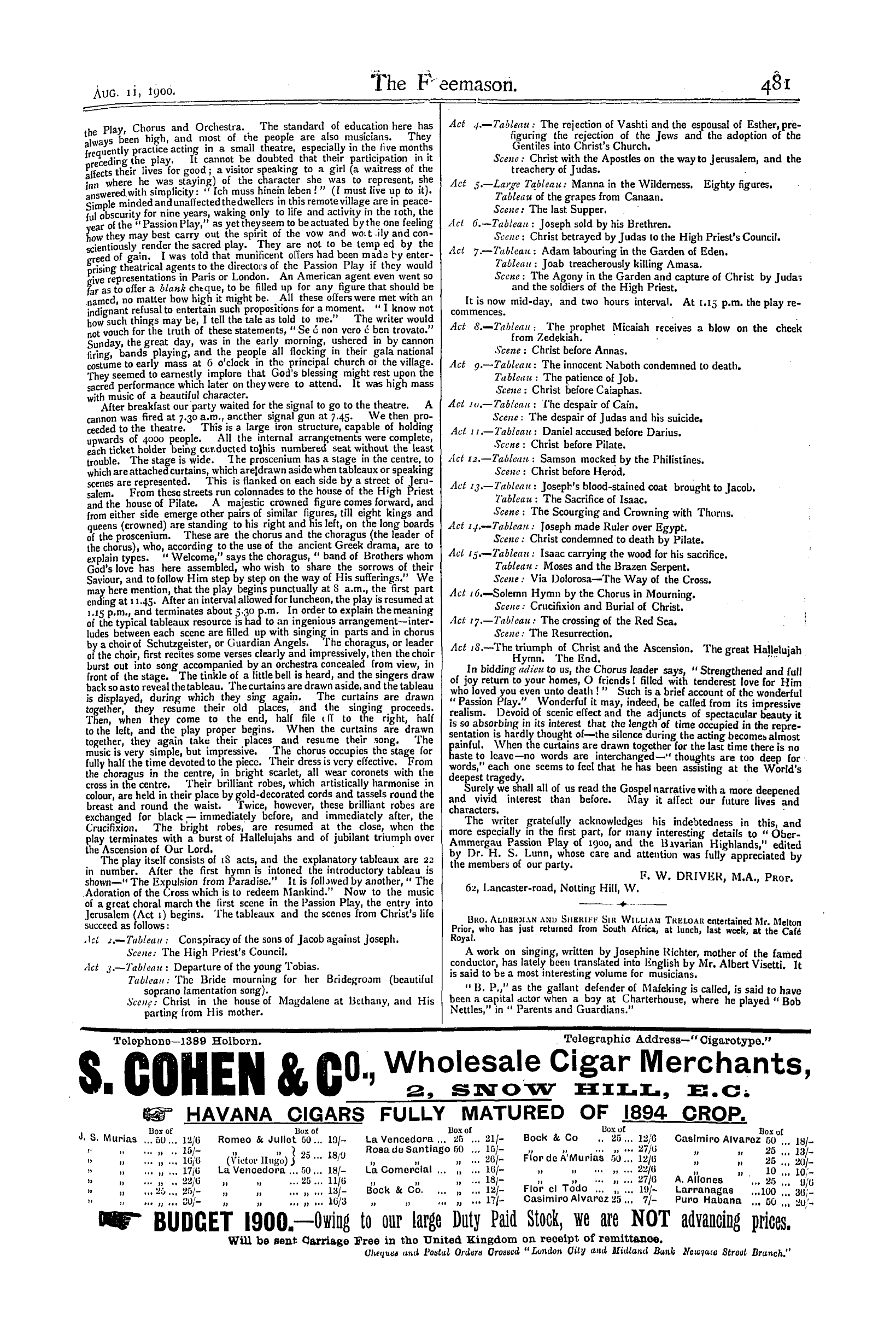
lowest . These tickets are only issued the day previous to the performance , and are to be obtained from the proprietor of the respective houses or villas . Oulside traffic in tickets is uuerly lorbidden and is an offence punishable by law . The actors are poorly remunerated , each receiving the same payment per day , two marks ( .-s . ) , from the Christus to the children in the chorus . About 70 a persons , nearly half the population , are employed in






Note: This text has been automatically extracted via Optical Character Recognition (OCR) software.
Correspondence.
Correspondence .
We do not hold ourselves responsible for the opinions expressed by our correspondents but we wish , in a spirit of fair play to all , to permit—within certain necessary limits—I" : discussion .
R . A . AND OTHER MATTERS . To the Editor of the " Freemason . " Dear Sir and Brother , My previous letter has invoked some excellent criticism , but , like most suggested reforms , has brought down on my devoted head the usual percentage of cynicism , mild abuse , and horror at my youthful temerity ~ and boldness ,
although I am 40 years of age , and have read and studied every book on the Craft possible to lay hold of , so I must perforce be a very wicked desperado . But to sum up the case . It is admitted that there is a grievance , and as I believe in a cause and a remedy for all ills that institutions , like individuals , are heir to , I ventured to suggest , along the lines of least resistance theory , a simple
reason and safe remedy for the rustiness of the R . A . machinery , to lubricate which and to make it run easily I thought some more P . Ms , are required , and now " Cynicus " acts up to his signature and snappishly states my suggestion of a three guinea fee was " a deliberate proposal to hold Masonic preferment up for sale ; " but no such idea entered my mind any more than the fee paid for initiation can be called holding Masonic preferment up for sale .
" Cynicus " may rest assured that I am not in any harry to occupy the chair , but if , by chance , I should Jo so , whether it be called a " fee " or otherwise , on the principle that in this w ; rld one cannot get something for nothing , I am confident that , like all others , . shall have to pay in some shape or form . Or does "Cynicus " suggest that F eemasonry is a philanthropic institution , dispensing its offices freely and gratuitioi sly , without money and without price 'i If so , he is in accord with his nom de plume .
I believe that good will come out of the discussion , and if any reform is needed then some brethren will be stirred up to look about and discover the best way to bring it about . Progress is a law in Freemasonry as in nature , and forward wb must go , though not too fast , whether we like it or not . In the meantime , like a philosopher , ! shall Calmly watch the evolution of a suggestion , knowing that a
prophet hath no honour among his kindred , but that all reforms pass through three stages —( 1 ) repulsion , ( 2 ) investigation , ( 3 ) acceptation , and so rest—Yours faithfully and fraternally , T . MAY , 754 . Tottenham .
To the Editor of the " Freemason . " Deait Sir and Brother , I should like to suggest as a possible method of popularising the Royal Arch Degree that every accepted candidate for initiation into the Craft
should' be charged a fee of , say , two guineas , plus the usual initiation fee , the amount to cover both initiation and exaltation ; in cases where no chapter is attached to the lodge the exaltation fee to be paid by the lodge to a conveniently situated chapter of the brother ' s own selection . This would practically ensure every Master Mason becoming a Royal Arch Mason .
1 would further suggest that a candidate for the office of Second or Third Principal need not necessarily be an Installed Master , but that the latter qualification should be a sine qua non for the First Principal's chair . These ideas may be crude , and may require considerable elaboration , but procedure on some such lines would , I feel sure , do much to simplify matters , and could not fail to make the R . A . Degree one of the most popular , as it is , undoubtedly , one of the most beautiful , in connection with our Order . —Yours . fraternally , A PAST PROVINCIAL OFFICER ( BOTH CRAFT AND ROYAL ARCH ) .
Tour To The Bavarian Highlands, En Route For "Passion Play" At Ober-Ammergau.
TOUR TO THE BAVARIAN HIGHLANDS , EN ROUTE FOR "PASSION PLAY" AT OBER-AMMERGAU .
( Continued ) . On the afternoon of our seventh and last day ( Friday ) , we left Garmisch with much regret , having spent a most pleasant week in the midst of beautiful mountain scenery . We drove to Ober-Ammergau , caught the last glimpses of the cloud-girdled mountains , till we passed Farchant . Two miles further , we approached the wooded amphitheatre of Oberau . To the
left of its entrance , stands the old church , on a hill of unrivalled beauty . The church , on the right , which ranks as a Basilica , is a present from the late King Louis IL It is said , for wc did not go to it , to contain two fine modern pictures over the High Altar , an Ascension , and , at a side altar , the king's patron , King Louis of France . St . Louis , as he is called , was a pattern monarch , and helped our English barons to obtain Magna Charta
Irom the reluctant hands of King John . King Louis , however , failed in his crusades against the Turks in Egypt and Tunis , and he died of sorrowful disappointment at the latter place . We son afterwards arrived at the fine new road , built in 1890 , at a cost of _ £ J 5 , . It commands very romantic views . Pursuing our journey , we arrived at the Benedictine Monastery of Ettal , and were astonished at the grandeur of its church . The
convent was built about 1330 , by the Emperor Louis , the Bavarian , in pursuance of a vow made to St . Benedict . The original church , of which only the west door remains , was circular ( probably in memory of the Lateran Baptistry , at Rome , where Louis was crowned ) , but in the decorated style of Gothic architecture . Behind grated doors , to the east , on the high altar , stood the ligure of the Madonna , brought by Louis from Italy , to which there are attached many legends , which , even at the present day ,
obtain full credence from the simple-minded peasantry . This figure may still be seen on the high altar of the present church , built from 1 744 to 1 790 , after the burning of the old one . The Mother and Child are a touching pair , evidently Irom an old workshop at Pisa . They attract annually many ihousai d pilgrims to Ettal , who gaze with rapt wonder on the great painting by Knoller ( pupil of Raphael Mengs , the famed Bohemian artist ) ol Heaven and all its Saints .
To the Ettal monks and their pupils , weowe the Ober-Ammergau play . Of their influence we shall speak lattr on . The wood carving schools at Ober-Ammergau were founded by them . The convent was suppressed by a royal decree in 1803 , but it has recently been purchased , and will be converted into a seminary for priests . The carri 'ges halted on the road , at the
Tour To The Bavarian Highlands, En Route For "Passion Play" At Ober-Ammergau.
entrance of a narrow lane , which led direct to this handsome domed structure . We could not fail to be struck with the interior of this sacred edifice . There are numerous shrines , each one dedicated to a saint more or less renowned for piety . About the altar , at most of these shrines , are vouched-for relics of the particular saint , and beneath are the veritable skeletons adorned with tinsel frippery , the skull grinning in the midst of its
jewelled ornaments at the spectators . Indeed , it was a gruesome spectacle . Throughout the church , on every side , are to be seen specimens of high art in painting and sculpture . One would hardly expect to see so splendid a structure in a district so remote from public resort . Rejoining our carriages , we resumed our journey , and at last entered the celebrated village , and found it crowded with carriages and people .
Reaching the centre of the busy thoroughfare we saw throngs of visitors , who were quitting the theatre ; there had been an extra performance on that day—Friday , St . Peter ' s Day . Ober-Ammergau is a clean village town , with broad streets and well-to-do houses , many of- them prettily frescoed ; but owing to the fire of 1 S 17 only two ancient buildings—the " Alte Post
Inn " and the "Stern Inn "—now remain . At the southern end are its chief natural beauties—the great Kofel Rock , the summit surmounted by an iron cross , 30 feet high , which is prominent in the early dawn and the fading sunset . Then there are the pretty flowering meadows and hillside walks , and the Bear ' s Grotto , containing a statue of the risen Christ .
Next day ( Saturday ) we devoted to the inspection of the chief objects of interest in this locality . Soon after breakfast many of the party crossed the meadows till we came to a road , gradual in ascent , which finally brought us to the summit of a hill , on which is erected a white marble Denkmal ( monument ) , consisting of three figures—the centre one representing the crucified Saviour ; on either side is the figure of the grief-laden , blessed
Mother and the beloved friend and disciple , St . John the Evangelist . This artistic monument was presented to the people of Ober-Ammergau to commemorate the visit of King Ludwig thell . to the "Passion Play . " A melancholy interest is attached to the erection of this monument . It is related that the sculptor personally superintended the removal of his work from the studio on the day appointed for its erection on the spot where it now stands .
Proceeding slowly along the winding road , a sudden jolt shook the cart , and caused the monument to topple over , and fall upon the artist , who was crushed to death beneath its weight . The assistant also received mortal injuries , from the effects of which he died the next day . The monument itself was not injured in the least degree . It is a noble work of art , and will perpetuate the name of the sculptor who conceived and executed it . The
moment chosen is when our Saviour commits his mother to the loving care of St . John . In the afternoon the members of our party visited the different carving shops and made purchases of specimens of artistic work executed b y the peasants , several x > f whom enacted characters in the " Passion Play . " I
visited the shop of Peter Rendl , to whom was assigned the part of St . John the Evangelist , " the beloved disciple . " At my request , he favoured me with his autograph . All the streets and ways were thronged with people making their arrangements as to lodging and accommodation with regard to the morrow ( Sunday ) , the day of the performance .
Of the nature and importance of the famed " Passion Play " a few details may be found useful . The origin of our modern drama may be traced to the plays acted by trade guilds in the Middle Ages . These were at first , religious spectacles suggested by the clergy , who wisely neglected no available means of influencing the human mind . Sacred plays were most solemnly performed in churches many centuries ago , being mentioned in the time of Charlemagne . They were afterwards removed to churchyards and market-places .
The scenes enacted were not solely confined to Bible history to point a moral ; others were gradually added , such as the Prologue , in which Mercy and Justice pleaded on behalf of man ' s redemption at the throne of God , or the two visits of angels to Judas before his suicide , imploring him to repent . Afterwards other virtues were introduced , and Vices and Devils personified .
In Longfellow s " Golden Legend " we form a good idea of the mystery play of olden times . The Vices and Devils at last became grotesque , and formed the lighter element , serving as a foil and relief to serious parts of the Sacred Narrative . These eventually became so gross in their character as to cause the representation of sacred plays in most places to be forbidden by the authorities .
In 1 633 the plague raged in Ober-Ammergau , and its inhabitants , by the advice of the monks at Ettal , vowed if they were spared by God ' s mercy from its further ravages , that a sacred performance , almost on the same lines as at present , should be periodically given . The people of Munich commemorated the cessation of the same plague by the celebrated SchaeMer Dance , to take place in the streets of the city every seven years .
The original text of the " Passion Play " was a combination of the St . L'liich Augsburgh Play ol 15 th century with one written by Sebastian Wild Meistersinger of the same city in the iOth . Both these plays are very simple and reverent , but the former contains very long parts for the Virgin and the other holy women , and a remarkable interview between Mary and Judas The tableaux from the Old Testament were probably introduced oy the
monk Rosner in 1750 . The first performance took place 1634 , and subsequent performances every 10 years till 16 74 . Next in 1680 , since when it has been enacted each decade with tolerable regularity . Since 1770 , however , the permission of the Bavarian Government was necessary , which , in 1810 , was only granted for the next year . The play was given in 1 S 15 as a thanksgiving for peace . In 1 S 20 it was given alter the fire of 1817 , and for
the last time in ihe churchyard . Between 1 S 40 and 1 S 50 the text was revised by Pastor Daisenberger , tne last surviving pupil of the Ettal monks . This version is the one now in use . The receipts from the performances are very large , but the village is . burdened now with a heavy debt incurred for the construction of the Oberau Road , of which we have previously spoken , and for the water supply , drains and hospital , commenced after 1890 ; also for the new iron auditorium .
The arrangements made for visitors are very curious . To obtain a ticket of admission , each visitor must sleep two nights , at least , in thevilla £ e or its immediate vicinity . According to the style of house inhabited and the price paid for accommodation , so is the charge for tickets—the prices ranging from 10 marks ( 10 s . ) for the highest , down to one mark ( is . ) for the
lowest . These tickets are only issued the day previous to the performance , and are to be obtained from the proprietor of the respective houses or villas . Oulside traffic in tickets is uuerly lorbidden and is an offence punishable by law . The actors are poorly remunerated , each receiving the same payment per day , two marks ( .-s . ) , from the Christus to the children in the chorus . About 70 a persons , nearly half the population , are employed in