-
Articles/Ads
Article ANNUAL FESTIVAL OF THE EMULATION LODGE OF IMPROVEMENT. Page 1 of 1 Article ANNUAL FESTIVAL OF THE EMULATION LODGE OF IMPROVEMENT. Page 1 of 1 Article PROVINCIAL GRAND LODGE OF EAST LANCASHIRE. Page 1 of 1 Article PROVINCIAL GRAND LODGE OF EAST LANCASHIRE. Page 1 of 1 Article DRAMATIC NOTES. Page 1 of 2 →
Note: This text has been automatically extracted via Optical Character Recognition (OCR) software.
Annual Festival Of The Emulation Lodge Of Improvement.
ANNUA L FESTIVAL OF THE EMULATION LODGE OF IMPROVEMENT .
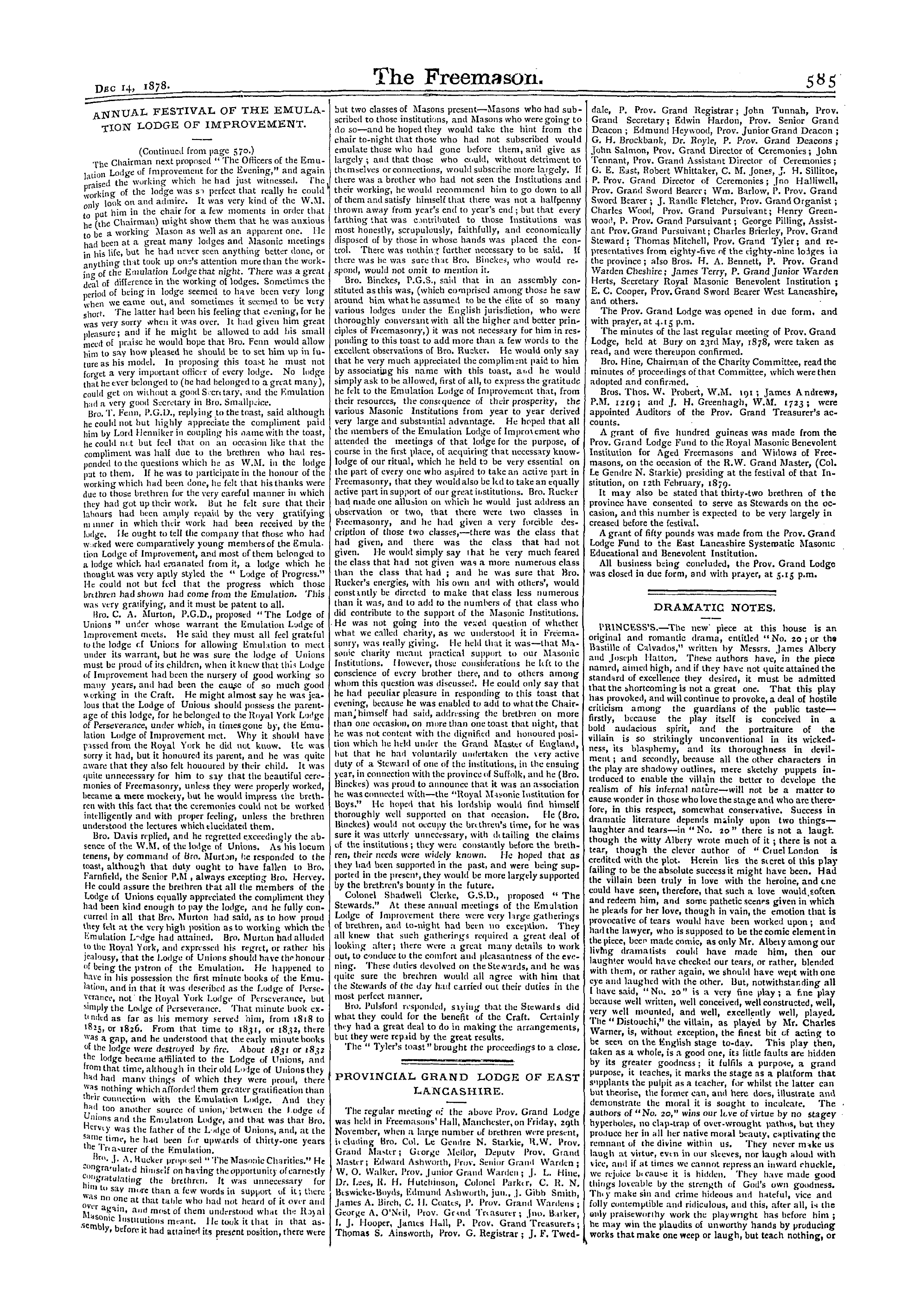
( Continued from page 570 . ) The Chairman next proposed " The Officers of the Emu-Htion Lodge of Improvement for the Evening , " and again raised the working which he had just witnessed . The forking 0 f the lodge was si perfect that really ha could nlv look on and admire . It was very kind of the W . M . chair for few moments in order that
put him in the a h ° e ( ihe Chairman ) might show them that he was anxious to be a working Mason as well as an apparent one . He had been at a great many lodges and Masonic meetings in his life , but he had never seen anything better done , or anything that took up ont ' s attention more than the workhie of the Emulation Lodge that night . There was a great
deal of difference in thc working of lodges . Sometimes the period of being in lodge seemed to have been very long when we came out , and sometimes it seemed to be very short . The latter had been his feeling that ceiling , for he was very sorry when it was over . It had given him great pleasure ; and if he might be allowed to add his small nieed of praise he would hope that Bro . Fcnn would allow
him to say how pleased he should be to set him up in future as his model . In proposing this toast he must not forget a very important officer of every lodge . No lodge that he ever belonged to ( he had belonged lo a great many ) , could get on without a good Secretary , and the Emulation had a very good Secretary in Bro . Smallpeice . Bro . T . Fenn , P . G . D ., replying to the toast , said although
he could not but highly appreciate the compliment paid him by Lord Henniker in coupling his iiamcvvith the toast , he could ne : t but feel that on an occasion like that the compliment was half due to the brethren who had responded to the questions which he as W . M . in the lodge
put to them . If he was to participate in the honour of thc working which had been done , he felt that his thanks were due to those brethren for the very careful manner in which they had got up their work . But he felt sure that their labours had been amply repaid by the very gratifying 111 inner in which their work had been received by the
lodge . He ought to tell the company that those who had w irked were comparatively young members of the Emulation Lodge of Improvement , and most of them belonged to a lodge which had emanated from it , a lodge which he thought was very aplly styled the " Lodge of Progress . " He could not but feci that the progress which those brethren had shown had come from the Emulation . This
was very gratifying , and it must be patent to all . Bro . C . A . Murton , P . G . D ., proposed " The Lodge of Unions " under whose warrant the Emulation Ljclge of Improvement meets . He said they must all feci grateful to the lodge r . f Unions for allowing Emulation to meet under its warrant , but he was sure the lodge of Unions must be proud of iis children , when it knew that this Lodge
of Improvement had been the nursery of good working so many years , and had been the cause of so much good working in the Craft . He might almost say he was jealous that the Lodge of Unious should possess the parentage of this lodge , for he belonged to the Royal York Lodge of Perseverance , under which , in times gone by , the Emulation Lodge of Improvement met . Why it shoulel have
passed from the Royal York he did not know . He was sorry it had , but it honoured its parent , and he was quite aware that they also felt hououred by their child . It was ejuite unnecessary for him to say that the beautiful ceremonies of Freemasonry , unless they were properly worked , became a mere mockeiy , but he would impress the brethren with this fact that the ceremonies could not be worked
intelligently and with proper feeling , unless the brethren understood the lectures which elucidated them . Bro . Davis replied , and he regretted exceedingly the absence of the W . M . of the lotlge of Unions . As his locum tenens , by command of Bro . Murtjn , he responded to Ihe toast , although that duty ought to have fallen lo Bro . Farnfield , the Senior P . M , always excepting Bro . Hervey .
He could assure the brethren that all the members of the Lodge of Unions equally appreciated the compliment they had been kind enough to pay the lodge , and he fully concurred in all that Bro . Murton had said , as to how proud they felt at the very high position as to working which thc Kmulation L"dge had attained . Bro . Murton had alluded to the Royal York , and expressed his regret , or rather his
jealousy , that the Lodge of Unions should have the honour "f being the patron of the Emulation . He happened to have in his possession thc first minute books of the Emulation , and in that it was described as the Lodge of Perseverance , not Ihe Royal York Lodge of Perseverance , but simpl y the Lodge of Perseverance . That minute book exhndedas far as his memory served him , from 1818 to
' 825 , or 1826 . From that time to 1831 , or 1832 , there was a gap , and he undeistood that the early minute books ° f the lodge were destroyed by fire . About 1831 or 18 32 'he lodge became affiliated to the Lodge of Unions , and from that time , although in their old Lodge of Unions they " » d had manv things of which they were proud , there was nothing which afforded them greater gratification than
their connection with the Emulation Loelge . And they " " ) loo another source of union , between the Lodge of Unions and ihe Emulation Lodge , and that was that Bro . Hervey was the father of the Ledge of Unions , and , at the Sjinie time , he had been for upwards of thirty-one years '" e Treasurer of the Emulation .
" " J . A . Rucker proposed "The Masonic Charities . " He - "ngra'ulatrd himself on having the opportunity of earnestly congratulating the brethren . It was unnecessary for l [ n to say more than a few words in support of it ; there ^ as no one at that table who had not heard of it over and er again , and most of them understood what the lloval sembT ' " stlu ? tio ,, s 'nra'it . He took it that in that as-0 | y , before it had attained its present position , there were
Annual Festival Of The Emulation Lodge Of Improvement.
but two classes of Masons present—Masons who had subscribed to those institutions , and Masons who were going to do so—and he hoped they would take the hint from the chair to-night that those who had not subscribed would emulate those who had gone before them , and give as largely ; and that those who could , without detriment to thtmselves or connections , would subscribe more largely . If
there was a brother who had not seen the Institutions and their working , he would recommend him to go down to all of them and satisfy himself that there was not a halfpenny thrown away from year's end to year ' s end ; but that every farthing that was contributed to those Institutions was most honestly , scrupulously , faithfully , and economically disposed of by those in whose hands was placed the
control . There was nothing further necessary to be said . If there was he was sure that Bro . Binckes , who would respond , would not omit to mention it . Bro . Binckes , P . G . S ., said that in an assembly constituted as this was , ( which comprised among those ; he saw around him what he assumed t . o be the elite of so many various lodges under the English jurisdiction , who were
thoroughly conversant with all the higher and better principles of Freemasonry , ) it was not necessary for him in responding to this toast to add more than a few words to thc excellent observations of Bro . Rucker . He would only say that he very much appreciated thc compliment paid to him by associating his name with this toast , and he would simply ask to be allowed , first of all , to express the gratitude
he felt to the Emulation Lodge of Improvement that , from their resources , the consequence of their prosperity , the various Masonic Institutions from year to year derived very large and substantial advantage . He hoped that all the members of the Emulation Lodge of Improvement who attended the meetings of that lodge for the purpose , of course in the first place , of acquiring that necessary
knowlodge of our ritual , which he held to be very essential on the part of every one who aspired to take an active part in Freemasonry , that they would also be led to take an equally active part in support of our great institutions . Bro . Rucker had made one allusion on which he would just address an observation or two , that there were two classes in Freemasonry , and he had given a very forcible
description of those two classes , —there was the class that had given , and there was the class that had not given . He would simply say I hat he very much feared the class that had not given was a more numerous class than the class that had ; and he was sure that Bro . Ruckcr's energies , with his own and with others' , would constantly be directed to make that class less numerous
than it was , and to add to the numbers of that class who did contribute to the support of the Masonic Institutions . He was not going into the vexed question of whether what we called charity , as we undcrstooel it in Freemasonry , was really giving . He held that it was—that Masonic charity meant practical support to our Masonic Institutions . However , those considerations he left to the
conscience of every brother there , and to others among whom this question was discussed . He could only say that he had peculiar pleasure in responding to this toast that evening , because he was enabled to add to what the Chairman , himself had said , addressing the brethren on more than one occasion , on more than one toast that night , that he was not content with the dignified and honoured
position which he held under the Grand Master of England , hut that he had voluntarily undertaken the very active duty of a Steward of one of the institutions , in the ensuing year , in connection with the province of Suffolk , and he ( Bro . Binckes ) was proud to announce that it was an association he was connected with—the "Royal Masonic Institution for Boys . " He hoped that his lordship would find himself
thoroughly well supported on that occasion . He ( Bro . Binckes ) would not occupy the brethren ' s time , for he was sure it was utterly unnecessary , with detailing the claims of the institutions ; they were constantly before the brethren , their needs were widely known . Me hoped that as they bad been supported in the past , and were being supported in the present , they would be more largely supported
by thc brethren's bounly in the future . Colonel Shadwell Clerke , G . S . D ., proposed " The Stewards . " At these annual meetings of thc Emulation Lodge of Improvement there were very large gatherings of brethren , and to-night had been no exception . They all knew that such gatherings required a great deal of looking alter ; there were a great many details to work out , to conduce to the comfort and pleasantness of the eve ' -
ning . These duties devolved on IheSte . vards , and he was quite sure thc brethren would all agree with him that the Stewards of thc day had carried out their duties in the most perfect manner . Bro . Pulsford responded , siyiug that thc Stewards did what they could for the benefit of the Craft . Certainly they had a great deal to do in making the arrangements , but they were repaid by the great results . Thc " Tyler's toast" brought Ihe proceedings to a close .
Provincial Grand Lodge Of East Lancashire.
PROVINCIAL GRAND LODGE OF EAST LANCASHIRE .
The regular meeting o : the above Prov . Grand Lodge was held in Freemasons' Hall , Manchester , on Friday , 29 th November , when a large number of brethren Were present , ii eluding Bro . Col . Le Gendre N . Starkie , R . W . Prov . Grand Master ; George Mellor , Deputy Prov . Grand
Master ; Edward Ash worth , Prov . Senior Grand Warden ; W . O . Walker . Prov . Junior Grand Warden ; J . L . Hine , Dr . Lees , K . H . Hutchinson , Colonel Parker , C . R . N . Bcswicke-Boyels , Edmund Ash worth , jun ., J . Gibb Smith , James A . Birch , C . 11 . Coates , P . Prov . Grand Wardens ; George A . O'N ' til , Prov . Gr < nd Treasurer ; Jno . Baiker , I . J . Hooper , James Ho . ll , P . Prov . Grand Treasurers ; Thomas S . Ainsivorth , Prov . G . Registrar ; J . F . Twed-
Provincial Grand Lodge Of East Lancashire.
dale , P . Prov . Grand Registrar ; John Tunnah , Prov . Grand Secretary ; Edwin Hardon , Prov . Senior Grand Deacon ; Edmund Heywood , Prov . Junior Grand Deacon ; G . H . Brockbank , Dr . Royle , P . Prov . Grand Deacons ; John Salmon , Prov . Grand Director of Ceremonies ; John Tennant , Prov . Grand Assistant Director of Ceremonies ; G . E . East , Robert Whittaker , C . M . Jones , J . H . Sillitoe ,
P . Prov . Grand Director of Ceremonies ; Jno Halliwell , Prov . Grand Sword Bearer ; Wm . Barlow , P . Prov . Grand Sword Bearer ; J . Randle Fletcher , Prov . Grand Organist ; Charles Wood , Prov . Grand Pursuivant ; Henry Greenwood , P . Prov . Grand Pursuivant ; George Pilling , Assistant Prov . Grand Pursuivant ; Charles Brierley , Prov . Grand Steward ; Thomas Mitchell , Prov . Grand Tyler ; and
representatives from eighty-five nf the eighty-nine lodges in the province ; also Bros . H . A . Bennett , P . Prov . Grand Warden Cheshire ; James Terry , P . Grand Junior Warden Herts , Secretary Royal Masonic Benevolent Institution ; E . C . Cooper , Prov . Grand Sword Bearer West Lancashire , and others . The Prov . Grand Lodge was opened in due form , and with prayer , at 4 . 1 ; p . m .
The minutes of thc last regular meeting of Pcov . Grand Lodge , held at Bury on 23 rd May , 1878 , were taken as read , and were thereupon confirmed . Bro . Hine , Chairman of the Charity Committee , read the minutes of proceedings of that Committee , which were then adopted and confirmed . Bros . Thos . W . Probert , W . M . 191 -, James Andrews , P . M . i 2 rg ; and J . H . Greenhagh , W . M . 1723 ; were appointed Auditors of the Prov . Grand Treasurer ' s
accounts . A grant of five hundred guineas was made from the Prov . Grand Lodge Fund to the Royal Masonic Benevolent Institution for Aged Freemasons and Widows of Freemasons , on the occasion of the R . W . Grand Master , ( Col . Le Gendre N . Starkie ) presiding at the festival of that Institution , on 12 th February , 1879 . It may also be stated that thirty-two brethren of thc
province have consented to serve as Stewards on the occasion , and this number is expected to be very largely in creased before the festival . A grant of fifty pounds was made from the Prov . Grand Lodge Fund to the East Lancashire Systematic Masonic Educational and Benevolent Institution . All business being concluded , the Prov . Grand Lodge was closed in due form , and with prayer , at 5 . 15 p . m .
Dramatic Notes.
DRAMATIC NOTES .
PRINCESS'S . —The new' piece at this house is an original and romantic drama , entitled "No . 20 ; or th » Bastille of Calvados , " written by Messrs . James Albery and Joseph Hatto . n . These authors have , in the piece named , aimed high , and if they have not quite attained the standard of excellence they desired , it must be admitted
that the shortcoming is not a great one . That this play has provoked , and will continue to provoke , a deal of hostile criticism among the guardians of the public tastefirstly , because the play itself is conceived in a bold audacious spirit , and the portraiture of the villain is so strikingly unconventional in its wickedness , its blasphemy , and its thoroughness in
devilment ; and secondly , because all the other characters in the play are shadowy outlines , mere sketchy puppets introduced to enable the villain the better to develope the realism of his infernal nature—will not be a matter to cause wonder in those who love the stage and who are therefore , in this respect , somewhat conservative . Success in dramatic literature depends nuinly upon two things-
laughter and tears—in " No . 20 " there is not a laugh though the witty Albery wrote much of it ; there is not a tear , though the clever author of " Cruel London is credited with the plot . Herein lies the stcret of this play failing to be the absolute success it might have been . Had the villain been truly in love with the heroine , and enc could have seen , therefore , that such a love would soften
and redeem him , and some pathetic scenes given in which he pleads for her love , though in vain , the emotion that is provocative of tears would have been worked upon ; and had the lawyer , who is supposed to be the comic element in the piece , been made comic , as only Mr . Albeiy among our living dramatists could have made him , then our laughter would have checked our tears , or rather , blended
with them , or rather again , we should have wept with one eye and laughed with the other . But , notwithstanding all I have said , "No . 20 " is a very fine play , a fine play because well written , well conceived , well constructed , well , very well mounted , and well , excellently well , played . The " Distouchi , " the villain , as played by Mr . Charles Warner , is , without exception , the finest bit of acting to
be seen on the English stage to-day . This play then , taken as a whole , is a good one , its little faults are hidden by its greater goodness ; it fulfils a purpose , a grand purpose , it teaches , it marks the stage as a platform that supplants the pulpit as a teacher , for whilst the latter can but theorise , the former can , and here does , illustrate and demonstrate the moral it is sought to inculcate . The
authors of "No . 20 , " wins our love of virtue by no stagey hyperboles , no clap-trap of over-wrought pathos , but they produce her in all her native moral beauty , captivating thc remnant of the divine within us . They never make us laugh at virtue , even in our sleeves , nor laugh aloud with vice , and if at times we cannot repress an inward rhuckle ,
we rejoice because it is hidden . They have made good things loveable by the strength of God ' s own goodness . They make sin and crime hideous and hateful , vice and folly contemptible and ridiculous , and this , after all , is the Bidy praiseworlhy work the playwright has before him ; he may win the plaudits of unworthy hands by producing works that make one weep or laugh , but teach nothing , or

Note: This text has been automatically extracted via Optical Character Recognition (OCR) software.
Annual Festival Of The Emulation Lodge Of Improvement.
ANNUA L FESTIVAL OF THE EMULATION LODGE OF IMPROVEMENT .
( Continued from page 570 . ) The Chairman next proposed " The Officers of the Emu-Htion Lodge of Improvement for the Evening , " and again raised the working which he had just witnessed . The forking 0 f the lodge was si perfect that really ha could nlv look on and admire . It was very kind of the W . M . chair for few moments in order that
put him in the a h ° e ( ihe Chairman ) might show them that he was anxious to be a working Mason as well as an apparent one . He had been at a great many lodges and Masonic meetings in his life , but he had never seen anything better done , or anything that took up ont ' s attention more than the workhie of the Emulation Lodge that night . There was a great
deal of difference in thc working of lodges . Sometimes the period of being in lodge seemed to have been very long when we came out , and sometimes it seemed to be very short . The latter had been his feeling that ceiling , for he was very sorry when it was over . It had given him great pleasure ; and if he might be allowed to add his small nieed of praise he would hope that Bro . Fcnn would allow
him to say how pleased he should be to set him up in future as his model . In proposing this toast he must not forget a very important officer of every lodge . No lodge that he ever belonged to ( he had belonged lo a great many ) , could get on without a good Secretary , and the Emulation had a very good Secretary in Bro . Smallpeice . Bro . T . Fenn , P . G . D ., replying to the toast , said although
he could not but highly appreciate the compliment paid him by Lord Henniker in coupling his iiamcvvith the toast , he could ne : t but feel that on an occasion like that the compliment was half due to the brethren who had responded to the questions which he as W . M . in the lodge
put to them . If he was to participate in the honour of thc working which had been done , he felt that his thanks were due to those brethren for the very careful manner in which they had got up their work . But he felt sure that their labours had been amply repaid by the very gratifying 111 inner in which their work had been received by the
lodge . He ought to tell the company that those who had w irked were comparatively young members of the Emulation Lodge of Improvement , and most of them belonged to a lodge which had emanated from it , a lodge which he thought was very aplly styled the " Lodge of Progress . " He could not but feci that the progress which those brethren had shown had come from the Emulation . This
was very gratifying , and it must be patent to all . Bro . C . A . Murton , P . G . D ., proposed " The Lodge of Unions " under whose warrant the Emulation Ljclge of Improvement meets . He said they must all feci grateful to the lodge r . f Unions for allowing Emulation to meet under its warrant , but he was sure the lodge of Unions must be proud of iis children , when it knew that this Lodge
of Improvement had been the nursery of good working so many years , and had been the cause of so much good working in the Craft . He might almost say he was jealous that the Lodge of Unious should possess the parentage of this lodge , for he belonged to the Royal York Lodge of Perseverance , under which , in times gone by , the Emulation Lodge of Improvement met . Why it shoulel have
passed from the Royal York he did not know . He was sorry it had , but it honoured its parent , and he was quite aware that they also felt hououred by their child . It was ejuite unnecessary for him to say that the beautiful ceremonies of Freemasonry , unless they were properly worked , became a mere mockeiy , but he would impress the brethren with this fact that the ceremonies could not be worked
intelligently and with proper feeling , unless the brethren understood the lectures which elucidated them . Bro . Davis replied , and he regretted exceedingly the absence of the W . M . of the lotlge of Unions . As his locum tenens , by command of Bro . Murtjn , he responded to Ihe toast , although that duty ought to have fallen lo Bro . Farnfield , the Senior P . M , always excepting Bro . Hervey .
He could assure the brethren that all the members of the Lodge of Unions equally appreciated the compliment they had been kind enough to pay the lodge , and he fully concurred in all that Bro . Murton had said , as to how proud they felt at the very high position as to working which thc Kmulation L"dge had attained . Bro . Murton had alluded to the Royal York , and expressed his regret , or rather his
jealousy , that the Lodge of Unions should have the honour "f being the patron of the Emulation . He happened to have in his possession thc first minute books of the Emulation , and in that it was described as the Lodge of Perseverance , not Ihe Royal York Lodge of Perseverance , but simpl y the Lodge of Perseverance . That minute book exhndedas far as his memory served him , from 1818 to
' 825 , or 1826 . From that time to 1831 , or 1832 , there was a gap , and he undeistood that the early minute books ° f the lodge were destroyed by fire . About 1831 or 18 32 'he lodge became affiliated to the Lodge of Unions , and from that time , although in their old Lodge of Unions they " » d had manv things of which they were proud , there was nothing which afforded them greater gratification than
their connection with the Emulation Loelge . And they " " ) loo another source of union , between the Lodge of Unions and ihe Emulation Lodge , and that was that Bro . Hervey was the father of the Ledge of Unions , and , at the Sjinie time , he had been for upwards of thirty-one years '" e Treasurer of the Emulation .
" " J . A . Rucker proposed "The Masonic Charities . " He - "ngra'ulatrd himself on having the opportunity of earnestly congratulating the brethren . It was unnecessary for l [ n to say more than a few words in support of it ; there ^ as no one at that table who had not heard of it over and er again , and most of them understood what the lloval sembT ' " stlu ? tio ,, s 'nra'it . He took it that in that as-0 | y , before it had attained its present position , there were
Annual Festival Of The Emulation Lodge Of Improvement.
but two classes of Masons present—Masons who had subscribed to those institutions , and Masons who were going to do so—and he hoped they would take the hint from the chair to-night that those who had not subscribed would emulate those who had gone before them , and give as largely ; and that those who could , without detriment to thtmselves or connections , would subscribe more largely . If
there was a brother who had not seen the Institutions and their working , he would recommend him to go down to all of them and satisfy himself that there was not a halfpenny thrown away from year's end to year ' s end ; but that every farthing that was contributed to those Institutions was most honestly , scrupulously , faithfully , and economically disposed of by those in whose hands was placed the
control . There was nothing further necessary to be said . If there was he was sure that Bro . Binckes , who would respond , would not omit to mention it . Bro . Binckes , P . G . S ., said that in an assembly constituted as this was , ( which comprised among those ; he saw around him what he assumed t . o be the elite of so many various lodges under the English jurisdiction , who were
thoroughly conversant with all the higher and better principles of Freemasonry , ) it was not necessary for him in responding to this toast to add more than a few words to thc excellent observations of Bro . Rucker . He would only say that he very much appreciated thc compliment paid to him by associating his name with this toast , and he would simply ask to be allowed , first of all , to express the gratitude
he felt to the Emulation Lodge of Improvement that , from their resources , the consequence of their prosperity , the various Masonic Institutions from year to year derived very large and substantial advantage . He hoped that all the members of the Emulation Lodge of Improvement who attended the meetings of that lodge for the purpose , of course in the first place , of acquiring that necessary
knowlodge of our ritual , which he held to be very essential on the part of every one who aspired to take an active part in Freemasonry , that they would also be led to take an equally active part in support of our great institutions . Bro . Rucker had made one allusion on which he would just address an observation or two , that there were two classes in Freemasonry , and he had given a very forcible
description of those two classes , —there was the class that had given , and there was the class that had not given . He would simply say I hat he very much feared the class that had not given was a more numerous class than the class that had ; and he was sure that Bro . Ruckcr's energies , with his own and with others' , would constantly be directed to make that class less numerous
than it was , and to add to the numbers of that class who did contribute to the support of the Masonic Institutions . He was not going into the vexed question of whether what we called charity , as we undcrstooel it in Freemasonry , was really giving . He held that it was—that Masonic charity meant practical support to our Masonic Institutions . However , those considerations he left to the
conscience of every brother there , and to others among whom this question was discussed . He could only say that he had peculiar pleasure in responding to this toast that evening , because he was enabled to add to what the Chairman , himself had said , addressing the brethren on more than one occasion , on more than one toast that night , that he was not content with the dignified and honoured
position which he held under the Grand Master of England , hut that he had voluntarily undertaken the very active duty of a Steward of one of the institutions , in the ensuing year , in connection with the province of Suffolk , and he ( Bro . Binckes ) was proud to announce that it was an association he was connected with—the "Royal Masonic Institution for Boys . " He hoped that his lordship would find himself
thoroughly well supported on that occasion . He ( Bro . Binckes ) would not occupy the brethren ' s time , for he was sure it was utterly unnecessary , with detailing the claims of the institutions ; they were constantly before the brethren , their needs were widely known . Me hoped that as they bad been supported in the past , and were being supported in the present , they would be more largely supported
by thc brethren's bounly in the future . Colonel Shadwell Clerke , G . S . D ., proposed " The Stewards . " At these annual meetings of thc Emulation Lodge of Improvement there were very large gatherings of brethren , and to-night had been no exception . They all knew that such gatherings required a great deal of looking alter ; there were a great many details to work out , to conduce to the comfort and pleasantness of the eve ' -
ning . These duties devolved on IheSte . vards , and he was quite sure thc brethren would all agree with him that the Stewards of thc day had carried out their duties in the most perfect manner . Bro . Pulsford responded , siyiug that thc Stewards did what they could for the benefit of the Craft . Certainly they had a great deal to do in making the arrangements , but they were repaid by the great results . Thc " Tyler's toast" brought Ihe proceedings to a close .
Provincial Grand Lodge Of East Lancashire.
PROVINCIAL GRAND LODGE OF EAST LANCASHIRE .
The regular meeting o : the above Prov . Grand Lodge was held in Freemasons' Hall , Manchester , on Friday , 29 th November , when a large number of brethren Were present , ii eluding Bro . Col . Le Gendre N . Starkie , R . W . Prov . Grand Master ; George Mellor , Deputy Prov . Grand
Master ; Edward Ash worth , Prov . Senior Grand Warden ; W . O . Walker . Prov . Junior Grand Warden ; J . L . Hine , Dr . Lees , K . H . Hutchinson , Colonel Parker , C . R . N . Bcswicke-Boyels , Edmund Ash worth , jun ., J . Gibb Smith , James A . Birch , C . 11 . Coates , P . Prov . Grand Wardens ; George A . O'N ' til , Prov . Gr < nd Treasurer ; Jno . Baiker , I . J . Hooper , James Ho . ll , P . Prov . Grand Treasurers ; Thomas S . Ainsivorth , Prov . G . Registrar ; J . F . Twed-
Provincial Grand Lodge Of East Lancashire.
dale , P . Prov . Grand Registrar ; John Tunnah , Prov . Grand Secretary ; Edwin Hardon , Prov . Senior Grand Deacon ; Edmund Heywood , Prov . Junior Grand Deacon ; G . H . Brockbank , Dr . Royle , P . Prov . Grand Deacons ; John Salmon , Prov . Grand Director of Ceremonies ; John Tennant , Prov . Grand Assistant Director of Ceremonies ; G . E . East , Robert Whittaker , C . M . Jones , J . H . Sillitoe ,
P . Prov . Grand Director of Ceremonies ; Jno Halliwell , Prov . Grand Sword Bearer ; Wm . Barlow , P . Prov . Grand Sword Bearer ; J . Randle Fletcher , Prov . Grand Organist ; Charles Wood , Prov . Grand Pursuivant ; Henry Greenwood , P . Prov . Grand Pursuivant ; George Pilling , Assistant Prov . Grand Pursuivant ; Charles Brierley , Prov . Grand Steward ; Thomas Mitchell , Prov . Grand Tyler ; and
representatives from eighty-five nf the eighty-nine lodges in the province ; also Bros . H . A . Bennett , P . Prov . Grand Warden Cheshire ; James Terry , P . Grand Junior Warden Herts , Secretary Royal Masonic Benevolent Institution ; E . C . Cooper , Prov . Grand Sword Bearer West Lancashire , and others . The Prov . Grand Lodge was opened in due form , and with prayer , at 4 . 1 ; p . m .
The minutes of thc last regular meeting of Pcov . Grand Lodge , held at Bury on 23 rd May , 1878 , were taken as read , and were thereupon confirmed . Bro . Hine , Chairman of the Charity Committee , read the minutes of proceedings of that Committee , which were then adopted and confirmed . Bros . Thos . W . Probert , W . M . 191 -, James Andrews , P . M . i 2 rg ; and J . H . Greenhagh , W . M . 1723 ; were appointed Auditors of the Prov . Grand Treasurer ' s
accounts . A grant of five hundred guineas was made from the Prov . Grand Lodge Fund to the Royal Masonic Benevolent Institution for Aged Freemasons and Widows of Freemasons , on the occasion of the R . W . Grand Master , ( Col . Le Gendre N . Starkie ) presiding at the festival of that Institution , on 12 th February , 1879 . It may also be stated that thirty-two brethren of thc
province have consented to serve as Stewards on the occasion , and this number is expected to be very largely in creased before the festival . A grant of fifty pounds was made from the Prov . Grand Lodge Fund to the East Lancashire Systematic Masonic Educational and Benevolent Institution . All business being concluded , the Prov . Grand Lodge was closed in due form , and with prayer , at 5 . 15 p . m .
Dramatic Notes.
DRAMATIC NOTES .
PRINCESS'S . —The new' piece at this house is an original and romantic drama , entitled "No . 20 ; or th » Bastille of Calvados , " written by Messrs . James Albery and Joseph Hatto . n . These authors have , in the piece named , aimed high , and if they have not quite attained the standard of excellence they desired , it must be admitted
that the shortcoming is not a great one . That this play has provoked , and will continue to provoke , a deal of hostile criticism among the guardians of the public tastefirstly , because the play itself is conceived in a bold audacious spirit , and the portraiture of the villain is so strikingly unconventional in its wickedness , its blasphemy , and its thoroughness in
devilment ; and secondly , because all the other characters in the play are shadowy outlines , mere sketchy puppets introduced to enable the villain the better to develope the realism of his infernal nature—will not be a matter to cause wonder in those who love the stage and who are therefore , in this respect , somewhat conservative . Success in dramatic literature depends nuinly upon two things-
laughter and tears—in " No . 20 " there is not a laugh though the witty Albery wrote much of it ; there is not a tear , though the clever author of " Cruel London is credited with the plot . Herein lies the stcret of this play failing to be the absolute success it might have been . Had the villain been truly in love with the heroine , and enc could have seen , therefore , that such a love would soften
and redeem him , and some pathetic scenes given in which he pleads for her love , though in vain , the emotion that is provocative of tears would have been worked upon ; and had the lawyer , who is supposed to be the comic element in the piece , been made comic , as only Mr . Albeiy among our living dramatists could have made him , then our laughter would have checked our tears , or rather , blended
with them , or rather again , we should have wept with one eye and laughed with the other . But , notwithstanding all I have said , "No . 20 " is a very fine play , a fine play because well written , well conceived , well constructed , well , very well mounted , and well , excellently well , played . The " Distouchi , " the villain , as played by Mr . Charles Warner , is , without exception , the finest bit of acting to
be seen on the English stage to-day . This play then , taken as a whole , is a good one , its little faults are hidden by its greater goodness ; it fulfils a purpose , a grand purpose , it teaches , it marks the stage as a platform that supplants the pulpit as a teacher , for whilst the latter can but theorise , the former can , and here does , illustrate and demonstrate the moral it is sought to inculcate . The
authors of "No . 20 , " wins our love of virtue by no stagey hyperboles , no clap-trap of over-wrought pathos , but they produce her in all her native moral beauty , captivating thc remnant of the divine within us . They never make us laugh at virtue , even in our sleeves , nor laugh aloud with vice , and if at times we cannot repress an inward rhuckle ,
we rejoice because it is hidden . They have made good things loveable by the strength of God ' s own goodness . They make sin and crime hideous and hateful , vice and folly contemptible and ridiculous , and this , after all , is the Bidy praiseworlhy work the playwright has before him ; he may win the plaudits of unworthy hands by producing works that make one weep or laugh , but teach nothing , or