-
Articles/Ads
Article Science. Art. and the Drama. Page 1 of 1 Article PAINTERS AND OTHER ARTISTS IN THE REIGN OF JAMES I. Page 1 of 1 Article PAINTERS AND OTHER ARTISTS IN THE REIGN OF JAMES I. Page 1 of 1 Article THE TRIUMPHS OF YOUTH. Page 1 of 1
Note: This text has been automatically extracted via Optical Character Recognition (OCR) software.
Science. Art. And The Drama.
Science . Art . and the Drama .
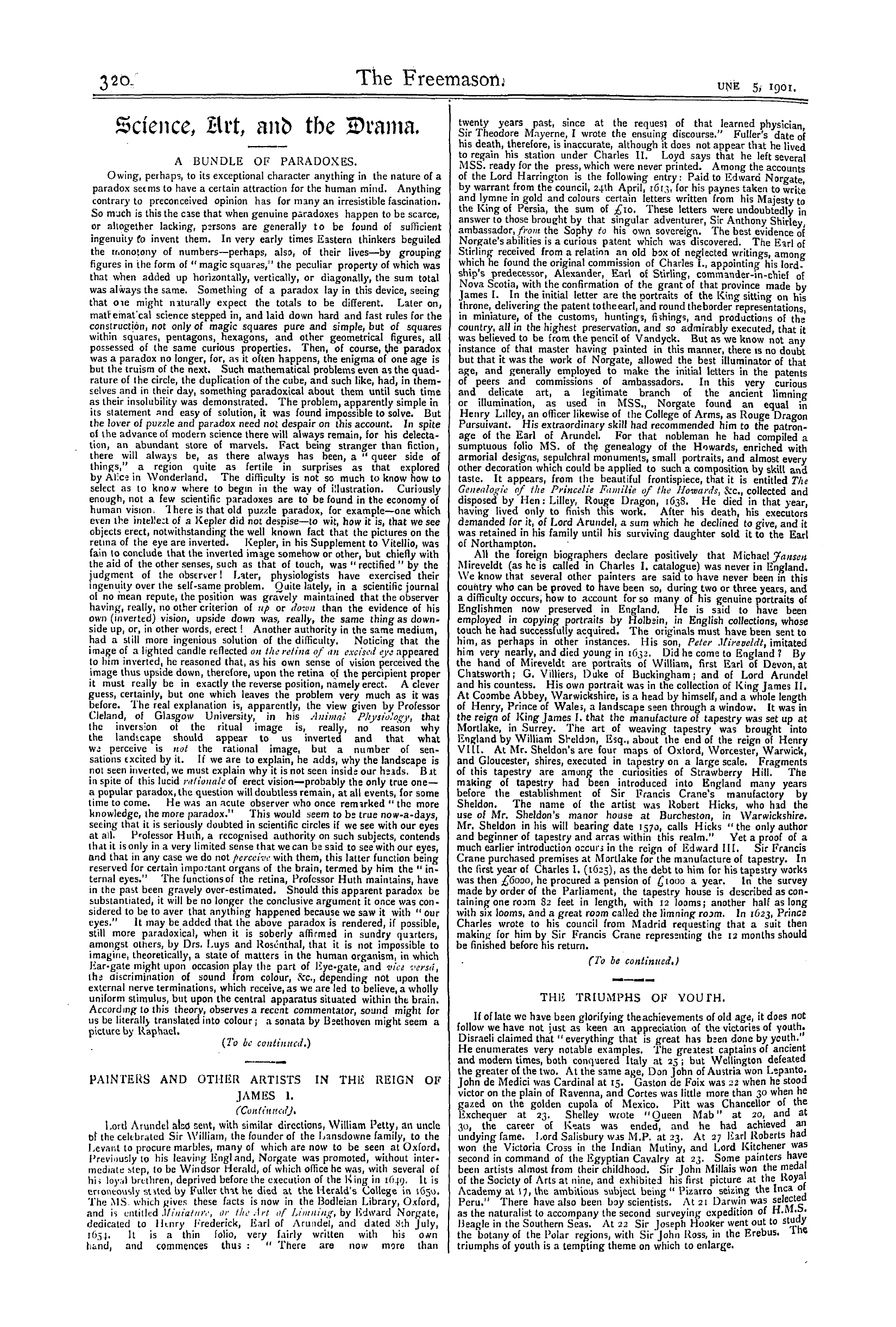
A BUNDLE OF PARADOXES . Owing , perhaps , to its exceptional character anything in the nature of a paradox seems to have a certain attraction for the human mind . Anything contrary to preconceived opinion has for many an irresistible fascination . So much is this the case that when genuine paradoxes happen to be scarce , or altogether lacking , p 2 rsons are generally to be found of sufficient
ingenuity fo invent them . In very early times Eastern thinkers beguiled the monotony of numbers—perhaps , also , of their lives—by grouping figures in the form of " magic squares , " the peculiar property of which was that when added up horizontally , vertically , or diagonally , the sum total was always the same . Something of a paradox lay in this device , seeing that one might naturally expect the totals to be different . Later on ,
matremat ' cal science stepped in , and laid down hard and fast rules for the construction , not only of magic squares pure and simple , but of squares within squares , pentagons , hexagons , and other geometrical figures , all possessed of the same curious properties . Then , of course , the paradox was a paradox no longer , for , as it often happens , the enigma of one age is but the truism of the next . Such mathematical problems even as the
quadrature of Ihe circle , the duplication of the cube , and such like , had , in themselves and in their day , something paradoxical about them until such time as their insolubility was demonstrated . The problem , apparently simple in its statement and easy of solution , it was found impossible to solve . But the lover of puzzle and paradox need not despair on this account . In spite of the advance of modern science there will always remain , for his
delectation , an abundant store of marvels . Fact being stranger than fiction , there will always be , as there always has been , a " queer side of things , " a region quite as fertile in surprises as that explored by Alice in Wonderland . The difficulty is not so much to know how to select as to know where to begin in the way of illustration . Curiously enough , not a few scientific paradoxes are to " be found in the economy of
human vision . 1 here is that old puzzle paradox , for example—one which even the intellect of a Kepler did not despise—to wit , how it is , that we see objects erect , notwithstanding the well known fact that the pictures on the retina of the eye are inverted . Kepler , in his Supplement to Vitellio , was fain to conclude that the inverted image somehow or other , but chiefly with the aid of the other senses , such as that of touch , was " rectified" by the
judgment of the observer ! Later , physiologists have exercised their ingenuity over the self-same problem . Quite lately , in a scientific journal ol no mean repute , the position was gravely maintained that the observer having , really , no other criterion of up or down than the evidence of his own ( inverted ) vision , upside down was , really , the same thing as downside up , or , in other words , erect ! Another authority in the same medium ,
had a still more ingenious solution of the difficulty . Noticing that the image of a lighted candle reflected on the retina of an excised eye appeared to him inverted , he reasoned that , as his own sense of vision perceived the image thus upside down , therefore , upon the retina qf the percipient proper it must really be in exactly the reverse position , namely erect . A clever guess , certainly , but one which leaves the problem very much as it was
before . The real explanation is , apparently , the view given by Professor Cieland , of Glasgow University , in his Animal Physiology , that the inveision ot the ritual image is , really , no reason why the landscape should appear to us inverted and that what Wi perceive is not the rational image , but a number of sensations excited by it . If we are to explain , he adds , why the landscape is
not seen inverted , we must explain why it is not seen inside our heads . Bit in spite of this lucid rationale of erect vision—probably the only true onea popular paradox , the question will doubtless remain , at all events , for some time to come . He was an acute observer who once remarked " the more knowledge , the more paradox . " This would seem to bs true now-a-days , seeing that it is seriously doubted in scientific circles if we see with our eyes
at all . Professor Huth , a recognised authority on such subjects , contends lhat it is only in a very limited sense that we can be said to see with our eyes , and that in any case we do not perceive with them , this latter function being reserved for certain important organs of the brain , termed by him the " internal eyes . " The functions of the retina , Professor Huth maintains , have in the past been gravely over-estimated . Should this apparent paradox be
substantiated , it will be no longer the conclusive argument it once was considered to be to aver that anything happened because we saw it with " our eyes . " It may be added that the above paradox is rendered , if possible , still more paradoxical , when it is soberly affirmed in sundry quarters , amongst others , by Drs . Luys and Rosenthal , that it is not impossible to imagine , theoretically , a state of matters in the human organism , in which Ear-gate might upon occasion play the part of Eye-gate , and via versa ,
ihi discrimination of sound from colour , Src , depending not upon the external nerve terminations , which receive , as we are led to believe , a wholly uniform stimulus , but upon the central apparatus situated within the brain . According to this theory , observes a recent commentator , sound might for us be literally translated into colour ; a sonata by Beethoven might seem a picture by Raphael . ( To be continued . )
Painters And Other Artists In The Reign Of James I.
PAINTERS AND OTHER ARTISTS IN THE REIGN OF JAMES I .
( Continued ] , Lord Arundel atsd sent , with similar directions , William Petty , an uncle bf the celebrated Sir William , the founder of the Lansdowne family , to the Levant to procure marbles , many of which are now to be seen at Oxford . Previously to his leaving Engl and , Norgate was promoted , without intermediate step , to be Windsor Herald , of which office he was , with several of
his loyal brethren , deprived before the execution of the King in 1649 . It is enoneously suted by Fuller thit he died at the Herald ' s College in 1650 . The MS . which gives these facts is now in the Bodleian Library , Oxford , and is entitled Miniature , ar the Art of Limning , by Edward Norgate , dedicated to lluiry Frederick , Earl of Arundel , and dated y * . h July , 1654 . It is a thin folio , very fairly written with his own hand , and commences thus : " There are now more than
Painters And Other Artists In The Reign Of James I.
twenty years past , since at the requesj of that learned physician Sir Theodore Mayerne , I wrote the ensuing discourse . " Fuller ' s date of his death , therefore , is inaccurate , although it does not appear that he lived to regain his station under Charles II . Loyd says that he left several MSS . ready for the press , which were never printed . Among the accounts of the Lord Harrington is the following entry r Paid to Edward Norgate
by warrant from the council , 24 th April , 1613 , for his paynes taken to write and Iymne in gold and colours certain letters written from his Majesty to the King of Persia , the sum of £ 10 . These letters were undoubtedl y in answer to those brought by that singular adventurer , Sir Anthony Shirley , ambassador , from the Sophy to his own sovereign . The best eviden ce of Norgale ' s abilities is a curious patent which was discovered . The Earl of
Stirling received from a relation an old box of neglected writings , among which he found the original commission of Charles I ., appointing his lord - ship ' s predecessor , Alexander , Earl of Stirling , commander-in-chief of Nova Scotia , with the confirmation of the grant of that province made by James I . In the initial letter are the portraits of the King sitting on his throne , delivering the patent totheearl , and round theborder representations
, in miniature , of the customs , huntings , fishings , and productions of the country , all in the highest preservation , and so admirably executed , that it was believed to be from the pencil of Vandyck . But as we know not any instance of that master having painted in this manner , there is no doubt but that it was the work of Norgate , allowed the best illuminator of that age , and generally employed to make the initial letters in the patents
of peers and commissions of ambassadors . In this very curious and delicate art , a legitimate branch of the ancient limning or illumination , as used in MSS ., Norgate found an equal in Henry Lilley , an officer likewise of the College of Arms , as Rouge Dragon Pursuivant . His extraordinary skill had recommended him to the patronage of the Earl of Arundel . For that nobleman he had compiled a
sumptuous folio MS . of the genealogy of the Howards , enriched with armorial designs , sepulchral monuments , small portraits , and almost every other decoration which could be applied to such a composition by skill and taste . It appears , from the beautiful frontispiece , that it is entitled The Genealogie of the Princelie Familie of the Howards , & c , collected and
disposed by Hen r Lilley , Rouge Dragon , 1638 . He died in that year , having lived only to finish this work . After his death , his executors demanded for it , of Lord Arundel , a sum which he declined to give , and it was retained in his family until his surviving daughter sold it to the Earl of Northampton .
All the foreign biographers declare positively that Michael Jansen Mireveldt ( as he is called in Charles I . catalogue ) was never in England , We know that several other painters are said to have never been in this country who can be proved to have been so , during two or three years , and a difficulty occurs , how to account for so many of his genuine portraits of Englishmen now preserved in England , He is said to have been
employed in copying portraits by Holbsin , in English collections , whose touch he had successfully acquired . The originals must have been sent to him , as perhaps in other instances . His son , Peter Mireveldt , imitated him very nearly , and died young in 1632 . Did he come to England ? By the hand of Mireveldt are portraits of William , first Earl of Devon , at Chatsworth ; G . Villiers , Duke of Buckingham ; and of Lord Arundel
and his countess . His own portrait was in the collection of King James II . At Coombe Abbey , Warwickshire , is a head by himself , and a whole length of Henry , Prince of Walei , a landscape seen through a window . It was in the reign of King James I . that the manufacture of tapestry was set up at Mortlake , in Surrey . The art of weaving tapestry was brought into England by William Sheldon , Esq ., about the end of the reign of Henry VIII . At Mr . Sheldon ' s are four maps of Oxford , Worcester , Warwick ,
and Gloucester , shires , executed in tapestry on a large scale . Fragments of this tapestry are among the curiosities of Strawberry Hill . The making of tapestry had been introduced into England many years before the establishment of Sir Francis Crane ' s manufactory by Sheldon . The name of the artist was Robert Hicks , who had the use of Mr . Sheldon ' s manor house at Burcheston , in Warwickshire .
Mr . Sheldon in his will bearing date 1570 , calls Hicks "the only author and beginner of tapestry and arras within this realm . " Yet a proof of a much earlier introduction occurs in the reign of Edward III . Sir Francis Crane purchased premises at Mortlake for the manufacture of tapestry . In the first year of Charles I . ( 1625 ) , as the debt to him for his tapestry works was then £ 6000 , he procured a pension of £ 1000 a year . In the survey
made by order of the Parliament , the tapestry house is described as containing one room 82 feet in length , with 12 looms ; another half as long with six looms , and a great room called the limning room . In 1623 , Prince Charles wrote to his council from Madrid requesting that a suit then making for him by Sir Francis Crane representing the 12 months should be finished before his return . ( To be continued . )
The Triumphs Of Youth.
THE TRIUMPHS OF YOUTH .
If of late we have been glorifying the achievements of old age , it does not follow we have not just as keen an appreciation of the victories of youth . Disraeli claimed that " everything that is great has been done by youth . " He enumerates very notable examples . The greatest captains of ancient and modern times , both conquered Italy at 25 ; but Wellington defeated the greater of the two . At the same age , Don John of Austria won Lepanto
John de Medici was Cardinal at 15 . Gaston de Foix was 22 when he stood victor on the plain of Ravenna , and Cortes was little more than 30 when he gazed on the golden cupola of Mexico . Pitt was Chancellor of the Exchequer at 23 . Shelley wrote "Queen Mab" at 20 , and at 30 , the career of Keats was ended , and he had achieved an undying fame . Lord Salisbury was M . P . at 23 . At 27 Earl Roberts had
won the Victoria Cross in the Indian Mutiny , and Lord Kitchener was second in command of the Egyptian Cavalry at 23 . Some painters have been artists almost from their childhood . Sir John Millais won the medal of the Society of Arts at nine , and exhibited his first picture at the Royal Academy at \ 1 , the ambitious subiect being " Pizarro seizing the Inca ot
Peru . " There have also been boy scientists . At 21 Darwin was ^" c as the naturalist to accompany the second surveying expedition of " ••;?" Beagle in the Southern Seas . At 22 Sir Josep h Hooker went out to study the botany of the Polar regions , with Sir John Ross , in the Erebus . In * * triumphs of youth is a tempting theme on which to enlarge .



Note: This text has been automatically extracted via Optical Character Recognition (OCR) software.
Science. Art. And The Drama.
Science . Art . and the Drama .
A BUNDLE OF PARADOXES . Owing , perhaps , to its exceptional character anything in the nature of a paradox seems to have a certain attraction for the human mind . Anything contrary to preconceived opinion has for many an irresistible fascination . So much is this the case that when genuine paradoxes happen to be scarce , or altogether lacking , p 2 rsons are generally to be found of sufficient
ingenuity fo invent them . In very early times Eastern thinkers beguiled the monotony of numbers—perhaps , also , of their lives—by grouping figures in the form of " magic squares , " the peculiar property of which was that when added up horizontally , vertically , or diagonally , the sum total was always the same . Something of a paradox lay in this device , seeing that one might naturally expect the totals to be different . Later on ,
matremat ' cal science stepped in , and laid down hard and fast rules for the construction , not only of magic squares pure and simple , but of squares within squares , pentagons , hexagons , and other geometrical figures , all possessed of the same curious properties . Then , of course , the paradox was a paradox no longer , for , as it often happens , the enigma of one age is but the truism of the next . Such mathematical problems even as the
quadrature of Ihe circle , the duplication of the cube , and such like , had , in themselves and in their day , something paradoxical about them until such time as their insolubility was demonstrated . The problem , apparently simple in its statement and easy of solution , it was found impossible to solve . But the lover of puzzle and paradox need not despair on this account . In spite of the advance of modern science there will always remain , for his
delectation , an abundant store of marvels . Fact being stranger than fiction , there will always be , as there always has been , a " queer side of things , " a region quite as fertile in surprises as that explored by Alice in Wonderland . The difficulty is not so much to know how to select as to know where to begin in the way of illustration . Curiously enough , not a few scientific paradoxes are to " be found in the economy of
human vision . 1 here is that old puzzle paradox , for example—one which even the intellect of a Kepler did not despise—to wit , how it is , that we see objects erect , notwithstanding the well known fact that the pictures on the retina of the eye are inverted . Kepler , in his Supplement to Vitellio , was fain to conclude that the inverted image somehow or other , but chiefly with the aid of the other senses , such as that of touch , was " rectified" by the
judgment of the observer ! Later , physiologists have exercised their ingenuity over the self-same problem . Quite lately , in a scientific journal ol no mean repute , the position was gravely maintained that the observer having , really , no other criterion of up or down than the evidence of his own ( inverted ) vision , upside down was , really , the same thing as downside up , or , in other words , erect ! Another authority in the same medium ,
had a still more ingenious solution of the difficulty . Noticing that the image of a lighted candle reflected on the retina of an excised eye appeared to him inverted , he reasoned that , as his own sense of vision perceived the image thus upside down , therefore , upon the retina qf the percipient proper it must really be in exactly the reverse position , namely erect . A clever guess , certainly , but one which leaves the problem very much as it was
before . The real explanation is , apparently , the view given by Professor Cieland , of Glasgow University , in his Animal Physiology , that the inveision ot the ritual image is , really , no reason why the landscape should appear to us inverted and that what Wi perceive is not the rational image , but a number of sensations excited by it . If we are to explain , he adds , why the landscape is
not seen inverted , we must explain why it is not seen inside our heads . Bit in spite of this lucid rationale of erect vision—probably the only true onea popular paradox , the question will doubtless remain , at all events , for some time to come . He was an acute observer who once remarked " the more knowledge , the more paradox . " This would seem to bs true now-a-days , seeing that it is seriously doubted in scientific circles if we see with our eyes
at all . Professor Huth , a recognised authority on such subjects , contends lhat it is only in a very limited sense that we can be said to see with our eyes , and that in any case we do not perceive with them , this latter function being reserved for certain important organs of the brain , termed by him the " internal eyes . " The functions of the retina , Professor Huth maintains , have in the past been gravely over-estimated . Should this apparent paradox be
substantiated , it will be no longer the conclusive argument it once was considered to be to aver that anything happened because we saw it with " our eyes . " It may be added that the above paradox is rendered , if possible , still more paradoxical , when it is soberly affirmed in sundry quarters , amongst others , by Drs . Luys and Rosenthal , that it is not impossible to imagine , theoretically , a state of matters in the human organism , in which Ear-gate might upon occasion play the part of Eye-gate , and via versa ,
ihi discrimination of sound from colour , Src , depending not upon the external nerve terminations , which receive , as we are led to believe , a wholly uniform stimulus , but upon the central apparatus situated within the brain . According to this theory , observes a recent commentator , sound might for us be literally translated into colour ; a sonata by Beethoven might seem a picture by Raphael . ( To be continued . )
Painters And Other Artists In The Reign Of James I.
PAINTERS AND OTHER ARTISTS IN THE REIGN OF JAMES I .
( Continued ] , Lord Arundel atsd sent , with similar directions , William Petty , an uncle bf the celebrated Sir William , the founder of the Lansdowne family , to the Levant to procure marbles , many of which are now to be seen at Oxford . Previously to his leaving Engl and , Norgate was promoted , without intermediate step , to be Windsor Herald , of which office he was , with several of
his loyal brethren , deprived before the execution of the King in 1649 . It is enoneously suted by Fuller thit he died at the Herald ' s College in 1650 . The MS . which gives these facts is now in the Bodleian Library , Oxford , and is entitled Miniature , ar the Art of Limning , by Edward Norgate , dedicated to lluiry Frederick , Earl of Arundel , and dated y * . h July , 1654 . It is a thin folio , very fairly written with his own hand , and commences thus : " There are now more than
Painters And Other Artists In The Reign Of James I.
twenty years past , since at the requesj of that learned physician Sir Theodore Mayerne , I wrote the ensuing discourse . " Fuller ' s date of his death , therefore , is inaccurate , although it does not appear that he lived to regain his station under Charles II . Loyd says that he left several MSS . ready for the press , which were never printed . Among the accounts of the Lord Harrington is the following entry r Paid to Edward Norgate
by warrant from the council , 24 th April , 1613 , for his paynes taken to write and Iymne in gold and colours certain letters written from his Majesty to the King of Persia , the sum of £ 10 . These letters were undoubtedl y in answer to those brought by that singular adventurer , Sir Anthony Shirley , ambassador , from the Sophy to his own sovereign . The best eviden ce of Norgale ' s abilities is a curious patent which was discovered . The Earl of
Stirling received from a relation an old box of neglected writings , among which he found the original commission of Charles I ., appointing his lord - ship ' s predecessor , Alexander , Earl of Stirling , commander-in-chief of Nova Scotia , with the confirmation of the grant of that province made by James I . In the initial letter are the portraits of the King sitting on his throne , delivering the patent totheearl , and round theborder representations
, in miniature , of the customs , huntings , fishings , and productions of the country , all in the highest preservation , and so admirably executed , that it was believed to be from the pencil of Vandyck . But as we know not any instance of that master having painted in this manner , there is no doubt but that it was the work of Norgate , allowed the best illuminator of that age , and generally employed to make the initial letters in the patents
of peers and commissions of ambassadors . In this very curious and delicate art , a legitimate branch of the ancient limning or illumination , as used in MSS ., Norgate found an equal in Henry Lilley , an officer likewise of the College of Arms , as Rouge Dragon Pursuivant . His extraordinary skill had recommended him to the patronage of the Earl of Arundel . For that nobleman he had compiled a
sumptuous folio MS . of the genealogy of the Howards , enriched with armorial designs , sepulchral monuments , small portraits , and almost every other decoration which could be applied to such a composition by skill and taste . It appears , from the beautiful frontispiece , that it is entitled The Genealogie of the Princelie Familie of the Howards , & c , collected and
disposed by Hen r Lilley , Rouge Dragon , 1638 . He died in that year , having lived only to finish this work . After his death , his executors demanded for it , of Lord Arundel , a sum which he declined to give , and it was retained in his family until his surviving daughter sold it to the Earl of Northampton .
All the foreign biographers declare positively that Michael Jansen Mireveldt ( as he is called in Charles I . catalogue ) was never in England , We know that several other painters are said to have never been in this country who can be proved to have been so , during two or three years , and a difficulty occurs , how to account for so many of his genuine portraits of Englishmen now preserved in England , He is said to have been
employed in copying portraits by Holbsin , in English collections , whose touch he had successfully acquired . The originals must have been sent to him , as perhaps in other instances . His son , Peter Mireveldt , imitated him very nearly , and died young in 1632 . Did he come to England ? By the hand of Mireveldt are portraits of William , first Earl of Devon , at Chatsworth ; G . Villiers , Duke of Buckingham ; and of Lord Arundel
and his countess . His own portrait was in the collection of King James II . At Coombe Abbey , Warwickshire , is a head by himself , and a whole length of Henry , Prince of Walei , a landscape seen through a window . It was in the reign of King James I . that the manufacture of tapestry was set up at Mortlake , in Surrey . The art of weaving tapestry was brought into England by William Sheldon , Esq ., about the end of the reign of Henry VIII . At Mr . Sheldon ' s are four maps of Oxford , Worcester , Warwick ,
and Gloucester , shires , executed in tapestry on a large scale . Fragments of this tapestry are among the curiosities of Strawberry Hill . The making of tapestry had been introduced into England many years before the establishment of Sir Francis Crane ' s manufactory by Sheldon . The name of the artist was Robert Hicks , who had the use of Mr . Sheldon ' s manor house at Burcheston , in Warwickshire .
Mr . Sheldon in his will bearing date 1570 , calls Hicks "the only author and beginner of tapestry and arras within this realm . " Yet a proof of a much earlier introduction occurs in the reign of Edward III . Sir Francis Crane purchased premises at Mortlake for the manufacture of tapestry . In the first year of Charles I . ( 1625 ) , as the debt to him for his tapestry works was then £ 6000 , he procured a pension of £ 1000 a year . In the survey
made by order of the Parliament , the tapestry house is described as containing one room 82 feet in length , with 12 looms ; another half as long with six looms , and a great room called the limning room . In 1623 , Prince Charles wrote to his council from Madrid requesting that a suit then making for him by Sir Francis Crane representing the 12 months should be finished before his return . ( To be continued . )
The Triumphs Of Youth.
THE TRIUMPHS OF YOUTH .
If of late we have been glorifying the achievements of old age , it does not follow we have not just as keen an appreciation of the victories of youth . Disraeli claimed that " everything that is great has been done by youth . " He enumerates very notable examples . The greatest captains of ancient and modern times , both conquered Italy at 25 ; but Wellington defeated the greater of the two . At the same age , Don John of Austria won Lepanto
John de Medici was Cardinal at 15 . Gaston de Foix was 22 when he stood victor on the plain of Ravenna , and Cortes was little more than 30 when he gazed on the golden cupola of Mexico . Pitt was Chancellor of the Exchequer at 23 . Shelley wrote "Queen Mab" at 20 , and at 30 , the career of Keats was ended , and he had achieved an undying fame . Lord Salisbury was M . P . at 23 . At 27 Earl Roberts had
won the Victoria Cross in the Indian Mutiny , and Lord Kitchener was second in command of the Egyptian Cavalry at 23 . Some painters have been artists almost from their childhood . Sir John Millais won the medal of the Society of Arts at nine , and exhibited his first picture at the Royal Academy at \ 1 , the ambitious subiect being " Pizarro seizing the Inca ot
Peru . " There have also been boy scientists . At 21 Darwin was ^" c as the naturalist to accompany the second surveying expedition of " ••;?" Beagle in the Southern Seas . At 22 Sir Josep h Hooker went out to study the botany of the Polar regions , with Sir John Ross , in the Erebus . In * * triumphs of youth is a tempting theme on which to enlarge .