-
Articles/Ads
Article MASONIC IRREGULARITIES. ← Page 2 of 2 Article WEST YORKSHIRE. Page 1 of 1 Article WEST YORKSHIRE. Page 1 of 1 Article SEWING MACHINES. Page 1 of 2 Article SEWING MACHINES. Page 1 of 2 →
Note: This text has been automatically extracted via Optical Character Recognition (OCR) software.
Masonic Irregularities.
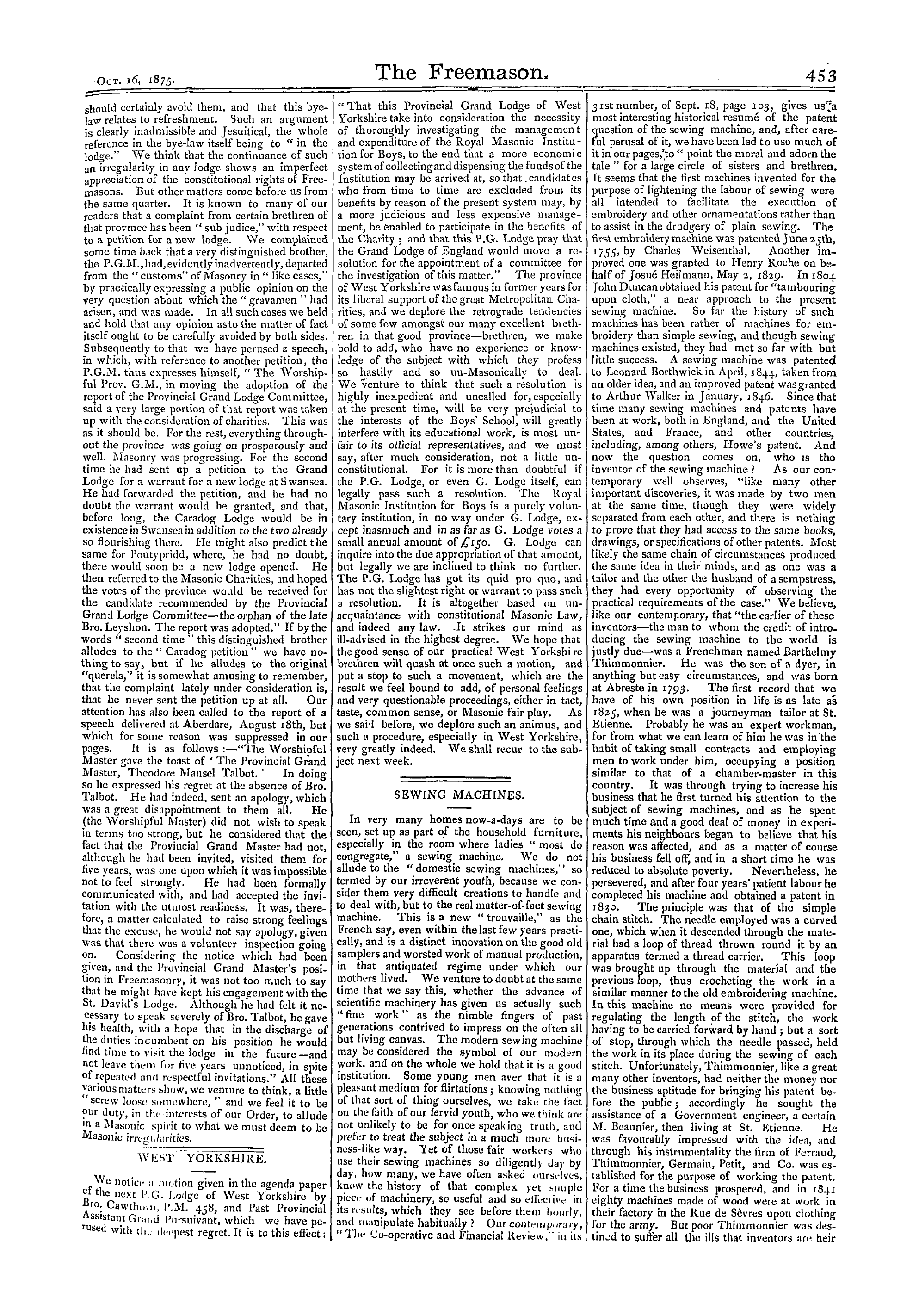
should certainly avoid them , and that this bye-] aw relates to refreshment . Such an argument is clearly inadmissible and Jesuitical , the whole reference in the bye-law itself being to " in the lodge . " We think that the continuance of such an irregularity in any lodge shows an imperfect
appreciation of the constitutional rights of Freemasons . But other matters come before us from the same quarter . It is known to many of our readers that a complaint from certain brethren of that province has been " sub judice , " with respect to a petition for a new lodge . We complained
some time back that a very distinguished brother , the P . G . M ., had , evidently inadvertently , departed from the " customs" of Masonry in " like cases , " by practically expressing a public opinion on the very question about which the " gravamen " had arisen , and was made . In all such cases we held
and hold that any opinion asto the matter of fact itself ought to be carefully avoided by both sides . Subsequently to that we have perused a speech , in which , with reference to another petition , the P . G . M . thus expresses himself , " The Worshipful Prov . G . M ., in moving the adoption of the
report of the Provincial Grand Lodge Committee , said a very large portion of that report was taken up with the consideration of charities . This was as it should be . For the rest , everything throughout tlie province was going on prosperously and well . Masonry was progressing . For the second
time he had sent up a petition to the Grand Lodge for a warrant for a new lodge at S wansea . He had forwarded the petition , and he had no doubt the warrant would be granted , and that , before long , the Caradog Lodge would be in existence in Swansea in addition to the two already
so flourishing there . He might also predict the same for Pontypridd , where , he had no doubt , there would soon be a new lodge opened . He then referred to the Masonic Charities , and hoped the votes of the province would be received for the candidate recommended by the Provincial
Grand Lodge Committee—the orphan of the late Bro . Leyshon . The report was adopted . " If by the words " second time " this distinguished brother alludes to the " Caradog petition " we have nothing to say , but if he alludes to the original " querela , '' it is somewhat amusing to remember ,
that the complaint lately under consideration is , that he never sent the petition up at all . Our attention has also been called to the report of a speech delivered at Aberdare , August 18 th , but •which for some reason was suppressed in our pages . It is as follows : — "The Worshipful
Master gave the toast of ' The Provincial Grand Master , Theodore Mansel Talbot . ' In doing so he expressed his regret at the absence of Bro . Talbot . He had indeed , sent an apology , which was a great disappointment to them all . He ( the Worshipful Master ) did not wish to speak
in terms too strong , but he considered that the fact that the Provincial Grand Master had not , although he had been invited , visited them for five years , was one upon which it was impossible not to feel strongly . He had been formall y communicated with , and had accepted the
invitation with the utmost readiness . It was , therefore , a matter calculated to raise strong feelings that the excuse , he would not say apology , given was that there was a volunteer inspection going on . Considering the notice which had been given , and the Provincial Grand Master ' s
position in Freemasonry , it was not too much to say that he might have kept his engagement with the St . David ' s Lodge . Although he had felt ft necessary to speak severely of Bro . Talbot , he gave his health , with a hope that in the discharge of the duties incumbent on his position he would find time to visit the lod ge in the future —and
not leave them for five years unnoticed , in spite of repeated and respectful invitations . " All these various matters show , we venture to think , a little ' screw loose somewhere , " and we feel it to be pur duty , in the interests of our Order , to allude 'n a Masonic spirit to what we must deem to be Masonic invsrularities .
West Yorkshire.
WEST YORKSHIRE .
We notice n motion given in the agenda paper « the next P . G . Lodge of West Yorkshire b y »™ .. Cawthmn , P . M . 458 , and Past Provincial Assistant Grind Pursuivant , which we have pemsed with the deepest regret . It is to this effect :
West Yorkshire.
"That this Provincial Grand Lodge of West Yorkshire take into consideration the necessity of thoroughly investigating the management and expenditure of the Royal Masonic Institution for Boys , to the end that a more economic system of collecting and dispensiug the funds of the
Institution may be arrived at , so that . candidates who from time to time are excluded from its benefits by reason of the present system may , by a more judicious and less expensive management , be enabled to participate in the benefits of the Charity ; and that this P . G . Lodge pray that
the Grand Lodge of England would move a resolution for the appointment of a committee for the investigation of this matter . " The province of West Yorkshire wasfamous in former years for its liberal support of the great Metropolitan Charities , and we deplore the retrograde tendencies
of some few amongst our many excellent brethren in that good province—brethren , we make bold to add , who have no experience or knowledge of the subject with which they profess so hastily and so un-Masonically to deal . We venture to think that such a resolution is
hig hly inexpedient and uncalled for , especially at the present time , will be very prejudicial to the interests of the Boys' School , will greatly interfere with its educational work , is most unfair to its official representatives , and we must say , after much consideration , not a little unconstitutional . For it is more than doubtful if
the P . G . Lodge , or even G . Lodge itself , can legally pass such a resolution . The Royal Masonic Institution for Boys is a purely voluntary institution , in no way under G . Lodge , except inasmuch and in as far as G . Lodge votes a small annual amount of £ i < o . G . Lodge can
inquire into the due appropriation of that amount , but legally we are inclined to think no further . The P . G . Lodge has got its quid pro quo , and has not the slightest right or warrant to pass such a resolution . It is altogether based on unacquaintance with constitutional Masonic Law ,
and indeed any law . -It strikes our mind as ill-advised in the highest degree . We hope that the good sense of our practical West Yorkshi re brethren will quash at once such a motion , and put a stop to such a movement , which are the result we feel bound to add , of personal feelings
and very questionable proceedings , either in tact , taste , common sense , or Masonic fair play . As we said before , we deplore such an animus , and such a procedure , especially in West Yorkshire , very greatly indeed . We shall recur to the subject next week .
Sewing Machines.
SEWING MACHINES .
In very many homes now-a-days are to be seen , set up as part of the household furniture , especially in the room where ladies " most do congregate , " a sewing machine . We do not allude to the " domestic sewing machines , '' so termed by our irreverent youth , because we consider them very difficult creations to handle and
to deal with , but to the real matter-of-fact sewing machine . This is a new " trouvaille , " as the French say , even within the last few years practically , and is a distinct innovation on the good old samplers and worsted work of manual production , in that antiquated regime under which our mothers lived . We venture to doubt at the same
time that we say this , whether the advance of scientific machinery has given us actually such "fine work" as the nimble fingers of past generations contrived to impress on the often all but living canvas . The modern sewing machine may be considered the symbol of our modern
work , and on the whole we hold that it is a good institution . Some young men aver that it is a pleasant medium for flirtations ; knowing nothing of that sort of thing ourselves , we take the fact on the faith of our fervid youth , who we think are not unlikely to be for once speaking truth , and prefer to treat the subject in a much more
business-like way . Yet of those fair workers who use their sewing machines so diligently day by day , how many , we have often asked ourselves , know the history of that complex yet simple piece of machinery , so useful and so effect we in its results , which they see before them hourly , and manipulate habitually > Our contemporary , " Ihe ( Jo-operative and Financial Review , " in its
Sewing Machines.
31 st number , of Sept . 18 , page 103 , gives us " a most interesting historical resume of the patent question of the sewing machine , and , after careful perusal of it , we have been led to use much of it in our pages / to " point the moral and adorn the tale " for a large circle of sisters and brethren .
It seems that the first machines invented for the purpose of lightening the labour of sewing were all intended to facilitate the execution of embroidery and other ornamentations rather than to assist in the drudgery of plain sewing . The first embroidery machine was patented June ajth ,
1 / . $ . !>> Dy Charles Weisenthal . Another improved one was granted to Henry Roche on behalf of Josue Heilmanu , May 2 , 1829 . In 1804 John Duncan obtained his patent for "tambouring upon cloth , " a near approach to the present sewing machine . So far the history of such
machines has been rather of machines for embroidery than simple sewing , and though sewing machines existed , they had met so far with but little success . A sewing machine was patented to Leonard Borthwick in April , 1844 , taken from an older idea , and an improved patent was granted
to Arthur Walker in January , 1846 . Since that time many sewing machines and patents have been at work , both in England , and the United States , and France , and other countries , including , among others , Howe ' s patent . And now the question comes on , who is the
inventor of the sewing machine ? As our contemporary well observes , "like many other important discoveries , it was made by two men at the same time , though they were widely separated from each other , and there is nothing to prove that they had access to the same books ,
drawings , or specifications of other patents . Most likely the same chain of circumstances produced the same idea in their minds , and as one was a tailor and the other the husband of a sempstress , they had every opportunity of observing the practical requirements of the case . " We believe ,
like our contemporary , that " the earlier of these inventors—the man to whom the credit of introducing the sewing machine to the world is justly due—was a Frenchman named Barthelmy Thimmonnier . He was the son of a dyer , in anything but easy circumstances , and was born
at Abreste in 1793 . The first record that we have of his own position in life is as late as 1825 , when he was a journeyman tailor at St . Etienne . Probably he was an expert workman , for from what we can learn of him he was in ' the habit of taking small contracts and employing
men to work under him , occupying a position similar to that of a chamber-master in this country . It was through trying to increase his business that he first turned his attention to the subject of sewing machines , and as he spent much time and a good deal of money in
experiments his neighbours began to believe that his reason was affected , and as a matter of course his business fell off , and in a short time he was reduced to absolute poverty . Nevertheless , he persevered , and after four years' patient labour he completed his machine and obtained a patent in
1830 . The principle was that of the simple chain stitch . The needle employed was a curved one , which when it descended through the material had a loop of thread thrown round it by an apparatus termed a thread carrier . This loop was brought up through the material and the
previous loop , thus crocheting the work in a similar manner to the old embroidering machine . In this machine no means were provided for regulating the length of the stitch , the work having to be carried forward by hand ; but a sort of stop , through which the needle passed , held
tnt : work in its place during the sewing of each stitch . Unfortunately , Thimmonnier , like a great many other inventors , had neither the money nor the business aptitude for bringing his patent before the public ; accordingly he sought the assistance of a Government engineer , a certain
M . Beaunier , then living at St . Etienne . He was favourabl y impressed with the idea , and through his instrumentality the firm of Ferraud , Thimmonnier , Germain , Petit , and Co . was established for the purpose of working the patent .
ror a time the business prospered , and in 1841 eighty machines made of wood were at work in their factory in the Rue de Sevres upon clothing for the army . But poor Thimmonnier was destined to suffer all the ills that inventors are heir
Note: This text has been automatically extracted via Optical Character Recognition (OCR) software.
Masonic Irregularities.
should certainly avoid them , and that this bye-] aw relates to refreshment . Such an argument is clearly inadmissible and Jesuitical , the whole reference in the bye-law itself being to " in the lodge . " We think that the continuance of such an irregularity in any lodge shows an imperfect
appreciation of the constitutional rights of Freemasons . But other matters come before us from the same quarter . It is known to many of our readers that a complaint from certain brethren of that province has been " sub judice , " with respect to a petition for a new lodge . We complained
some time back that a very distinguished brother , the P . G . M ., had , evidently inadvertently , departed from the " customs" of Masonry in " like cases , " by practically expressing a public opinion on the very question about which the " gravamen " had arisen , and was made . In all such cases we held
and hold that any opinion asto the matter of fact itself ought to be carefully avoided by both sides . Subsequently to that we have perused a speech , in which , with reference to another petition , the P . G . M . thus expresses himself , " The Worshipful Prov . G . M ., in moving the adoption of the
report of the Provincial Grand Lodge Committee , said a very large portion of that report was taken up with the consideration of charities . This was as it should be . For the rest , everything throughout tlie province was going on prosperously and well . Masonry was progressing . For the second
time he had sent up a petition to the Grand Lodge for a warrant for a new lodge at S wansea . He had forwarded the petition , and he had no doubt the warrant would be granted , and that , before long , the Caradog Lodge would be in existence in Swansea in addition to the two already
so flourishing there . He might also predict the same for Pontypridd , where , he had no doubt , there would soon be a new lodge opened . He then referred to the Masonic Charities , and hoped the votes of the province would be received for the candidate recommended by the Provincial
Grand Lodge Committee—the orphan of the late Bro . Leyshon . The report was adopted . " If by the words " second time " this distinguished brother alludes to the " Caradog petition " we have nothing to say , but if he alludes to the original " querela , '' it is somewhat amusing to remember ,
that the complaint lately under consideration is , that he never sent the petition up at all . Our attention has also been called to the report of a speech delivered at Aberdare , August 18 th , but •which for some reason was suppressed in our pages . It is as follows : — "The Worshipful
Master gave the toast of ' The Provincial Grand Master , Theodore Mansel Talbot . ' In doing so he expressed his regret at the absence of Bro . Talbot . He had indeed , sent an apology , which was a great disappointment to them all . He ( the Worshipful Master ) did not wish to speak
in terms too strong , but he considered that the fact that the Provincial Grand Master had not , although he had been invited , visited them for five years , was one upon which it was impossible not to feel strongly . He had been formall y communicated with , and had accepted the
invitation with the utmost readiness . It was , therefore , a matter calculated to raise strong feelings that the excuse , he would not say apology , given was that there was a volunteer inspection going on . Considering the notice which had been given , and the Provincial Grand Master ' s
position in Freemasonry , it was not too much to say that he might have kept his engagement with the St . David ' s Lodge . Although he had felt ft necessary to speak severely of Bro . Talbot , he gave his health , with a hope that in the discharge of the duties incumbent on his position he would find time to visit the lod ge in the future —and
not leave them for five years unnoticed , in spite of repeated and respectful invitations . " All these various matters show , we venture to think , a little ' screw loose somewhere , " and we feel it to be pur duty , in the interests of our Order , to allude 'n a Masonic spirit to what we must deem to be Masonic invsrularities .
West Yorkshire.
WEST YORKSHIRE .
We notice n motion given in the agenda paper « the next P . G . Lodge of West Yorkshire b y »™ .. Cawthmn , P . M . 458 , and Past Provincial Assistant Grind Pursuivant , which we have pemsed with the deepest regret . It is to this effect :
West Yorkshire.
"That this Provincial Grand Lodge of West Yorkshire take into consideration the necessity of thoroughly investigating the management and expenditure of the Royal Masonic Institution for Boys , to the end that a more economic system of collecting and dispensiug the funds of the
Institution may be arrived at , so that . candidates who from time to time are excluded from its benefits by reason of the present system may , by a more judicious and less expensive management , be enabled to participate in the benefits of the Charity ; and that this P . G . Lodge pray that
the Grand Lodge of England would move a resolution for the appointment of a committee for the investigation of this matter . " The province of West Yorkshire wasfamous in former years for its liberal support of the great Metropolitan Charities , and we deplore the retrograde tendencies
of some few amongst our many excellent brethren in that good province—brethren , we make bold to add , who have no experience or knowledge of the subject with which they profess so hastily and so un-Masonically to deal . We venture to think that such a resolution is
hig hly inexpedient and uncalled for , especially at the present time , will be very prejudicial to the interests of the Boys' School , will greatly interfere with its educational work , is most unfair to its official representatives , and we must say , after much consideration , not a little unconstitutional . For it is more than doubtful if
the P . G . Lodge , or even G . Lodge itself , can legally pass such a resolution . The Royal Masonic Institution for Boys is a purely voluntary institution , in no way under G . Lodge , except inasmuch and in as far as G . Lodge votes a small annual amount of £ i < o . G . Lodge can
inquire into the due appropriation of that amount , but legally we are inclined to think no further . The P . G . Lodge has got its quid pro quo , and has not the slightest right or warrant to pass such a resolution . It is altogether based on unacquaintance with constitutional Masonic Law ,
and indeed any law . -It strikes our mind as ill-advised in the highest degree . We hope that the good sense of our practical West Yorkshi re brethren will quash at once such a motion , and put a stop to such a movement , which are the result we feel bound to add , of personal feelings
and very questionable proceedings , either in tact , taste , common sense , or Masonic fair play . As we said before , we deplore such an animus , and such a procedure , especially in West Yorkshire , very greatly indeed . We shall recur to the subject next week .
Sewing Machines.
SEWING MACHINES .
In very many homes now-a-days are to be seen , set up as part of the household furniture , especially in the room where ladies " most do congregate , " a sewing machine . We do not allude to the " domestic sewing machines , '' so termed by our irreverent youth , because we consider them very difficult creations to handle and
to deal with , but to the real matter-of-fact sewing machine . This is a new " trouvaille , " as the French say , even within the last few years practically , and is a distinct innovation on the good old samplers and worsted work of manual production , in that antiquated regime under which our mothers lived . We venture to doubt at the same
time that we say this , whether the advance of scientific machinery has given us actually such "fine work" as the nimble fingers of past generations contrived to impress on the often all but living canvas . The modern sewing machine may be considered the symbol of our modern
work , and on the whole we hold that it is a good institution . Some young men aver that it is a pleasant medium for flirtations ; knowing nothing of that sort of thing ourselves , we take the fact on the faith of our fervid youth , who we think are not unlikely to be for once speaking truth , and prefer to treat the subject in a much more
business-like way . Yet of those fair workers who use their sewing machines so diligently day by day , how many , we have often asked ourselves , know the history of that complex yet simple piece of machinery , so useful and so effect we in its results , which they see before them hourly , and manipulate habitually > Our contemporary , " Ihe ( Jo-operative and Financial Review , " in its
Sewing Machines.
31 st number , of Sept . 18 , page 103 , gives us " a most interesting historical resume of the patent question of the sewing machine , and , after careful perusal of it , we have been led to use much of it in our pages / to " point the moral and adorn the tale " for a large circle of sisters and brethren .
It seems that the first machines invented for the purpose of lightening the labour of sewing were all intended to facilitate the execution of embroidery and other ornamentations rather than to assist in the drudgery of plain sewing . The first embroidery machine was patented June ajth ,
1 / . $ . !>> Dy Charles Weisenthal . Another improved one was granted to Henry Roche on behalf of Josue Heilmanu , May 2 , 1829 . In 1804 John Duncan obtained his patent for "tambouring upon cloth , " a near approach to the present sewing machine . So far the history of such
machines has been rather of machines for embroidery than simple sewing , and though sewing machines existed , they had met so far with but little success . A sewing machine was patented to Leonard Borthwick in April , 1844 , taken from an older idea , and an improved patent was granted
to Arthur Walker in January , 1846 . Since that time many sewing machines and patents have been at work , both in England , and the United States , and France , and other countries , including , among others , Howe ' s patent . And now the question comes on , who is the
inventor of the sewing machine ? As our contemporary well observes , "like many other important discoveries , it was made by two men at the same time , though they were widely separated from each other , and there is nothing to prove that they had access to the same books ,
drawings , or specifications of other patents . Most likely the same chain of circumstances produced the same idea in their minds , and as one was a tailor and the other the husband of a sempstress , they had every opportunity of observing the practical requirements of the case . " We believe ,
like our contemporary , that " the earlier of these inventors—the man to whom the credit of introducing the sewing machine to the world is justly due—was a Frenchman named Barthelmy Thimmonnier . He was the son of a dyer , in anything but easy circumstances , and was born
at Abreste in 1793 . The first record that we have of his own position in life is as late as 1825 , when he was a journeyman tailor at St . Etienne . Probably he was an expert workman , for from what we can learn of him he was in ' the habit of taking small contracts and employing
men to work under him , occupying a position similar to that of a chamber-master in this country . It was through trying to increase his business that he first turned his attention to the subject of sewing machines , and as he spent much time and a good deal of money in
experiments his neighbours began to believe that his reason was affected , and as a matter of course his business fell off , and in a short time he was reduced to absolute poverty . Nevertheless , he persevered , and after four years' patient labour he completed his machine and obtained a patent in
1830 . The principle was that of the simple chain stitch . The needle employed was a curved one , which when it descended through the material had a loop of thread thrown round it by an apparatus termed a thread carrier . This loop was brought up through the material and the
previous loop , thus crocheting the work in a similar manner to the old embroidering machine . In this machine no means were provided for regulating the length of the stitch , the work having to be carried forward by hand ; but a sort of stop , through which the needle passed , held
tnt : work in its place during the sewing of each stitch . Unfortunately , Thimmonnier , like a great many other inventors , had neither the money nor the business aptitude for bringing his patent before the public ; accordingly he sought the assistance of a Government engineer , a certain
M . Beaunier , then living at St . Etienne . He was favourabl y impressed with the idea , and through his instrumentality the firm of Ferraud , Thimmonnier , Germain , Petit , and Co . was established for the purpose of working the patent .
ror a time the business prospered , and in 1841 eighty machines made of wood were at work in their factory in the Rue de Sevres upon clothing for the army . But poor Thimmonnier was destined to suffer all the ills that inventors are heir