Note: This text has been automatically extracted via Optical Character Recognition (OCR) software.
Review Of G. M. Gardner's Address On Henry Price.
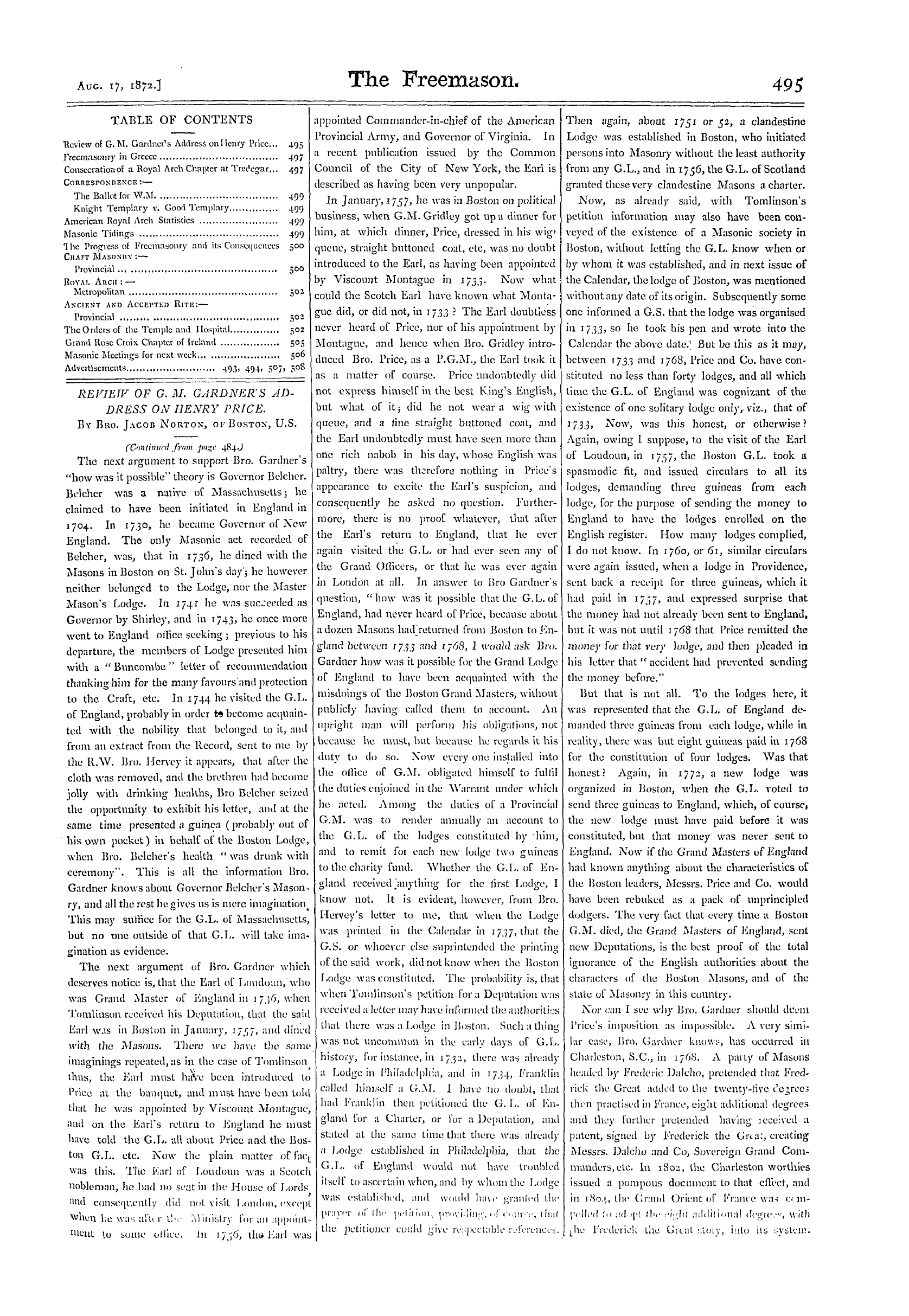
But it was not until 18 . 33 that a Bro . Macconnay , from New York was inspired with an idea to inquire ofthe G . L . authorities of Berlin if there was any truth in the Frederick the Great story ,
when an answer was returned that the Frederick story was " the grand lie of the order , " and what is more , I am acquainted in Boston and New York with scores of 32 iids and many 33 rds , and
I have never conversed with a member of those hi" * h decrees , who did not confess an utter Jis-00 ' belief in the said Frederick story . Now , he it remembered , that in 1 S 04 ,
Frederick William of Prussia acknowledged Napoleon , and peace reigned between those two countries for about two years -. communication between Paris and Berlin , was doubtless frequent , the
time necessary to travel to or fro , did not exceed even in those days , three or four days * then again , after 1815 , there is no doubt that hundreds of Masons crossed the borders , and interchanged
Masonic visits , but yet , up to 1833 , no French Mason ever inquired of the Berlin authorities whether Frederick the Great did or did not institute higher degrees , and it was only after 1830 ,
that Bro . Dr . Kloss undertook to investigate the Frederick story , when , as already remarked , the Berlin authorities wcre able to reply lo the New York enquirer , in the words of Kloss , that it was
" the grand lie of the order . " While on the other hand , between ifl . ) and ifriS , intercourse between London and Boston , was , comparatively speaking , rare ; perhaps as infrequent in it is to
day between London and Japan , while the time occupied in crossing and re-crossing the Atlantic in those days , was equal to what it now requires to circimmaviqatc the globe . Now , if the Dalcho
swindle continued unchallenged from 1786 to 18 , 3 , 3 , why then should we feel surprised at the Henry Price imposture being unknown to the Grand Lodge of England until 1 768 r True ,
the English authorities , though surprised at Price ' s claim , yet imagined that there mig ht be some truth in it . But yet , while the Duke of
Beaufort expressed confidence in Rowe ' s Deputation , of Henry Price ' s pretentions , the letter of Grand Secretary French , discloses that the Duke wanted full information ' * relation * to this
point , " which as already stated , Price very snnrtly dodged and evaded , and promised to explain face to lace in London , etc . Now 1 come to " our record , " " the record
says so , " etc . The preamble to Tomlinson ' s Deputation says "Whereas , a petition has been presented to us . . . humbly praying that we would please to nominate a new Grand
Master , " etc ., and Bro . Gardner dwells on the word " new . " New , he says , implies that the English Grand Master was conscious of there having been a Grand Master of the province before , etc .
The record also says that Price resigned , and here is another point to harp upon . " To whom did he resign ? " says Bro . G ., " but to the Grand
Master of England , * ' and consequently , the Grand Master of England must have known till about it , etc . I have already stated that the record was manufactured In * Chas . Pelham in
1 7 , 5 1 or 2 , consequently , the record is no evidence . Now , allowing Bro . Gardner all the comfort he can draw from the word " new , " the question is , has he any proof that Pelham faithfull y transcribed Tomlinson ' s Deputation . Now ,
Review Of G. M. Gardner's Address On Henry Price.
in Pelham ' s record are embraced four documents , viz ., the Deputations of Price , Tomlinson , and of Oxnard , likewise the petition for the constitution of the first lodge . Out of these four documents
the original petition alone is preserved . I have copied both—the orig inal and Pelham ' s transcript , —and placed them side by side , and I found the original to be not only considerably longer , but
Pelham ' s transcript contains ideas that are not found in the original . Now , if Pelham could take such liberties with one document , he may
also have garbled and altered the others , and if theie is any weight in the word " new , " or in "he having resigned , " it is worthless , because Pelham manufactured the record , and was not
accurate , even as a copyist . The next question I shall discuss is , did the first lodge have an original recoril from 173 , 3 ? Bro . Gardner assured the Grand Lodge that "the
records ofthe first lodge ' gave abetter account of Masonry in Boston than thc proceedings [ which means thc record ] of the Grand Lodge . The Deputation of Pi ice was copied into the first
lodge records , and a minute and full account of the progress of the Craft here were set out upon its pages . If the Grand Lodge had quarleily
meetings , they were not recorded until after 1749 . "
Bro . Gardner can find among the MSS . a slip of Pelham ' s handwriting , dated Sept . 2 , 5 th , 17 . 5 1 , wherein he says that on the 13 th April , 1750 , it was decided to hold quarterly meetings ; he may
therefore rest assured that no quarterly meetings were held before that date . The supposition of Bro . Gardner , that the . lodge possessed an orig inal record from 1733 , rests upon the unsupported
authority of Bro . Chas . W . Moore . Bro . Moore told Bro . Gardner that some years ago he borrowed the said record from Bro . Whiting , thc Secretary of St . John ' s Lodge , now deceased ,
that he extracted therefrom the by-laws of the lodge , passed in J 7 . 5 . 3 , that lie returned the said book to Bro . Whiting , and that it was destroyed with the Temple in 1864 . Bro . Thornton , late
G . S ., and successor to Bro . Whiting , as Secretary of St . John ' s Lotlge , assured us , however , that he fetched away all the bo : > ks and papers belonging to his lotlge , from Mrs . Whiting ' s
residence , that no such a book as that described b y Bro . Moore was among the cll ' ects , ami that no book whatever belonging to his lotlge was destroyed with the Temple .
In the appendix to Bro . Gardner ' s address , wc have the fourteen by-laws , but at tlie end of the thirteen laws , Bro . Moore informs us , in
brackets , that the thirteenth article was not voted upon till Nov 14 th , It is therefore evident that the fourteen laws could not have been inscribed
on the record on the 14 th of November . Bro . Moore also furnished the following certificate . "That the said record book commenced on the , 30 th of Jul } -, 1 733 , and that at the
commencement 01 the said record book , a copy of the Deputation to R . \ V . Henry Price , Prov . G . M ., from Anthony Brown , Viscount Montague , was set out in full . *'
But as Bro . Moore persisted in misprinting the name of Montague , and had even the hardihood to accuse me of " malicious misrepresentation , " knowing all the while that I was right and himself wrong , and as he als ; i misprinted Bro .
Review Of G. M. Gardner's Address On Henry Price.
Hervey ' s letter in 186 9 ( see Freemason , June 19 , 1869 ) , and as in the Massachusetts proceedings for 1871 , page 409 , Bro . Gardner himself expressed much doubt about the genuineness
of the copy of a charter which Bro . Moore furnished the brethren of St . John ' s Lodge as a substitute for the one destroyed in 1864 . Now , if Bro . Gardner doubts Bro . Moore ' s
veracity in one case , how can he expect that I shall put faith in his veracity regarding the lodge record ? Besides , if we carefully examine the by-laws , we must come to the conclusion that
some of them , at least were quite uncalled for and unnecessary for an entirel y new society , of less than three months old . For instance we may imagine that , after the society had existed ,
say twenty years , that some of the members may have been reduced to poverty , when a permanent tax was found necessary to relieve the repeated calls of the unfortunates , such necessity did not
exist in 17 , 3 , 3 , and therefore the brethren could not have taxed themselves with eight shillings per annum for charity . We may also imagine that in the course of time a number of Masons
accumulate , who will contribute nothing to the institution , but will nevertheless persist in visiting lodges , anil enjoying the company ofthe brotherhood , until at last it is found necessary to exclude
them from the right of visit ; but what necessity was there for such a law in 17 . 3 , 3 , when Governor Belcher may have been the only unatfilliated Mason in Boston . The truth , however , appears
tti be , that those by-laws wcre not adopted by the lodge until October , 24 th , 17 , 5 . 3 . My reason for that supposition is as follows : — In the record of the Grand Lodge , I found that
on "Friday , October 12 th , 1 7 , 5 . 3 , " the Grand Lodge appointed a Committee of five , to draw up byc-lawsf or the Lodge . Bro . Gardiner maintains that it meant , for the Grand Lodge . But
besides that , the words " for the Lodge , " are sufficientl y significant . If the meaning had been as Bro . Gardner thinks , vh ., forthe Grand Lodge , then we may rationally expect that the said
committee ought to have reported something at the next , or some subsequent meeting of the Grand Lodge , but as no such a report is alluded to , it strengthens my belief , that they were appointed
to thaw up the bye-laws for the Lotlge , and having performed their duty , a verbal report to the Grand Lotlge was all that was necessary . Now , according to my theory , the Committee
were appointed October 12 th , 17 , 5 , 3 . On the 24 th of the same month , the Lodge adopted the said laws , and on the 14 th of November following , tin- laws were re-considered , when another
lawwas placed between the laws passed by the Committee , as subsequently recorded . My theory is further confirmed by the fact , that whereas the regular lodge-nights of the Lodge , wcre on the
second and fourth Wednesdays of each month . Now it so happened that in 1 7 , 53 , the 241110 !' October , and the 14 th of November , correspond with the regular lodge-nig hts ofthe Lodge , while
in 17 . 3 . 3 , the said dates , fell on Tuesdays instead of Wednesdays . But lest some one should ask , " may not the Lodge have been too busy in
October , 17 . 3 , 3 , to attend at its regular meetings to the consideration of the bye-laws ? * ' I must here inform the reader that Charles Pelham comp iled a list of the members of the Lodgo

Note: This text has been automatically extracted via Optical Character Recognition (OCR) software.
Review Of G. M. Gardner's Address On Henry Price.
But it was not until 18 . 33 that a Bro . Macconnay , from New York was inspired with an idea to inquire ofthe G . L . authorities of Berlin if there was any truth in the Frederick the Great story ,
when an answer was returned that the Frederick story was " the grand lie of the order , " and what is more , I am acquainted in Boston and New York with scores of 32 iids and many 33 rds , and
I have never conversed with a member of those hi" * h decrees , who did not confess an utter Jis-00 ' belief in the said Frederick story . Now , he it remembered , that in 1 S 04 ,
Frederick William of Prussia acknowledged Napoleon , and peace reigned between those two countries for about two years -. communication between Paris and Berlin , was doubtless frequent , the
time necessary to travel to or fro , did not exceed even in those days , three or four days * then again , after 1815 , there is no doubt that hundreds of Masons crossed the borders , and interchanged
Masonic visits , but yet , up to 1833 , no French Mason ever inquired of the Berlin authorities whether Frederick the Great did or did not institute higher degrees , and it was only after 1830 ,
that Bro . Dr . Kloss undertook to investigate the Frederick story , when , as already remarked , the Berlin authorities wcre able to reply lo the New York enquirer , in the words of Kloss , that it was
" the grand lie of the order . " While on the other hand , between ifl . ) and ifriS , intercourse between London and Boston , was , comparatively speaking , rare ; perhaps as infrequent in it is to
day between London and Japan , while the time occupied in crossing and re-crossing the Atlantic in those days , was equal to what it now requires to circimmaviqatc the globe . Now , if the Dalcho
swindle continued unchallenged from 1786 to 18 , 3 , 3 , why then should we feel surprised at the Henry Price imposture being unknown to the Grand Lodge of England until 1 768 r True ,
the English authorities , though surprised at Price ' s claim , yet imagined that there mig ht be some truth in it . But yet , while the Duke of
Beaufort expressed confidence in Rowe ' s Deputation , of Henry Price ' s pretentions , the letter of Grand Secretary French , discloses that the Duke wanted full information ' * relation * to this
point , " which as already stated , Price very snnrtly dodged and evaded , and promised to explain face to lace in London , etc . Now 1 come to " our record , " " the record
says so , " etc . The preamble to Tomlinson ' s Deputation says "Whereas , a petition has been presented to us . . . humbly praying that we would please to nominate a new Grand
Master , " etc ., and Bro . Gardner dwells on the word " new . " New , he says , implies that the English Grand Master was conscious of there having been a Grand Master of the province before , etc .
The record also says that Price resigned , and here is another point to harp upon . " To whom did he resign ? " says Bro . G ., " but to the Grand
Master of England , * ' and consequently , the Grand Master of England must have known till about it , etc . I have already stated that the record was manufactured In * Chas . Pelham in
1 7 , 5 1 or 2 , consequently , the record is no evidence . Now , allowing Bro . Gardner all the comfort he can draw from the word " new , " the question is , has he any proof that Pelham faithfull y transcribed Tomlinson ' s Deputation . Now ,
Review Of G. M. Gardner's Address On Henry Price.
in Pelham ' s record are embraced four documents , viz ., the Deputations of Price , Tomlinson , and of Oxnard , likewise the petition for the constitution of the first lodge . Out of these four documents
the original petition alone is preserved . I have copied both—the orig inal and Pelham ' s transcript , —and placed them side by side , and I found the original to be not only considerably longer , but
Pelham ' s transcript contains ideas that are not found in the original . Now , if Pelham could take such liberties with one document , he may
also have garbled and altered the others , and if theie is any weight in the word " new , " or in "he having resigned , " it is worthless , because Pelham manufactured the record , and was not
accurate , even as a copyist . The next question I shall discuss is , did the first lodge have an original recoril from 173 , 3 ? Bro . Gardner assured the Grand Lodge that "the
records ofthe first lodge ' gave abetter account of Masonry in Boston than thc proceedings [ which means thc record ] of the Grand Lodge . The Deputation of Pi ice was copied into the first
lodge records , and a minute and full account of the progress of the Craft here were set out upon its pages . If the Grand Lodge had quarleily
meetings , they were not recorded until after 1749 . "
Bro . Gardner can find among the MSS . a slip of Pelham ' s handwriting , dated Sept . 2 , 5 th , 17 . 5 1 , wherein he says that on the 13 th April , 1750 , it was decided to hold quarterly meetings ; he may
therefore rest assured that no quarterly meetings were held before that date . The supposition of Bro . Gardner , that the . lodge possessed an orig inal record from 1733 , rests upon the unsupported
authority of Bro . Chas . W . Moore . Bro . Moore told Bro . Gardner that some years ago he borrowed the said record from Bro . Whiting , thc Secretary of St . John ' s Lodge , now deceased ,
that he extracted therefrom the by-laws of the lodge , passed in J 7 . 5 . 3 , that lie returned the said book to Bro . Whiting , and that it was destroyed with the Temple in 1864 . Bro . Thornton , late
G . S ., and successor to Bro . Whiting , as Secretary of St . John ' s Lotlge , assured us , however , that he fetched away all the bo : > ks and papers belonging to his lotlge , from Mrs . Whiting ' s
residence , that no such a book as that described b y Bro . Moore was among the cll ' ects , ami that no book whatever belonging to his lotlge was destroyed with the Temple .
In the appendix to Bro . Gardner ' s address , wc have the fourteen by-laws , but at tlie end of the thirteen laws , Bro . Moore informs us , in
brackets , that the thirteenth article was not voted upon till Nov 14 th , It is therefore evident that the fourteen laws could not have been inscribed
on the record on the 14 th of November . Bro . Moore also furnished the following certificate . "That the said record book commenced on the , 30 th of Jul } -, 1 733 , and that at the
commencement 01 the said record book , a copy of the Deputation to R . \ V . Henry Price , Prov . G . M ., from Anthony Brown , Viscount Montague , was set out in full . *'
But as Bro . Moore persisted in misprinting the name of Montague , and had even the hardihood to accuse me of " malicious misrepresentation , " knowing all the while that I was right and himself wrong , and as he als ; i misprinted Bro .
Review Of G. M. Gardner's Address On Henry Price.
Hervey ' s letter in 186 9 ( see Freemason , June 19 , 1869 ) , and as in the Massachusetts proceedings for 1871 , page 409 , Bro . Gardner himself expressed much doubt about the genuineness
of the copy of a charter which Bro . Moore furnished the brethren of St . John ' s Lodge as a substitute for the one destroyed in 1864 . Now , if Bro . Gardner doubts Bro . Moore ' s
veracity in one case , how can he expect that I shall put faith in his veracity regarding the lodge record ? Besides , if we carefully examine the by-laws , we must come to the conclusion that
some of them , at least were quite uncalled for and unnecessary for an entirel y new society , of less than three months old . For instance we may imagine that , after the society had existed ,
say twenty years , that some of the members may have been reduced to poverty , when a permanent tax was found necessary to relieve the repeated calls of the unfortunates , such necessity did not
exist in 17 , 3 , 3 , and therefore the brethren could not have taxed themselves with eight shillings per annum for charity . We may also imagine that in the course of time a number of Masons
accumulate , who will contribute nothing to the institution , but will nevertheless persist in visiting lodges , anil enjoying the company ofthe brotherhood , until at last it is found necessary to exclude
them from the right of visit ; but what necessity was there for such a law in 17 . 3 , 3 , when Governor Belcher may have been the only unatfilliated Mason in Boston . The truth , however , appears
tti be , that those by-laws wcre not adopted by the lodge until October , 24 th , 17 , 5 . 3 . My reason for that supposition is as follows : — In the record of the Grand Lodge , I found that
on "Friday , October 12 th , 1 7 , 5 . 3 , " the Grand Lodge appointed a Committee of five , to draw up byc-lawsf or the Lodge . Bro . Gardiner maintains that it meant , for the Grand Lodge . But
besides that , the words " for the Lodge , " are sufficientl y significant . If the meaning had been as Bro . Gardner thinks , vh ., forthe Grand Lodge , then we may rationally expect that the said
committee ought to have reported something at the next , or some subsequent meeting of the Grand Lodge , but as no such a report is alluded to , it strengthens my belief , that they were appointed
to thaw up the bye-laws for the Lotlge , and having performed their duty , a verbal report to the Grand Lotlge was all that was necessary . Now , according to my theory , the Committee
were appointed October 12 th , 17 , 5 , 3 . On the 24 th of the same month , the Lodge adopted the said laws , and on the 14 th of November following , tin- laws were re-considered , when another
lawwas placed between the laws passed by the Committee , as subsequently recorded . My theory is further confirmed by the fact , that whereas the regular lodge-nights of the Lodge , wcre on the
second and fourth Wednesdays of each month . Now it so happened that in 1 7 , 53 , the 241110 !' October , and the 14 th of November , correspond with the regular lodge-nig hts ofthe Lodge , while
in 17 . 3 . 3 , the said dates , fell on Tuesdays instead of Wednesdays . But lest some one should ask , " may not the Lodge have been too busy in
October , 17 . 3 , 3 , to attend at its regular meetings to the consideration of the bye-laws ? * ' I must here inform the reader that Charles Pelham comp iled a list of the members of the Lodgo