-
Articles/Ads
Article TABLE OF CONTENTS Page 1 of 1 Article SPIRIT AGENCY. Page 1 of 2 Article SPIRIT AGENCY. Page 1 of 2 Article SPIRIT AGENCY. Page 1 of 2 →
Note: This text has been automatically extracted via Optical Character Recognition (OCR) software.
Table Of Contents
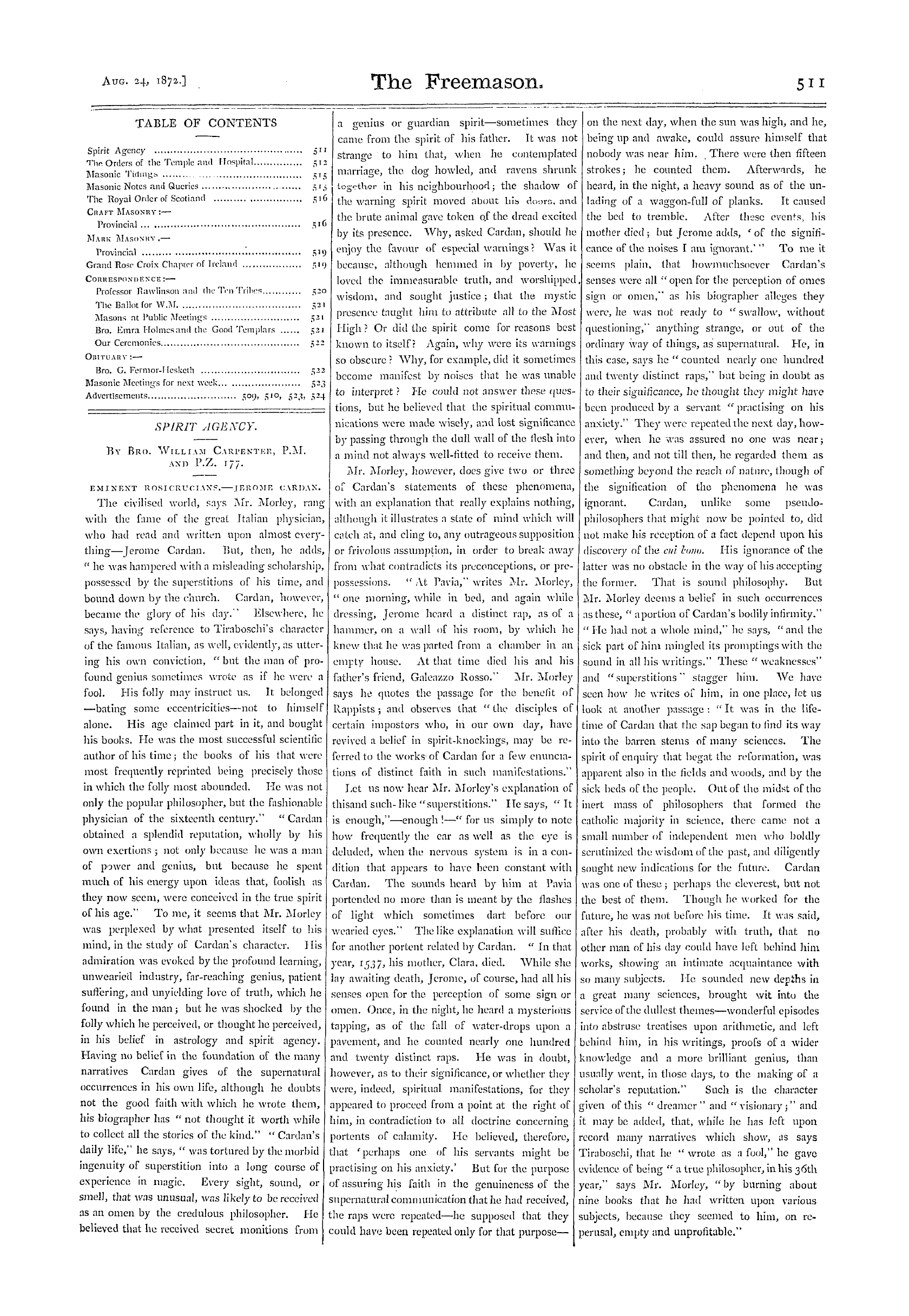
TABLE OF CONTENTS
Spirit Agency 5 " Thr . Orders of the Temple anil Hospital 512 Masonic Tidings 1575 Masonic Notes and Queries , ii , i The Royal Order of Scotland 516
CRAFT MASONRY : — Provincial 516 MARK MASONUV . — Provincial Si 9 Grand Rose Croix Chapter of Ireland SKI
CORRESPONDENCE : Professor Rawlinson and the Ten Tribes 520 The Ballot for W . M 521 Masons at Public Meetings 521 Bro . Emra Holmes and the Good Templars 521
Our Ceremonies 522 OBITUARY : — Bro . G . Fermor-Ucskcth 522 Masonic Meeting's for next week 52 , 5 Advertisements soil , 510 , 5 : 5 , = 24
Spirit Agency.
SPIRIT AGENCY .
Bv BRO . WILLIAM CARPENTER , P . M . AND P . Z . 177 . EMINENT ROSICRUCIAN ? . JEROME CARDAN . The civilised world , says Mr . Morley , rang
with the fame of the great Italian physician . who had read and written upon almost everything—Jerome Cardan . But , then , he adds , " he was hampered with a misleading scholarship ,
possessed by the superstitions of his time , and bound down by the church . Cardan , however , became the glory of his day . " Elsewhere , he says , having reference to Tiraboschi ' s character
of thc famous Italian , as well , evidently , as uttering his own conviction , " but tlie man of profound genius sometimes wrote as if he were a fool . His folly may instruct us . It belonged
¦—bating some eccentricities—not to himself alone . His age claimed part in it , and bought his books . He was the most successful scientific author of his time : the books of his that were
most frequently reprinted being precisely those in which the folly most abounded . He was not only the popular philosopher , but the fashionable physician ofthe sixteenth century . " "Cardan
obtained a splendid reputation , wholly by his own exertions ; not only because lie was a man of power and genius , but because he spent much of his energy upon ideas that , foolish as
they now seem , were conceived in the true spirit of his age . " To me , it seems that Mr . Morley was perplexed by what presented itself to his mind , in the study of Cardan ' s character . His
admiration was evoked by the profound learning , unwearied industry , far-reaching genius , patient suffering , and unyielding love of truth , whicli he found in the man ; but he was shocked by the
folly which he perceived , or thought he perceived , in his belief in astrology and spirit agency . Having no belief in the foundation of the many narratives Cardan gives of the supernatural
occurrences in his own life , although he doubts not the good faith with which he wrote them , his biographer has " not thought it wortli while to collect all the stories of the kind . " " Cardan ' s
daily life , " he says , " was tortured b y the morbid ingenuity of superstition into a long course of experience in magic . Every sight , sound , or
smell , that wns unusual , was likel y to be received as an omen by the credulous philosopher . He believed that he received secret monitions from
Spirit Agency.
a genius or guardian spirit—sometimes they came from the spirit of his father . It was not strange to him that , when he contemplated marriage , the dog howled , and ravens shrunk
logctUer in his neig hbourhood ; the shadow of the warning spirit moved about bib dooro , and the brute animal gave token o . f the dread excited by its presence . Why , asked Cardan , should he
enjoy thc favour of especial warnings ? Was it because , although hemmed in by poverty , he loved thc immeasurable truth , and worshipped wisdom , and sought justice ; that the mystic
presence taught him to attribute all to tlie Most High ? Or did the spirit come for reasons best known to itself ? Again , why were its warnings so obscure r Why , for example , did it sometimes become manifest bv noises that he was unable
to interpret ? He could not answer these questions , but he believed that the spiritual communications were made wisely , and lost significance by passing through the dull wall of the flesh into
a mind not always well-fitted to receive them . Mr . Morley , however , does give two or three of Cardan ' s statements of these phenomena , with an explanation that really explains nothing ,
although it illustrates a state of mind which will catch at , and cling to , any outrageous supposition or frivolous assumption , in order to break away from what contradicts its preconceptions , or
prepossessions . " At Pavia , " writes Mr . Morley , " one morning , while in bed , and again while dressing , Jerome heard a distinct rap , as of a hammer , on a wall of his room , by whicli he
knew that he was parted from a chamber 111 an empty house . At that time died his and his father ' s friend , Galeazzo Rosso . " Mr . Morley says he quotes the passage for the benefit of
Rappists ; and observes that " the discip les of certain impostors who , in our own day , have revived a belief in spirit-knockings , may be referred to the works of Cardan for a few
enunciations of distinct faith in such manifestations . ' Let us now hear Mr . Morley ' s explanation of thisand such- like " superstitions . " He says , " It is enough , "—enough !— " for us simplv to note
how frequently the ear as well as thc eye is deluded , when the nervous system is in a condition that appears to have been constant with Cardan . The sounds heard by him at Pavia
portended no more than is meant by the flashes of light which sometimes dart before our wearied eyes . " The like explanation will suffice for another portent related by Cardan . " In that
year , 1 , 5 . 57 , his mother , Clara , died . While she lay awaiting death , Jerome , of course , had all his senses open for the perception of some sign or omen . Once , in thc night , he heard a mysterious
tapping , as of the fall of water-drops upon a pavement , and hc counted nearly one hundred and twenty distinct raps . He was in doubt , however , as to their significance , or whether they
were , indeed , spiritual manifestations , for they appeared to proceed from a point at the right of him , in contradiction to all doctrine concerning portents of calamity . Hc believed , therefore ,
that ' perhaps one . of his servants might be practising on his anxiety . ' But for the purpose of assuring his faith in the genuineness of the
supernatural communication that he had received , the raps were repeated—he supposed that they could have been repeated onl y for that purpose—
Spirit Agency.
on tho next day , when the sun was high , and he , being up and awake , could assure himself that nobody was near him . . There were then fifteen strokes ; he counted them . Afterwards , he
heard , in the night , a heavy sound as of the unlading of a waggon-full of planks . It caused the bed to tremble . After these events , his mother died ; but Jerome adds , ' of the
significance ofthe noises I am ignorant . ' " To me it seems plain , that howmuchsocver Cardan ' s senses were all " open for the perception of omes sism or omen , " as his biographer alleges they
were , he was not ready to " swallow , without questioning , " anything strange , or out of the ordinary way of things , as supernatural . Lie , in this case , says hc " counted nearly one hundred
and twenty distinct raps , but being in doubt as to their significance , hc thought they might have been produced by a servant " practising on his anxiety . " They were repeated the next day ,
however , when he was assured no one was near ; and then , and not till then , he regarded them as something beyond the reach of nature , though of the signification of the phenomena he was
ignorant . Cardan , unlike some pseudophilosophers that might now be pointed to , did not make his reception of a fact depend upon his discovery of the cui bono . His ignorance of the
latter was no obstacle in the way of his accepting the former . That is sound philosophy . But Mr . Morley deems a belief in such occurrences as these , " a portion of Cardan ' s bodily infirmity . "
" He had not a whole mind , " he says , " and the sick part of him mingled its promptings with the sound in all his writings . " These " weaknesses " and " superstitions" stagger him . We have
seen how he writes of him , in one place , let us look at another passage : " It was in the lifetime of Cardan that the sap began to lind its way into the barren stems of man } ' - sciences . The
spirit of enquiry that begat the reformation , was apparent also in the fields and woods , and by the sick beds of the people . Out of the midst ofthe inert mass of philosophers that formed the
catholic majority in science , there came not a small number of independent men who boldly scrutinized the wisdom of the past , and diligently sought new indications for the future . Cardan
was one of these ; perhaps the cleverest , but not the best of them . Though he worked for the future , he was not before his time . It was said , after his death , probably with truth , that no
other man of his day could have left behind him works , showing an intimate acquaintance with so many subjects . He sounded new depths in a great many sciences , brought wit into the
service ofthe dullest themes—wonderful episodes into abstruse treatises upon arithmetic , and left behind him , in his writings , proofs of a wider knowledge and a more brilliant genius , than
usually went , in those days , to the making of a scholar ' s reputation . " Such is the character given of this " dreamer" and " visionary ; " and
it may be added , that , while he has left upon record many narratives which show , as says Tiraboschi , that he " wrote as a fool , " hc gave evidence , of being " a true philosopher , in his 36 th
year , ' says Mr . Morley , " by burning about nine books that he had written upon various subjects , because they seemed to him , on reperusal , empty and unprofitable . "

Note: This text has been automatically extracted via Optical Character Recognition (OCR) software.
Table Of Contents
TABLE OF CONTENTS
Spirit Agency 5 " Thr . Orders of the Temple anil Hospital 512 Masonic Tidings 1575 Masonic Notes and Queries , ii , i The Royal Order of Scotland 516
CRAFT MASONRY : — Provincial 516 MARK MASONUV . — Provincial Si 9 Grand Rose Croix Chapter of Ireland SKI
CORRESPONDENCE : Professor Rawlinson and the Ten Tribes 520 The Ballot for W . M 521 Masons at Public Meetings 521 Bro . Emra Holmes and the Good Templars 521
Our Ceremonies 522 OBITUARY : — Bro . G . Fermor-Ucskcth 522 Masonic Meeting's for next week 52 , 5 Advertisements soil , 510 , 5 : 5 , = 24
Spirit Agency.
SPIRIT AGENCY .
Bv BRO . WILLIAM CARPENTER , P . M . AND P . Z . 177 . EMINENT ROSICRUCIAN ? . JEROME CARDAN . The civilised world , says Mr . Morley , rang
with the fame of the great Italian physician . who had read and written upon almost everything—Jerome Cardan . But , then , he adds , " he was hampered with a misleading scholarship ,
possessed by the superstitions of his time , and bound down by the church . Cardan , however , became the glory of his day . " Elsewhere , he says , having reference to Tiraboschi ' s character
of thc famous Italian , as well , evidently , as uttering his own conviction , " but tlie man of profound genius sometimes wrote as if he were a fool . His folly may instruct us . It belonged
¦—bating some eccentricities—not to himself alone . His age claimed part in it , and bought his books . He was the most successful scientific author of his time : the books of his that were
most frequently reprinted being precisely those in which the folly most abounded . He was not only the popular philosopher , but the fashionable physician ofthe sixteenth century . " "Cardan
obtained a splendid reputation , wholly by his own exertions ; not only because lie was a man of power and genius , but because he spent much of his energy upon ideas that , foolish as
they now seem , were conceived in the true spirit of his age . " To me , it seems that Mr . Morley was perplexed by what presented itself to his mind , in the study of Cardan ' s character . His
admiration was evoked by the profound learning , unwearied industry , far-reaching genius , patient suffering , and unyielding love of truth , whicli he found in the man ; but he was shocked by the
folly which he perceived , or thought he perceived , in his belief in astrology and spirit agency . Having no belief in the foundation of the many narratives Cardan gives of the supernatural
occurrences in his own life , although he doubts not the good faith with which he wrote them , his biographer has " not thought it wortli while to collect all the stories of the kind . " " Cardan ' s
daily life , " he says , " was tortured b y the morbid ingenuity of superstition into a long course of experience in magic . Every sight , sound , or
smell , that wns unusual , was likel y to be received as an omen by the credulous philosopher . He believed that he received secret monitions from
Spirit Agency.
a genius or guardian spirit—sometimes they came from the spirit of his father . It was not strange to him that , when he contemplated marriage , the dog howled , and ravens shrunk
logctUer in his neig hbourhood ; the shadow of the warning spirit moved about bib dooro , and the brute animal gave token o . f the dread excited by its presence . Why , asked Cardan , should he
enjoy thc favour of especial warnings ? Was it because , although hemmed in by poverty , he loved thc immeasurable truth , and worshipped wisdom , and sought justice ; that the mystic
presence taught him to attribute all to tlie Most High ? Or did the spirit come for reasons best known to itself ? Again , why were its warnings so obscure r Why , for example , did it sometimes become manifest bv noises that he was unable
to interpret ? He could not answer these questions , but he believed that the spiritual communications were made wisely , and lost significance by passing through the dull wall of the flesh into
a mind not always well-fitted to receive them . Mr . Morley , however , does give two or three of Cardan ' s statements of these phenomena , with an explanation that really explains nothing ,
although it illustrates a state of mind which will catch at , and cling to , any outrageous supposition or frivolous assumption , in order to break away from what contradicts its preconceptions , or
prepossessions . " At Pavia , " writes Mr . Morley , " one morning , while in bed , and again while dressing , Jerome heard a distinct rap , as of a hammer , on a wall of his room , by whicli he
knew that he was parted from a chamber 111 an empty house . At that time died his and his father ' s friend , Galeazzo Rosso . " Mr . Morley says he quotes the passage for the benefit of
Rappists ; and observes that " the discip les of certain impostors who , in our own day , have revived a belief in spirit-knockings , may be referred to the works of Cardan for a few
enunciations of distinct faith in such manifestations . ' Let us now hear Mr . Morley ' s explanation of thisand such- like " superstitions . " He says , " It is enough , "—enough !— " for us simplv to note
how frequently the ear as well as thc eye is deluded , when the nervous system is in a condition that appears to have been constant with Cardan . The sounds heard by him at Pavia
portended no more than is meant by the flashes of light which sometimes dart before our wearied eyes . " The like explanation will suffice for another portent related by Cardan . " In that
year , 1 , 5 . 57 , his mother , Clara , died . While she lay awaiting death , Jerome , of course , had all his senses open for the perception of some sign or omen . Once , in thc night , he heard a mysterious
tapping , as of the fall of water-drops upon a pavement , and hc counted nearly one hundred and twenty distinct raps . He was in doubt , however , as to their significance , or whether they
were , indeed , spiritual manifestations , for they appeared to proceed from a point at the right of him , in contradiction to all doctrine concerning portents of calamity . Hc believed , therefore ,
that ' perhaps one . of his servants might be practising on his anxiety . ' But for the purpose of assuring his faith in the genuineness of the
supernatural communication that he had received , the raps were repeated—he supposed that they could have been repeated onl y for that purpose—
Spirit Agency.
on tho next day , when the sun was high , and he , being up and awake , could assure himself that nobody was near him . . There were then fifteen strokes ; he counted them . Afterwards , he
heard , in the night , a heavy sound as of the unlading of a waggon-full of planks . It caused the bed to tremble . After these events , his mother died ; but Jerome adds , ' of the
significance ofthe noises I am ignorant . ' " To me it seems plain , that howmuchsocver Cardan ' s senses were all " open for the perception of omes sism or omen , " as his biographer alleges they
were , he was not ready to " swallow , without questioning , " anything strange , or out of the ordinary way of things , as supernatural . Lie , in this case , says hc " counted nearly one hundred
and twenty distinct raps , but being in doubt as to their significance , hc thought they might have been produced by a servant " practising on his anxiety . " They were repeated the next day ,
however , when he was assured no one was near ; and then , and not till then , he regarded them as something beyond the reach of nature , though of the signification of the phenomena he was
ignorant . Cardan , unlike some pseudophilosophers that might now be pointed to , did not make his reception of a fact depend upon his discovery of the cui bono . His ignorance of the
latter was no obstacle in the way of his accepting the former . That is sound philosophy . But Mr . Morley deems a belief in such occurrences as these , " a portion of Cardan ' s bodily infirmity . "
" He had not a whole mind , " he says , " and the sick part of him mingled its promptings with the sound in all his writings . " These " weaknesses " and " superstitions" stagger him . We have
seen how he writes of him , in one place , let us look at another passage : " It was in the lifetime of Cardan that the sap began to lind its way into the barren stems of man } ' - sciences . The
spirit of enquiry that begat the reformation , was apparent also in the fields and woods , and by the sick beds of the people . Out of the midst ofthe inert mass of philosophers that formed the
catholic majority in science , there came not a small number of independent men who boldly scrutinized the wisdom of the past , and diligently sought new indications for the future . Cardan
was one of these ; perhaps the cleverest , but not the best of them . Though he worked for the future , he was not before his time . It was said , after his death , probably with truth , that no
other man of his day could have left behind him works , showing an intimate acquaintance with so many subjects . He sounded new depths in a great many sciences , brought wit into the
service ofthe dullest themes—wonderful episodes into abstruse treatises upon arithmetic , and left behind him , in his writings , proofs of a wider knowledge and a more brilliant genius , than
usually went , in those days , to the making of a scholar ' s reputation . " Such is the character given of this " dreamer" and " visionary ; " and
it may be added , that , while he has left upon record many narratives which show , as says Tiraboschi , that he " wrote as a fool , " hc gave evidence , of being " a true philosopher , in his 36 th
year , ' says Mr . Morley , " by burning about nine books that he had written upon various subjects , because they seemed to him , on reperusal , empty and unprofitable . "