-
Articles/Ads
Article BOARD OF BENEVOLENCE. Page 1 of 1 Article PHYSICAL QUALIFICATIONS. Page 1 of 1 Article PHYSICAL QUALIFICATIONS. Page 1 of 1 Article " WERE WOMEN EVER YORK RITE MASONS ? Page 1 of 1 Article DISCOVERY OF FRESCOES IN DEANS-YARD , WESTMINSTER. Page 1 of 1 Article DISCOVERY OF FRESCOES IN DEANS-YARD , WESTMINSTER. Page 1 of 1 Article GERMANY—CHRISTIAN AND JEW IN LODGES. Page 1 of 1 Article IRELAND. Page 1 of 1
Note: This text has been automatically extracted via Optical Character Recognition (OCR) software.
Board Of Benevolence.
BOARD OF BENEVOLENCE .
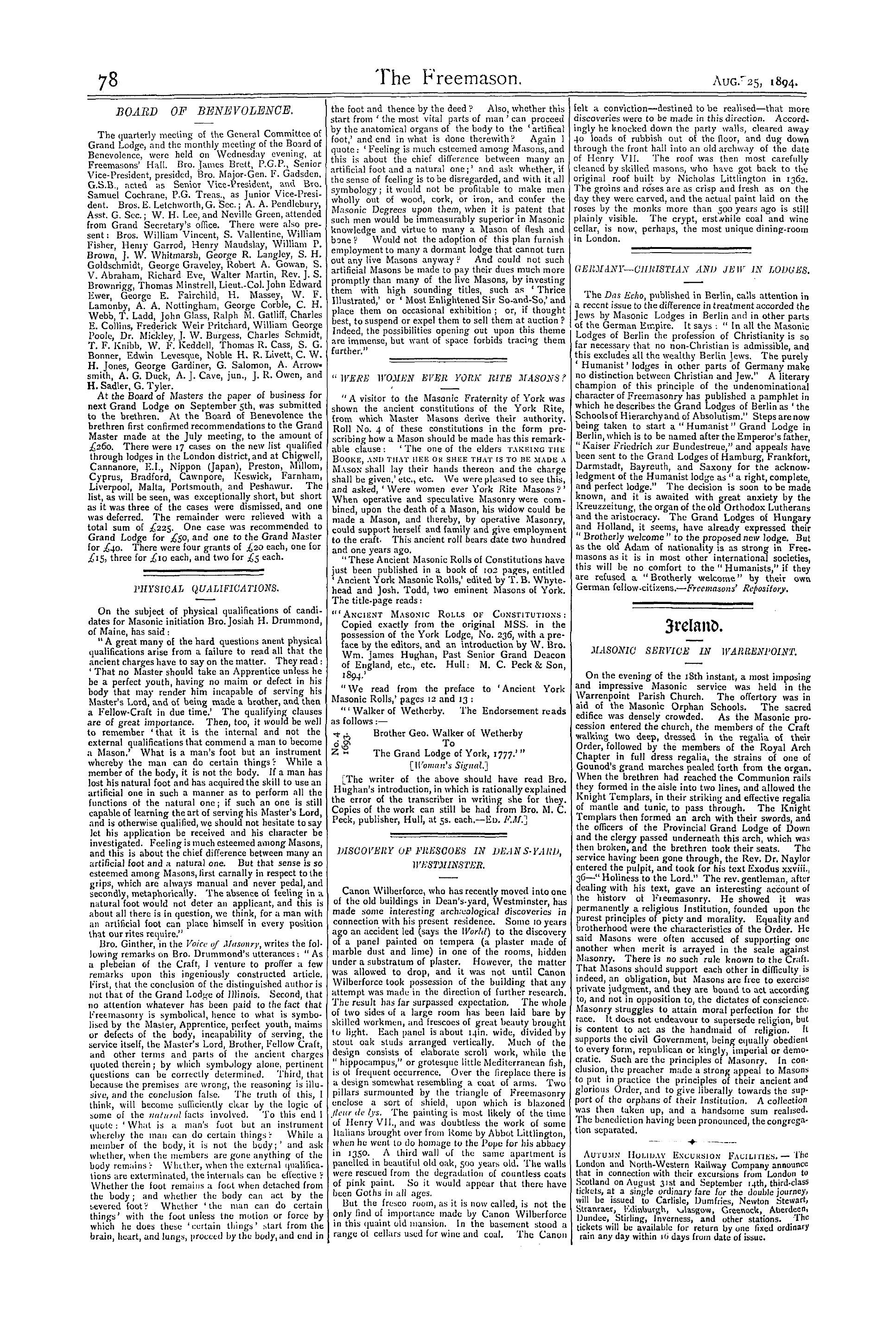
The quarterly meeting of the General Committee of Grand Lodge , and the monthly meeting of the Board of Benevolence , were held on Wednesday evening , at Freemasons' Hall . Bro . James Brett , P . G . P ., Senior Vice-President , presided , Bro . Major-Gen . F . Gadsden . G . S . B ., acted as Senior Vice-President , and Bvo . Samuel Cochrane , P . G . Treas ., as Junior
Vice-President . Bros . E . Letchworth , G . Sec . ; A . A . Pendlebury , Asst . G . Sec . ; W . H . Lee , and Neville Green , attended from Grand Secretary's office . There were also present : Bros . William Vincent , S . Vallentine , William Fisher , Hemy Garrod , Henry Maudslay , William P . Brown , J . W . Whitmarsh , George R . Langley , S . H . Goldschmidt , George Graveley , Robert A . Gowan , S ,
V . Abraham , Richard Eve , Walter Martin , Rev . J . S . Brownrigg , Thomas Minstrell , Lieut .-Col . John Edward Ewer , George E . Fairchild , H . Massey , W . F . Lamonby , A . A . Nottingham , George Corbie , C . H . Webb , T . Ladd , John Glass , Ralph M . Gatliff , Charles E . Collins , Frederick Weir Pritchard , William George Poole , Dr . Mickley , J . W . Burgess , Charles Schmidt ,
T . F . Knibb , W . F . Keddell , Thomas R . Cass , S . G . Bonner , Edwin Levesque , Noble H . R . Livett , C . W . H . Jones , George Gardiner , G . Salomon , A . Arrowsmith , A . G . Duck , A . J . Cave , jun ., J . R . Owen , and H . Sadler , G . Tyler . At the Board of Masters the paper of business for next Grand Lodge on September 5 th , was submitted
to the brethren . At the Board of Benevolence the brethren first confirmed recommendations to the Grand Master made at the July meeting , to the amount of £ 260 . There were 17 cases on the new list qualified through lodges in the London district , and at Chigwell , Cannanore , E . I .-, Nippon ( Japan ) , Preston , Millom , Cyprus , Bradford , Cawnpore , Keswick , Farnham ,
Liverpool , Malta , Portsmouth , and Peshawur . The list , as will be seen , was exceptionally short , but short as it was three of the cases were dismissed , and one was deferred . The remainder were relieved with a total sum of £ 225 . One case was recommended to Grand Lodge for . £ 50 , and one to the Grand Master for ^ 40 . There were four grants of ^ 20 each , one for ^ 15 , three for . £ 10 each , and two for ^ 5 each .
Physical Qualifications.
PHYSICAL QUALIFICATIONS .
On the subject of physical qualifications of candidates for Masonic initiation Bro . Josiah H . Drummond , of Maine , has said : " A great many of the hard questions anent physical qualifications arise from a failure to read all that the ancient charges have to say on the matter . They read
' That no Master should take an Apprentice unless he be a perfect youth , having no maim or defect in his body that may render him incapable of serving his Master ' s Lord , and of being made a brother , and then a Fellow-Craft in due time . ' The qualifying clauses are of great importance . Then , too , it would be well to remember ' that it is the internal and not the
external qualifications that commend a man to become a Mason . ' What is a man's foot but an instrument whereby the man can do certain things ? While a member of the body , it is not the body . If a man has lost his natural foot and has acquired the skill to use an artificial one in such a manner as to perform all the functions ot the natural one : if such an one is still
capable of learning the art of serving his Master ' s Lord , and is otherwise qualified , we should not hesitate to say let his application be received and his character be investigated . Feeling is much esteemed among Masons , and this is about the chief difference between many an artificial foot and a natural one . But that sense is so esteemed among Masons , first carnally in respect to the
grips , which are always manual and never pedal , and secondly , metaphorically . The absence of feeling in a natural foot would not deter an applicant , and this is about all there is in question , we think , for a man with an artificial foot can place himself in every position that our rites require . " Bro . Ginther , in the Voice of Masonry , writes the
following remarks on Bro . Drummond ' s utterances : " As a plebeian of the Craft , I venture to proffer a few remarks upon this ingeniously constructed article . First , that the conclusion of the distinguished author is not that of the Grand Lodge of Illinois . Second , that no attention whatever has been paid to the fact that Freemasonry is symbolical , hence to what is
symbolised by the Master , Apprentice , perfect youth , maims or defects of the body , incapability of serving , the service itself , the Master ' s Lord , Brother , Fellow Craft , and other terms and parts of the ancient charges quoted therein ; by which symbology alone , pertinent questions can be correctly determined . Third , that because the premises are wrong , the reasoning is
illusive , and the conclusion false . The truth of this , I think , will become sufficiently clear by the logic of some of the natural facts involved . To this end 1 quote : ' What is a man ' s foot but an instrument whereby the man can do certain things ' : While a member of the body . it is not the body ; ' and ask whether , when the members are gone anything of the
body remains r Whether , when the external qualifications are exterminated , the internals can be effective ? Whether the loot remains a foot when detached from the body ; and whether the body can act by the Levered footV Whether 'the man can do certain things' with the foot unless the motion or force by which he does these ' certain things' start from the brain , heart , and lungs , proceed by the body , and end in
Physical Qualifications.
the foot and thence by the deed ? Also , whether this start from ' the most vital parts of man ' can proceed by the anatomical organs of the body to the ' artifical foot , ' and end in what is done therewith ? Again I quote : ' Feeling is much esteemed among Masons , and this is about the chief difference between many an artificial foot and a natural one ; ' and ask whether , if
the sense of feeling is to be disregarded , and with it all symbology ; it would not be profitable to make men wholly out of wood , cork , or iron , and confer the Masonic Degrees upon them , when it is patent that such men would be immeasurably superior in Masonic knowledge and virtue to many a Mason of flesh and bone V Would not the adoption of this plan furnish
employment to many a dormant lodge that cannot turn out any live Masons anyway ? And could not such artificial Masons be made to pay their dues much more promptly than many of the live Masons , by investing them with hig h sounding titles , such as ' Thrice
Illustrated , ' or ' Most Enlightened Sir So-and-So , ' and place them on occasional exhibition ; or , if thought best , to suspend or expel them to sell them at auction ? Indeed , the possibilities opening out upon this theme are immense , but want of space forbids tracing them further . "
" Were Women Ever York Rite Masons ?
" WERE WOMEN EVER YORK RITE MASONS ?
" A visitor to the Masonic Fraternity of York was shown the ancient constitutions of the York Rite , from which Master Masons derive their authority . Roll No . 4 of these constitutions in the form prescribing how a Mason should be made has this remarkable clause : 'The one of the elders TAKEING THE
BOOKE , AND THAT HEE OR SHEE THAT IS TO HE MADE A MASON shall lay their hands thereon and the charge shall be given , ' etc ., etc . We were pleased to see this , and asked , ' Were women ever York Rite Masons ? ' When operative and speculative Masonry were combined , upon the death of a Mason , his widow could be made a Mason , and thereby , by operative Masonry ,
could support herself and family and give employment to the craft . This ancient roll bears date two hundred and one years ago . " These Ancient Masonic Rolls of Constitutions have just been published in a book of 103 pages , entitled ' Ancient York Masonic Rolls , ' edited by T . B . Whytehead and Josh . Todd , two eminent Masons of York . The title-page reads :
"' ANCIENT MASONIC ROLLS OF CONSTITUTIONS Copied exactly from the original MSS . in the possession of the York Lodge , No . 236 , with a preface by the editors , and an introduction by W . Bro . Wm . James Hughan , Past Senior Grand Deacon of England , etc ., etc . Hull : M . C . Peck & Son , 18 94 . '
" We read from the preface to ' Ancient York Masonic Rolls , ' pages 12 and 13 : "' Walker of Wetherby . The Endorsement reads as follows : — - * ^ Brother Geo . Walker of Wetherby 6 g To Z - The Grand Lodge of York , 1777 . ' "
[ Woman s Signal . " ] [ The writer of the above should have read Bro . Hughan's introduction , in which is rationally explained the error of the transcriber in writing she for they . Copies of the work can still be had from Bro . M . C . Peck , publisher , Hull , at 5 s . each . —ED . P . M . " ]
Discovery Of Frescoes In Deans-Yard , Westminster.
DISCOVERY OF FRESCOES IN DEANS-YARD , WESTMINSTER .
Canon Wilberforce , who has recently moved into one of the old buildings in Dean ' s-yard , Westminster , has made some interesting arch . eological discoveries in connection with his present residence . Some 10 years ago an accident led ( says the World ) to the discovery
of a panel painted on tempera ( a plaster made of marble dust and lime ) in one of the rooms , hidden under a substratum of plaster . However , the matter was allowed to drop , and it was not until Canon Wilberforce took possession of the building that any attempt was made in the direction of further research .
I he result has far surpassed expectation . The whole of two sides of a large room has been laid bare b y skilled workmen , and frescoes of great beauty brought to light . Each panel is about 14 m . wide , divided by stout oak studs arranged vertically . Much of the design consists of elaborate scroll work , while the
hippocampus , or grotesque little Mediterranean fish , is ot frequent occurrence . Over the fireplace there is a design somewhat resembling a coat of arms . Two pillars surmounted by the triangle of Freemasonry enclose a sort of shield , upon which is blazoned tleur de lys . The painting is most likely of the time
of Henry VII ,, and was doubtless the work of some Italians brought over from Rome by Abbot Littlington , when he went to do homage to the Pope for his abbacy in 1350 . A third wall of the same apartment is panelled in beautiful old oak , 500 years old . The walls were rescued from the degradation of countless coats
of pink paint . So it would appear that there have been Goths in all ages . But the fresco room , as it is now called , is not the only find of importance made by Canon Wilberforce in this quaint old mansion . In the basement stood a range ot cellars used for wine and coal . The Canon
Discovery Of Frescoes In Deans-Yard , Westminster.
felt a conviction—destined to be realised—that more discoveries were to be made in this direction . Accordingly he knocked down the party walls , cleared away 40 loads of rubbish out of the floor , and dug down through the front hall into an old archway of the date of Henry VII . The roof was then most carefully
cleaned by skilled masons , who have got back to the original roof built by Nicholas Littlington in 1362 . The groins and roses are as crisp and fresh as on the day they were carved , and the actual paint laid on the roses by the monks more than 500 years ago is still plainly visible . The crypt , erstwhile coal and wine cellar , is now , perhaps , the most unique dining-room in London .
Germany—Christian And Jew In Lodges.
GERMANY—CHRISTIAN AND JEW IN LODGES .
The Das Echo , published in Berlin , calls attention in a recent issue to the difference in treatment accorded the Jews by Masonic Lodges in Berlin and in other parts of the German Empire . It says -. " In all the Masonic Lodges of Berlin the profession of Christianity is so
far necessary that no non-Christian is admissible , and this excludes all the wealthy Berlin jews . The purely ' Humanist' lodges in other parts of Germany make no distinction between Christian and Jew . " A literary champion of this principle of the undenominational character of Freemasonry has published a pamphlet in
which he describes the Grand Lodges of Berlin as ' the Schools of Hierarchy and of Absolutism . " Steps are now being taken to start a " Humanist" Grand Lodge in Berlin , which is to be named after the Emperor ' s father , " Kaiser Friedrich zur Bundestreue , " and appeals have been sent to the Grand Lodges of Hamburg , Frankfort ,
Darmstadt , Bayreuth , and Saxony for the acknowledgment of the Humanist lodge as " a right , complete , and perfect lodge . " The decision is soon to be made known , and it is awaited with great anxiety by the Kreuzzeitung , the organ of the old Orthodox Lutherans and the aristocracy . The Grand Lodges of Hungary
and Holland , it seems , have already expressed their " Brotherly welcome " to the proposed new lodge . But as the old Adam of nationality is as strong in Freemasons as it is in most other international societies , this will be no comfort to the " Humanists , " if they are refused a "Brotherly welcome" by their own German fellow-citizens . —Freemasons' Repository .
Ireland.
3 relairt > .
MASONIC SERVICE IN WARRENPOINT . On the evening of the 18 th instant , a most imposing and impressive Masonic service was held in the Warrenpoint Parish Church . The offertory was in aid of the Masonic Orphan Schools . The sacred edifice was densely crowded . As the Masonic procession entered the church , the members of the Craft
walking two deep , dressed in the regalia , of their Order , followed by the members of the Royal Arch Chapter in full dress regalia , the strains of one of Gounod ' s grand marches pealed forth from the organ , When the brethren had reached the Communion rails they formed in the aisle into two lines , and allowed the Knight Templars , in their striking and effective regalia
of mantle and tunic , to pass through . The Knight Templars then formed an arch with their swords , and the officers of the Provincial Grand Lodge of Down and the clergy passed underneath this arch , which was then broken , and the brethren took their seats . The service having been gone through , the Rev . Dr . Naylor entered the pulpit , and took for his text Exodus xxviii .,
36— "Holiness to the Lord . " The rev . gentleman , after dealing with his text , gave an interesting account of the historv ol Fieemasonry . He showed it was permanently a religious Institution , founded upon the purest principles of piety and morality . Equality and brotherhood were the characteristics of the Order . He said Masons were often accused of supporting one
another when merit is arrayed in the scale against Masonry . There is no such rule known to the Craft . That Masons should support each other in difficulty is indeed , an obligation , but Masons are free to exercise private judgment , and they are bound to act according to , and not in opposition to , the dictates of conscience . Masonry struggles to attain moral perfection for the
race . It does not endeavour to supersede religion , but is content to act as the handmaid of reli gion . It supports the civil Government , being equally obedient to every form , republican or kingl y , imperial or democratic . Such are the principles of Masonry . In conclusion , the preacher made a strong appeal to Masons
to put in practice the principles of their ancient and glorious Order , and to give liberall y towards the support of the orphans of their Institution . A collection was then taken up , and a handsome sum realised . The benediction having been pronounced , the congregation separated .
AUTUMN HOLIDAY EXCURSION FACILITIES . — The London and North-Western Railway Company announce that in connection with their excursions from London to Scotland on August 31 st and September 14 th , third-class tickets , at a single ordinary fare for the double journey , will be issued to Carlisle , Dumfries , Newton Stewart , Stranraer , F-dinbutgh , ulasgow , Greenock , Aberdeen , Dundee , Stirling , Inverness , and other stations . The tickets will be available for return by one fixed ordinary rain any day within 16 days from date of issue .



Note: This text has been automatically extracted via Optical Character Recognition (OCR) software.
Board Of Benevolence.
BOARD OF BENEVOLENCE .
The quarterly meeting of the General Committee of Grand Lodge , and the monthly meeting of the Board of Benevolence , were held on Wednesday evening , at Freemasons' Hall . Bro . James Brett , P . G . P ., Senior Vice-President , presided , Bro . Major-Gen . F . Gadsden . G . S . B ., acted as Senior Vice-President , and Bvo . Samuel Cochrane , P . G . Treas ., as Junior
Vice-President . Bros . E . Letchworth , G . Sec . ; A . A . Pendlebury , Asst . G . Sec . ; W . H . Lee , and Neville Green , attended from Grand Secretary's office . There were also present : Bros . William Vincent , S . Vallentine , William Fisher , Hemy Garrod , Henry Maudslay , William P . Brown , J . W . Whitmarsh , George R . Langley , S . H . Goldschmidt , George Graveley , Robert A . Gowan , S ,
V . Abraham , Richard Eve , Walter Martin , Rev . J . S . Brownrigg , Thomas Minstrell , Lieut .-Col . John Edward Ewer , George E . Fairchild , H . Massey , W . F . Lamonby , A . A . Nottingham , George Corbie , C . H . Webb , T . Ladd , John Glass , Ralph M . Gatliff , Charles E . Collins , Frederick Weir Pritchard , William George Poole , Dr . Mickley , J . W . Burgess , Charles Schmidt ,
T . F . Knibb , W . F . Keddell , Thomas R . Cass , S . G . Bonner , Edwin Levesque , Noble H . R . Livett , C . W . H . Jones , George Gardiner , G . Salomon , A . Arrowsmith , A . G . Duck , A . J . Cave , jun ., J . R . Owen , and H . Sadler , G . Tyler . At the Board of Masters the paper of business for next Grand Lodge on September 5 th , was submitted
to the brethren . At the Board of Benevolence the brethren first confirmed recommendations to the Grand Master made at the July meeting , to the amount of £ 260 . There were 17 cases on the new list qualified through lodges in the London district , and at Chigwell , Cannanore , E . I .-, Nippon ( Japan ) , Preston , Millom , Cyprus , Bradford , Cawnpore , Keswick , Farnham ,
Liverpool , Malta , Portsmouth , and Peshawur . The list , as will be seen , was exceptionally short , but short as it was three of the cases were dismissed , and one was deferred . The remainder were relieved with a total sum of £ 225 . One case was recommended to Grand Lodge for . £ 50 , and one to the Grand Master for ^ 40 . There were four grants of ^ 20 each , one for ^ 15 , three for . £ 10 each , and two for ^ 5 each .
Physical Qualifications.
PHYSICAL QUALIFICATIONS .
On the subject of physical qualifications of candidates for Masonic initiation Bro . Josiah H . Drummond , of Maine , has said : " A great many of the hard questions anent physical qualifications arise from a failure to read all that the ancient charges have to say on the matter . They read
' That no Master should take an Apprentice unless he be a perfect youth , having no maim or defect in his body that may render him incapable of serving his Master ' s Lord , and of being made a brother , and then a Fellow-Craft in due time . ' The qualifying clauses are of great importance . Then , too , it would be well to remember ' that it is the internal and not the
external qualifications that commend a man to become a Mason . ' What is a man's foot but an instrument whereby the man can do certain things ? While a member of the body , it is not the body . If a man has lost his natural foot and has acquired the skill to use an artificial one in such a manner as to perform all the functions ot the natural one : if such an one is still
capable of learning the art of serving his Master ' s Lord , and is otherwise qualified , we should not hesitate to say let his application be received and his character be investigated . Feeling is much esteemed among Masons , and this is about the chief difference between many an artificial foot and a natural one . But that sense is so esteemed among Masons , first carnally in respect to the
grips , which are always manual and never pedal , and secondly , metaphorically . The absence of feeling in a natural foot would not deter an applicant , and this is about all there is in question , we think , for a man with an artificial foot can place himself in every position that our rites require . " Bro . Ginther , in the Voice of Masonry , writes the
following remarks on Bro . Drummond ' s utterances : " As a plebeian of the Craft , I venture to proffer a few remarks upon this ingeniously constructed article . First , that the conclusion of the distinguished author is not that of the Grand Lodge of Illinois . Second , that no attention whatever has been paid to the fact that Freemasonry is symbolical , hence to what is
symbolised by the Master , Apprentice , perfect youth , maims or defects of the body , incapability of serving , the service itself , the Master ' s Lord , Brother , Fellow Craft , and other terms and parts of the ancient charges quoted therein ; by which symbology alone , pertinent questions can be correctly determined . Third , that because the premises are wrong , the reasoning is
illusive , and the conclusion false . The truth of this , I think , will become sufficiently clear by the logic of some of the natural facts involved . To this end 1 quote : ' What is a man ' s foot but an instrument whereby the man can do certain things ' : While a member of the body . it is not the body ; ' and ask whether , when the members are gone anything of the
body remains r Whether , when the external qualifications are exterminated , the internals can be effective ? Whether the loot remains a foot when detached from the body ; and whether the body can act by the Levered footV Whether 'the man can do certain things' with the foot unless the motion or force by which he does these ' certain things' start from the brain , heart , and lungs , proceed by the body , and end in
Physical Qualifications.
the foot and thence by the deed ? Also , whether this start from ' the most vital parts of man ' can proceed by the anatomical organs of the body to the ' artifical foot , ' and end in what is done therewith ? Again I quote : ' Feeling is much esteemed among Masons , and this is about the chief difference between many an artificial foot and a natural one ; ' and ask whether , if
the sense of feeling is to be disregarded , and with it all symbology ; it would not be profitable to make men wholly out of wood , cork , or iron , and confer the Masonic Degrees upon them , when it is patent that such men would be immeasurably superior in Masonic knowledge and virtue to many a Mason of flesh and bone V Would not the adoption of this plan furnish
employment to many a dormant lodge that cannot turn out any live Masons anyway ? And could not such artificial Masons be made to pay their dues much more promptly than many of the live Masons , by investing them with hig h sounding titles , such as ' Thrice
Illustrated , ' or ' Most Enlightened Sir So-and-So , ' and place them on occasional exhibition ; or , if thought best , to suspend or expel them to sell them at auction ? Indeed , the possibilities opening out upon this theme are immense , but want of space forbids tracing them further . "
" Were Women Ever York Rite Masons ?
" WERE WOMEN EVER YORK RITE MASONS ?
" A visitor to the Masonic Fraternity of York was shown the ancient constitutions of the York Rite , from which Master Masons derive their authority . Roll No . 4 of these constitutions in the form prescribing how a Mason should be made has this remarkable clause : 'The one of the elders TAKEING THE
BOOKE , AND THAT HEE OR SHEE THAT IS TO HE MADE A MASON shall lay their hands thereon and the charge shall be given , ' etc ., etc . We were pleased to see this , and asked , ' Were women ever York Rite Masons ? ' When operative and speculative Masonry were combined , upon the death of a Mason , his widow could be made a Mason , and thereby , by operative Masonry ,
could support herself and family and give employment to the craft . This ancient roll bears date two hundred and one years ago . " These Ancient Masonic Rolls of Constitutions have just been published in a book of 103 pages , entitled ' Ancient York Masonic Rolls , ' edited by T . B . Whytehead and Josh . Todd , two eminent Masons of York . The title-page reads :
"' ANCIENT MASONIC ROLLS OF CONSTITUTIONS Copied exactly from the original MSS . in the possession of the York Lodge , No . 236 , with a preface by the editors , and an introduction by W . Bro . Wm . James Hughan , Past Senior Grand Deacon of England , etc ., etc . Hull : M . C . Peck & Son , 18 94 . '
" We read from the preface to ' Ancient York Masonic Rolls , ' pages 12 and 13 : "' Walker of Wetherby . The Endorsement reads as follows : — - * ^ Brother Geo . Walker of Wetherby 6 g To Z - The Grand Lodge of York , 1777 . ' "
[ Woman s Signal . " ] [ The writer of the above should have read Bro . Hughan's introduction , in which is rationally explained the error of the transcriber in writing she for they . Copies of the work can still be had from Bro . M . C . Peck , publisher , Hull , at 5 s . each . —ED . P . M . " ]
Discovery Of Frescoes In Deans-Yard , Westminster.
DISCOVERY OF FRESCOES IN DEANS-YARD , WESTMINSTER .
Canon Wilberforce , who has recently moved into one of the old buildings in Dean ' s-yard , Westminster , has made some interesting arch . eological discoveries in connection with his present residence . Some 10 years ago an accident led ( says the World ) to the discovery
of a panel painted on tempera ( a plaster made of marble dust and lime ) in one of the rooms , hidden under a substratum of plaster . However , the matter was allowed to drop , and it was not until Canon Wilberforce took possession of the building that any attempt was made in the direction of further research .
I he result has far surpassed expectation . The whole of two sides of a large room has been laid bare b y skilled workmen , and frescoes of great beauty brought to light . Each panel is about 14 m . wide , divided by stout oak studs arranged vertically . Much of the design consists of elaborate scroll work , while the
hippocampus , or grotesque little Mediterranean fish , is ot frequent occurrence . Over the fireplace there is a design somewhat resembling a coat of arms . Two pillars surmounted by the triangle of Freemasonry enclose a sort of shield , upon which is blazoned tleur de lys . The painting is most likely of the time
of Henry VII ,, and was doubtless the work of some Italians brought over from Rome by Abbot Littlington , when he went to do homage to the Pope for his abbacy in 1350 . A third wall of the same apartment is panelled in beautiful old oak , 500 years old . The walls were rescued from the degradation of countless coats
of pink paint . So it would appear that there have been Goths in all ages . But the fresco room , as it is now called , is not the only find of importance made by Canon Wilberforce in this quaint old mansion . In the basement stood a range ot cellars used for wine and coal . The Canon
Discovery Of Frescoes In Deans-Yard , Westminster.
felt a conviction—destined to be realised—that more discoveries were to be made in this direction . Accordingly he knocked down the party walls , cleared away 40 loads of rubbish out of the floor , and dug down through the front hall into an old archway of the date of Henry VII . The roof was then most carefully
cleaned by skilled masons , who have got back to the original roof built by Nicholas Littlington in 1362 . The groins and roses are as crisp and fresh as on the day they were carved , and the actual paint laid on the roses by the monks more than 500 years ago is still plainly visible . The crypt , erstwhile coal and wine cellar , is now , perhaps , the most unique dining-room in London .
Germany—Christian And Jew In Lodges.
GERMANY—CHRISTIAN AND JEW IN LODGES .
The Das Echo , published in Berlin , calls attention in a recent issue to the difference in treatment accorded the Jews by Masonic Lodges in Berlin and in other parts of the German Empire . It says -. " In all the Masonic Lodges of Berlin the profession of Christianity is so
far necessary that no non-Christian is admissible , and this excludes all the wealthy Berlin jews . The purely ' Humanist' lodges in other parts of Germany make no distinction between Christian and Jew . " A literary champion of this principle of the undenominational character of Freemasonry has published a pamphlet in
which he describes the Grand Lodges of Berlin as ' the Schools of Hierarchy and of Absolutism . " Steps are now being taken to start a " Humanist" Grand Lodge in Berlin , which is to be named after the Emperor ' s father , " Kaiser Friedrich zur Bundestreue , " and appeals have been sent to the Grand Lodges of Hamburg , Frankfort ,
Darmstadt , Bayreuth , and Saxony for the acknowledgment of the Humanist lodge as " a right , complete , and perfect lodge . " The decision is soon to be made known , and it is awaited with great anxiety by the Kreuzzeitung , the organ of the old Orthodox Lutherans and the aristocracy . The Grand Lodges of Hungary
and Holland , it seems , have already expressed their " Brotherly welcome " to the proposed new lodge . But as the old Adam of nationality is as strong in Freemasons as it is in most other international societies , this will be no comfort to the " Humanists , " if they are refused a "Brotherly welcome" by their own German fellow-citizens . —Freemasons' Repository .
Ireland.
3 relairt > .
MASONIC SERVICE IN WARRENPOINT . On the evening of the 18 th instant , a most imposing and impressive Masonic service was held in the Warrenpoint Parish Church . The offertory was in aid of the Masonic Orphan Schools . The sacred edifice was densely crowded . As the Masonic procession entered the church , the members of the Craft
walking two deep , dressed in the regalia , of their Order , followed by the members of the Royal Arch Chapter in full dress regalia , the strains of one of Gounod ' s grand marches pealed forth from the organ , When the brethren had reached the Communion rails they formed in the aisle into two lines , and allowed the Knight Templars , in their striking and effective regalia
of mantle and tunic , to pass through . The Knight Templars then formed an arch with their swords , and the officers of the Provincial Grand Lodge of Down and the clergy passed underneath this arch , which was then broken , and the brethren took their seats . The service having been gone through , the Rev . Dr . Naylor entered the pulpit , and took for his text Exodus xxviii .,
36— "Holiness to the Lord . " The rev . gentleman , after dealing with his text , gave an interesting account of the historv ol Fieemasonry . He showed it was permanently a religious Institution , founded upon the purest principles of piety and morality . Equality and brotherhood were the characteristics of the Order . He said Masons were often accused of supporting one
another when merit is arrayed in the scale against Masonry . There is no such rule known to the Craft . That Masons should support each other in difficulty is indeed , an obligation , but Masons are free to exercise private judgment , and they are bound to act according to , and not in opposition to , the dictates of conscience . Masonry struggles to attain moral perfection for the
race . It does not endeavour to supersede religion , but is content to act as the handmaid of reli gion . It supports the civil Government , being equally obedient to every form , republican or kingl y , imperial or democratic . Such are the principles of Masonry . In conclusion , the preacher made a strong appeal to Masons
to put in practice the principles of their ancient and glorious Order , and to give liberall y towards the support of the orphans of their Institution . A collection was then taken up , and a handsome sum realised . The benediction having been pronounced , the congregation separated .
AUTUMN HOLIDAY EXCURSION FACILITIES . — The London and North-Western Railway Company announce that in connection with their excursions from London to Scotland on August 31 st and September 14 th , third-class tickets , at a single ordinary fare for the double journey , will be issued to Carlisle , Dumfries , Newton Stewart , Stranraer , F-dinbutgh , ulasgow , Greenock , Aberdeen , Dundee , Stirling , Inverness , and other stations . The tickets will be available for return by one fixed ordinary rain any day within 16 days from date of issue .