-
Articles/Ads
Article THE UNATTACHED MEMBER. Page 1 of 1 Article THE UNATTACHED MEMBER. Page 1 of 1 Ad Untitled Page 1 of 1
Note: This text has been automatically extracted via Optical Character Recognition (OCR) software.
The Unattached Member.
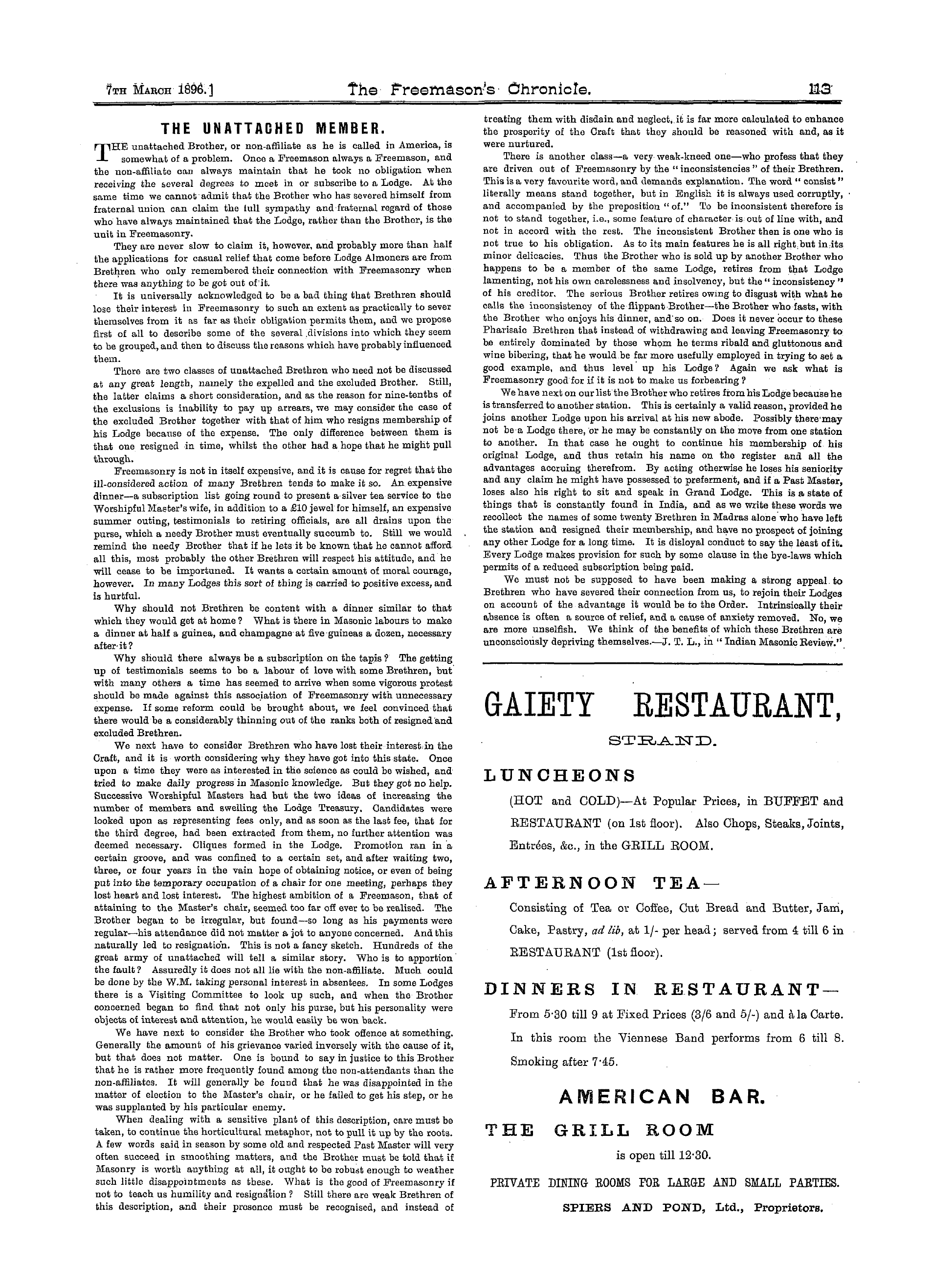
THE UNATTACHED MEMBER .
npHE unattached Brother , or non-affiliate as he is called in America , is -L somewhat of a problem . Once a Freemason always a Freemason , and the non-affiliate can always maintain that he took no obligation when receiving the several degrees to meet in or subscribe to a Lodge . At the
same time we cannot admit that the Brother who has severed himself from fraternal union can claim the lull sympathy and fraternal regard of those who have always maintained that the Lodge , rather than the Brother , is the unit in Freemasonry .
They are never slow to claim it , however , and probably more than half the applications for casual relief that come before Lodge Almoners are from Brethren who only remembered their connection with Freemasonry when there was anything to be got out of it . It is universally acknowledged to be a bad thing that Brethren should
lose their interest in Freemasonry to such an extent as practically to sever themselves from it as far as their obligation permits them , and we propose first of all to describe some of the several ^ divisions into which they seem to be grouped , and then to discuss the reasons which have probably influenced them .
There are two classes of unattached Brethren who need not be discussed at any great length , namely the expelled and the excluded Brother . Still , the latter claims a short consideration , and as the reason for nine-tenths of the exclusions is inabilitv to pay up arrears , we may consider the case of
the excluded Brother together with that of him who resigns membership of his Lodge because of the expense . The only difference between them is that one resigned in time , whilst the other had a hope that he might pull through .
Freemasonry is not in itself expensive , and it is cause for regret that the ill-considered action of many Brethren tends to make it so . An expensive dinner—a subscription list going round to present a silver tea service to the Worshipful Master ' s wife , in addition to a £ 10 jewel for himself , an expensive summer outing , testimonials to retiring officials , are all drains upon the
purse , which a needy Brother must eventually succumb to . Still we would remind the needy Brother that if he lets it be known that he cannot afford all this , most probably the other Brethren will respect his attitude , and he will cease to be importuned . It wants a certain amount of moral courage , however . In many Lodges this sort of thing is carried to positive excess , and is hurtful .
Why should not Brethren be content with a dinner similar to that which they would get at home ? What is there in Masonic labours to make a dinner at half a guinea , and champagne at five guineas a dozen , necessary after-it ? Why should there always be a subscription on the tapis ? The getting
up of testimonials seems to be a labour of love with some Brethren , but with many others a time has seemed to arrive when some vigorous protest should be made against this association of Freemasonry with unnecessary expense . If some reform could be brought about , we feel convinced that there would be a considerably thinning out of the ranks both of resigned and excluded Brethren .
We next have to consider Brethren who have lost their interest in the Craft , and it is worth considering why they have got into this state . Once upon a time they were as interested in the science as could he wished , and tried to make daily progress in Masonic knowledge . But they got no help . Successive Worshipful Masters had but the two ideas of increasing the
number of members and swelling the Lodge Treasury . Candidates were looked upon as representing fees only , and as soon as the last fee , that for the third degree , had been extracted from them , no further attention was deemed necessary . Cliques formed in the Lodge . Promotion ran in a certain groove , and was confined to a certain set , and after waiting two ,
three , or four years in the vain hope of obtaining notice , or even of being put into the temporary occupation of a chair for one meeting , perhaps they lost heart and lost interest . The highest ambition of a Freemason , that of attaining to the Master ' s chair , seemed too far off ever to be realised . The Brother began to be irregular , but found—so long as his payments were
regular— -his attendance did not matter a jot to anyone concerned . And this naturally led to resignation . This is not a fancy sketch . Hundreds of the great army of unattached will tell a similar story . Who is to apportion the fault ? Assuredly it does not all lie with the non-affiliate . Much could
be done by the W . M . taking personal interest in absentees . In some Lodges there is a Visiting Committee to look up such , and when the Brother concerned began to find that not only his purse , but his personality were objects of interest and attention , he would easily be won back .
We have next to consider the Brother who took offence at something . Generally the amount of his grievance varied inversely with the cause of it , but that does not matter . One is bound to say in justice to this Brother
that he is rather more frequently found among the non-attendants than the non-affiliates . It will generally be found that he was disappointed in the matter of election to the Master ' s chair , or he failed to get his step , or he was supplanted by his particular enemy .
When dealing with a sensitive plant of this description , care must be taken , to continue the horticultural metaphor , not to pull it up by the roots . A few words said in season by some old and respected Past Master will very often succeed in smoothing matters , and the Brother must be told that if
Masonry is worth anything at all , it ought to be robust enough to weather such little disappointments as these . What is the good of Freemasonry if not to teach us humility and resignation ? Still there are weak Brethren of this description , and their presence must be recognised , and instead of
The Unattached Member.
treating them with disdain and neglect * it is far more calculated to enhance the prosperity of tho Craft that they should be reasoned with and , as it were nurtured . There is another class—a very weak-kneed one—who profess that they are driven out of Freemasonry by the " inconsistencies " of their Brethren .
This is a very favourite word , and demands explanation . The word " consist literally means stand together , but in English it is always used corruptly , and accompanied by the preposition " of . " To be inconsistent therefore is not to stand together , i . e ., some feature of character- is ^ out of line with , and not in accord with the rest . The inconsistent Brother then is one who is
not true to his obligation . As to its mam features he is all right but in its minor delicacies . Thus the Brother who is sold up by another Brother who happens to be a member of the same Lodge , retires from that Lodge lamenting , not his own carelessness and insolvency , but the " inconsistency " of his creditor . The serious Brother retires owing to disgust with what he calls the inconsistency of the flippant Brother—the Brother who fasts , with
the Brother who enjoys his dinner , and ' so on . Does it never occur to these Pharisaic Brethren that instead of withdrawing and leaving Freemasonry to be entirely dominated by those whom he terms ribald and gluttonous and wine bibering , that he would be far more usefully employed in trying to set a good example , and thus level up his Lodge ? Again we ask what is Freemasonry good for if it is not to make us forbearing ?
We have next on our list the Brother who retires from his Lodge because he is transferred to another station . This is certainly a valid reason , provided he joins another Lodge upon his arrival at his new abode . Possibly there ' may not he a Lodge there , or he may be constantly on the move from one station to another . In that case he ought to continue his membership of his
original Lodge , and thus retain his name on the register and all the advantages accruing therefrom . By acting otherwise he loses his seniority and any claim he might have possessed to preferment , and if a Past Master , loses also his right to sit and speak in Grand Lodge . This is a state of things that is constantly found in India , and as we write these words we
recollect the names of some twenty Brethren in Madras alone who have left the station and resigned their membership , and have no prospect of joining any other Lodge for a long time . It is disloyal conduct to say the least of it . Every Lodge makes provision for such by some clause in the bye-laws which permits of a reduced subscription being paid .
We must not be supposed to have been making a strong appeal , to Brethren who have severed their connection from us , to rejoin their Lodges on account of the advantage it would be to the Order . Intrinsically their absence is often a source of relief , and a cause of anxiety removed . No , we are more unselfish . We think of the benefits of which these Brethren are unconsciously depriving themselves . —J . T . L ., in " Indian Masonic Review . "
Ad00502
GAIETY RESTAURANT , STUAISTD . LUNCHEONS ( HOT and COLD)—At Popular Prices , in BUFFET and EESTAUEANT ( on 1 st floor ) . Also Chops , Steaks , Joints , Entrees , & c , in the GEILL EOOM . AFTERNOON TEAConsisting of Tea or Coffee , Cut Bread and Butter , Jam , Cake , Pastry , ad lib , at 1 / - per head ; served from 4 till 6 in EESTAUEANT ( 1 st floor ) . DINNERS IN RESTAURANTFrom 5-30 till 9 at Fixed Prices ( 3 / 6 and 5 / - ) and a la Carte . In this room the Viennese Band performs from 6 till 8 . Smoking after 7 - 45 . AMERICAN BAR . THE GRILL ROOM is open till 12-30 . PE 1 TATE DINING- E 00 MS POE LAKGE AND SMALL PARTIES . SPIERS AND POND , Ltd ., Proprietors .


Note: This text has been automatically extracted via Optical Character Recognition (OCR) software.
The Unattached Member.
THE UNATTACHED MEMBER .
npHE unattached Brother , or non-affiliate as he is called in America , is -L somewhat of a problem . Once a Freemason always a Freemason , and the non-affiliate can always maintain that he took no obligation when receiving the several degrees to meet in or subscribe to a Lodge . At the
same time we cannot admit that the Brother who has severed himself from fraternal union can claim the lull sympathy and fraternal regard of those who have always maintained that the Lodge , rather than the Brother , is the unit in Freemasonry .
They are never slow to claim it , however , and probably more than half the applications for casual relief that come before Lodge Almoners are from Brethren who only remembered their connection with Freemasonry when there was anything to be got out of it . It is universally acknowledged to be a bad thing that Brethren should
lose their interest in Freemasonry to such an extent as practically to sever themselves from it as far as their obligation permits them , and we propose first of all to describe some of the several ^ divisions into which they seem to be grouped , and then to discuss the reasons which have probably influenced them .
There are two classes of unattached Brethren who need not be discussed at any great length , namely the expelled and the excluded Brother . Still , the latter claims a short consideration , and as the reason for nine-tenths of the exclusions is inabilitv to pay up arrears , we may consider the case of
the excluded Brother together with that of him who resigns membership of his Lodge because of the expense . The only difference between them is that one resigned in time , whilst the other had a hope that he might pull through .
Freemasonry is not in itself expensive , and it is cause for regret that the ill-considered action of many Brethren tends to make it so . An expensive dinner—a subscription list going round to present a silver tea service to the Worshipful Master ' s wife , in addition to a £ 10 jewel for himself , an expensive summer outing , testimonials to retiring officials , are all drains upon the
purse , which a needy Brother must eventually succumb to . Still we would remind the needy Brother that if he lets it be known that he cannot afford all this , most probably the other Brethren will respect his attitude , and he will cease to be importuned . It wants a certain amount of moral courage , however . In many Lodges this sort of thing is carried to positive excess , and is hurtful .
Why should not Brethren be content with a dinner similar to that which they would get at home ? What is there in Masonic labours to make a dinner at half a guinea , and champagne at five guineas a dozen , necessary after-it ? Why should there always be a subscription on the tapis ? The getting
up of testimonials seems to be a labour of love with some Brethren , but with many others a time has seemed to arrive when some vigorous protest should be made against this association of Freemasonry with unnecessary expense . If some reform could be brought about , we feel convinced that there would be a considerably thinning out of the ranks both of resigned and excluded Brethren .
We next have to consider Brethren who have lost their interest in the Craft , and it is worth considering why they have got into this state . Once upon a time they were as interested in the science as could he wished , and tried to make daily progress in Masonic knowledge . But they got no help . Successive Worshipful Masters had but the two ideas of increasing the
number of members and swelling the Lodge Treasury . Candidates were looked upon as representing fees only , and as soon as the last fee , that for the third degree , had been extracted from them , no further attention was deemed necessary . Cliques formed in the Lodge . Promotion ran in a certain groove , and was confined to a certain set , and after waiting two ,
three , or four years in the vain hope of obtaining notice , or even of being put into the temporary occupation of a chair for one meeting , perhaps they lost heart and lost interest . The highest ambition of a Freemason , that of attaining to the Master ' s chair , seemed too far off ever to be realised . The Brother began to be irregular , but found—so long as his payments were
regular— -his attendance did not matter a jot to anyone concerned . And this naturally led to resignation . This is not a fancy sketch . Hundreds of the great army of unattached will tell a similar story . Who is to apportion the fault ? Assuredly it does not all lie with the non-affiliate . Much could
be done by the W . M . taking personal interest in absentees . In some Lodges there is a Visiting Committee to look up such , and when the Brother concerned began to find that not only his purse , but his personality were objects of interest and attention , he would easily be won back .
We have next to consider the Brother who took offence at something . Generally the amount of his grievance varied inversely with the cause of it , but that does not matter . One is bound to say in justice to this Brother
that he is rather more frequently found among the non-attendants than the non-affiliates . It will generally be found that he was disappointed in the matter of election to the Master ' s chair , or he failed to get his step , or he was supplanted by his particular enemy .
When dealing with a sensitive plant of this description , care must be taken , to continue the horticultural metaphor , not to pull it up by the roots . A few words said in season by some old and respected Past Master will very often succeed in smoothing matters , and the Brother must be told that if
Masonry is worth anything at all , it ought to be robust enough to weather such little disappointments as these . What is the good of Freemasonry if not to teach us humility and resignation ? Still there are weak Brethren of this description , and their presence must be recognised , and instead of
The Unattached Member.
treating them with disdain and neglect * it is far more calculated to enhance the prosperity of tho Craft that they should be reasoned with and , as it were nurtured . There is another class—a very weak-kneed one—who profess that they are driven out of Freemasonry by the " inconsistencies " of their Brethren .
This is a very favourite word , and demands explanation . The word " consist literally means stand together , but in English it is always used corruptly , and accompanied by the preposition " of . " To be inconsistent therefore is not to stand together , i . e ., some feature of character- is ^ out of line with , and not in accord with the rest . The inconsistent Brother then is one who is
not true to his obligation . As to its mam features he is all right but in its minor delicacies . Thus the Brother who is sold up by another Brother who happens to be a member of the same Lodge , retires from that Lodge lamenting , not his own carelessness and insolvency , but the " inconsistency " of his creditor . The serious Brother retires owing to disgust with what he calls the inconsistency of the flippant Brother—the Brother who fasts , with
the Brother who enjoys his dinner , and ' so on . Does it never occur to these Pharisaic Brethren that instead of withdrawing and leaving Freemasonry to be entirely dominated by those whom he terms ribald and gluttonous and wine bibering , that he would be far more usefully employed in trying to set a good example , and thus level up his Lodge ? Again we ask what is Freemasonry good for if it is not to make us forbearing ?
We have next on our list the Brother who retires from his Lodge because he is transferred to another station . This is certainly a valid reason , provided he joins another Lodge upon his arrival at his new abode . Possibly there ' may not he a Lodge there , or he may be constantly on the move from one station to another . In that case he ought to continue his membership of his
original Lodge , and thus retain his name on the register and all the advantages accruing therefrom . By acting otherwise he loses his seniority and any claim he might have possessed to preferment , and if a Past Master , loses also his right to sit and speak in Grand Lodge . This is a state of things that is constantly found in India , and as we write these words we
recollect the names of some twenty Brethren in Madras alone who have left the station and resigned their membership , and have no prospect of joining any other Lodge for a long time . It is disloyal conduct to say the least of it . Every Lodge makes provision for such by some clause in the bye-laws which permits of a reduced subscription being paid .
We must not be supposed to have been making a strong appeal , to Brethren who have severed their connection from us , to rejoin their Lodges on account of the advantage it would be to the Order . Intrinsically their absence is often a source of relief , and a cause of anxiety removed . No , we are more unselfish . We think of the benefits of which these Brethren are unconsciously depriving themselves . —J . T . L ., in " Indian Masonic Review . "
Ad00502
GAIETY RESTAURANT , STUAISTD . LUNCHEONS ( HOT and COLD)—At Popular Prices , in BUFFET and EESTAUEANT ( on 1 st floor ) . Also Chops , Steaks , Joints , Entrees , & c , in the GEILL EOOM . AFTERNOON TEAConsisting of Tea or Coffee , Cut Bread and Butter , Jam , Cake , Pastry , ad lib , at 1 / - per head ; served from 4 till 6 in EESTAUEANT ( 1 st floor ) . DINNERS IN RESTAURANTFrom 5-30 till 9 at Fixed Prices ( 3 / 6 and 5 / - ) and a la Carte . In this room the Viennese Band performs from 6 till 8 . Smoking after 7 - 45 . AMERICAN BAR . THE GRILL ROOM is open till 12-30 . PE 1 TATE DINING- E 00 MS POE LAKGE AND SMALL PARTIES . SPIERS AND POND , Ltd ., Proprietors .