-
Articles/Ads
Article REPLY TO BRO. HUGHAN'S "SPECULATIVE MASONRY." ← Page 2 of 3 Article REPLY TO BRO. HUGHAN'S "SPECULATIVE MASONRY." Page 2 of 3 →
Note: This text has been automatically extracted via Optical Character Recognition (OCR) software.
Reply To Bro. Hughan's "Speculative Masonry."
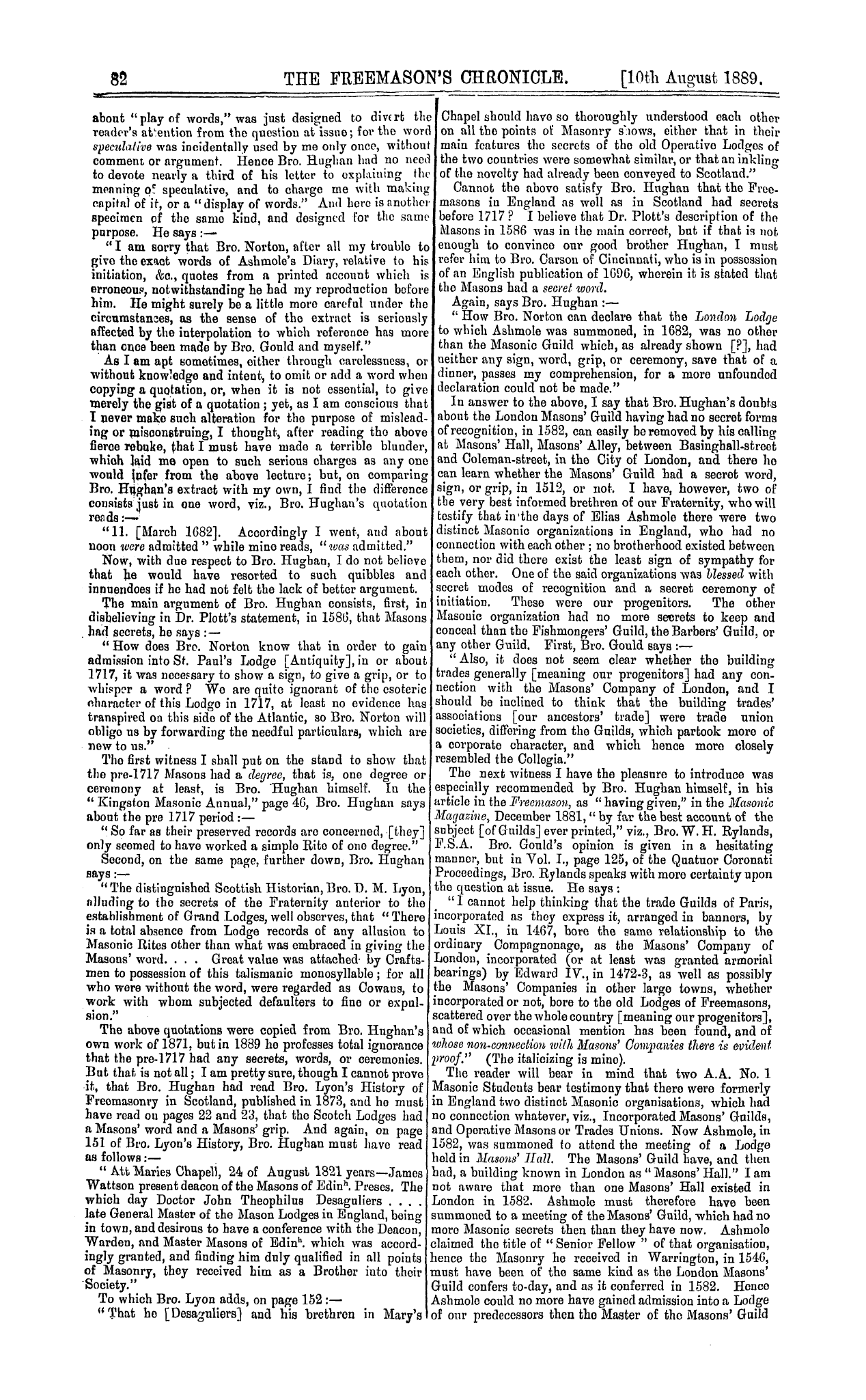
about " play of words , " was just designed to divert the reader ' s att ention from the question at issue ; for the word speculative was incidentally used by me only once , without comment or argument . Hence Bro . Hughan had no need
to devote nearly a third of his letter to explaining the meaning p . speculative , and to charge me with making capital of it , or a "display of words . " And hero is another specimen of the samo kind , and designed for the samo
purpose . He says : — " I am sorry that Bro . Norton , after all my trouble to
givo the exact words of Ashmole ' s Diary , relative to his initiation , & 0 ., quotes from a printed account which is erroneous * , notwithstanding he had ray reproduction before
him . He might surely be a little more careful under the circumstances , as the sense of tho extract is seriously affected by the interpolation to which reference has more than once been made by Bro . Gould and myself . "
As I am apt sometimes , either through carelessness , or without knowledge and intent , to omit or add a word when copying a quotation , or , when it is not essential , to give
merely the gist of a quotation ; yet , as I am conscious that I never make such alteration for the purpose of
misleading or mjsoanefcruing , I thought , after reading tho above fierce rebuke , that I must have made a terrible blunder , which laid mo open to such serious charges as any one
"would Infer . from the above lectnro ; but , on comparing Bro . Hughan ' s extract with my own , I find the difference consists just in one word , viz ., Bro . Hughan ' s quotation reads : —
" 11 . [ March 1682 ] . Accordingly I went , aud about
noon were admitted " while mine reads , " was admitted . Now , with due respect to Bro . Hughan , I do not believe that he would have resorted to such quibbles and
innuendoes if he had not felt the lack of better argument . The main argument of Bro . Hughan consists , first , in disbelieving in Dr . Plott ' s statement , in 1586 , that Masons
. had secrets , he says : — " How does Bro . Norton know that in order to gain admission into St . Paul ' s Lodge [ Antiquity ] , in or about 1717 , it was necessary to show a sign , to give a grip , or to
¦ whisper a word ? Wo are quite ignorant of tho esoteric character of this Lodgo in 1717 , at least no evidence has transpired on this side of the Atlantic , so Bro . Norton will oblige ns by forwarding the needful particulars , which are new to us . "
Tho first witness I shall put on the stand to show that the pre-1717 Masons had a degree , that is , one degree or ceremony at least , is Bro . Hughan himself . In the " Kingston Masonic Annual , " page 46 , Bro . Hnghan says about the pre 1717 period : —
" So far as their preserved records are concerned , [ they ] only seemed to have worked a simple Rito of ono degree . " Second , on the same page , further down , Bro . Hughan says : —
' The distinguished Scottish Historian , Bro . D . M . Lyon , alluding to the secrets of the Fraternity anterior to the establishment of Grand Lodges , well observes , that " There is a total absence from Lodge records of any allusion to Masonic Rites other than what was embraced in giving the
Masons' word . . . . Great value was attached- by Craftsmen to possession of this talismanic monosyllable ; for all who were without the word , were regarded as Cowans , to work with whom subjected defaulters to fine or expulsion . " The above quotations were copied from Bro . Hughan ' s own work of 1871 , but in 1889 he professes total ignorance that the pre-1717 had any secrets , words , or ceremonies . But that is not all ; I am pretty sure , though I cannot prove it , that Bro . Hughan had read Bro . Lyon ' s History of
Freemasonry in Scotland , published in 1873 , and he must have read ou pages 22 and 23 , that the Scotch Lodges had a Masons' word and a Masons' grip . And again , on page 151 of Bro . Lyon ' s History , Bro . Hughan must have read as follows : —
" Att Maries Chapell , 24 of August 1821 years—James Wattson present deacon of the Masons of Edin . Preses . The which day Doctor John Theophilus Desaguliers . . . . late General Master of the Mason Lodges in England , being
in town , and desirous to have a conference with the Deacon , Warden , and Master Masons of Edin . which was accordingly granted , and finding him duly qualified in all points of Masonry , they received him as a Brother into their Society . "
To which Bro . Lyon adds , on page 152 : — " That ho [ Desaguliers ] and his brethren in Mary ' s
Reply To Bro. Hughan's "Speculative Masonry."
Chapel should have so thoroughly understood each other on all tho points of Masonry S ' IOWS , either that in their main features tho secrets of tho old Operative Lodges of the two countries were somewhat similar , or that an inkling of the novelty had already been conveyed to Scotland . "
Cannot the above satisfy Bro . Hnghan that the Freemasons in England as well as in Scotland had secrets before 1717 ? I believe that Dr . Plott's description of tho Masons in 1586 was in the main correct , but if that is not
enough to convinco our good brother Hughan , I must refer him to Bro . Carson of Cincinnati , who is in possession of an English publication of 1 G 96 , wherein it is stated that the Masons had a secret word . Again , says Bro . Hughan : —
" How Bro . Norton can declare that the London Lodge to which Ashmole was summoned , in 1682 , was no other than the Masonic Guild which , as already shown [?] , had neither any sign , word , grip , or ceremony , save that of a dinner , passes my comprehension , for a moro unfounded declaration could not be made . "
In answer to the above , I say that Bro . Hughan ' s doubts about the London Masons' Guild having had no secret forms of recognition , in 1582 , can easily be removed by his calling at Masons' Hall , Masons' Alley , between Basinghall-street and Coleman-street , in the City of London , and there ho can learn whether the Masons' Guild had a secret word
sign , or grip , in 1512 , or not . I have , however , two of the very best informed brethren of our Fraternity , who will testify that in the days of Elias Ashmole there were two distinct Masonic organizations in England , who had no
connection with each other ; no brotherhood existed between them , nor did there exist the least sign of sympathy for each other . One of the said organizations was "blessed with secret modes of recognition and a secret ceremony of
initiation . These were our progenitors . The other Masouic organization had no more secrets to keep and conceal than the Fishmongers' Guild , the Barbers' Guild , or any other Guild . First , Bro . Gould says : —
' Also , ifc does nofc seem clear whether the building trades generally [ meaning our progenitors ] had any connection with the Masons' Company of London , and I should be inclined to think thafc the building trades '
associations [ our ancestors' trade ] were trade union societies , differing from the Guilds , which partook more of a corporate character , and which hence more closely resembled the Collegia . "
The nexfc witness I have the pleasure to introduce was especially recommended hy Bro . Hughan himself , in his article in the Freemason , as " having given , " in the Masonic Magazine , December 1881 , " by far the best account of the
subject [ of Guilds ] ever printed , " viz ., Bro . W . H . Rylands , F . S . A . Bro . Gould ' s opinion is given in a hesitating manner , but in Vol . I ., page 125 , of the Quatuor Coronati Proceedings , Bro . Rylands speaks with more certainty upon the question at issue . He says :
" I cannot help thinking that the trade Guilds of Paris , incorporated as they express ifc , arranged in banners , by Louis XI ., in 1467 , bore the same relationship to the ordinary Compagnonage , as fche Masons' Company of London , incorporated ( or at least was granted armorial
bearings ) by Edward IV ., in 1472-3 , as well as possibly the Masons' Companies in other large towns , whether incorporated or not , bore to the old Lodges of Freemasons ,
scattered over the whole country [ meaning our progenitors ] , and of which occasional mention has been found , and of whose non-connection with Masons' Companies there is evident proof . ' " ( The italicizing is mine ) . The reader will bear in mind that two A . A . No . 1
Masonic Students bear testimony that thero were formerly
m England two distinct Masonic organisations , which had no connection whatever , viz ., Incorporated Masons' Guilds , and Operative Masons or Trades Unions . Now Ashmole , in 1582 , was summoned to attend the meeting of a Lodge
hence the Masonry he received in Warrington , in 1546 , must have been of the same kind as the London Masons ' Guild confers to-day , and as ifc conferred in 1582 . Hence Ashmole could no more have gained admission into a Lodge of onr predecessors then tho Master of the Masons' Guild
held in Masons' Hall . The Masons' Guild have , and then had , a building known in London as " Masons' Hall . " I am not aware that more than one Masons' Hall existed in London in 1582 . Ashmole must therefore have been
summoned to a meeting of the Masons' Guild , -which had no moro Masonic secrets then than they have now . Ashmolo claimed the title of " Senior Fellow " of that organisation ,




Note: This text has been automatically extracted via Optical Character Recognition (OCR) software.
Reply To Bro. Hughan's "Speculative Masonry."
about " play of words , " was just designed to divert the reader ' s att ention from the question at issue ; for the word speculative was incidentally used by me only once , without comment or argument . Hence Bro . Hughan had no need
to devote nearly a third of his letter to explaining the meaning p . speculative , and to charge me with making capital of it , or a "display of words . " And hero is another specimen of the samo kind , and designed for the samo
purpose . He says : — " I am sorry that Bro . Norton , after all my trouble to
givo the exact words of Ashmole ' s Diary , relative to his initiation , & 0 ., quotes from a printed account which is erroneous * , notwithstanding he had ray reproduction before
him . He might surely be a little more careful under the circumstances , as the sense of tho extract is seriously affected by the interpolation to which reference has more than once been made by Bro . Gould and myself . "
As I am apt sometimes , either through carelessness , or without knowledge and intent , to omit or add a word when copying a quotation , or , when it is not essential , to give
merely the gist of a quotation ; yet , as I am conscious that I never make such alteration for the purpose of
misleading or mjsoanefcruing , I thought , after reading tho above fierce rebuke , that I must have made a terrible blunder , which laid mo open to such serious charges as any one
"would Infer . from the above lectnro ; but , on comparing Bro . Hughan ' s extract with my own , I find the difference consists just in one word , viz ., Bro . Hughan ' s quotation reads : —
" 11 . [ March 1682 ] . Accordingly I went , aud about
noon were admitted " while mine reads , " was admitted . Now , with due respect to Bro . Hughan , I do not believe that he would have resorted to such quibbles and
innuendoes if he had not felt the lack of better argument . The main argument of Bro . Hughan consists , first , in disbelieving in Dr . Plott ' s statement , in 1586 , that Masons
. had secrets , he says : — " How does Bro . Norton know that in order to gain admission into St . Paul ' s Lodge [ Antiquity ] , in or about 1717 , it was necessary to show a sign , to give a grip , or to
¦ whisper a word ? Wo are quite ignorant of tho esoteric character of this Lodgo in 1717 , at least no evidence has transpired on this side of the Atlantic , so Bro . Norton will oblige ns by forwarding the needful particulars , which are new to us . "
Tho first witness I shall put on the stand to show that the pre-1717 Masons had a degree , that is , one degree or ceremony at least , is Bro . Hughan himself . In the " Kingston Masonic Annual , " page 46 , Bro . Hnghan says about the pre 1717 period : —
" So far as their preserved records are concerned , [ they ] only seemed to have worked a simple Rito of ono degree . " Second , on the same page , further down , Bro . Hughan says : —
' The distinguished Scottish Historian , Bro . D . M . Lyon , alluding to the secrets of the Fraternity anterior to the establishment of Grand Lodges , well observes , that " There is a total absence from Lodge records of any allusion to Masonic Rites other than what was embraced in giving the
Masons' word . . . . Great value was attached- by Craftsmen to possession of this talismanic monosyllable ; for all who were without the word , were regarded as Cowans , to work with whom subjected defaulters to fine or expulsion . " The above quotations were copied from Bro . Hughan ' s own work of 1871 , but in 1889 he professes total ignorance that the pre-1717 had any secrets , words , or ceremonies . But that is not all ; I am pretty sure , though I cannot prove it , that Bro . Hughan had read Bro . Lyon ' s History of
Freemasonry in Scotland , published in 1873 , and he must have read ou pages 22 and 23 , that the Scotch Lodges had a Masons' word and a Masons' grip . And again , on page 151 of Bro . Lyon ' s History , Bro . Hughan must have read as follows : —
" Att Maries Chapell , 24 of August 1821 years—James Wattson present deacon of the Masons of Edin . Preses . The which day Doctor John Theophilus Desaguliers . . . . late General Master of the Mason Lodges in England , being
in town , and desirous to have a conference with the Deacon , Warden , and Master Masons of Edin . which was accordingly granted , and finding him duly qualified in all points of Masonry , they received him as a Brother into their Society . "
To which Bro . Lyon adds , on page 152 : — " That ho [ Desaguliers ] and his brethren in Mary ' s
Reply To Bro. Hughan's "Speculative Masonry."
Chapel should have so thoroughly understood each other on all tho points of Masonry S ' IOWS , either that in their main features tho secrets of tho old Operative Lodges of the two countries were somewhat similar , or that an inkling of the novelty had already been conveyed to Scotland . "
Cannot the above satisfy Bro . Hnghan that the Freemasons in England as well as in Scotland had secrets before 1717 ? I believe that Dr . Plott's description of tho Masons in 1586 was in the main correct , but if that is not
enough to convinco our good brother Hughan , I must refer him to Bro . Carson of Cincinnati , who is in possession of an English publication of 1 G 96 , wherein it is stated that the Masons had a secret word . Again , says Bro . Hughan : —
" How Bro . Norton can declare that the London Lodge to which Ashmole was summoned , in 1682 , was no other than the Masonic Guild which , as already shown [?] , had neither any sign , word , grip , or ceremony , save that of a dinner , passes my comprehension , for a moro unfounded declaration could not be made . "
In answer to the above , I say that Bro . Hughan ' s doubts about the London Masons' Guild having had no secret forms of recognition , in 1582 , can easily be removed by his calling at Masons' Hall , Masons' Alley , between Basinghall-street and Coleman-street , in the City of London , and there ho can learn whether the Masons' Guild had a secret word
sign , or grip , in 1512 , or not . I have , however , two of the very best informed brethren of our Fraternity , who will testify that in the days of Elias Ashmole there were two distinct Masonic organizations in England , who had no
connection with each other ; no brotherhood existed between them , nor did there exist the least sign of sympathy for each other . One of the said organizations was "blessed with secret modes of recognition and a secret ceremony of
initiation . These were our progenitors . The other Masouic organization had no more secrets to keep and conceal than the Fishmongers' Guild , the Barbers' Guild , or any other Guild . First , Bro . Gould says : —
' Also , ifc does nofc seem clear whether the building trades generally [ meaning our progenitors ] had any connection with the Masons' Company of London , and I should be inclined to think thafc the building trades '
associations [ our ancestors' trade ] were trade union societies , differing from the Guilds , which partook more of a corporate character , and which hence more closely resembled the Collegia . "
The nexfc witness I have the pleasure to introduce was especially recommended hy Bro . Hughan himself , in his article in the Freemason , as " having given , " in the Masonic Magazine , December 1881 , " by far the best account of the
subject [ of Guilds ] ever printed , " viz ., Bro . W . H . Rylands , F . S . A . Bro . Gould ' s opinion is given in a hesitating manner , but in Vol . I ., page 125 , of the Quatuor Coronati Proceedings , Bro . Rylands speaks with more certainty upon the question at issue . He says :
" I cannot help thinking that the trade Guilds of Paris , incorporated as they express ifc , arranged in banners , by Louis XI ., in 1467 , bore the same relationship to the ordinary Compagnonage , as fche Masons' Company of London , incorporated ( or at least was granted armorial
bearings ) by Edward IV ., in 1472-3 , as well as possibly the Masons' Companies in other large towns , whether incorporated or not , bore to the old Lodges of Freemasons ,
scattered over the whole country [ meaning our progenitors ] , and of which occasional mention has been found , and of whose non-connection with Masons' Companies there is evident proof . ' " ( The italicizing is mine ) . The reader will bear in mind that two A . A . No . 1
Masonic Students bear testimony that thero were formerly
m England two distinct Masonic organisations , which had no connection whatever , viz ., Incorporated Masons' Guilds , and Operative Masons or Trades Unions . Now Ashmole , in 1582 , was summoned to attend the meeting of a Lodge
hence the Masonry he received in Warrington , in 1546 , must have been of the same kind as the London Masons ' Guild confers to-day , and as ifc conferred in 1582 . Hence Ashmole could no more have gained admission into a Lodge of onr predecessors then tho Master of the Masons' Guild
held in Masons' Hall . The Masons' Guild have , and then had , a building known in London as " Masons' Hall . " I am not aware that more than one Masons' Hall existed in London in 1582 . Ashmole must therefore have been
summoned to a meeting of the Masons' Guild , -which had no moro Masonic secrets then than they have now . Ashmolo claimed the title of " Senior Fellow " of that organisation ,