-
Articles/Ads
Article THE ADMISSION OF VISITORS. Page 1 of 1 Article MASONIC HOMES V MASONIC CHARITY. Page 1 of 1 Article MASONIC HOMES V MASONIC CHARITY. Page 1 of 1
Note: This text has been automatically extracted via Optical Character Recognition (OCR) software.
The Admission Of Visitors.
THE ADMISSION OF VISITORS ,
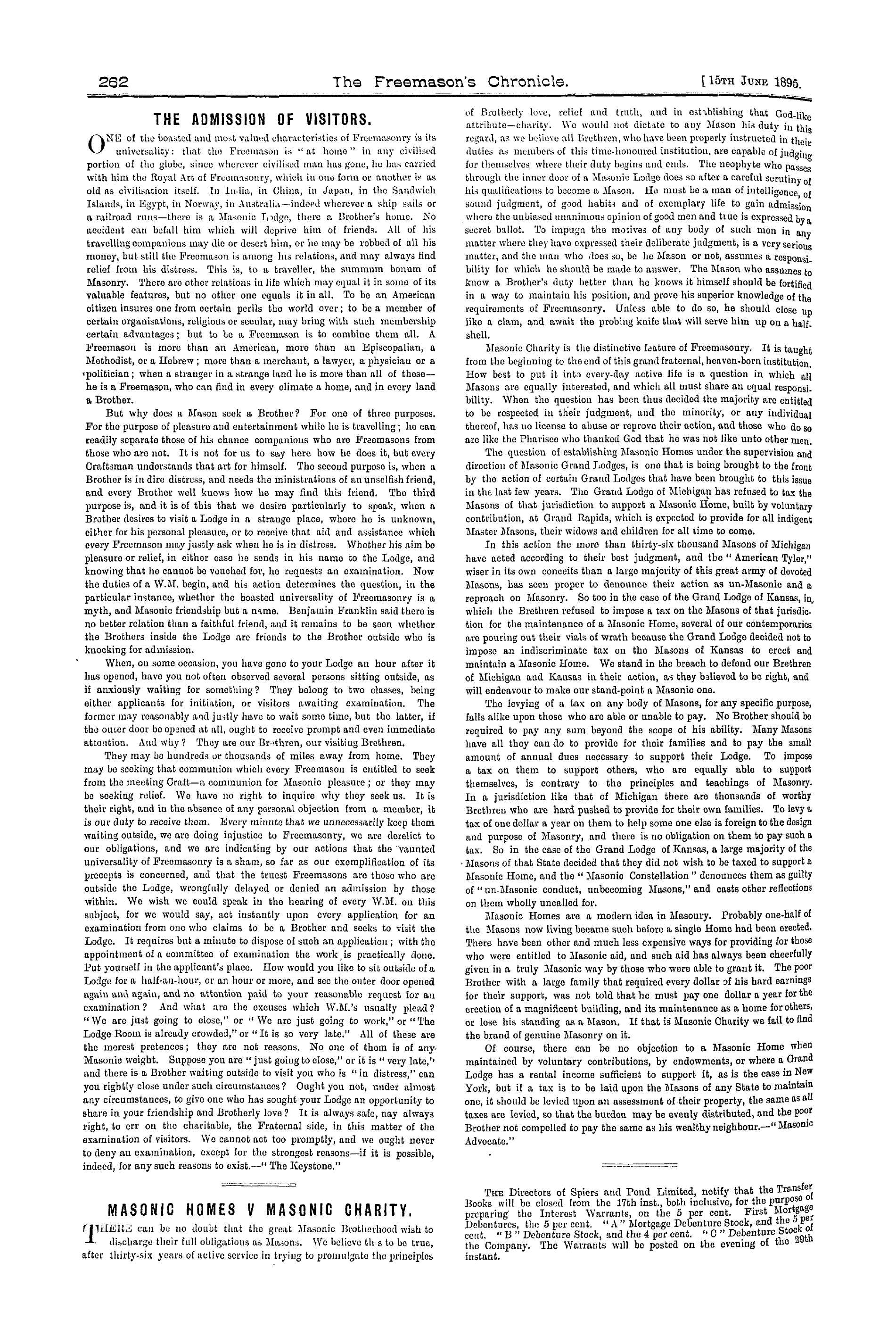
ONE of the boasted and mo * t valued characteristics of Freemasonry is its universality : that the Freemason is " at home" in any civilised portion of the globe , since wherever civilised man has gone , lie has carried with him the Royal Art of Freemasonry , which iu one form or another is as old as civilisation itself . In India , in China , iu Japan , in tho Sandwich Islands , in Egypt , in Norwav , iu Australia—indeed wherever a ship sails or
a railroad runs—there is a Masonic Lidge , there a Brothers home . No accident can befall him which will deprive him of friends . All of his travelling companions may dio or desert him , or he may bo robbed of all his money , but still the Freemason is among his relations , and may always find relief from his distress . This is , to a traveller , the summum bonum of
Masonry . There are other relations in life which may equal it in some of its valuable features , but no other one equals it iu all . To bo an American citizen insures one from certain perils tho world over ; to be a member of certain organisations , religious or secular , may bring with such membership certain advantages ; but to be a Freemason is to combine them all . A
Freemason is more than an American , more than an Episcopalian , a Methodist , or a Hebrew ; more than a merchant , a lawyer , a physician or a 'politician ; when a stranger in a strange land he is more than all of thosehe is a Freemason , who can find in every climate a home , and in every land a Brother .
But why does a Mason seek a Brother ? For one of threo purposes . For tho purpose of pleasure and entertainment while he is travelling ; he can readily separate those of his chance companions who aro Freemasons from those who aro not . It is not for us to say hore how he does it , but every Craftsman understands that art for himself . Tho second purposo is , when a
Brother is in dire distress , and needs tho ministrations of an unselfish friend , and every Brother well knows how he may find this friend . Tho third purpose is , and it is of this that we desire particularly to speak , when a Brother desires to visit a Lodge in a strange place , whore ho is unknown , either for his personal pleasure , or to receive that aid and assistance which
every Freemason may justly ask when he is in distress . Whether his aim bo pleasure or relief , in either case he sends in his namo to the Lodge , and knowing that he cannot bo vouched for , he requests an examination . Now the dutios of a W . M . begin , and his action determines the question , in the
particular instance , whether the boasted universality of Freemasonry is a myth , and Masonic friendship but a ni . me . Benjamin Franklin said there is no better relation than a faithful friend , and it remains to be seen whether the Brothers inside the Lodgo are friends to the Brother outside who is knocking for admission .
When , on some occasion , you have gone to your Lodge an hour after it has opened , have you not often observed several persons sitting outside , as if anxiously waiting for something ? They belong to two classes , being
either applicants for initiation , or visitors awaiting examination . The former may reasonably and justly have to wait somo time , but the latter , if the outer door bo opened at all , ought to receive prompt and even immediato attention . And why ? They are our Brethren , our visiting Brethren .
They may bo hundreds or thousands of miles away from homo . They may be seeking that communion which every Freemason is entitled to seek from the meeting Cratt—a communion for Masonic pleasure ; or they may bo seeking relief . We have no right to inquire why they seek us . It is their right , and in the absence of any personal objection from a member , it
is our duty to receive them . Every minute that we unnecessarily keep them waiting outside , wo are doing injustice to Freemasonry , we are derelict to our obligations , and we are indicating by our actions that the vaunted universality of Freemasonry is a sham , so far as our exemplification of its precepts is concerned , and that the truest Freemasons aro those who are
outside the Lodge , wrongfully delayed or denied an admission by those within . We wish we could speak in tho hearing of every W . M . on this subject , for we would say , act instantly upon every application for an examination from one who claims to be a Brother and seeks to visit the Lodge . It requires but a minute to dispose of such an application ; with the
appointment of a committee of examination the work is practically done . Put yourself in the applicant ' s place . How would you like to sit outside of a Lodgo for a half-ati-hour , or an hour or more , and sec the outer door opened again and again , and no attention paid to your reasonable request for an examination ? And what are the excuses which W . M . ' s usually plead ?
"We are just going to close , " or " Wo are just going to work , " or "The Lodge Room is already crowded , " or " It is so very late . " All of these are the merest pretences ; they are not reasons . No one of them is of any Masonic weight . Suppose you are " just going to close , " or it is " very late , '' and there is a Brother waiting outside to visit you who is " in distress , " can
you rightly close under such circumstances ? Ought you not , under almost any circumstances , to give one who has sought your Lodge an opportunity to share iu your friendship and Brotherly love ? It is always safe , nay always
right , to err on the charitable , the Fraternal side , in this matter of the examination of visitors . We cannot act too promptly , and we ought never to deny an examination , except for the strongest reasons—if it is possible , indeed , for any such reasons to exist . — " The Keystone . "
Masonic Homes V Masonic Charity.
MASONIC HOMES V MASONIC CHARITY
rililERE can be no doubt that the great Masonic Brotherhood wish to - * - discharge their full obligations as Masons . We believe th s to be true , after thirty-six years of active service in trying to promulgate the principles
Masonic Homes V Masonic Charity.
of Brotherly love , relief and truth , and in establishing that God-like attribute—charity . We would not dictate to any Mason his dut y in th ; - regard , as we believe all Brethren , who have been properly instructed in their duties as members of this time-honoured institution , are capable of jud"inc for themselves where their duty begins and ends . The neophyte who passes
through the inner door of a Masonic Lodge does so after a careful scrutiny of his qualifications to become a Mason . Ho must be a man of intelli gence of sound judgment , of good habits and of exemplary life to gain admission where the unbiased unanimous opinion of good men and true is expressed by a secret ballot . To impugn tho motives of any body of such men in anv
matter where they have expressed their deliberate judgment , is a very serious matter , and the man who does so , be he Mason or not , assumes a responsibility for which he should be made to answer . The Mason who assumes to know a Brother ' s duty better than he knows it himself should be fortified
in a way to maintain his position , and prove his superior knowled ge of the requirements of Freemasonry . Unless able to do so , he should close up like a clam , and await the probing knife that will serve him np on a halfshell .
Masonic Charity is the distinctive feature of Freemasonry . It is taught from the beginning to the end of this grand fraternal , heaven-born institution . How best to put it into overy-day active life is a question in which all Masons are equally interested , and which all must share an equal responsibility . When the question has been thus decidod the majority are entitled
to be respected in their judgment , and tho minority , or any individual thereof , has no license to abuse or reprove their action , and those who do so avo like the Phariseo who thanked God that he was not like unto other men . The question of establishing Masonic Homes under tho supervision and direction of Masonic Grand Lodges , is ono that is being brought to the front
by the action of certain Grand Lodges that have been brought to this issue in the last few years . The Grand Lodgo of Michigan has refused to tax the Masons of that jurisdiction to support a Masonic Home , built by voluntary contribution , at Grand Rapids , which is expected to provide for all indi gent Master Masons , their widows and children for all time to come .
In this action the moro than thirty-six thousand Masons of Michi gan have acted according to their best judgment , and tho " American Tyler , " wiser in its own conceits than a large majority of this great army of devoted Masons , has seen proper to denounce their action as un-Masonic and a reproach on Masonry . So too in the caso of the Grand Lodge of Kansas , in
which tho Brethren refused to impose a tax on the Masons of that jurisdiction for the maintenance of a Masonic Home , several of our contemporaries aro pouring out their vials of wrath because the Grand Lodge decided not to impose an indiscriminate tax on the Masons of Kansas to erect and maintain a Masonic Home . We stand in the breach to defend our Brethren
of Michigan and Kansas in their action , as they believed to be right , and will endeavour to make our stand-point a Masonic one . Tho levying of a tax on any body of Masons , for any specific purpose , falls alike upon those who are able or unable to pay . No Brother should be required to pay any sum beyond the scope of his ability . Many Masons
have all they can do to provide for their families and to pay the small amount of annual dues necessary to support their Lodge . To impose a tax on them to support others , who are equally able to support themselves , is contrary to the principles and teachings of Masonry . In a jurisdiction like that of Michigan there are thousands of worthy
Brethren who are hard pushed to provide for their own families . To levy a tax of one dollar a year on them to help some one else is foreign to the design and purpose of Masonry , and there is no obligation on them to pay such a tax . So in the case of the Grand Lodge of Kansas , a large majority of the
Masons of that State decided that they did not wish to be taxed to support a Masonic Home , and the " Masonic Constellation " denounces them as guilty of " un-Masonic conduct , unbecoming Masons , " and casts other reflections on them wholly uncalled for .
Masonic Homes are a modern idea in Masonry . Probably one-half of the Masons now living became such before a single Home had been erected . There have been other and much less expensive ways for providing for those who were entitled to Masonic aid , and such aid has always been cheerfully given in a truly Masonic way by those who were able to grant it . The poor
Brother with a largo family that required every dollar of his hard earnings for their support , was not told that he must pay one dollar a year for the erection of a magnificent building , and its maintenance as a home for others , or lose his standing as a Mason . If that is" Masonic Charity we fail to find the brand of genuine Masonry on it .
Of course , there can be no objection to a Masonic Home when maintained by voluntary contributions , by endowments , or where a Grand Lodge has a rental income sufficient to support it , as is the case in New Yorkbut if a tax is to be laid upon the Masons of any State to maintain
, one , it should be levied upon an assessment of their property , the same as all taxes are levied , so that the burden may be evenly distributed , and the poor Brother not compelled to pay the same as his wealthy neighbour . — " Masonic Advocate . "
THE Directors of Spiers and Pond Limited , notify that the Transfe Books will be closed from the 17 th inst ., both inclusive , for the P P ° preparing the Interest Warrants , on the 5 per cent . First Mort ] J & o Debentures , the 5 per cent . " A " Mortgage Debenture Stock , and the J p cent . " B " Debenture Stock , and the 4 per cent . " C " Debenture Stock " tho Company . The Warrants will bo posted on the evening of tho -J instant .

Note: This text has been automatically extracted via Optical Character Recognition (OCR) software.
The Admission Of Visitors.
THE ADMISSION OF VISITORS ,
ONE of the boasted and mo * t valued characteristics of Freemasonry is its universality : that the Freemason is " at home" in any civilised portion of the globe , since wherever civilised man has gone , lie has carried with him the Royal Art of Freemasonry , which iu one form or another is as old as civilisation itself . In India , in China , iu Japan , in tho Sandwich Islands , in Egypt , in Norwav , iu Australia—indeed wherever a ship sails or
a railroad runs—there is a Masonic Lidge , there a Brothers home . No accident can befall him which will deprive him of friends . All of his travelling companions may dio or desert him , or he may bo robbed of all his money , but still the Freemason is among his relations , and may always find relief from his distress . This is , to a traveller , the summum bonum of
Masonry . There are other relations in life which may equal it in some of its valuable features , but no other one equals it iu all . To bo an American citizen insures one from certain perils tho world over ; to be a member of certain organisations , religious or secular , may bring with such membership certain advantages ; but to be a Freemason is to combine them all . A
Freemason is more than an American , more than an Episcopalian , a Methodist , or a Hebrew ; more than a merchant , a lawyer , a physician or a 'politician ; when a stranger in a strange land he is more than all of thosehe is a Freemason , who can find in every climate a home , and in every land a Brother .
But why does a Mason seek a Brother ? For one of threo purposes . For tho purpose of pleasure and entertainment while he is travelling ; he can readily separate those of his chance companions who aro Freemasons from those who aro not . It is not for us to say hore how he does it , but every Craftsman understands that art for himself . Tho second purposo is , when a
Brother is in dire distress , and needs tho ministrations of an unselfish friend , and every Brother well knows how he may find this friend . Tho third purpose is , and it is of this that we desire particularly to speak , when a Brother desires to visit a Lodge in a strange place , whore ho is unknown , either for his personal pleasure , or to receive that aid and assistance which
every Freemason may justly ask when he is in distress . Whether his aim bo pleasure or relief , in either case he sends in his namo to the Lodge , and knowing that he cannot bo vouched for , he requests an examination . Now the dutios of a W . M . begin , and his action determines the question , in the
particular instance , whether the boasted universality of Freemasonry is a myth , and Masonic friendship but a ni . me . Benjamin Franklin said there is no better relation than a faithful friend , and it remains to be seen whether the Brothers inside the Lodgo are friends to the Brother outside who is knocking for admission .
When , on some occasion , you have gone to your Lodge an hour after it has opened , have you not often observed several persons sitting outside , as if anxiously waiting for something ? They belong to two classes , being
either applicants for initiation , or visitors awaiting examination . The former may reasonably and justly have to wait somo time , but the latter , if the outer door bo opened at all , ought to receive prompt and even immediato attention . And why ? They are our Brethren , our visiting Brethren .
They may bo hundreds or thousands of miles away from homo . They may be seeking that communion which every Freemason is entitled to seek from the meeting Cratt—a communion for Masonic pleasure ; or they may bo seeking relief . We have no right to inquire why they seek us . It is their right , and in the absence of any personal objection from a member , it
is our duty to receive them . Every minute that we unnecessarily keep them waiting outside , wo are doing injustice to Freemasonry , we are derelict to our obligations , and we are indicating by our actions that the vaunted universality of Freemasonry is a sham , so far as our exemplification of its precepts is concerned , and that the truest Freemasons aro those who are
outside the Lodge , wrongfully delayed or denied an admission by those within . We wish we could speak in tho hearing of every W . M . on this subject , for we would say , act instantly upon every application for an examination from one who claims to be a Brother and seeks to visit the Lodge . It requires but a minute to dispose of such an application ; with the
appointment of a committee of examination the work is practically done . Put yourself in the applicant ' s place . How would you like to sit outside of a Lodgo for a half-ati-hour , or an hour or more , and sec the outer door opened again and again , and no attention paid to your reasonable request for an examination ? And what are the excuses which W . M . ' s usually plead ?
"We are just going to close , " or " Wo are just going to work , " or "The Lodge Room is already crowded , " or " It is so very late . " All of these are the merest pretences ; they are not reasons . No one of them is of any Masonic weight . Suppose you are " just going to close , " or it is " very late , '' and there is a Brother waiting outside to visit you who is " in distress , " can
you rightly close under such circumstances ? Ought you not , under almost any circumstances , to give one who has sought your Lodge an opportunity to share iu your friendship and Brotherly love ? It is always safe , nay always
right , to err on the charitable , the Fraternal side , in this matter of the examination of visitors . We cannot act too promptly , and we ought never to deny an examination , except for the strongest reasons—if it is possible , indeed , for any such reasons to exist . — " The Keystone . "
Masonic Homes V Masonic Charity.
MASONIC HOMES V MASONIC CHARITY
rililERE can be no doubt that the great Masonic Brotherhood wish to - * - discharge their full obligations as Masons . We believe th s to be true , after thirty-six years of active service in trying to promulgate the principles
Masonic Homes V Masonic Charity.
of Brotherly love , relief and truth , and in establishing that God-like attribute—charity . We would not dictate to any Mason his dut y in th ; - regard , as we believe all Brethren , who have been properly instructed in their duties as members of this time-honoured institution , are capable of jud"inc for themselves where their duty begins and ends . The neophyte who passes
through the inner door of a Masonic Lodge does so after a careful scrutiny of his qualifications to become a Mason . Ho must be a man of intelli gence of sound judgment , of good habits and of exemplary life to gain admission where the unbiased unanimous opinion of good men and true is expressed by a secret ballot . To impugn tho motives of any body of such men in anv
matter where they have expressed their deliberate judgment , is a very serious matter , and the man who does so , be he Mason or not , assumes a responsibility for which he should be made to answer . The Mason who assumes to know a Brother ' s duty better than he knows it himself should be fortified
in a way to maintain his position , and prove his superior knowled ge of the requirements of Freemasonry . Unless able to do so , he should close up like a clam , and await the probing knife that will serve him np on a halfshell .
Masonic Charity is the distinctive feature of Freemasonry . It is taught from the beginning to the end of this grand fraternal , heaven-born institution . How best to put it into overy-day active life is a question in which all Masons are equally interested , and which all must share an equal responsibility . When the question has been thus decidod the majority are entitled
to be respected in their judgment , and tho minority , or any individual thereof , has no license to abuse or reprove their action , and those who do so avo like the Phariseo who thanked God that he was not like unto other men . The question of establishing Masonic Homes under tho supervision and direction of Masonic Grand Lodges , is ono that is being brought to the front
by the action of certain Grand Lodges that have been brought to this issue in the last few years . The Grand Lodgo of Michigan has refused to tax the Masons of that jurisdiction to support a Masonic Home , built by voluntary contribution , at Grand Rapids , which is expected to provide for all indi gent Master Masons , their widows and children for all time to come .
In this action the moro than thirty-six thousand Masons of Michi gan have acted according to their best judgment , and tho " American Tyler , " wiser in its own conceits than a large majority of this great army of devoted Masons , has seen proper to denounce their action as un-Masonic and a reproach on Masonry . So too in the caso of the Grand Lodge of Kansas , in
which tho Brethren refused to impose a tax on the Masons of that jurisdiction for the maintenance of a Masonic Home , several of our contemporaries aro pouring out their vials of wrath because the Grand Lodge decided not to impose an indiscriminate tax on the Masons of Kansas to erect and maintain a Masonic Home . We stand in the breach to defend our Brethren
of Michigan and Kansas in their action , as they believed to be right , and will endeavour to make our stand-point a Masonic one . Tho levying of a tax on any body of Masons , for any specific purpose , falls alike upon those who are able or unable to pay . No Brother should be required to pay any sum beyond the scope of his ability . Many Masons
have all they can do to provide for their families and to pay the small amount of annual dues necessary to support their Lodge . To impose a tax on them to support others , who are equally able to support themselves , is contrary to the principles and teachings of Masonry . In a jurisdiction like that of Michigan there are thousands of worthy
Brethren who are hard pushed to provide for their own families . To levy a tax of one dollar a year on them to help some one else is foreign to the design and purpose of Masonry , and there is no obligation on them to pay such a tax . So in the case of the Grand Lodge of Kansas , a large majority of the
Masons of that State decided that they did not wish to be taxed to support a Masonic Home , and the " Masonic Constellation " denounces them as guilty of " un-Masonic conduct , unbecoming Masons , " and casts other reflections on them wholly uncalled for .
Masonic Homes are a modern idea in Masonry . Probably one-half of the Masons now living became such before a single Home had been erected . There have been other and much less expensive ways for providing for those who were entitled to Masonic aid , and such aid has always been cheerfully given in a truly Masonic way by those who were able to grant it . The poor
Brother with a largo family that required every dollar of his hard earnings for their support , was not told that he must pay one dollar a year for the erection of a magnificent building , and its maintenance as a home for others , or lose his standing as a Mason . If that is" Masonic Charity we fail to find the brand of genuine Masonry on it .
Of course , there can be no objection to a Masonic Home when maintained by voluntary contributions , by endowments , or where a Grand Lodge has a rental income sufficient to support it , as is the case in New Yorkbut if a tax is to be laid upon the Masons of any State to maintain
, one , it should be levied upon an assessment of their property , the same as all taxes are levied , so that the burden may be evenly distributed , and the poor Brother not compelled to pay the same as his wealthy neighbour . — " Masonic Advocate . "
THE Directors of Spiers and Pond Limited , notify that the Transfe Books will be closed from the 17 th inst ., both inclusive , for the P P ° preparing the Interest Warrants , on the 5 per cent . First Mort ] J & o Debentures , the 5 per cent . " A " Mortgage Debenture Stock , and the J p cent . " B " Debenture Stock , and the 4 per cent . " C " Debenture Stock " tho Company . The Warrants will bo posted on the evening of tho -J instant .