-
Articles/Ads
Article MASONIC AID FOR OUTSIDE CHARITIES. ← Page 2 of 2 Article MASONIC LABOUR. Page 1 of 2 Article MASONIC LABOUR. Page 1 of 2 →
Note: This text has been automatically extracted via Optical Character Recognition (OCR) software.
Masonic Aid For Outside Charities.
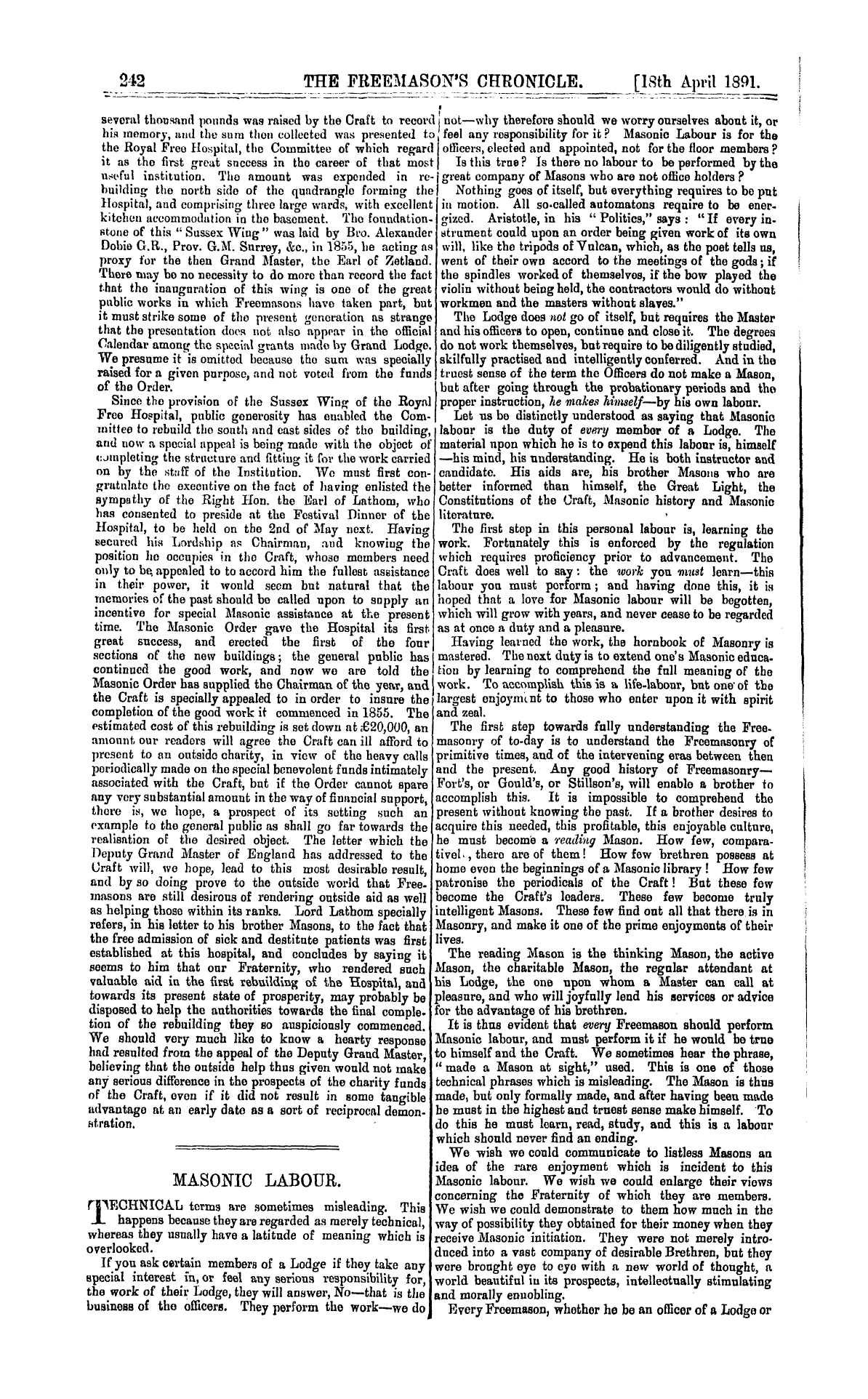
several thousand pounds was raised by the Craft to record his memory , and the sum then collected was presented to the Royal Free Hospital , the Committee of which regard it as tho first great snecess in tho career of that most
useful institution . The amount was expended in rebuilding tho north side of the quadrangle forming the Hospital , and comprising three large wards , with excellent kitchen accommodation in tho basement . Tho
foundationstone of this " Sussex Wiug " was laid by Bro . Alexander Dobie G . R ., Prov . G . M . Surrey , & e ., in 1855 , he acting aa proxy for the then Grand Master , tho Earl of Zetland . There may bo no necessity to do more than record the fact that the inauguration of this wing is ono of the great
public works in which Freemasons have taken part , but it must strike some of the present generation aa strange that the presentation does not also appear in the official
Calendar among the special grants nmdo by Grand Lodge . We presume it is omitted because tho sum was specially raised for a given purpose , and not voted from the funds of the Order .
Since the provision of tho Sussex Wing of the Royal Freo Hospital , public generosity has enabled the Committee to rebuild the south and east sides of tho building , aud now a special appeal is being made with the object of « : jmpleting the structure and fitting ifc for the work carried
on by the stuff of the Institution . Wo must first congratulate the executive on the fact of having enlisted the sympathy of tho Right Hon . the Earl of Lathom , who has consented to preside at the Festival Dinner of the Hospital , to be held on the 2 nd of May next . Having
secured his Lordshi p as Chairman , and knowing the position ho occupies in tho Craft , whoso members need only to be , appealed to to accord him the fullest assistance in their power , it would seem but natural that the memories of the past should bo called upon to supply an
incentive for special Masonic assistance at the present time . The Masonic Order gave the Hospital its first great success , and erected the first of the four sections of the new buildings ; the general public has continued the good work , and now we are told the
Masonic Order has supplied the Chairman , of the year , and the Craft is specially appealed to in order to insure the completion of the good work it commenced in 1855 . The estimated cost of this rebuilding is set down afc £ 20 , 000 , an amount our readers will agree the Craft can ill afford to
present to an ontsido charity , in view of the heavy calls periodically made on the special benevolent funds intimatel y associated with the Craft , but if the Order cannot spare any very substantial amount in the way of financial support , there is , we hope , a prospect of its sotting such an
example to the general public as shall go far towards the realisation of the desired object . The letter which the Deputy Grand Master of England has addressed to the Craft will , we hope , lead to this most desirable result , and by so doing prove to the outside world that
Freemasons are still desirous of rendering outside aid as well as helping thoso within its ranks . Lord Lathom specially refers , in his letter to his brother Masons , to the fact thafc the free admission of sick and destitute patients was first established at this hospital , and concludes by saying it
seems to him thafc our Fraternity , who rendered such valuable aid in the first rebuilding ol the Hospital , and towards its present state of prosperity , may probably be disposed to help the authorities towards the final comple . tion of the rebuilding they so auspiciously commenced .
We shonld very much like to know a hearty response had resulted from the appeal of the Deputy Grand Master , believing that the outside help thus given would not make
any serious difference in the prospects of the charity funds of the Craft , even if it did nofc result in some tangible advantage afc an early date as a sort of reciprocal demonstration .
Masonic Labour.
MASONIC LABOUR .
nnEGHNICAL terms are sometimes misleading . This JL happens because they are regarded as merely technical , whereas they usually have a latitude of meaning which is overlooked .
If you ask certain membera of a Lodge if they take any special interest in , or feel any serious responsibilit y for , the work of their Lodge , they will answer , No—that is the business of the officers . They perform the work—we do
Masonic Labour.
not—why therefore should we worry ourselves abont it , or feel any responsibility for ifc ? Masonic Labour is for the officers , elected and appointed , not for the floor members ? Is this true ? Is there no labour to be performed by the great company of Masons who are not office holders ?
Nothing goes of itself , bufc everything requires to be put in motion . All so-called automatons require to be energized . Aristotle , in his " Politics , " says : " If every instrument could upon an order being given work of its own
will , like the tripods of Vnlcan , which , as tho poet tells us , went of their own accord to the meetings of the gods ; if the spindles worked of themselves , if the bow played the violin without being held , the contractors would do without workmen and the masters without slaves . "
The Lodge does not go of itself , bufc requires the Master and his officera to open , continue and close it . The degrees do not work themselves , bat require to be diligently studied ,
skilfully practised and intelligently conferred . And in the truest sense of the term the Officera do not make a Mason , bufc after going through the probationary periods and the proper instruction , he makes himself—by his own labonr .
Let us bo distinctly understood as saying thafc Masonio labour is the duty of every member of a Lodge . The material npon which he is to expend this labonr is , himself —his mind , his understanding . He is both instructor and
candidate . His aids are , his brother Masons who are better informed than himself , the Great Light , the Constitutions of the Craft , Masonic history and Masonic literature . >
The first stop in this personal labour is , learning the work . Fortunately this is enforced by the regulation which requires proficiency prior to advancement . The Craft does well to say : tbe work you must learn—this
labour you must perform ; and having done this , it is hoped that a love for Masonic labour will be begotten , which will grow wifch years , and never cease to be regarded as at once a duty and a pleasure .
Having learned the work , the hornbook of Masonry is mastered . The next duty is to extend one ' s Masonic education by learning to comprehend the full meaning of the work . To accomplish this is a life-labour , but one of tbe largest enjoyment to those who enter npon ifc with spirit and zeal .
The first step towards fully understanding the Freemasonry of to-day is to understand the Freemasonry of primitive times , and of the intervening eras between then and the present . Any good history of Freemasonry—Fort ' s , or Gould ' s , or Stillson ' s , will enable a brother to
accomplish this . Ifc is impossible to comprehend tho present without knowing tbo pasfc . If a brother desires to acquire this needed , this profitable , this enjoyable culture , he must become a reading Mason . How few , comparative ! ¦ , there are of them ! How few brethren possess afc
home even the beginnings of a Masonic library ! How few patronise the periodicals of the Craft ! But these few become the Craft ' s leaders . These few become truly intelligent Masons . These few find out all that there is in Masonry , and make ifc one of the prime enjoyments of their lives .
The reading Mason is tbe thinking Mason , the active Mason , the charitable Mason , the regular attendant afc his Lodge , tbe one npon whom a Master can call at pleasure , and who will joyfully lend his services or advice for the advantage of his brethren .
Ifc is thus evident that every Freemason should perform Masonic labour , and must perform it if he would be true to himself and the Craft . We sometimes hear the phrase , " made a Mason at sight , " used . This is one of those
technical phrases which is misleading . The Mason is thus made , but only formally made , and after having been made be must in tbe highest and truest sense make himself . To do this he must learn , read , study , and this is a labour which should never find an ending . We wish we could communicate to listless Masons an
idea of the rare enjoyment which is incident to this Masonic labour . We wish we could enlarge their views concerning the Fraternity of whioh they are members . We wish we could demonstrate to them how much in the way of possibility they obtained for their money when they
receive Masonic initiation . They were not merel y introduced into a vast company of desirable Brethren , but thoy were brought eye to eye with a new world of thought , a world beautiful in its prospects , intellectually stimulating and morally ennobling . Every Freemason , whether he be an officer of a Lodge or
Note: This text has been automatically extracted via Optical Character Recognition (OCR) software.
Masonic Aid For Outside Charities.
several thousand pounds was raised by the Craft to record his memory , and the sum then collected was presented to the Royal Free Hospital , the Committee of which regard it as tho first great snecess in tho career of that most
useful institution . The amount was expended in rebuilding tho north side of the quadrangle forming the Hospital , and comprising three large wards , with excellent kitchen accommodation in tho basement . Tho
foundationstone of this " Sussex Wiug " was laid by Bro . Alexander Dobie G . R ., Prov . G . M . Surrey , & e ., in 1855 , he acting aa proxy for the then Grand Master , tho Earl of Zetland . There may bo no necessity to do more than record the fact that the inauguration of this wing is ono of the great
public works in which Freemasons have taken part , but it must strike some of the present generation aa strange that the presentation does not also appear in the official
Calendar among the special grants nmdo by Grand Lodge . We presume it is omitted because tho sum was specially raised for a given purpose , and not voted from the funds of the Order .
Since the provision of tho Sussex Wing of the Royal Freo Hospital , public generosity has enabled the Committee to rebuild the south and east sides of tho building , aud now a special appeal is being made with the object of « : jmpleting the structure and fitting ifc for the work carried
on by the stuff of the Institution . Wo must first congratulate the executive on the fact of having enlisted the sympathy of tho Right Hon . the Earl of Lathom , who has consented to preside at the Festival Dinner of the Hospital , to be held on the 2 nd of May next . Having
secured his Lordshi p as Chairman , and knowing the position ho occupies in tho Craft , whoso members need only to be , appealed to to accord him the fullest assistance in their power , it would seem but natural that the memories of the past should bo called upon to supply an
incentive for special Masonic assistance at the present time . The Masonic Order gave the Hospital its first great success , and erected the first of the four sections of the new buildings ; the general public has continued the good work , and now we are told the
Masonic Order has supplied the Chairman , of the year , and the Craft is specially appealed to in order to insure the completion of the good work it commenced in 1855 . The estimated cost of this rebuilding is set down afc £ 20 , 000 , an amount our readers will agree the Craft can ill afford to
present to an ontsido charity , in view of the heavy calls periodically made on the special benevolent funds intimatel y associated with the Craft , but if the Order cannot spare any very substantial amount in the way of financial support , there is , we hope , a prospect of its sotting such an
example to the general public as shall go far towards the realisation of the desired object . The letter which the Deputy Grand Master of England has addressed to the Craft will , we hope , lead to this most desirable result , and by so doing prove to the outside world that
Freemasons are still desirous of rendering outside aid as well as helping thoso within its ranks . Lord Lathom specially refers , in his letter to his brother Masons , to the fact thafc the free admission of sick and destitute patients was first established at this hospital , and concludes by saying it
seems to him thafc our Fraternity , who rendered such valuable aid in the first rebuilding ol the Hospital , and towards its present state of prosperity , may probably be disposed to help the authorities towards the final comple . tion of the rebuilding they so auspiciously commenced .
We shonld very much like to know a hearty response had resulted from the appeal of the Deputy Grand Master , believing that the outside help thus given would not make
any serious difference in the prospects of the charity funds of the Craft , even if it did nofc result in some tangible advantage afc an early date as a sort of reciprocal demonstration .
Masonic Labour.
MASONIC LABOUR .
nnEGHNICAL terms are sometimes misleading . This JL happens because they are regarded as merely technical , whereas they usually have a latitude of meaning which is overlooked .
If you ask certain membera of a Lodge if they take any special interest in , or feel any serious responsibilit y for , the work of their Lodge , they will answer , No—that is the business of the officers . They perform the work—we do
Masonic Labour.
not—why therefore should we worry ourselves abont it , or feel any responsibility for ifc ? Masonic Labour is for the officers , elected and appointed , not for the floor members ? Is this true ? Is there no labour to be performed by the great company of Masons who are not office holders ?
Nothing goes of itself , bufc everything requires to be put in motion . All so-called automatons require to be energized . Aristotle , in his " Politics , " says : " If every instrument could upon an order being given work of its own
will , like the tripods of Vnlcan , which , as tho poet tells us , went of their own accord to the meetings of the gods ; if the spindles worked of themselves , if the bow played the violin without being held , the contractors would do without workmen and the masters without slaves . "
The Lodge does not go of itself , bufc requires the Master and his officera to open , continue and close it . The degrees do not work themselves , bat require to be diligently studied ,
skilfully practised and intelligently conferred . And in the truest sense of the term the Officera do not make a Mason , bufc after going through the probationary periods and the proper instruction , he makes himself—by his own labonr .
Let us bo distinctly understood as saying thafc Masonio labour is the duty of every member of a Lodge . The material npon which he is to expend this labonr is , himself —his mind , his understanding . He is both instructor and
candidate . His aids are , his brother Masons who are better informed than himself , the Great Light , the Constitutions of the Craft , Masonic history and Masonic literature . >
The first stop in this personal labour is , learning the work . Fortunately this is enforced by the regulation which requires proficiency prior to advancement . The Craft does well to say : tbe work you must learn—this
labour you must perform ; and having done this , it is hoped that a love for Masonic labour will be begotten , which will grow wifch years , and never cease to be regarded as at once a duty and a pleasure .
Having learned the work , the hornbook of Masonry is mastered . The next duty is to extend one ' s Masonic education by learning to comprehend the full meaning of the work . To accomplish this is a life-labour , but one of tbe largest enjoyment to those who enter npon ifc with spirit and zeal .
The first step towards fully understanding the Freemasonry of to-day is to understand the Freemasonry of primitive times , and of the intervening eras between then and the present . Any good history of Freemasonry—Fort ' s , or Gould ' s , or Stillson ' s , will enable a brother to
accomplish this . Ifc is impossible to comprehend tho present without knowing tbo pasfc . If a brother desires to acquire this needed , this profitable , this enjoyable culture , he must become a reading Mason . How few , comparative ! ¦ , there are of them ! How few brethren possess afc
home even the beginnings of a Masonic library ! How few patronise the periodicals of the Craft ! But these few become the Craft ' s leaders . These few become truly intelligent Masons . These few find out all that there is in Masonry , and make ifc one of the prime enjoyments of their lives .
The reading Mason is tbe thinking Mason , the active Mason , the charitable Mason , the regular attendant afc his Lodge , tbe one npon whom a Master can call at pleasure , and who will joyfully lend his services or advice for the advantage of his brethren .
Ifc is thus evident that every Freemason should perform Masonic labour , and must perform it if he would be true to himself and the Craft . We sometimes hear the phrase , " made a Mason at sight , " used . This is one of those
technical phrases which is misleading . The Mason is thus made , but only formally made , and after having been made be must in tbe highest and truest sense make himself . To do this he must learn , read , study , and this is a labour which should never find an ending . We wish we could communicate to listless Masons an
idea of the rare enjoyment which is incident to this Masonic labour . We wish we could enlarge their views concerning the Fraternity of whioh they are members . We wish we could demonstrate to them how much in the way of possibility they obtained for their money when they
receive Masonic initiation . They were not merel y introduced into a vast company of desirable Brethren , but thoy were brought eye to eye with a new world of thought , a world beautiful in its prospects , intellectually stimulating and morally ennobling . Every Freemason , whether he be an officer of a Lodge or