-
Articles/Ads
Article CHURCH SERVICES. ← Page 2 of 3 Article CHURCH SERVICES. Page 2 of 3 →
Note: This text has been automatically extracted via Optical Character Recognition (OCR) software.
Church Services.
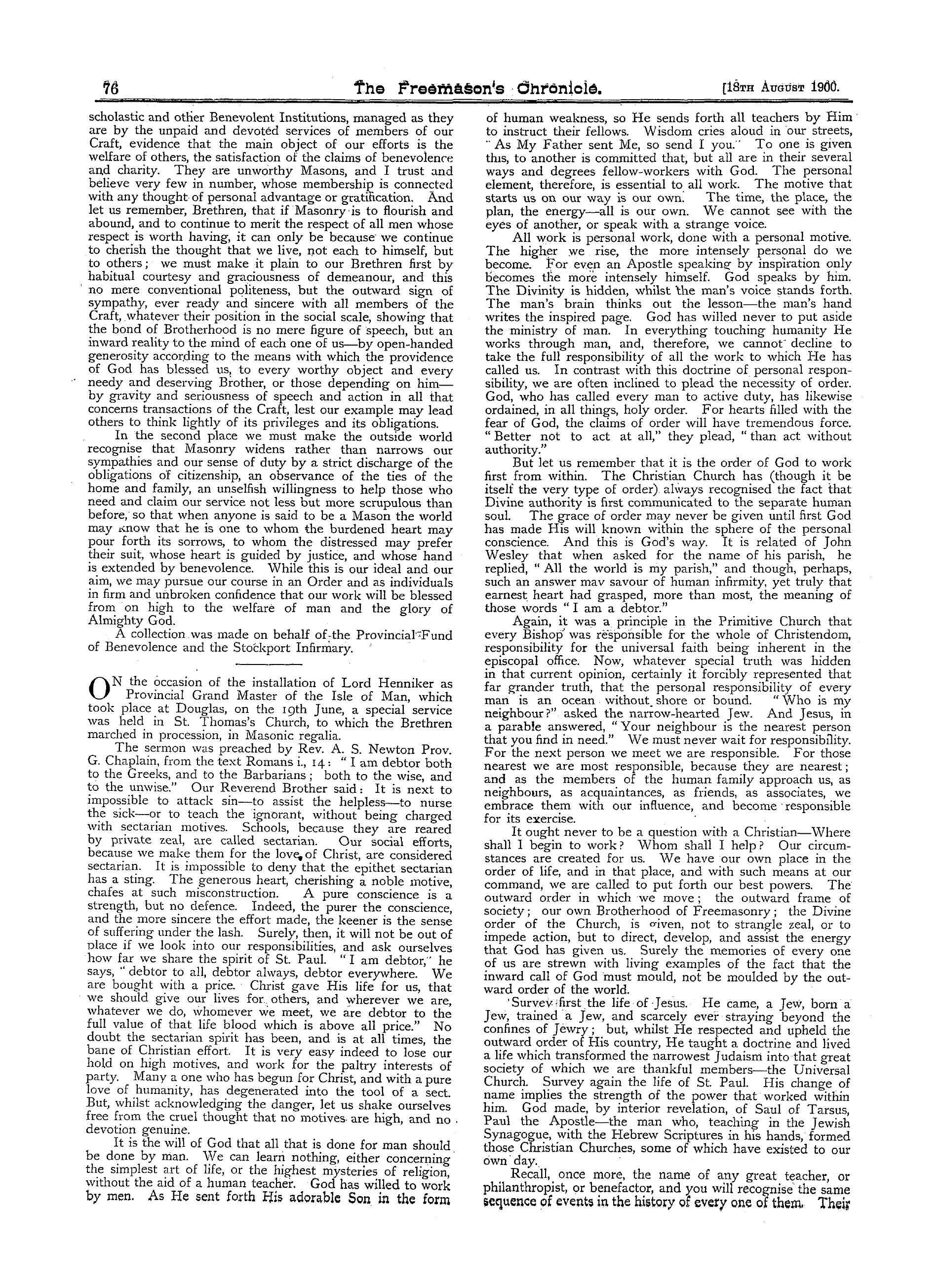
scholastic and other Benevolent Institutions , managed as they are by the unpaid and devoted services of members of our Craft , evidence that the main object of our efforts is the welfare of others , the satisfaction of the claims of benevolence and charity . They are unworthy Masons , and I trust and
believe very few in number , whose membership is connected with any thought of personal advantage or gratification . And let us remember , Brethren , that if Masonry is to flourish and abound , and to continue to merit the respect of all men whose respect is worth having , it can only be because we continue to cherish the thought that we live , not each to himself , but
to others ; we must make it plain to our Brethren first by habitual courtesy and graciousness of demeanour , and this no mere conventional politeness , but the outward sign of sympathy , ever ready and sincere with all members of the Craft , whatever their position in the social scale , showing that
the bond of Brotherhood is no mere figure of speech , but an inward reality to the mind of each one of us—by open-handed generosity according to the means with which the providence of God has blessed us , to every worthy object and every
needy and deserving Brother , or those depending on himby gravity and seriousness of speech and action in all that concerns transactions of the Craft , lest our example may lead others to think lightly of its privileges and its obligations .
In the second place we must make the outside world recognise that Masonry widens rather than narrows our sympathies and our sense of duty by a strict discharge of the obligations of citizenship , an observance of the ties of the home and family , an unselfish willingness to help those who
need and claim our service not less but more scrupulous than before , so that when anyone is said to be a Mason the world may Know that he is one to whom the burdened heart may pour forth its sorrows , to whom the distressed may prefer their suit , whose heart is guided by justice , and whose hand
is extended by benevolence . While this is our ideal and our aim , we may pursue our course in an Order and as individuals in firm and unbroken confidence that our work will be blessed from on high to the welfare of man and the glory of Almighty God .
A collection was made on behalf of-the Provincial'Fund of Benevolence and the Stockport Infirmary .
ON the occasion of the installation of Lord Henniker as Provincial Grand Master of the Isle of Man , which took place at Douglas , on the 19 th June , a special service was held in St . Thomas ' s Church , to which the Brethren marched in procession , in Masonic regalia . The sermon was preached by Rev . A . S . Newton Prov .
G . Chaplain , from the text Romans i ., 14 . "I am debtor both to the Greeks , and to the Barbarians ; both to the wise , and to the unwise . " Our Reverend Brother said : It is next to impossible to attack sin—to assist the helpless—to nurse the sick—or to teach the ignorant , without being charged
with sectarian motives . Schools , because they are reared by private zeal , are called sectarian . Our social efforts , because we make them for the love , of Christ , are considered sectarian . It is impossible to deny that the epithet sectarian has a sting . The generous heart , cherishing a noble motive ,
chafes at such misconstruction . A pure conscience is a strength , but no defence . Indeed , the purer the conscience , and the more sincere the effort made , the keener is the sense of suffering under the lash . Surely , then , it will not be out of place if we look into our responsibilities , and ask ourselves
how far we share the spirit of St . Paul . " I am debtor , ' he says , " debtor to all , debtor always , debtor everywhere . We are bought with a price . Christ gave His life for us , that we should give our lives for . others , and wherever we are , whatever we do , whomever we meet , we are debtor to the
full value of that life blood which is above all price . " No doubt the sectarian spirit has been , and is at all times , the bane of Christian effort . It is very easy indeed to lose our hold on high motives , and work for the paltry interests of
party . Many a one who has begun for Christ , and with a pure love of humanity , has degenerated into the tool of a sect . But , whilst acknowledging the danger , let us shake ourselves free from the cruel thought that no motives- are high , and no devotion genuine .
It is the will of God that all that is done for man should be done by man . We can learn nothing , either concerning the simplest art of life , or the highest mysteries of religion , without the aid of a human teacher . God has willed to work by men . As He sent forth His adorable Son in the form
Church Services.
of human weakness , so He sends forth all teachers by Him to instruct their fellows . Wisdom cries aloud in our streets , " As My Father sent Me , so send I you . " To one is given this , to another is committed that , but all are in their several
ways and degrees fellow-workers with God . The personal element , therefore , is essential to all work . The motive that starts us on our way is our own . The time , the place , the plan , the energy—all is our own . We cannot see with the eyes of another , or speak with a strange voice .
All work is personal work , done with a personal motive . The higher we rise , the more intensely personal do we become . For even an Apostle speaking by inspiration only becomes the more intensely himself . God speaks by him . The Divinity is hidden , whilst the man ' s voice stands forth . The man ' s brain thinks out the lesson—the man ' s hand
writes the inspired page . God has willed never to put aside the ministry of man . In everything touching humanity He works through man , and , therefore , we cannot ^ decline to take the full responsibility of all the work to which He has called us . In contrast with this doctrine of personal
responsibility , we are often inclined to plead the necessity of order . God , who has called every man to active duty , has likewise ordained , in all things , holy order . For hearts filled with the fear of God , the claims of order will have tremendous force . " Better not to act at all , " they plead , " than act without authority . " But let us remember that it is the order of God to work
first from within . The Christian Church has ( though it be itself the very type of order ) always recognised the fact that Divine authority is first communicated to the separate human soul . The grace of order may never be given until first God has made His will known within the sphere of the personal
conscience . And this is God ' s way . It is related of John Wesley that when asked for the name of his parish , he replied , " All the world is my parish , " and though , perhaps , such an answer mav savour of human infirmity , yet truly that earnest heart had grasped , more than most , the meaning of those words " I am a debtor . "
Again , it was a principle in the Primitive Church that every Bishop " was responsible for the whole of Christendom , responsibility for the universal faith being inherent in the episcopal office . Now , whatever special truth was hidden in that current opinion , certainly it forcibly represented that
far grander truth , that the personal responsibility of every man is an ocean without , shore or bound . " Who is my neighbour ? " asked the narrow-hearted Jew . And Jesus , in a parable answered , " Your neighbour is the nearest person that you find in need . " We must never wait for responsibility .
For the next person we meet we are responsible . For those nearest we are most responsible , because they are nearest ; and as the members of the human family approach us , as neighbours , as acquaintances , as friends , as associates , we embrace them with our influence , and become ' responsible for its exercise .
It ought never to be a question with a Christian—Where shall I begin to work ? Whom shall I help ? Our circumstances are created for us . We have our own place in the order of life , and in that place , and with such means at our command , we are called to put forth our best powers . The
outward order in which we move ; the outward frame of society ; our own Brotherhood of Freemasonry ; the Divine order of the Church , is ° iven , not to strangle zeal , or to impede action , but to direct , develop , and assist the energy
that God has given us . Surely the memories of every one of us are strewn with living examples of the fact that the inward call of God must mould , not be moulded by the outward order of the world .
'Survev first the life of Jesus . He came , a Jew , born a Jew , trained a Jew , and scarcely ever straying beyond the confines of Jewry ; but , whilst He respected and upheld the outward order of His country , He taught a doctrine and lived a life which transformed the narrowest Judaism into that great
society of which we are thankful members—the Universal Church . Survey again the life of St . Paul . Flis change of name implies the strength of the power that worked within him . God made , by interior revelation , of Saul of Tarsus ,
Paul the Apostle—the man who , teaching in the Jewish Synagogue , with the Hebrew Scriptures in his hands / formed those Christian Churches , some of which have existed to our own day .
Recall , once more , the name of any great teacher , or philanthropist , or benefactor , and you will recognise the same sequence of events in the history 0 ! every one 0 ? them , Theiy




Note: This text has been automatically extracted via Optical Character Recognition (OCR) software.
Church Services.
scholastic and other Benevolent Institutions , managed as they are by the unpaid and devoted services of members of our Craft , evidence that the main object of our efforts is the welfare of others , the satisfaction of the claims of benevolence and charity . They are unworthy Masons , and I trust and
believe very few in number , whose membership is connected with any thought of personal advantage or gratification . And let us remember , Brethren , that if Masonry is to flourish and abound , and to continue to merit the respect of all men whose respect is worth having , it can only be because we continue to cherish the thought that we live , not each to himself , but
to others ; we must make it plain to our Brethren first by habitual courtesy and graciousness of demeanour , and this no mere conventional politeness , but the outward sign of sympathy , ever ready and sincere with all members of the Craft , whatever their position in the social scale , showing that
the bond of Brotherhood is no mere figure of speech , but an inward reality to the mind of each one of us—by open-handed generosity according to the means with which the providence of God has blessed us , to every worthy object and every
needy and deserving Brother , or those depending on himby gravity and seriousness of speech and action in all that concerns transactions of the Craft , lest our example may lead others to think lightly of its privileges and its obligations .
In the second place we must make the outside world recognise that Masonry widens rather than narrows our sympathies and our sense of duty by a strict discharge of the obligations of citizenship , an observance of the ties of the home and family , an unselfish willingness to help those who
need and claim our service not less but more scrupulous than before , so that when anyone is said to be a Mason the world may Know that he is one to whom the burdened heart may pour forth its sorrows , to whom the distressed may prefer their suit , whose heart is guided by justice , and whose hand
is extended by benevolence . While this is our ideal and our aim , we may pursue our course in an Order and as individuals in firm and unbroken confidence that our work will be blessed from on high to the welfare of man and the glory of Almighty God .
A collection was made on behalf of-the Provincial'Fund of Benevolence and the Stockport Infirmary .
ON the occasion of the installation of Lord Henniker as Provincial Grand Master of the Isle of Man , which took place at Douglas , on the 19 th June , a special service was held in St . Thomas ' s Church , to which the Brethren marched in procession , in Masonic regalia . The sermon was preached by Rev . A . S . Newton Prov .
G . Chaplain , from the text Romans i ., 14 . "I am debtor both to the Greeks , and to the Barbarians ; both to the wise , and to the unwise . " Our Reverend Brother said : It is next to impossible to attack sin—to assist the helpless—to nurse the sick—or to teach the ignorant , without being charged
with sectarian motives . Schools , because they are reared by private zeal , are called sectarian . Our social efforts , because we make them for the love , of Christ , are considered sectarian . It is impossible to deny that the epithet sectarian has a sting . The generous heart , cherishing a noble motive ,
chafes at such misconstruction . A pure conscience is a strength , but no defence . Indeed , the purer the conscience , and the more sincere the effort made , the keener is the sense of suffering under the lash . Surely , then , it will not be out of place if we look into our responsibilities , and ask ourselves
how far we share the spirit of St . Paul . " I am debtor , ' he says , " debtor to all , debtor always , debtor everywhere . We are bought with a price . Christ gave His life for us , that we should give our lives for . others , and wherever we are , whatever we do , whomever we meet , we are debtor to the
full value of that life blood which is above all price . " No doubt the sectarian spirit has been , and is at all times , the bane of Christian effort . It is very easy indeed to lose our hold on high motives , and work for the paltry interests of
party . Many a one who has begun for Christ , and with a pure love of humanity , has degenerated into the tool of a sect . But , whilst acknowledging the danger , let us shake ourselves free from the cruel thought that no motives- are high , and no devotion genuine .
It is the will of God that all that is done for man should be done by man . We can learn nothing , either concerning the simplest art of life , or the highest mysteries of religion , without the aid of a human teacher . God has willed to work by men . As He sent forth His adorable Son in the form
Church Services.
of human weakness , so He sends forth all teachers by Him to instruct their fellows . Wisdom cries aloud in our streets , " As My Father sent Me , so send I you . " To one is given this , to another is committed that , but all are in their several
ways and degrees fellow-workers with God . The personal element , therefore , is essential to all work . The motive that starts us on our way is our own . The time , the place , the plan , the energy—all is our own . We cannot see with the eyes of another , or speak with a strange voice .
All work is personal work , done with a personal motive . The higher we rise , the more intensely personal do we become . For even an Apostle speaking by inspiration only becomes the more intensely himself . God speaks by him . The Divinity is hidden , whilst the man ' s voice stands forth . The man ' s brain thinks out the lesson—the man ' s hand
writes the inspired page . God has willed never to put aside the ministry of man . In everything touching humanity He works through man , and , therefore , we cannot ^ decline to take the full responsibility of all the work to which He has called us . In contrast with this doctrine of personal
responsibility , we are often inclined to plead the necessity of order . God , who has called every man to active duty , has likewise ordained , in all things , holy order . For hearts filled with the fear of God , the claims of order will have tremendous force . " Better not to act at all , " they plead , " than act without authority . " But let us remember that it is the order of God to work
first from within . The Christian Church has ( though it be itself the very type of order ) always recognised the fact that Divine authority is first communicated to the separate human soul . The grace of order may never be given until first God has made His will known within the sphere of the personal
conscience . And this is God ' s way . It is related of John Wesley that when asked for the name of his parish , he replied , " All the world is my parish , " and though , perhaps , such an answer mav savour of human infirmity , yet truly that earnest heart had grasped , more than most , the meaning of those words " I am a debtor . "
Again , it was a principle in the Primitive Church that every Bishop " was responsible for the whole of Christendom , responsibility for the universal faith being inherent in the episcopal office . Now , whatever special truth was hidden in that current opinion , certainly it forcibly represented that
far grander truth , that the personal responsibility of every man is an ocean without , shore or bound . " Who is my neighbour ? " asked the narrow-hearted Jew . And Jesus , in a parable answered , " Your neighbour is the nearest person that you find in need . " We must never wait for responsibility .
For the next person we meet we are responsible . For those nearest we are most responsible , because they are nearest ; and as the members of the human family approach us , as neighbours , as acquaintances , as friends , as associates , we embrace them with our influence , and become ' responsible for its exercise .
It ought never to be a question with a Christian—Where shall I begin to work ? Whom shall I help ? Our circumstances are created for us . We have our own place in the order of life , and in that place , and with such means at our command , we are called to put forth our best powers . The
outward order in which we move ; the outward frame of society ; our own Brotherhood of Freemasonry ; the Divine order of the Church , is ° iven , not to strangle zeal , or to impede action , but to direct , develop , and assist the energy
that God has given us . Surely the memories of every one of us are strewn with living examples of the fact that the inward call of God must mould , not be moulded by the outward order of the world .
'Survev first the life of Jesus . He came , a Jew , born a Jew , trained a Jew , and scarcely ever straying beyond the confines of Jewry ; but , whilst He respected and upheld the outward order of His country , He taught a doctrine and lived a life which transformed the narrowest Judaism into that great
society of which we are thankful members—the Universal Church . Survey again the life of St . Paul . Flis change of name implies the strength of the power that worked within him . God made , by interior revelation , of Saul of Tarsus ,
Paul the Apostle—the man who , teaching in the Jewish Synagogue , with the Hebrew Scriptures in his hands / formed those Christian Churches , some of which have existed to our own day .
Recall , once more , the name of any great teacher , or philanthropist , or benefactor , and you will recognise the same sequence of events in the history 0 ! every one 0 ? them , Theiy