-
Articles/Ads
Article OUR MASONIC ANNALS. Page 1 of 2 Article OUR MASONIC ANNALS. Page 1 of 2 →
Note: This text has been automatically extracted via Optical Character Recognition (OCR) software.
Our Masonic Annals.
OUR MASONIC ANNALS .
WHEN Sir H . A . Layard published his great work on Nineveh and Babylon a reviewer in the " Times " commenced a most striking notice with these words , " The veil is slowly rising , " & c . & c . How truly does this very passage seem still to describe
the gradual unveiling and unfolding of our Masonic story , and that silent yet full-voiced witness to its life , its truth , its actuality and its meaning , which the efforts of a loyal
band of students are gradually and slowly , ( too slowly perhaps for some , ) and happily and carefully bringing about . The veritable character and outcome of our Masonic
Annals are , by laborious researches , and judicious lucubrations , dawning , so to say , on the minds of our present Masonic generation , obscured as those annals have been , to
a great extent , we feel bound to admit , by the fads of the fanciful , the ignorance of the sciolist , and the inanity of uncritical expositors .
Indeed , in one sense , it may fairly be asserted , that despite all our " ten lamina " after fact instead of fiction , reality instead of romance ; notwithstanding all that has
been written , unravelled , searched out , resuscitated , and cleared up , our Masonic Annals are still , in a great measure , to be explained clearly and expounded critically .
Wc still want and desiderate certainty in statement , continuation in descent , the " missing link" of origin , entirety , progress and perpetuation ; the identity of the developments of the present with the shadows of the past ,
before we can pronounce safely , fully , satisfactorily alike , on the episodes and the evidences of our remarkable Order , and on its existence and pathway through the world ' s ages and vicissitudes .
And hence there seems to be an imperative call on us all , students and writers alike , to exhibit caution , care and modest reticence alike in our assertions and our asseverations , our decisive conclusions and our dogmatic
declarations , lest we again fall into opposite and other errors , as signal as those we fondly trust we have left behind us . There is a great danger just now lest we in our measure , owing to hasty inductions or imperfect data , owing to
presumptive postulates instead of absolute conclusiveness , should become as uncritical as some of our good old romance writers , lest we should allow again assertion to
stand in the place of actuality , and reiterated assumptions to be forced down upon us , " nolentes volentes , " as positive and uncontrovertible facts .
Bro . Sadler ' s very interesting and seasonable work shews us , as we venture to think incontestably , how needful is this premonitory protest , for us all , students and writers
just now ; how doubtful , to say the least of it , after all are some of our apparently most popular assertions and constantiy repeated averments .
Bro . Sadler proves his case as regards the " Irish swarm" in our humble opinion . Such a rectification of the " vulgar" history of the Antient development must henceforth we conceive be
necessaril y the "factor" iu tho question of the rapid organisation and true history of the Antient Masons . The •act that several Lodges existed outside the groat Revival io
1717 is a point now established by Bro . Sadler , and is very important in its Janus-like bearing on tho history of English Freemasonry immediately anterior to 1717 . and as immediatel y subsequent .
Our Masonic Annals.
That members of these unwarranted and independent Lodges were called " St . John's Masons , " also may now be accepted as an established fact , and a very interesting one it is .
That more Lodges existed therefore in 1717 than the four or six mentioned by Anderson and " Mulfca Faucis " may also now be accepted as a further established point . Bro . Sadler may fairly claim the merit of putting the
matter before students more clearly , concisely , and conclusively , than it has been done before , though for some time among students this matter has been pretty nearly accepted as a foregone conclusion .
We seem to gather from the evidences Bro . Sadler adduces , and the facts bo establishes , that many Lodges , like that afc Swalwell , the Swan afc Chichester , the Lodge at fche King ' s Head , Catford , the three Lodges in Chester , ( one of
them probably a successor of Handle Holmes' old Lodge ) , the Lodge at Madrid , of St . John ' s , Gibraltar , at the Magpie , were existing , and probably many more , whose history went back behind even 1700 .
We know that the Alnwick Lodge existed in 1704 , and taking into consideration the Lodge at Warrington 1646 , Chester 1670 , London 1682 , York 1690 , we obtain
by this important study of Bro . Sadler , another and a most important link in the chain , connecting the Freemasonry of the eighteenth with the Freemasonry of the seventeenth centuries .
Remembering the utter laxity of those days we need not then be astonished that so few indicia , of a former Freemasonry exist , or the available evidence thus far is so fragmentary .
But as we said before , Bro . Sadler ' s work , fall as it ia of information , is also a work in which we must read between the lines , for it often suggests more than it proves , of vital importance to the student and historian of
Freemasonry . It also suggests a much needed caution as to laying down the law too dogmatically on many a moot point .
To-day we must content ourselves with one illustration , but we shall on other occasions have to mention some others which have occurred to us .
It is asserted both by Anderson and " Multa Panels " that the first Duke of Richmond was Grand Master in 1688 . It is denied by many others that this statement is
correct , and that Grand Masters existed before 1717 . To this latter point with others so often advanced now we will draw attention on another occasion . But the evidence adduced by Bro . Sadler , and before this alluded to in the Freemason by another writer , as
regards a certain transaction in 1724 on the minutes of Grand Lodge , seems to suggest grave doubts and greater caution as to accepting the negative view of the case offhand . The first Duke died in 1723 , and in 1724 we have
the second Duke , and Grand Master , at a meeting of Grand Lodge , bringing forward himself , as Bro . Sadler suggests , at any rate personally supporting the claims of a Brother Hall for relief , who stated that he had been made a Mason
by the first Duke thirty-six years before afc a Lodge at the Swan , Chichester . This curiously enough takes us back to 1688 . Now the Grand Master in 1724 must have known
whether his father , who died in 1723 , was either a Freemason at all , and a Master of a Lodge , or a Grand Master ; nnd as he accedes in 1724 openly to the statement that ho acted as W . M . in 1688 , and the proof sheets of the 1738


Note: This text has been automatically extracted via Optical Character Recognition (OCR) software.
Our Masonic Annals.
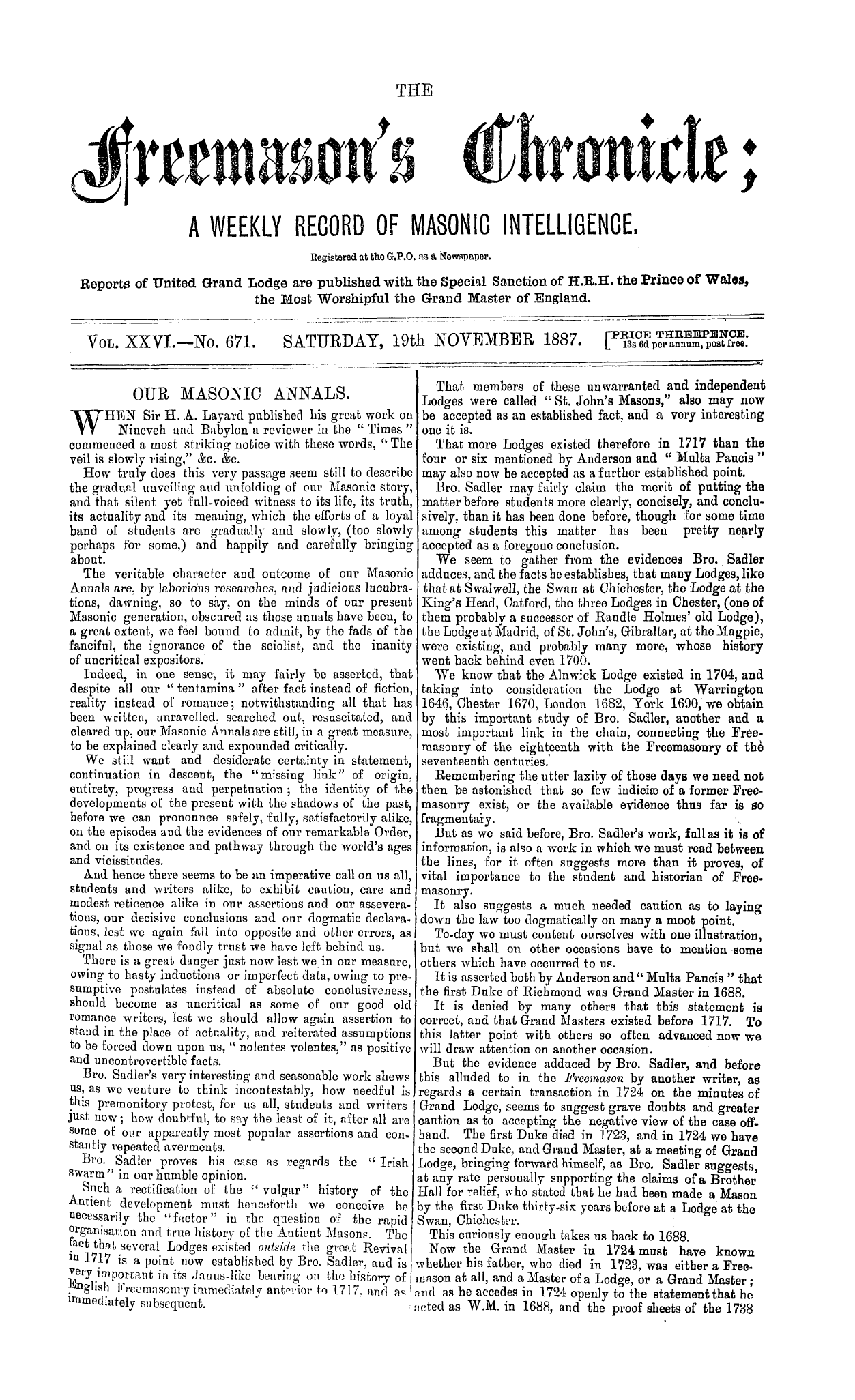
OUR MASONIC ANNALS .
WHEN Sir H . A . Layard published his great work on Nineveh and Babylon a reviewer in the " Times " commenced a most striking notice with these words , " The veil is slowly rising , " & c . & c . How truly does this very passage seem still to describe
the gradual unveiling and unfolding of our Masonic story , and that silent yet full-voiced witness to its life , its truth , its actuality and its meaning , which the efforts of a loyal
band of students are gradually and slowly , ( too slowly perhaps for some , ) and happily and carefully bringing about . The veritable character and outcome of our Masonic
Annals are , by laborious researches , and judicious lucubrations , dawning , so to say , on the minds of our present Masonic generation , obscured as those annals have been , to
a great extent , we feel bound to admit , by the fads of the fanciful , the ignorance of the sciolist , and the inanity of uncritical expositors .
Indeed , in one sense , it may fairly be asserted , that despite all our " ten lamina " after fact instead of fiction , reality instead of romance ; notwithstanding all that has
been written , unravelled , searched out , resuscitated , and cleared up , our Masonic Annals are still , in a great measure , to be explained clearly and expounded critically .
Wc still want and desiderate certainty in statement , continuation in descent , the " missing link" of origin , entirety , progress and perpetuation ; the identity of the developments of the present with the shadows of the past ,
before we can pronounce safely , fully , satisfactorily alike , on the episodes and the evidences of our remarkable Order , and on its existence and pathway through the world ' s ages and vicissitudes .
And hence there seems to be an imperative call on us all , students and writers alike , to exhibit caution , care and modest reticence alike in our assertions and our asseverations , our decisive conclusions and our dogmatic
declarations , lest we again fall into opposite and other errors , as signal as those we fondly trust we have left behind us . There is a great danger just now lest we in our measure , owing to hasty inductions or imperfect data , owing to
presumptive postulates instead of absolute conclusiveness , should become as uncritical as some of our good old romance writers , lest we should allow again assertion to
stand in the place of actuality , and reiterated assumptions to be forced down upon us , " nolentes volentes , " as positive and uncontrovertible facts .
Bro . Sadler ' s very interesting and seasonable work shews us , as we venture to think incontestably , how needful is this premonitory protest , for us all , students and writers
just now ; how doubtful , to say the least of it , after all are some of our apparently most popular assertions and constantiy repeated averments .
Bro . Sadler proves his case as regards the " Irish swarm" in our humble opinion . Such a rectification of the " vulgar" history of the Antient development must henceforth we conceive be
necessaril y the "factor" iu tho question of the rapid organisation and true history of the Antient Masons . The •act that several Lodges existed outside the groat Revival io
1717 is a point now established by Bro . Sadler , and is very important in its Janus-like bearing on tho history of English Freemasonry immediately anterior to 1717 . and as immediatel y subsequent .
Our Masonic Annals.
That members of these unwarranted and independent Lodges were called " St . John's Masons , " also may now be accepted as an established fact , and a very interesting one it is .
That more Lodges existed therefore in 1717 than the four or six mentioned by Anderson and " Mulfca Faucis " may also now be accepted as a further established point . Bro . Sadler may fairly claim the merit of putting the
matter before students more clearly , concisely , and conclusively , than it has been done before , though for some time among students this matter has been pretty nearly accepted as a foregone conclusion .
We seem to gather from the evidences Bro . Sadler adduces , and the facts bo establishes , that many Lodges , like that afc Swalwell , the Swan afc Chichester , the Lodge at fche King ' s Head , Catford , the three Lodges in Chester , ( one of
them probably a successor of Handle Holmes' old Lodge ) , the Lodge at Madrid , of St . John ' s , Gibraltar , at the Magpie , were existing , and probably many more , whose history went back behind even 1700 .
We know that the Alnwick Lodge existed in 1704 , and taking into consideration the Lodge at Warrington 1646 , Chester 1670 , London 1682 , York 1690 , we obtain
by this important study of Bro . Sadler , another and a most important link in the chain , connecting the Freemasonry of the eighteenth with the Freemasonry of the seventeenth centuries .
Remembering the utter laxity of those days we need not then be astonished that so few indicia , of a former Freemasonry exist , or the available evidence thus far is so fragmentary .
But as we said before , Bro . Sadler ' s work , fall as it ia of information , is also a work in which we must read between the lines , for it often suggests more than it proves , of vital importance to the student and historian of
Freemasonry . It also suggests a much needed caution as to laying down the law too dogmatically on many a moot point .
To-day we must content ourselves with one illustration , but we shall on other occasions have to mention some others which have occurred to us .
It is asserted both by Anderson and " Multa Panels " that the first Duke of Richmond was Grand Master in 1688 . It is denied by many others that this statement is
correct , and that Grand Masters existed before 1717 . To this latter point with others so often advanced now we will draw attention on another occasion . But the evidence adduced by Bro . Sadler , and before this alluded to in the Freemason by another writer , as
regards a certain transaction in 1724 on the minutes of Grand Lodge , seems to suggest grave doubts and greater caution as to accepting the negative view of the case offhand . The first Duke died in 1723 , and in 1724 we have
the second Duke , and Grand Master , at a meeting of Grand Lodge , bringing forward himself , as Bro . Sadler suggests , at any rate personally supporting the claims of a Brother Hall for relief , who stated that he had been made a Mason
by the first Duke thirty-six years before afc a Lodge at the Swan , Chichester . This curiously enough takes us back to 1688 . Now the Grand Master in 1724 must have known
whether his father , who died in 1723 , was either a Freemason at all , and a Master of a Lodge , or a Grand Master ; nnd as he accedes in 1724 openly to the statement that ho acted as W . M . in 1688 , and the proof sheets of the 1738