-
Articles/Ads
Article THE ENGLISH RITE OF FREEMASONRY. Page 1 of 2 Article THE ENGLISH RITE OF FREEMASONRY. Page 1 of 2 →
Note: This text has been automatically extracted via Optical Character Recognition (OCR) software.
The English Rite Of Freemasonry.
THE ENGLISH RITE OF FREEMASONRY .
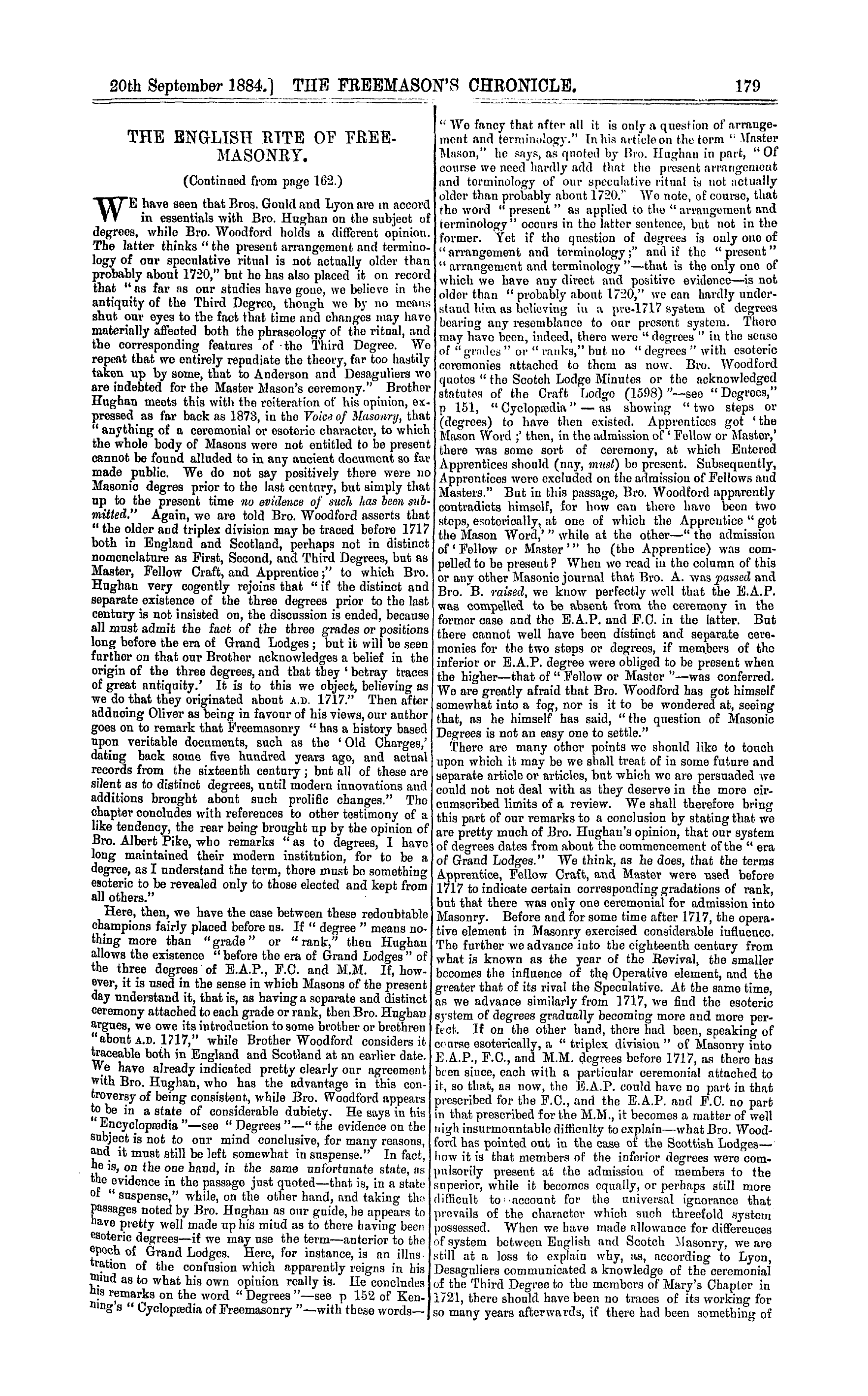
( Continued from page 162 . ) WE have seen that Bros . Gould and Lyon are in accord in essentials with Bro . Hughan on the subject of degrees , while Bro . Woodford holds a different opinion . The latter thinks " the present arrangement and terminology of our speculative ritual is not actually older than
probably about 1720 , " but he has also placed it on record that " as far as our studies have gone , we believe in the antiquity of the Third Degree , though we by no moans shut our eyes to the fact that time and changes may havo materially affected both the phraseology of the ritual , and
the corresponding features of -the Third Degree . We repeat that we entirely repudiate the theory , far too hastily taken up by some , that to Anderson and Desaguliers wo are indebted for the Master Mason ' s ceremony . " Brother Hughan meets this with the reiteration of his opinion ,
expressed as far back as 1873 , in the Voice of Masonry , that " anything of a ceremonial or esoteric character , to which the whole body of Masons were not entitled to be present cannot be found alluded to in any ancient document so far made public . We do not say positively there \ rere no
Masonic degres prior to the last century , but simply that up to the present time no evidence of such has been submitted . " Again , we are told Bro . Woodford asserts that " the older and tri plex division may be traced before 1717 both in England and Scotland , perhaps not in distinct
nomenclature as First , Second , and Third Degrees , but as Master , Fellow Craft , and Apprentice ; " to which Bro . Hughan very cogently rejoins that " if the distinct and separate existence of the three degrees prior to the last
century is not insisted on , the discussion is ended , because all must admit the fact of the three grades or positions long before the era of Grand Lodges ; but it will be seen further on that our Brother acknowledges a belief in the
origin of the three degrees , and that they ' betray traces of great antiquity . ' It is to this we object , believing as we do that they originated about A . D . 1717 . " Then after adducing Oliver as being in favour of his views , our author goes on to remark that Freemasonry " has a history based
upon veritable documents , such as the ' Old Charges , ' dating back some five hundred years ago , and actual records from the sixteenth century ; but all of these are silent as to distinct degrees , until modern innovations and additions brought about such prolific changes . " The
chapter concludes with references to other testimony of a like tendency , the rear being brought up by the opinion of Bro . Albert Pike , who remarks " as to degrees , I have
long maintained their modern institution , for to be a degree , as I understand the term , there must be something esoteric to be revealed only to those elected and kept from all others . "
Here , then , we have the case between these redoubtable champions fairly placed before us . If " degree " means nothing more than " grade" or "rank , " then Hughan allows the existence " before the era of Grand Lodges " of the three degrees of E . A . P ., F . C . and M . M . If ,
however , it is used m the sense in which Masons of the present day understand it , that is , as having a separate and distinct ceremony attached to each grade or rank , then Bro . Hughan argues , we owe its introduction to some brother or brethren " about A . D . 1717 , " while Brother Woodford considers it
traceable both in England and Scotland at an earlier date . We have already indicated pretty clearly our agreement with Bro . Hughan , who has the advantage in this controversy of being consistent , while Bro . Woodford appears to be in a state of considerable dubiety . He says in his
Encyclopaadia "—see " Degrees "— " the evidence on the subject is not to our mind conclusive , for many reasons , and it must still be left somewhat in suspense . " In fact , ne is , on the one hand , in the same unfortunate state , as the evidence in the passage just quoted—that isin a state
, ° f " suspense , " while , on the other hand , and taking tho passages noted by Bro . Hughan as our guide , he appears to have pretty well made up his mind as to there having been esoteric degrees—if we may use the term—anterior to the
epoch of Grand Lodges . Here , for instance , is an illns ^ 'ration of the confusion which apparently reigns in his £ » nd as to what his own opinion really is . He concludes fl | s remarks on the word " Degrees "—see p 152 of Kenning ' s " Cycloptedia of Freemasonry "—with these words—
The English Rite Of Freemasonry.
" Wo fancy that after all it is onl y a question of arrangement and terminology . " In his article on the term li Master Mason , " he says , as quoted by Bro . Haghan in part , "Of course we need hardly add that the present arrangement and torminology of our speculative ritual is not actually
older than probably about 1720 . " We note , of course , that the word " present " as applied to the " arrangement and terminology " occurs in tho latter sentence , but not in tho former . Yet if the question of degrees is only ono of " arrangement and terminology ; " and if tho " present "
" arrangement and terminology "—that is the only one of which we have any direct and positive evidence—is not older than " probably about 1720 , " we can hardly understand him as believing iu a pve-1717 system of degrees bearing any resemblance to our present system . There may have been , indeed , there were " degrees " in tho sense
of "grades " or " ranks , " but no " degrees " with esoteric ceremonies attached to them as now . Bro . Woodford quotes " tho Scotch Lodge Minutes or the acknowledged statutes of tho Craft Lodgo ( 1598 ) "—see " Degrees , "
p 151 , " Cyclopaedia — as showing " two steps or ( degrees ) to have then existed . Apprentices got ' the Mason Word ; ' then , in the admission of' Follow or Master , ' there was some sort of ceremony , at which Entered Apprentices should ( nay , must ) bo present . Subsequently ,
Apprentices were excluded on the admission of Fellows and Masters . " But in this passage , Bro . Woodford apparently contradicts himself , for how can there havo been two steps , esoterically , at one of which the Apprentice " got the Mason Word ' " while at the other— " the admission
of ' Fellow or Master '" he ( the Apprentice ) was compelled to be present ? When we read in the column of this or any other Masonic journal that Bro . A . was passed and Bro . B . raised , we know perfectly well that the E . A . P . was compelled to be absent from the ceremony in the former case and the E . A . P . and F . C . in the latter . But
there cannot well have been distinct and separate ceremonies for the two steps or degrees , if members of the inferior or E . A . P . degree were obliged to be present when the higher—that of " Fellow or Master "—was conferred .
We are greatly afraid that Bro . Woodford has got himself somewhat into a fog , nor is it to be wondered at , seeing that , as he himself has said , "the question of Masonic Degrees is not an easy one to settle . "
There are many other points we should like to touch upon which it may be we shall treat of in some future and separate article or articles , but which we are persuaded we could not not deal with as they deserve in the more circumscribed limits of a review . We shall therefore brinf *
this part of our remarks to a conclusion by stating that we are pretty much of Bro . Hughan ' s opinion , that our system of degrees dates from about the commencement of the " era of Grand Lodges . " We think , as he does , that the terms Apprentice , Fellow Craft , and Master were used before
1717 to indicate certain corresponding gradations of rank , but that there was only one ceremonial for admission into Masonry . Before and for some time after 1717 , the operative element in Masonry exercised considerable influence . The further we advance into the eighteenth century from
what is known as the year of the Revival , the smaller becomes the influence of the Operative element , and the greater that of its rival the Speculative . At the same time , as we advance similarly from 1717 , we find the esoteric system of degrees gradually becoming more and more
perfect . If on the other hand , there had been , speaking of course esoterically , a " triplex division " of Masonry into E . A . P ., F . C , and M . M . degrees before 1717 , as there has been siuce , each with a particular ceremonial attached to it , so that , as now , the 1 Q . A . P . could have no part in that
prescribed for the F . C , and the E . A . P . and F . C . no part in that prescribed for the M . M ., it becomes a matter of well nigh insurmountable difficulty to explain—what Bro . Woodford has pointed out iu the case of the Scottish Lodgeshow it is that members of the inferior degrees were
compnlsorily present at the admission of members to the superior , while it becomes equally , or perhaps still more difficult to-account for the universal ignorance that prevails of the character which such threefold system possessed . When we have made allowance for differences
of system between English and Scotch ilasonry , we are still at a loss to explain why , as , according to Lyon , Desaguliers communicated a knowledge of the ceremonial of the Third Degree to tho members of Mary ' s Chapter in 1721 , there should have been no traces of its working for so many years afterwards , if there had been something of




Note: This text has been automatically extracted via Optical Character Recognition (OCR) software.
The English Rite Of Freemasonry.
THE ENGLISH RITE OF FREEMASONRY .
( Continued from page 162 . ) WE have seen that Bros . Gould and Lyon are in accord in essentials with Bro . Hughan on the subject of degrees , while Bro . Woodford holds a different opinion . The latter thinks " the present arrangement and terminology of our speculative ritual is not actually older than
probably about 1720 , " but he has also placed it on record that " as far as our studies have gone , we believe in the antiquity of the Third Degree , though we by no moans shut our eyes to the fact that time and changes may havo materially affected both the phraseology of the ritual , and
the corresponding features of -the Third Degree . We repeat that we entirely repudiate the theory , far too hastily taken up by some , that to Anderson and Desaguliers wo are indebted for the Master Mason ' s ceremony . " Brother Hughan meets this with the reiteration of his opinion ,
expressed as far back as 1873 , in the Voice of Masonry , that " anything of a ceremonial or esoteric character , to which the whole body of Masons were not entitled to be present cannot be found alluded to in any ancient document so far made public . We do not say positively there \ rere no
Masonic degres prior to the last century , but simply that up to the present time no evidence of such has been submitted . " Again , we are told Bro . Woodford asserts that " the older and tri plex division may be traced before 1717 both in England and Scotland , perhaps not in distinct
nomenclature as First , Second , and Third Degrees , but as Master , Fellow Craft , and Apprentice ; " to which Bro . Hughan very cogently rejoins that " if the distinct and separate existence of the three degrees prior to the last
century is not insisted on , the discussion is ended , because all must admit the fact of the three grades or positions long before the era of Grand Lodges ; but it will be seen further on that our Brother acknowledges a belief in the
origin of the three degrees , and that they ' betray traces of great antiquity . ' It is to this we object , believing as we do that they originated about A . D . 1717 . " Then after adducing Oliver as being in favour of his views , our author goes on to remark that Freemasonry " has a history based
upon veritable documents , such as the ' Old Charges , ' dating back some five hundred years ago , and actual records from the sixteenth century ; but all of these are silent as to distinct degrees , until modern innovations and additions brought about such prolific changes . " The
chapter concludes with references to other testimony of a like tendency , the rear being brought up by the opinion of Bro . Albert Pike , who remarks " as to degrees , I have
long maintained their modern institution , for to be a degree , as I understand the term , there must be something esoteric to be revealed only to those elected and kept from all others . "
Here , then , we have the case between these redoubtable champions fairly placed before us . If " degree " means nothing more than " grade" or "rank , " then Hughan allows the existence " before the era of Grand Lodges " of the three degrees of E . A . P ., F . C . and M . M . If ,
however , it is used m the sense in which Masons of the present day understand it , that is , as having a separate and distinct ceremony attached to each grade or rank , then Bro . Hughan argues , we owe its introduction to some brother or brethren " about A . D . 1717 , " while Brother Woodford considers it
traceable both in England and Scotland at an earlier date . We have already indicated pretty clearly our agreement with Bro . Hughan , who has the advantage in this controversy of being consistent , while Bro . Woodford appears to be in a state of considerable dubiety . He says in his
Encyclopaadia "—see " Degrees "— " the evidence on the subject is not to our mind conclusive , for many reasons , and it must still be left somewhat in suspense . " In fact , ne is , on the one hand , in the same unfortunate state , as the evidence in the passage just quoted—that isin a state
, ° f " suspense , " while , on the other hand , and taking tho passages noted by Bro . Hughan as our guide , he appears to have pretty well made up his mind as to there having been esoteric degrees—if we may use the term—anterior to the
epoch of Grand Lodges . Here , for instance , is an illns ^ 'ration of the confusion which apparently reigns in his £ » nd as to what his own opinion really is . He concludes fl | s remarks on the word " Degrees "—see p 152 of Kenning ' s " Cycloptedia of Freemasonry "—with these words—
The English Rite Of Freemasonry.
" Wo fancy that after all it is onl y a question of arrangement and terminology . " In his article on the term li Master Mason , " he says , as quoted by Bro . Haghan in part , "Of course we need hardly add that the present arrangement and torminology of our speculative ritual is not actually
older than probably about 1720 . " We note , of course , that the word " present " as applied to the " arrangement and terminology " occurs in tho latter sentence , but not in tho former . Yet if the question of degrees is only ono of " arrangement and terminology ; " and if tho " present "
" arrangement and terminology "—that is the only one of which we have any direct and positive evidence—is not older than " probably about 1720 , " we can hardly understand him as believing iu a pve-1717 system of degrees bearing any resemblance to our present system . There may have been , indeed , there were " degrees " in tho sense
of "grades " or " ranks , " but no " degrees " with esoteric ceremonies attached to them as now . Bro . Woodford quotes " tho Scotch Lodge Minutes or the acknowledged statutes of tho Craft Lodgo ( 1598 ) "—see " Degrees , "
p 151 , " Cyclopaedia — as showing " two steps or ( degrees ) to have then existed . Apprentices got ' the Mason Word ; ' then , in the admission of' Follow or Master , ' there was some sort of ceremony , at which Entered Apprentices should ( nay , must ) bo present . Subsequently ,
Apprentices were excluded on the admission of Fellows and Masters . " But in this passage , Bro . Woodford apparently contradicts himself , for how can there havo been two steps , esoterically , at one of which the Apprentice " got the Mason Word ' " while at the other— " the admission
of ' Fellow or Master '" he ( the Apprentice ) was compelled to be present ? When we read in the column of this or any other Masonic journal that Bro . A . was passed and Bro . B . raised , we know perfectly well that the E . A . P . was compelled to be absent from the ceremony in the former case and the E . A . P . and F . C . in the latter . But
there cannot well have been distinct and separate ceremonies for the two steps or degrees , if members of the inferior or E . A . P . degree were obliged to be present when the higher—that of " Fellow or Master "—was conferred .
We are greatly afraid that Bro . Woodford has got himself somewhat into a fog , nor is it to be wondered at , seeing that , as he himself has said , "the question of Masonic Degrees is not an easy one to settle . "
There are many other points we should like to touch upon which it may be we shall treat of in some future and separate article or articles , but which we are persuaded we could not not deal with as they deserve in the more circumscribed limits of a review . We shall therefore brinf *
this part of our remarks to a conclusion by stating that we are pretty much of Bro . Hughan ' s opinion , that our system of degrees dates from about the commencement of the " era of Grand Lodges . " We think , as he does , that the terms Apprentice , Fellow Craft , and Master were used before
1717 to indicate certain corresponding gradations of rank , but that there was only one ceremonial for admission into Masonry . Before and for some time after 1717 , the operative element in Masonry exercised considerable influence . The further we advance into the eighteenth century from
what is known as the year of the Revival , the smaller becomes the influence of the Operative element , and the greater that of its rival the Speculative . At the same time , as we advance similarly from 1717 , we find the esoteric system of degrees gradually becoming more and more
perfect . If on the other hand , there had been , speaking of course esoterically , a " triplex division " of Masonry into E . A . P ., F . C , and M . M . degrees before 1717 , as there has been siuce , each with a particular ceremonial attached to it , so that , as now , the 1 Q . A . P . could have no part in that
prescribed for the F . C , and the E . A . P . and F . C . no part in that prescribed for the M . M ., it becomes a matter of well nigh insurmountable difficulty to explain—what Bro . Woodford has pointed out iu the case of the Scottish Lodgeshow it is that members of the inferior degrees were
compnlsorily present at the admission of members to the superior , while it becomes equally , or perhaps still more difficult to-account for the universal ignorance that prevails of the character which such threefold system possessed . When we have made allowance for differences
of system between English and Scotch ilasonry , we are still at a loss to explain why , as , according to Lyon , Desaguliers communicated a knowledge of the ceremonial of the Third Degree to tho members of Mary ' s Chapter in 1721 , there should have been no traces of its working for so many years afterwards , if there had been something of