-
Articles/Ads
Article COMMENTS ON " FACTS AND FICTIONS." ← Page 2 of 2 Article COMMENTS ON " FACTS AND FICTIONS." Page 2 of 2 Article PERSONAL WORTH. Page 1 of 1
Note: This text has been automatically extracted via Optical Character Recognition (OCR) software.
Comments On " Facts And Fictions."
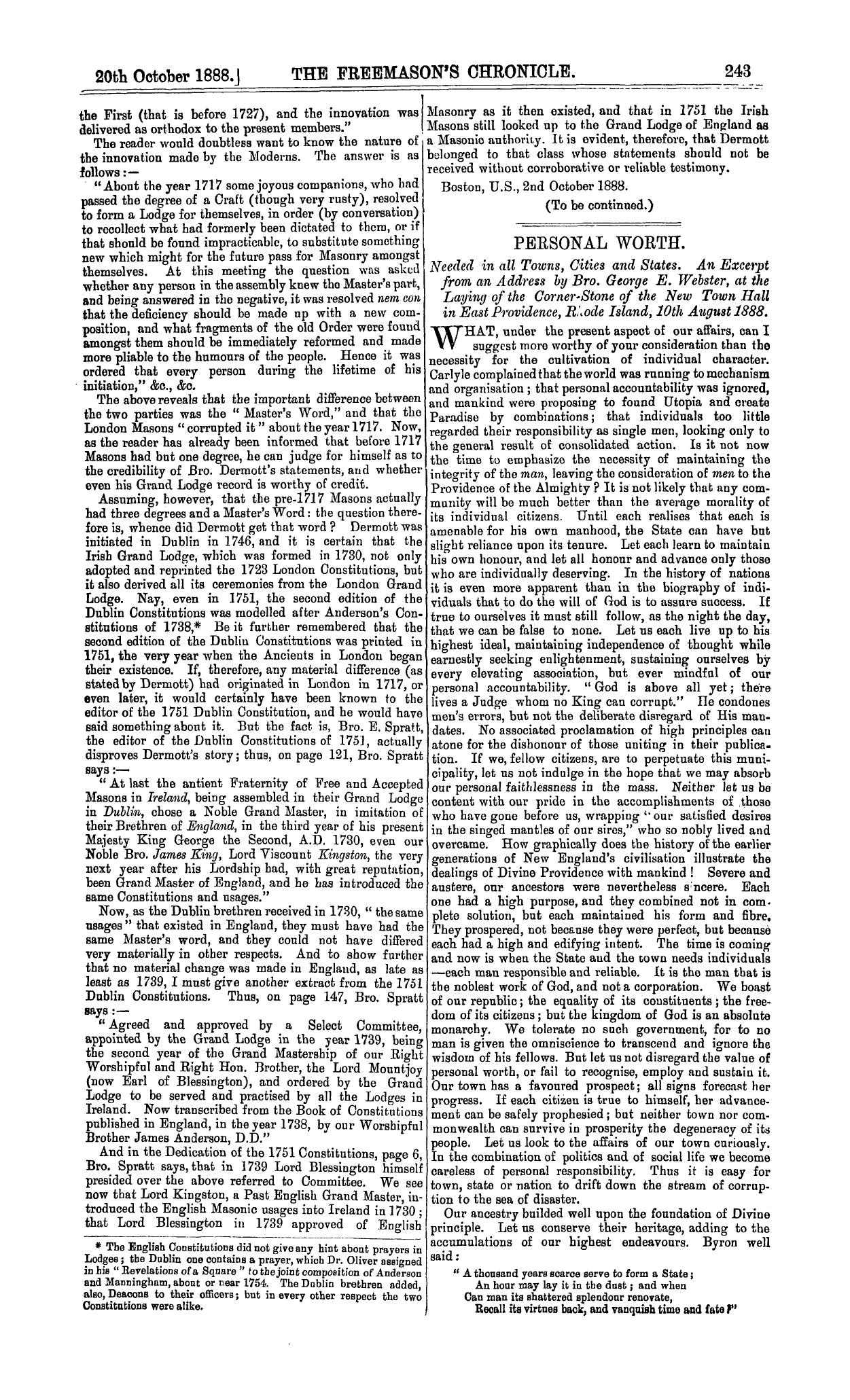
the First ( that is before 1727 ) , and the innovation was delivered as orthodox to the present members . "
The reader would doubtless want to know the nature of the innovation made by the Moderns . The answer is as follows : —
" About the year 1717 some joyous companions , who had passed the degree of a Craft ( though very rusty ) , resolved to form a Lodge for themselves , in order ( by conversation ) to recollect what had formerly been dictated to them , or if
that should be found impracticable , to substitute something new which might for the future pass for Masonry amongst themselves . At this meeting the question was asked
•whether any person in the assembly knew tho Master ' s part , and being answered in the negative , it was resolved nem con that the deficiency should be made up with a new
composition , and what fragments of the old Order were found amongst them should be immediately reformed and made more pliable to the humours of the people . Hence it was ordered that every person during the lifetime of his initiation , " & c , & c . The above reveals that the important difference between the two parties was the " Master's Word , " and that tho London Masons " corrupted it " about the year 1717 . Now ,
as the reader has already been informed that before 1717 Masons had but one degree , he can judge for himself as to the credibility of Bro . Dermott's statements , and whether even his Grand Lodge record is worthy of credit .
Assuming , however , that the pre-1717 Masons actually had three degrees and a Master's Word : the question therefore is , whence did Dermott get that word ? Dermott was
initiated in Dublin in 1746 , and it is certain that the Irish Grand Lodge , which was formed in 1730 , not only adopted and reprinted the 1723 London Constitutions , but it also derived all its ceremonies from the London Grand
Lodge . Nay , even in 1751 , the second edition of the Dublin Constitutions was modelled after Anderson ' s Constitutions of 1738 , * Be it further remembered that the second edition of the Dublin Constitutions was printed in
1751 , the very year when the Ancients in London began their existence . If , therefore , any material difference ( as stated by Dermott ) had originated in London in 1717 , or
even later , it would certainly have been known to the editor of the 1751 Dublin Constitution , and he would have said something about it . But the fact is , Bro . E . Spratt , the editor of the Dublin Constitutions of 175 J , actually disproves Dermott's story ; thus , on page 121 , Bro . Spratt
says : — " At last the antient Fraternity of Free and Accepted Masons in Ireland , being assembled in their Grand Lodge in Dublin , chose a Noble Grand Master , in imitation of
their Brethren of England , in the third year of his present Majesty King George the Second , A . D . 1730 , even our Noble Bro . James King , Lord Viscount Kingston , the very
next year after his Lordship had , with great reputation , been Grand Master of England , and he has introduced the same Constitutions and usages . "
Now , as the Dublin brethren received in 1730 , " the same usages " that existed in England , they must have had the same Master ' s word , and they could not have differed
very materially in other respects . And to show further that no material change was made in England , as late as least as 1739 , I must give another extract from the 1751
Dublin Constitutions . Thus , on page 147 , Bro . Spratt
says : — " Agreed and approved by a Select Committee , appointed by the Grand Lodge in the year 1739 , being the second year of the Grand Mastership of our Right
Worshipful and Right Hon . Brother , the Lord Mountjoy ( now Earl of Blessington ) , and ordered by the Grand Lodge to be served and practised by all the Lodges in
Ireland . Now transcribed from the Book of Constitutions published in England , in the year 1738 , by our Worshipful Brother James Anderson , D . D . "
And in the Dedication of the 1751 Constitutions , page 6 , Bro . Spratt says , that in 1739 Lord Blessington himself presided over the above referred to Committee . We see
now that Lord Kingston , a Past English Grand Master , introduced the English Masonic usages into Ireland in 1730 ; that Lord Blessington in 1739 approved of English
Comments On " Facts And Fictions."
Masonry as it then existed , and that in 1751 the Irish Masons still looked up to the Grand Lodge of England as
a Masonic authority . It is evident , therefore , that Dermott belonged to that class whose statements should not be received without corroborative or reliable testimony .
Boston , U . S ., 2 nd October 1888 . ( To be continued . )
Personal Worth.
PERSONAL WORTH .
Needed m all Towns , Cities and States , An Excerpt from an Address by Bro . George E . Webster , at the Laying of the Corner-Stone of the New Town Hall in East Providence , Biode Island , 10 th August 1888 .
WHAT , under the present aspect of our affairs , can I suggest more worthy of your consideration than the necessity for the cultivation of individual character . Carlyle complained that the world was running to mechanism and organisation ; that personal accountability was ignored ,
and mankind were proposing to found Utopia and create Paradise by combinations ; that individuals too little regarded their responsibility as single men , looking only to the general result of consolidated action . Is it not now
the time to emphasize the necessity of maintaining the integrity of the man , leaving the consideration of men to the Providence of the Almighty ? It is not likely that any community will be much better than the average morality of its individual citizens . Until each realises that each is
amenable for bis own manhood , the State can have but slight reliance upon its tenure . Let each learn to maintain his own honour , and let all honour and advance only those
who are individually deserving . In the history of nations it is even more apparent than in the biography of individuals that to do the will of God is to assure success . If
true to ourselves it must still follow , as the night the day , that we can be false to none . Let us each live up to his highest ideal , maintaining independence of thought while earnestly seeking enlightenment , sustaining ourselves by
every elevating association , but ever mindful or our personal accountability . " God is above all yet ; there lives a Judge whom no King can corrupt . " He condones men ' s errors , but not the deliberate disregard of His
mandates . No associated proclamation of high principles can atone for the dishonour of those uniting in their publication . If we , fellow citizens , are to perpetuate this municipality , let us not indulge in the hope that we may absorb
our personal faithlessness in the mass . Neither let us be content with our pride in the accomplishments of those who have gone before us , wrapping '' our satisfied desires in the singed mantles of our sires , " who so nobly lived and
overcame . How graphically does the history of the earlier generations of New England ' s civilisation illustrate the dealings of Divine Providence with mankind ! Severe and austere , our ancestors were nevertheless s ncere . Each
one had a high purpose , and they combined not in complete solution , but each maintained his form and fibre , They prospered , not because they were perfect , but because each had a high and edifying intent . The time is coming and now is when the State aud the town needs individuals
—each man responsible and reliable . It is the man that is the noblest work of God , and not a corporation . We boast of our republic ; the equality of its constituents ; the freedom of its citizens ; but the kingdom of God is an absolute monarchy . We tolerate no such government , for to no man is given the omniscience to transcend and ignore the
wisdom of his fellows . But let us not disregard the value of personal worth , or fail to recognise , employ and sustain it . Our town has a favoured prospect ; all signs forecast her progress . If each citizen is true to himself , her
advancement can be safely prophesied ; but neither town nor commonwealth can survive in prosperity the degeneracy of its people . Let us look to the affairs of our town curiously .
In the combination of politics and of social life we become careless of personal responsibility . Thus it is easy for town , state or nation to drift down the stream of corruption to the sea of disaster .
Our ancestry builded well upon the foundation of Divine principle . Let us conserve their heritage , adding to the accumulations of our highest endeavours . Byron well said :
A thousand years scarce serve to form a State ; An hour may lay it in the dust ; and when Can man its shattered splendour renovate , Recall its virtues back , and vanquish time and fate ?'





Note: This text has been automatically extracted via Optical Character Recognition (OCR) software.
Comments On " Facts And Fictions."
the First ( that is before 1727 ) , and the innovation was delivered as orthodox to the present members . "
The reader would doubtless want to know the nature of the innovation made by the Moderns . The answer is as follows : —
" About the year 1717 some joyous companions , who had passed the degree of a Craft ( though very rusty ) , resolved to form a Lodge for themselves , in order ( by conversation ) to recollect what had formerly been dictated to them , or if
that should be found impracticable , to substitute something new which might for the future pass for Masonry amongst themselves . At this meeting the question was asked
•whether any person in the assembly knew tho Master ' s part , and being answered in the negative , it was resolved nem con that the deficiency should be made up with a new
composition , and what fragments of the old Order were found amongst them should be immediately reformed and made more pliable to the humours of the people . Hence it was ordered that every person during the lifetime of his initiation , " & c , & c . The above reveals that the important difference between the two parties was the " Master's Word , " and that tho London Masons " corrupted it " about the year 1717 . Now ,
as the reader has already been informed that before 1717 Masons had but one degree , he can judge for himself as to the credibility of Bro . Dermott's statements , and whether even his Grand Lodge record is worthy of credit .
Assuming , however , that the pre-1717 Masons actually had three degrees and a Master's Word : the question therefore is , whence did Dermott get that word ? Dermott was
initiated in Dublin in 1746 , and it is certain that the Irish Grand Lodge , which was formed in 1730 , not only adopted and reprinted the 1723 London Constitutions , but it also derived all its ceremonies from the London Grand
Lodge . Nay , even in 1751 , the second edition of the Dublin Constitutions was modelled after Anderson ' s Constitutions of 1738 , * Be it further remembered that the second edition of the Dublin Constitutions was printed in
1751 , the very year when the Ancients in London began their existence . If , therefore , any material difference ( as stated by Dermott ) had originated in London in 1717 , or
even later , it would certainly have been known to the editor of the 1751 Dublin Constitution , and he would have said something about it . But the fact is , Bro . E . Spratt , the editor of the Dublin Constitutions of 175 J , actually disproves Dermott's story ; thus , on page 121 , Bro . Spratt
says : — " At last the antient Fraternity of Free and Accepted Masons in Ireland , being assembled in their Grand Lodge in Dublin , chose a Noble Grand Master , in imitation of
their Brethren of England , in the third year of his present Majesty King George the Second , A . D . 1730 , even our Noble Bro . James King , Lord Viscount Kingston , the very
next year after his Lordship had , with great reputation , been Grand Master of England , and he has introduced the same Constitutions and usages . "
Now , as the Dublin brethren received in 1730 , " the same usages " that existed in England , they must have had the same Master ' s word , and they could not have differed
very materially in other respects . And to show further that no material change was made in England , as late as least as 1739 , I must give another extract from the 1751
Dublin Constitutions . Thus , on page 147 , Bro . Spratt
says : — " Agreed and approved by a Select Committee , appointed by the Grand Lodge in the year 1739 , being the second year of the Grand Mastership of our Right
Worshipful and Right Hon . Brother , the Lord Mountjoy ( now Earl of Blessington ) , and ordered by the Grand Lodge to be served and practised by all the Lodges in
Ireland . Now transcribed from the Book of Constitutions published in England , in the year 1738 , by our Worshipful Brother James Anderson , D . D . "
And in the Dedication of the 1751 Constitutions , page 6 , Bro . Spratt says , that in 1739 Lord Blessington himself presided over the above referred to Committee . We see
now that Lord Kingston , a Past English Grand Master , introduced the English Masonic usages into Ireland in 1730 ; that Lord Blessington in 1739 approved of English
Comments On " Facts And Fictions."
Masonry as it then existed , and that in 1751 the Irish Masons still looked up to the Grand Lodge of England as
a Masonic authority . It is evident , therefore , that Dermott belonged to that class whose statements should not be received without corroborative or reliable testimony .
Boston , U . S ., 2 nd October 1888 . ( To be continued . )
Personal Worth.
PERSONAL WORTH .
Needed m all Towns , Cities and States , An Excerpt from an Address by Bro . George E . Webster , at the Laying of the Corner-Stone of the New Town Hall in East Providence , Biode Island , 10 th August 1888 .
WHAT , under the present aspect of our affairs , can I suggest more worthy of your consideration than the necessity for the cultivation of individual character . Carlyle complained that the world was running to mechanism and organisation ; that personal accountability was ignored ,
and mankind were proposing to found Utopia and create Paradise by combinations ; that individuals too little regarded their responsibility as single men , looking only to the general result of consolidated action . Is it not now
the time to emphasize the necessity of maintaining the integrity of the man , leaving the consideration of men to the Providence of the Almighty ? It is not likely that any community will be much better than the average morality of its individual citizens . Until each realises that each is
amenable for bis own manhood , the State can have but slight reliance upon its tenure . Let each learn to maintain his own honour , and let all honour and advance only those
who are individually deserving . In the history of nations it is even more apparent than in the biography of individuals that to do the will of God is to assure success . If
true to ourselves it must still follow , as the night the day , that we can be false to none . Let us each live up to his highest ideal , maintaining independence of thought while earnestly seeking enlightenment , sustaining ourselves by
every elevating association , but ever mindful or our personal accountability . " God is above all yet ; there lives a Judge whom no King can corrupt . " He condones men ' s errors , but not the deliberate disregard of His
mandates . No associated proclamation of high principles can atone for the dishonour of those uniting in their publication . If we , fellow citizens , are to perpetuate this municipality , let us not indulge in the hope that we may absorb
our personal faithlessness in the mass . Neither let us be content with our pride in the accomplishments of those who have gone before us , wrapping '' our satisfied desires in the singed mantles of our sires , " who so nobly lived and
overcame . How graphically does the history of the earlier generations of New England ' s civilisation illustrate the dealings of Divine Providence with mankind ! Severe and austere , our ancestors were nevertheless s ncere . Each
one had a high purpose , and they combined not in complete solution , but each maintained his form and fibre , They prospered , not because they were perfect , but because each had a high and edifying intent . The time is coming and now is when the State aud the town needs individuals
—each man responsible and reliable . It is the man that is the noblest work of God , and not a corporation . We boast of our republic ; the equality of its constituents ; the freedom of its citizens ; but the kingdom of God is an absolute monarchy . We tolerate no such government , for to no man is given the omniscience to transcend and ignore the
wisdom of his fellows . But let us not disregard the value of personal worth , or fail to recognise , employ and sustain it . Our town has a favoured prospect ; all signs forecast her progress . If each citizen is true to himself , her
advancement can be safely prophesied ; but neither town nor commonwealth can survive in prosperity the degeneracy of its people . Let us look to the affairs of our town curiously .
In the combination of politics and of social life we become careless of personal responsibility . Thus it is easy for town , state or nation to drift down the stream of corruption to the sea of disaster .
Our ancestry builded well upon the foundation of Divine principle . Let us conserve their heritage , adding to the accumulations of our highest endeavours . Byron well said :
A thousand years scarce serve to form a State ; An hour may lay it in the dust ; and when Can man its shattered splendour renovate , Recall its virtues back , and vanquish time and fate ?'