-
Articles/Ads
Article TWENTY-FIVE YEARS SERVICE IN MASONRY. Page 1 of 2 Article TWENTY-FIVE YEARS SERVICE IN MASONRY. Page 1 of 2 →
Note: This text has been automatically extracted via Optical Character Recognition (OCR) software.
Twenty-Five Years Service In Masonry.
TWENTY-FIVE YEARS SERVICE IN MASONRY .
WHEN we look back on the last twenty-five years in the History of Freemasonry we seem to have a period that is scarcely worthy of special consideration in
comparison with the long ages through which our beloved Order has flourished , but if we take these twenty-five years in association with the Masonic career of an individual
member of the Fraternity what a different aspect presents itself to our view . In the one case , the twenty-five years is but one of many similar periods through which Freemasonry has passed , and will pass again ; in the other the
term represents a considerable portion of an ordinary lifetime , while it may be said to be far above the average period of a Brother ' s connection with the Order . At the present time , when Masonic Lodges are to be found in all
parts of the globe , and their subscribing members may be counted by hundreds of thousands , it hardly seems possible that twenty-five years since the larger number of these Lodges were unthought of , while the majority of the
members of to-day had not emerged from the happy time of boyhood ; yet such is the case , and the brother who can boast an uninterrupted Masonic career of twenty-five years enjoys a position in the Craft which should entitle him to
more than respect at the hands of his fellows . There are not many brethren who can point to such a period of Masonic activity , and hence it is that the honour is all the more to be prized . It would not indeed be a difficult matter to count the brethren who have taken an active
and continuous interest in Freemasonry during the last twenty-five years , and , strange as it may seem , were we to do so we should find in their midst some of the most
prominent Masons of the present day , thus proving that a long association with the Order does not necessarily result in a loss of interest in its concerns .
There is one brother whose name is at present prominently before the English Craft , who , by his untiring energy during the past thirty-five years on behalf of
Freemasonry , has played no unimportant part in raising the Order to its present state of prosperity . We do not say that without him the Order would have been less
popular than now it is , but we do believe that one of its noblest principles , that of Charity—as exemplified in the maintenance of the widow and orphan , and the education of the young—would not have assumed so large and
practical a shape as it at present enjoys in this country had he not , in his earlier days , devoted himself to its promulgation , and , with unceasing energy during the last twenty-five years , continued his efforts to promote its practice . "Our
^ ercules , as some ten years since we designated the brother of whom we speak , has lost none of that zeal and persev erance of which he then possessed so large a share , and which formed the basis on which rested his right to wie
title we selected for him . On the contrary , the time ° at has passed since then unquestionably has given him greater experience , and increased his desire to help those on whose behalf he has so long pleaded , and for whom he
«•» aoue au that has lain in his power , xlecogmzing these acts , it is not surprising that a movement has been inaugurated for the purpose of raising a testimonial to be presented
7 "' - , m recognition ot his twenty-Uve years grvice as Secretary of tbe Royal Masonic Institution for . ° ys , or that an influential body of brethren has already given their support to the proposal .
Twenty-Five Years Service In Masonry.
We have already said that to Bro . Binckes much credit is due for the share he has taken in raising Freemasonry to its present position , and if we are to recognise any brother or body of brethren as being the cause , wholly or in part , of the progress of the Order , then our statement is
a just one , for it would be hard to point to another who has worked as zealously as he has done in furtherance of the true principles of Freemasonry . We will not speak of his career previous to his appointment as Secretary of
the Boys' School , it is in that position he has made for himself the reputation he now enjoys ; moreover , it is in recognition of bis services inhis Secretarial capacity that the testimonial now proposed is being raised . In 1861 , when
Bro . Binckes undertook the duties of Secretary , the Royal Masonic Institution for Boys was , comparatively speaking , and basing our opinion on its present dimensions , an insignificant affair , enjoying an income from all sources of say
£ 2 , 048 per annum . It then had seventy boys on it 3 foundation ; fifty of these were educated and maintained in a house which had been purchased and adapted for the purpose , while the remaining twenty were educated
outside , a system which , as our readers are aware , has been abolished for some years . In the interval which has passed since the election of Bro . Binckes as Secretary ,
the Institution has grown to such an extent that to-day we find it in possession of some twelve acres of freehold land , with schools and other buildings erected thereon , which together have cost no less a sum
than £ 80 , 000 . In addition to this , the funded property has been increased to £ 17 , 500 , and the number of boys on the establishment to 240 , all being educated and maintained in the buildings of the Institution , at an annual
cost of £ 11 , 000 . How much of this increase is due to natural growth , and how much to the persistent attention of Bro . Binckes , it is impossible to say , but no one who has heard him advocate the claims of the Charity—and what
Mason has not ?—will venture the opinion that he is not entitled to a large share of the credit . For many years Bro . Binckes has never lost an opportunity of urging on the
Freemasons of England the claims of the orphan , the widow , and the needy brother ; he has never refused an invitation to attend a meeting unless a previous engagement prevented it , and no journey has been too long for him providing it was
possible to reach his destination in time for the gathering . At Newcastle perhaps one day , he would journey to the South of England the next , and then back to the Midland counties for the following , and so on , week after week , month after month , aye , and year after year . Brethren
who are in the habit of attending their own Lodges some six or eight times a year , and who accept one or two invitations from others in the course of the twelve months , can
form no idea of the fatigue this continuous visiting entails . The incessant excitement and the repeated repetition of the same forms and ceremonies is more than some men could
endure , but " Our Hercules " has proved himself above the average in this respect , and to-day enjoys a reputation unique in the annals of Freemasonry or of any kindred
organization . Can it be doubted this continued visiting and repeated advocacy of the claims of Charity has bad no result ? Rather should the present condition of the Masonic Institutions and the large sums annually contributed for their maintenance be ascribed to the exertions of Bro . Binckes and those who , in
more recent years , have supported him in his endeavours , and now that some recognition of his long services ia con-





Note: This text has been automatically extracted via Optical Character Recognition (OCR) software.
Twenty-Five Years Service In Masonry.
TWENTY-FIVE YEARS SERVICE IN MASONRY .
WHEN we look back on the last twenty-five years in the History of Freemasonry we seem to have a period that is scarcely worthy of special consideration in
comparison with the long ages through which our beloved Order has flourished , but if we take these twenty-five years in association with the Masonic career of an individual
member of the Fraternity what a different aspect presents itself to our view . In the one case , the twenty-five years is but one of many similar periods through which Freemasonry has passed , and will pass again ; in the other the
term represents a considerable portion of an ordinary lifetime , while it may be said to be far above the average period of a Brother ' s connection with the Order . At the present time , when Masonic Lodges are to be found in all
parts of the globe , and their subscribing members may be counted by hundreds of thousands , it hardly seems possible that twenty-five years since the larger number of these Lodges were unthought of , while the majority of the
members of to-day had not emerged from the happy time of boyhood ; yet such is the case , and the brother who can boast an uninterrupted Masonic career of twenty-five years enjoys a position in the Craft which should entitle him to
more than respect at the hands of his fellows . There are not many brethren who can point to such a period of Masonic activity , and hence it is that the honour is all the more to be prized . It would not indeed be a difficult matter to count the brethren who have taken an active
and continuous interest in Freemasonry during the last twenty-five years , and , strange as it may seem , were we to do so we should find in their midst some of the most
prominent Masons of the present day , thus proving that a long association with the Order does not necessarily result in a loss of interest in its concerns .
There is one brother whose name is at present prominently before the English Craft , who , by his untiring energy during the past thirty-five years on behalf of
Freemasonry , has played no unimportant part in raising the Order to its present state of prosperity . We do not say that without him the Order would have been less
popular than now it is , but we do believe that one of its noblest principles , that of Charity—as exemplified in the maintenance of the widow and orphan , and the education of the young—would not have assumed so large and
practical a shape as it at present enjoys in this country had he not , in his earlier days , devoted himself to its promulgation , and , with unceasing energy during the last twenty-five years , continued his efforts to promote its practice . "Our
^ ercules , as some ten years since we designated the brother of whom we speak , has lost none of that zeal and persev erance of which he then possessed so large a share , and which formed the basis on which rested his right to wie
title we selected for him . On the contrary , the time ° at has passed since then unquestionably has given him greater experience , and increased his desire to help those on whose behalf he has so long pleaded , and for whom he
«•» aoue au that has lain in his power , xlecogmzing these acts , it is not surprising that a movement has been inaugurated for the purpose of raising a testimonial to be presented
7 "' - , m recognition ot his twenty-Uve years grvice as Secretary of tbe Royal Masonic Institution for . ° ys , or that an influential body of brethren has already given their support to the proposal .
Twenty-Five Years Service In Masonry.
We have already said that to Bro . Binckes much credit is due for the share he has taken in raising Freemasonry to its present position , and if we are to recognise any brother or body of brethren as being the cause , wholly or in part , of the progress of the Order , then our statement is
a just one , for it would be hard to point to another who has worked as zealously as he has done in furtherance of the true principles of Freemasonry . We will not speak of his career previous to his appointment as Secretary of
the Boys' School , it is in that position he has made for himself the reputation he now enjoys ; moreover , it is in recognition of bis services inhis Secretarial capacity that the testimonial now proposed is being raised . In 1861 , when
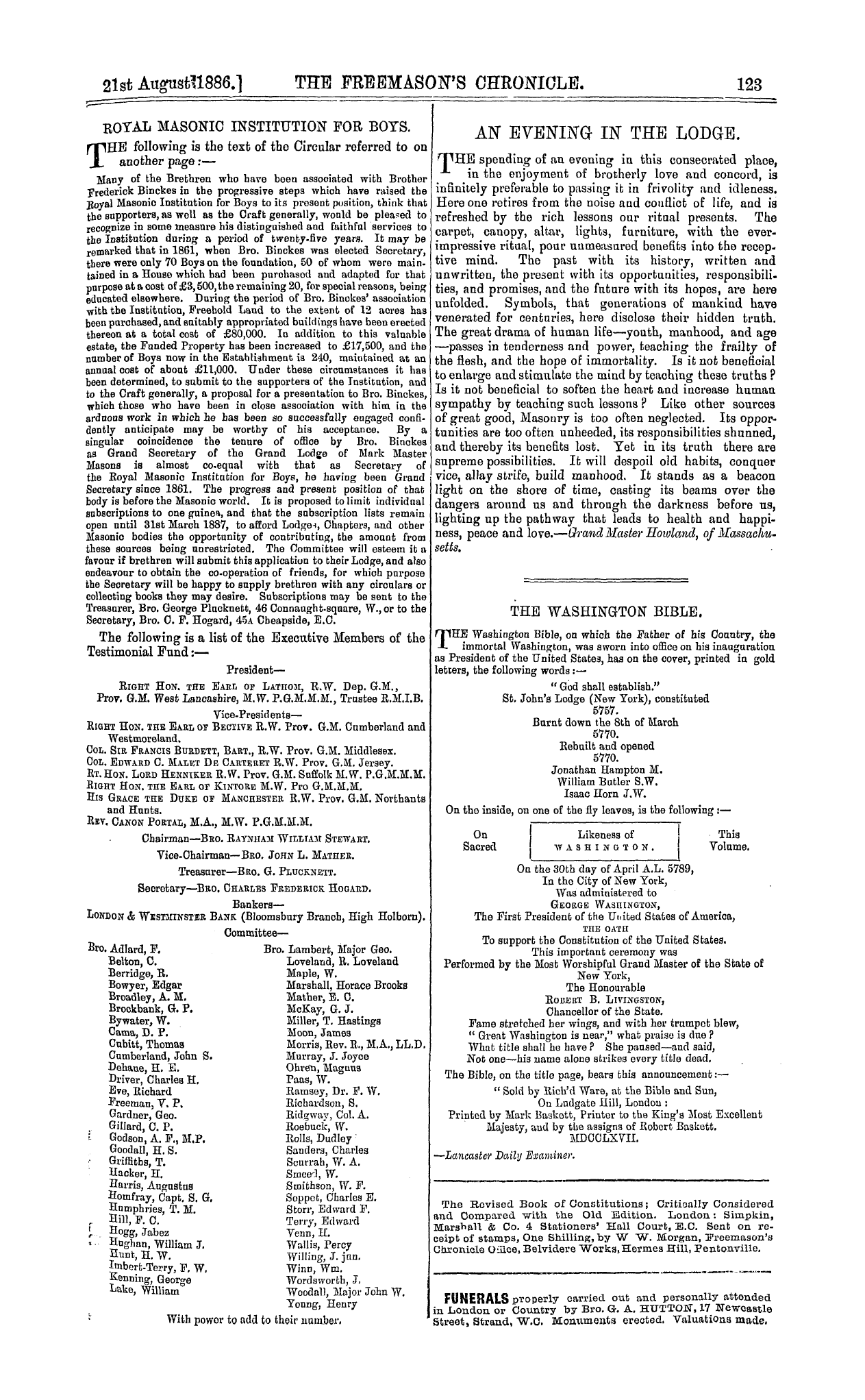
Bro . Binckes undertook the duties of Secretary , the Royal Masonic Institution for Boys was , comparatively speaking , and basing our opinion on its present dimensions , an insignificant affair , enjoying an income from all sources of say
£ 2 , 048 per annum . It then had seventy boys on it 3 foundation ; fifty of these were educated and maintained in a house which had been purchased and adapted for the purpose , while the remaining twenty were educated
outside , a system which , as our readers are aware , has been abolished for some years . In the interval which has passed since the election of Bro . Binckes as Secretary ,
the Institution has grown to such an extent that to-day we find it in possession of some twelve acres of freehold land , with schools and other buildings erected thereon , which together have cost no less a sum
than £ 80 , 000 . In addition to this , the funded property has been increased to £ 17 , 500 , and the number of boys on the establishment to 240 , all being educated and maintained in the buildings of the Institution , at an annual
cost of £ 11 , 000 . How much of this increase is due to natural growth , and how much to the persistent attention of Bro . Binckes , it is impossible to say , but no one who has heard him advocate the claims of the Charity—and what
Mason has not ?—will venture the opinion that he is not entitled to a large share of the credit . For many years Bro . Binckes has never lost an opportunity of urging on the
Freemasons of England the claims of the orphan , the widow , and the needy brother ; he has never refused an invitation to attend a meeting unless a previous engagement prevented it , and no journey has been too long for him providing it was
possible to reach his destination in time for the gathering . At Newcastle perhaps one day , he would journey to the South of England the next , and then back to the Midland counties for the following , and so on , week after week , month after month , aye , and year after year . Brethren
who are in the habit of attending their own Lodges some six or eight times a year , and who accept one or two invitations from others in the course of the twelve months , can
form no idea of the fatigue this continuous visiting entails . The incessant excitement and the repeated repetition of the same forms and ceremonies is more than some men could
endure , but " Our Hercules " has proved himself above the average in this respect , and to-day enjoys a reputation unique in the annals of Freemasonry or of any kindred
organization . Can it be doubted this continued visiting and repeated advocacy of the claims of Charity has bad no result ? Rather should the present condition of the Masonic Institutions and the large sums annually contributed for their maintenance be ascribed to the exertions of Bro . Binckes and those who , in
more recent years , have supported him in his endeavours , and now that some recognition of his long services ia con-