Note: This text has been automatically extracted via Optical Character Recognition (OCR) software.
Brother Sadler's Answer To Bro. Jacob Norton's
BROTHER SADLER'S ANSWER TO BRO . JACOB NORTON'S
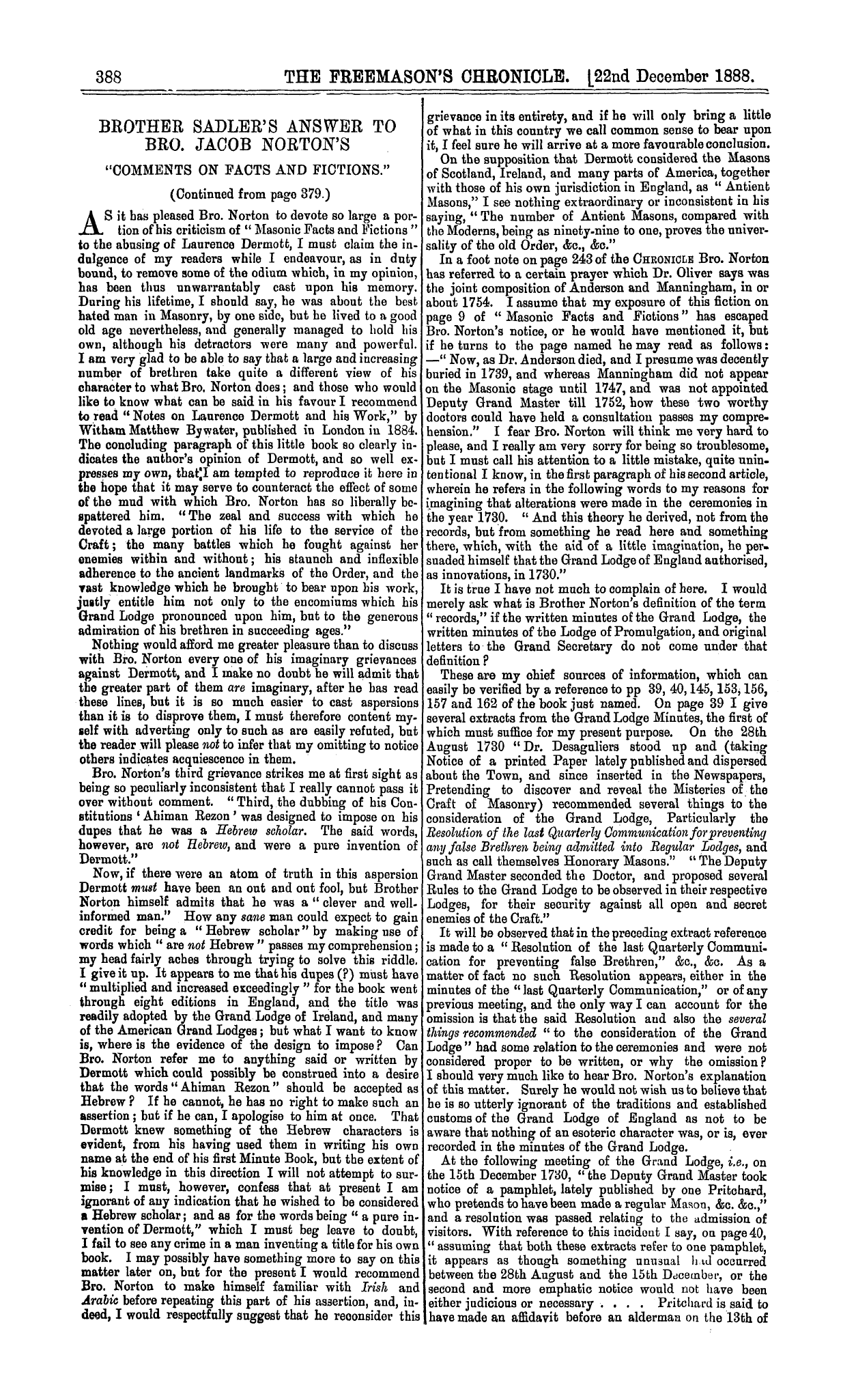
"COMMENTS ON FACTS AND FICTIONS . " ( Continued from page 379 . ) AS it has pleased Bro . Norton to devote so large a portion of his criticism of " Masonic Facts and Fictions " to the abusing of Laurence Dermott , I must claim the
indulgence of my readers while I endeavour , as in duty bound , to remove some of the odium which , in my opinion , has been thus unwarrantably cast upon his memory . During his lifetime , I should say , he was about the best
hated man in Masonry , by one side , but he lived to a good old age nevertheless , and generally managed to hold his own , although his detractors were many and powerful . I am very glad to be able to say thafc a large and increasing
number of brethren take quite a different view of his character to what Bro . Norton does ; and those who would like to know what can be said in his favour I recommend to read " Notes on Laurence Dermott and hia Work , " by
Witham Matthew Bywater , published in London in 1884 . The concluding paragraph of this little book so clearly indicates the author ' s opinion of Dermott , and so well expresses my own , that'I am tempted to reproduce ifc here in the hope that it may serve to counteract the effect of some
ot the mud witn which tiro . Norton has so liberally bespattered him . "The zeal and success with which he devoted a large portion of his life to the service of the Craft ; the many battles which he fought against her enemies within and without : his staunch and inflexible
adherence to the ancient landmarks of the Order , and the vast knowledge which he brought to bear upon his work , justly entitle him not only to the encomiums which his Grand Lodge pronounced upon him , but to the generous admiration of his brethren in succeeding ages . "
Nothing would aftord me greater pleasure than to discuss with Bro . Norton every one of his imaginary grievances against Dermott , and I make no doubt he will admit thafc the greater part of them are imaginary , after he has read these lines , but it is so much easier to cast aspersions
than it is to disprove them , I must therefore content myself with adverting only to such as are easily refuted , but the reader will please not to infer that my omitting to notice
others indicates acquiescence in them . Bro . Norton ' s third grievance strikes me at first sight as being so peculiarly inconsistent thafc I really cannofc pass ifc over without comment . " Third , the dubbing of his Constitutions ' Ahiman Rezon ' was designed to impose on his
dupes that he was a Hebrew scholar . The said words , however , are not Hebrew , and were a pure invention of Dermott . "
Now , if there were an atom of truth in this aspersion Dermott must have been an out and out fool , but Brother Norton himself admits that he was a " clever and
wellinformed man . How any sane man could expect fco gain credit , for being a " Hebrew scholar" by making use of words which " are not Hebrew " passes my comprehension ; my head fairly aches through trying to solve this riddle .
I give it up . It appears to me that his dupes (?) must have " multiplied and increased exceedingly " for the book went through eight editions in England , and the title was
readily adopted by the Grand Lodge of Ireland , and many of the American Grand Lodges ; but what I want to know is , where is the evidence of the design to impose ? Can Bro . Norton refer me to anything said or written bv
Dermott which could possibly be construed into a desire that the words " Ahiman Rezon" should be accepted as Hebrew ? If he cannot , he has no right to make such an assertion ; but if he can , I apologise to him at once . Thafc Dermott knew something of the Hebrew characters is
evident , from his having used them in writing his own name at the end of his first Minute Book , but the extent of his knowledge in this direction I will not attempt to surmise : I must , howeverconfess that afc -m _ . _ . < . nt . T am f £ .. *
, - - , J - .- __ ,, _ . __ . ___ — - _ .. ___ . ignorant of any indication that he wished to be considered a Hebrew scholar ; and as for the words being " a pure invention of Dermott . " which T must HAD * Inavo in dnnW . ¦ " ¦ ¦
-, . — ~ O ¦ * ' —•» - •'¦ ' , I fail to see any crime in a man inventing a title for his own book . I may possibly have something more to say on this matter later on , but for the present I would recommend
Joro . IN orton to make himself familiar with Irish and Arabic before repeating this part of his assertion , and , indeed , I would respectfully suggest that he reconsider this
Brother Sadler's Answer To Bro. Jacob Norton's
grievance in its entirety , and if he v . ill only bring a little of what in this country we call common sense to bear upon it , I feel sure he will arrive at a more favourable conclusion .
On tbe supposition that Dermott considered the Masons of Scotland , Ireland , and many parts of America , together with those of his own jurisdiction in England , as " Antient Masons , " I see nothing extraordinary or inconsistent in his
saying , " The number of Antient Masons , compared with the Moderns , being as ninety-nine to one , proves the universality of the old Order , & c , & c . " 4
in a toot note on page ___ s ot tne _ . HRONICLE uro . Norton has referred to a certain prayer which Dr . Oliver says -was the joint composition of Anderson and Manningham , in or about 1754 . I assume that my exposure of this fiction on page 9 of " Masonic Pacts and Fictions" has escaped Bro . Norton ' s notice , or he would have mentioned it , but
if he turns to the page named he may read as follows : — " Now , as Dr . Anderson died , and I presume was decently buried in 1739 , and whereas Manningham did not appear on the Masonic stage until 1747 , and was not appointed
Deputy Grand Master till 1752 , bow these two worthy doctors could have beld a consultation passes my comprehension . " I fear Bro . Norton will think me very hard to please , and I really am very sorry for being so troublesome , but I must call his attention to a little mistake , quite
unintentional I know , in the firsfc paragraph of his second article , wherein he refers in the following words to my reasons for imagining that alterations were made in the ceremonies in the year 1730 . " And this theory he derived , not from the
records , but from something he read here and something there , which , with the aid of a little imagination , he persuaded himself that the Grand Lodge of England authorised ,
as innovations , in 1730 . " It is true I have not much to complain of here . I would merely ask what is Brother Norton ' s definition of the term " records , " if the written minutes of the Grand Lodge , the written minutes of the Lodge of Promulgation , and original
letters to the Grand Secretary do not come under that definition ? These are my chief sources of information , which can easily be verified by a reference to pp 39 , 40 , 145 , 153 j 156 , 157 and 162 of the book just named . On page 39 I give
several extracts from the Grand Lodge Minutes , the first of which must suffice for my present purpose . On the 28 th August 1730 "Dr . Desaguliers stood up and ( taking Notice of a printed Paper lately published and dispersed about the Town , and since inserted in the Newspapers .
Pretending to discover and reveal the Misteries of the Craft of Masonry ) recommended several things to the consideration of the Grand Lodge , Particularly the
Resolution of the last Quarterly Communication for preventing any false Brethren heing admitted into Regular Lodges , and such as call themselves Honorary Masons . " " The Deputy
Grand Master seconded the Doctor , and proposed several Rules to the Grand Lodge to be observed in their respective Lodges , for their security against all open and secret enemies of the Craft . " It will be observed thafc in the preceding extract reference is made to a " Resolution of the last Quarterly
Communication for preventing false Brethren , " & c , & c . As a matter of fact no such Resolution appears , either in the minutes of the " lasfc Quarterly Communication , " or of any previous meeting , and the only way I can account for the omission is that the said Resolution aud also the several
tmngs recommended " to the consideration of the Grand Lodge " had some relation to the ceremonies and were nofc considered proper to be written , or why the omission ? I should very mucb like to hear Bro . Norton ' s explanation
of this matter . Surely he would nofc wish us to believe that he is so utterly ignorant of the traditions and established customs of the Grand Lodge of England as not to be aware that nothing : of an esoteric character was , or is , ever
recorded in the minutes of the Grand Lodge . At the following meeting of the Grand Lodge , i . e ., on the 15 th December 1730 , " the Deputy Grand Master took notice of a pamphlet , lately published by one Pritchard ,
who pretends to have been made a regular Mason , & c . & c , " and a resolution was passed relating to the admission of visitors . With reference to this incident I say , on page 40 , " assuming that both these extracts refer fco one pamphlet ,
it appears as though something unusual h . id occurred between the 28 fch August and the 15 th Ddcetnbei * , or the second and more emphatic notice would not have been either judicious or necessary .... Pritchard is said to
have made an affidavit before an alderman on the 13 th of

Note: This text has been automatically extracted via Optical Character Recognition (OCR) software.
Brother Sadler's Answer To Bro. Jacob Norton's
BROTHER SADLER'S ANSWER TO BRO . JACOB NORTON'S
"COMMENTS ON FACTS AND FICTIONS . " ( Continued from page 379 . ) AS it has pleased Bro . Norton to devote so large a portion of his criticism of " Masonic Facts and Fictions " to the abusing of Laurence Dermott , I must claim the
indulgence of my readers while I endeavour , as in duty bound , to remove some of the odium which , in my opinion , has been thus unwarrantably cast upon his memory . During his lifetime , I should say , he was about the best
hated man in Masonry , by one side , but he lived to a good old age nevertheless , and generally managed to hold his own , although his detractors were many and powerful . I am very glad to be able to say thafc a large and increasing
number of brethren take quite a different view of his character to what Bro . Norton does ; and those who would like to know what can be said in his favour I recommend to read " Notes on Laurence Dermott and hia Work , " by
Witham Matthew Bywater , published in London in 1884 . The concluding paragraph of this little book so clearly indicates the author ' s opinion of Dermott , and so well expresses my own , that'I am tempted to reproduce ifc here in the hope that it may serve to counteract the effect of some
ot the mud witn which tiro . Norton has so liberally bespattered him . "The zeal and success with which he devoted a large portion of his life to the service of the Craft ; the many battles which he fought against her enemies within and without : his staunch and inflexible
adherence to the ancient landmarks of the Order , and the vast knowledge which he brought to bear upon his work , justly entitle him not only to the encomiums which his Grand Lodge pronounced upon him , but to the generous admiration of his brethren in succeeding ages . "
Nothing would aftord me greater pleasure than to discuss with Bro . Norton every one of his imaginary grievances against Dermott , and I make no doubt he will admit thafc the greater part of them are imaginary , after he has read these lines , but it is so much easier to cast aspersions
than it is to disprove them , I must therefore content myself with adverting only to such as are easily refuted , but the reader will please not to infer that my omitting to notice
others indicates acquiescence in them . Bro . Norton ' s third grievance strikes me at first sight as being so peculiarly inconsistent thafc I really cannofc pass ifc over without comment . " Third , the dubbing of his Constitutions ' Ahiman Rezon ' was designed to impose on his
dupes that he was a Hebrew scholar . The said words , however , are not Hebrew , and were a pure invention of Dermott . "
Now , if there were an atom of truth in this aspersion Dermott must have been an out and out fool , but Brother Norton himself admits that he was a " clever and
wellinformed man . How any sane man could expect fco gain credit , for being a " Hebrew scholar" by making use of words which " are not Hebrew " passes my comprehension ; my head fairly aches through trying to solve this riddle .
I give it up . It appears to me that his dupes (?) must have " multiplied and increased exceedingly " for the book went through eight editions in England , and the title was
readily adopted by the Grand Lodge of Ireland , and many of the American Grand Lodges ; but what I want to know is , where is the evidence of the design to impose ? Can Bro . Norton refer me to anything said or written bv
Dermott which could possibly be construed into a desire that the words " Ahiman Rezon" should be accepted as Hebrew ? If he cannot , he has no right to make such an assertion ; but if he can , I apologise to him at once . Thafc Dermott knew something of the Hebrew characters is
evident , from his having used them in writing his own name at the end of his first Minute Book , but the extent of his knowledge in this direction I will not attempt to surmise : I must , howeverconfess that afc -m _ . _ . < . nt . T am f £ .. *
, - - , J - .- __ ,, _ . __ . ___ — - _ .. ___ . ignorant of any indication that he wished to be considered a Hebrew scholar ; and as for the words being " a pure invention of Dermott . " which T must HAD * Inavo in dnnW . ¦ " ¦ ¦
-, . — ~ O ¦ * ' —•» - •'¦ ' , I fail to see any crime in a man inventing a title for his own book . I may possibly have something more to say on this matter later on , but for the present I would recommend
Joro . IN orton to make himself familiar with Irish and Arabic before repeating this part of his assertion , and , indeed , I would respectfully suggest that he reconsider this
Brother Sadler's Answer To Bro. Jacob Norton's
grievance in its entirety , and if he v . ill only bring a little of what in this country we call common sense to bear upon it , I feel sure he will arrive at a more favourable conclusion .
On tbe supposition that Dermott considered the Masons of Scotland , Ireland , and many parts of America , together with those of his own jurisdiction in England , as " Antient Masons , " I see nothing extraordinary or inconsistent in his
saying , " The number of Antient Masons , compared with the Moderns , being as ninety-nine to one , proves the universality of the old Order , & c , & c . " 4
in a toot note on page ___ s ot tne _ . HRONICLE uro . Norton has referred to a certain prayer which Dr . Oliver says -was the joint composition of Anderson and Manningham , in or about 1754 . I assume that my exposure of this fiction on page 9 of " Masonic Pacts and Fictions" has escaped Bro . Norton ' s notice , or he would have mentioned it , but
if he turns to the page named he may read as follows : — " Now , as Dr . Anderson died , and I presume was decently buried in 1739 , and whereas Manningham did not appear on the Masonic stage until 1747 , and was not appointed
Deputy Grand Master till 1752 , bow these two worthy doctors could have beld a consultation passes my comprehension . " I fear Bro . Norton will think me very hard to please , and I really am very sorry for being so troublesome , but I must call his attention to a little mistake , quite
unintentional I know , in the firsfc paragraph of his second article , wherein he refers in the following words to my reasons for imagining that alterations were made in the ceremonies in the year 1730 . " And this theory he derived , not from the
records , but from something he read here and something there , which , with the aid of a little imagination , he persuaded himself that the Grand Lodge of England authorised ,
as innovations , in 1730 . " It is true I have not much to complain of here . I would merely ask what is Brother Norton ' s definition of the term " records , " if the written minutes of the Grand Lodge , the written minutes of the Lodge of Promulgation , and original
letters to the Grand Secretary do not come under that definition ? These are my chief sources of information , which can easily be verified by a reference to pp 39 , 40 , 145 , 153 j 156 , 157 and 162 of the book just named . On page 39 I give
several extracts from the Grand Lodge Minutes , the first of which must suffice for my present purpose . On the 28 th August 1730 "Dr . Desaguliers stood up and ( taking Notice of a printed Paper lately published and dispersed about the Town , and since inserted in the Newspapers .
Pretending to discover and reveal the Misteries of the Craft of Masonry ) recommended several things to the consideration of the Grand Lodge , Particularly the
Resolution of the last Quarterly Communication for preventing any false Brethren heing admitted into Regular Lodges , and such as call themselves Honorary Masons . " " The Deputy
Grand Master seconded the Doctor , and proposed several Rules to the Grand Lodge to be observed in their respective Lodges , for their security against all open and secret enemies of the Craft . " It will be observed thafc in the preceding extract reference is made to a " Resolution of the last Quarterly
Communication for preventing false Brethren , " & c , & c . As a matter of fact no such Resolution appears , either in the minutes of the " lasfc Quarterly Communication , " or of any previous meeting , and the only way I can account for the omission is that the said Resolution aud also the several
tmngs recommended " to the consideration of the Grand Lodge " had some relation to the ceremonies and were nofc considered proper to be written , or why the omission ? I should very mucb like to hear Bro . Norton ' s explanation
of this matter . Surely he would nofc wish us to believe that he is so utterly ignorant of the traditions and established customs of the Grand Lodge of England as not to be aware that nothing : of an esoteric character was , or is , ever
recorded in the minutes of the Grand Lodge . At the following meeting of the Grand Lodge , i . e ., on the 15 th December 1730 , " the Deputy Grand Master took notice of a pamphlet , lately published by one Pritchard ,
who pretends to have been made a regular Mason , & c . & c , " and a resolution was passed relating to the admission of visitors . With reference to this incident I say , on page 40 , " assuming that both these extracts refer fco one pamphlet ,
it appears as though something unusual h . id occurred between the 28 fch August and the 15 th Ddcetnbei * , or the second and more emphatic notice would not have been either judicious or necessary .... Pritchard is said to
have made an affidavit before an alderman on the 13 th of