-
Articles/Ads
Article REPORTS OF MEETINGS. ← Page 4 of 4 Article DR. LUKE RIVINGTON AND THE FREEMASONS. Page 1 of 1 Article A NOVEL POINT. Page 1 of 1 Article A NOVEL POINT. Page 1 of 1 Article IS MASONRY A RELIGION? Page 1 of 2 →
Note: This text has been automatically extracted via Optical Character Recognition (OCR) software.
Reports Of Meetings.
Steward for one of the Charities during their year of office , and personally he had set the example and had represented thoir Lodge at all three . The Lodge Benevolent Fund was an easy method of becoming Life Subscribers by paying a shilling a week . He had attended that afternoon before the Board of Benevolence , and had obtained a grant of £ 40 for the widow of a deceased Brother . Bros . Johnson and Hyde responded on behalf of the Visitors , and the Tyler ' s toast brought the proceedings to a close .
The speeches during the evening were interspersed with songs given by Messrs . Iverm ^ ski , Geo . Barratt , and Martin Foreshaw ; Bro . O . Mannheimer officiating at the piano .
Dr. Luke Rivington And The Freemasons.
DR . LUKE RIVINGTON AND THE FREEMASONS .
ON Sunday morning Dr . Rivington continued -the subject of " Secret Societies , " which he introduced on the previous ^ Sunday as a development of the general question of authority upon which his Lenten course haa turned at the Pro-Cathedral . The weathor was very inclement ; nevertheless , the church vrxi filled , a larga congregation of men being present ,
attracted evidently by the preacher ' s promise to explain the attitude of the Church towards English Freemasonry and the solidarity of the Masonic sect in England with that of the continent . He gave numerous extracts from Papal Encyclicals during the last century and a quarter on the subject , to show on what principles Freemasonry had bsen condemned by the Sovereign Pontiffs .
Quoting from Clement XII ., who sounded the alarm 130 years ago , Benedict XIV ., whose mildness was illustrated by his saying , " You will never convert Protestants except by persuasion and sweetness , " Pius VII ., Leo XII ., Gregory XVI ., and Pius IX ., who , while beginning his enlightened reign with a general amnesty for all offenders , yet renewed all the
condemnations of Freemasonry promulgated by his predecessors , Dr . Rivington dwelt with particular detail on the Encyclical of Leo XIII ., published in 1884 . In that Encyclical the false principle of naturalism , or the reliance on nature and human reason only , is declared to be the fundamental flaw in Masonic teaching .
He showed how all the Popes condemned the clandestine nature of the meetings and the secrecy of the rites of Freemasonry , and all concurred in blaming the oath of initiation . In these characteristics English Freemasonry was identical with the continental variety . The oath of initiation , which was . the same in English Lodges as in all others , he denounced as detestable
and abominable , and reminded them that , however distinct the English Masons might profess themsalves to be , the worst form of Freemasonry that existed on the continent started from London . He would concede that many English Masons might not , and indeed he would believe did not , profess the principles which actuated their continental Brethren , but the power for evil
of such associations was supported and strengthened by the numbers of those who were initiated to the lower degrees , and who though ignorant of the secret purposes of the inner circles were one in solidarity with them . The English Masons might wait their hour . As Clement XII . sounded the note of alarm in his day , so now Leo XIII . had warned society of the evil of that secret sect .
He concluded with pointing out that if Freemasons claimed , as some did , to promote religion , it was impossible for Catholics not to reply that their own religion is sufficient for everything . If Freemasons pleaded the philanthropy of their aims , we might well wait until Freemasons had produced a St . Vincent de Paul , or the innumerable charities of the Catholic
Church . He would say to young men who desired to practise philanthropy , " practise your own religion and you will exhibit philanthropy in its hi ghest form . " If , again , Freemasons pleaded that there was no meaning and no harm in their rifes and teaching , then why have resourse to the dangerous
expedient of a tremendous oath and clandestine duings ? Besides , it had been seen that the Masonic organisation lent itself too naturally to evil under circumstances which might any day arise . He claimed for the Holy See a speciality of wisdom , and of care for the children of the Church , in uttering her ceaseless protests against that kind of association . — " Taolet" ( 2 nd April 1898 ) .
A Novel Point.
A NOVEL POINT .
rpHE following letter was addressed to the Editor of the JL " New Zealand Craftsman . " SIB , —A short time ago I was asked to give reasons why the chairs of the three principal Officers of the Lodge to wnich I have the honour to belong were cushioned with blue , purple , and crimson respectively , and I have since been requested to give the substance of my reply to you . I mention this to excuse my occupying your valuable space . The question at issue was the
correct arrangement and appropriate selection of the colours . These old and royal colours—blue , purple , and crimson—were brought out of Egypt by the Israelites ( the Egyptians were famous for their wonderfully rich dyes ) and adopted for the decoration of the Tabernacle in the wilderness and afterwards of the magnificent Veil of the Temple at Jerusalem . Originally , with white , they represented the four elements—white , the colour of the fine linen ( made from flax ) being referred to the earth : blue , the colour of the
sky ( the atmosphere ) , air ; purple , in reference to the fish murex from which the dye of this colour was obtained , the sea or water ; and crimson to the regeneration and purification of souls , as illustrative of the great principle — fire . The moral lessons they teach are —( 1 ) Blue—Brotherly love and benevolence , which should be as extensive as the blue vault of Heaven ; ( 2 ) Purple—Union and harmony—this colour being the harmonious union of blue and crimson ; ( 3 ) Crimson—Zeal and ardour , for what is more zealous
A Novel Point.
or ardent in nature than fire . The colours are referable to the three degrees , the three steps , and the three principal Officers , viz . —( 1 ) Youth—Blue signifies the air or Divine breath , the great cause of all birth ; ( 2 ) Manhsod —Purple—The intermediate stage between birth and death—viz ., lifesignifying a Brother ' s life during his search after truth and perfection ; and ( 3 ) Old age and death—Crimson— -Immortality , or the result of the
regeneration and purification of the soul . These colours are the colours of Ancient York Masonry , the first threo degrees being blue , hence so called , blue Lodges . The degrees of Mark Master , Past Master , and Excellent Master , purple ; while the Boyal Arch , with the three degrees attached to the three principal Officers , are crimson . Hence they may appropriately and symbolically be relegated for the purposes of Lodge decorations to the J . W ., S . W ., and the W . M . respectively . Fraternally yours , & c , UNANIMITY .
Is Masonry A Religion?
IS MASONRY A RELIGION ?
rjTHE following was addressed to the Editor of the JL " Kansas Freemason : " I have been greatly interested in the views expressed by the " Brothers " as to whether or not Masonry is a religion ; albeit I find that their individual views upon the subject are widely divergent and almost hopelessly varied . I have read many statements bearing upon this question , and have been permitted upon several occasions to hear it discussed , and found that the views of the average Brother are somewhat influenced by his church creed .
For instance ; The Baptist insisted that Masonry was very much hi evidence when Moses led the Israelites over Jordan , saying that they " marched across as a Masonic Lodge ; while Pnaroah and his hosts received the only kind of baptism they were entitled to . " The Brother whose creed was of Calvanistic blue , readily agreed that " Masonry bore the marks of his kind of religion , since the ' elect' only were entitled to it . " Thus emboldened he had adopted no church creed , boldly
asserted that " the light oi God ' s word , transmitted through the centuries of time via tho Hebrews , was the only revelation of God to man , and was the light of speculative Masonry , while the rest of the world walked in darkness . " Wnen I asked them what Masonry was , that I , too , might think intelligently upon it , they looked upon one another and said : " Verily , it is a progressive science ; " whicli I thought at the time was a very wide and safe diagnosis . It was as though they had waved their arms out over all creation , saying ,
' •. Here it is , now investigate and compare . " So I asked them to define religion , but they all " with ono consent began to make excuses . " I told them that . vith my very uncertain knowledge of Masonry , and their ( seemingly ) limited knowledge of religion , we ought to strike a fair average , and they advised me to try it , so here . I am with an unlimited subject , and limited space , which require me to eliminate all lost motion . ( By the way , life is full of lost motion . )
All science means knowledge , classified knowledge ; and all science shows but one Fo _ . ce , one Universal Cause ; there is no other . There are laws , but , as some one has aptly said : " Law cannot execute itself , it is not self-imposed , it refers to an author , an agent . " In short , law never governed anything ; it is only the statement of the way in which things are governed .
Masonry being a " progressive science , presumably recognises no particular form of church creed , no particular form of church doctrine , no particular church , and no particular religion ( not being confined within the boundaries of the" Christian Religion " ) so that Masonry is then a universal as well as a " progressive science . "
Religion is also universal , it being by no means confined to what we know as the Christian religion ; it is necessarily progressive , and it is a science of high degree , for although it recognises creeds and doctrines as adjuncts , it is in no wise dependent upon them for its being , for it lived before they did ; it is the science of divine things ; take the word theology ; from Theos God , and Logos doctrine , and it means a classified science of our supposed knowledge of God ; and progressive scientific theology says that " truth is infinite . "
The word religion , from " relogare , " meaning to bind fast . In its practical application it moans fellowship with God , "that obligation we feel in our minds from the relation in which we stand to some superior power . " lt is well known that the first religion was natural or rational , having for its principal the author of nature . The pagans searched nature for their divinity , but the Hebrew looked into his own soul ; the one worshipped force , the other worshipped righteousness ; the one built temples no the supposed
representative of that force , the other built one temple to the living God . Wfien we consider that " the Kingaoin of Nature and the Kingdom , of God have the same laws "—for the Kingdom of Nature is within the Kingdom of God—•' we will find that they were not very widely separated , for both Kingdoms have the same truth , the one operating ou a business , scientific-, or geometrical level ; and the other on a hign spiritual plane . This , in
rational theology , by the exercise of rational faculties , its physical operations explained by symbols before the lessons are universally understood , find the Supreme Force , governing the Kingdom of Nature . " Its spiritual application is purely speculative ; it is religion ; and the dividing line is found in the statement : — " The light shone in the darkness , and the darkness comprehended it not . "
Perhaps we can trace some similarity between " progressive science and religion on a scientific basis ( remembering that we are not discussing the practice of religion , or forms of chuch worship ) . Bacon says : Science is the interpretation of nature as defined by rational thought and reason ; reason being that intellectual power by which we apprehend and discover truth . Tnus science is but a partial copy of the intellectual svstem , co-extensive with the material universe , and he who seeks
truth will lay aside his own narrow views and adopt the thoughts of the Infinite Thinker . " Lot us suppose light and truth to be interchangable terms , or rather let us suppose light to bo the word of God , and religion to be the worship of God " in spirit and in truth , " and we Und that light and truth are inseparable . He who searches for light will find truth ; it is the one eternal principle through which light radiates ; who finds one finds the other , and in the quest of light , or in the search for truth , we arc actually seeking
to discover the mind of God . It is hardly possible to " find and adopt the thoughts of God , without thinking in harmony with the divine mind , " If he is a Mason who reaches this plane ; , I Uncy he has found the spiritual interpretation of this " progressive science , " and seeing the light reflected in his own soul , will realise what , the Master meant when he said "The Kingdom of Heaven is within you , " and the fettois of earthly woven creeds falls from him . When he who is searcning for truth , reaches this height , he stands upright , and walks with God . Both have found that the truth hay < j


Note: This text has been automatically extracted via Optical Character Recognition (OCR) software.
Reports Of Meetings.
Steward for one of the Charities during their year of office , and personally he had set the example and had represented thoir Lodge at all three . The Lodge Benevolent Fund was an easy method of becoming Life Subscribers by paying a shilling a week . He had attended that afternoon before the Board of Benevolence , and had obtained a grant of £ 40 for the widow of a deceased Brother . Bros . Johnson and Hyde responded on behalf of the Visitors , and the Tyler ' s toast brought the proceedings to a close .
The speeches during the evening were interspersed with songs given by Messrs . Iverm ^ ski , Geo . Barratt , and Martin Foreshaw ; Bro . O . Mannheimer officiating at the piano .
Dr. Luke Rivington And The Freemasons.
DR . LUKE RIVINGTON AND THE FREEMASONS .
ON Sunday morning Dr . Rivington continued -the subject of " Secret Societies , " which he introduced on the previous ^ Sunday as a development of the general question of authority upon which his Lenten course haa turned at the Pro-Cathedral . The weathor was very inclement ; nevertheless , the church vrxi filled , a larga congregation of men being present ,
attracted evidently by the preacher ' s promise to explain the attitude of the Church towards English Freemasonry and the solidarity of the Masonic sect in England with that of the continent . He gave numerous extracts from Papal Encyclicals during the last century and a quarter on the subject , to show on what principles Freemasonry had bsen condemned by the Sovereign Pontiffs .
Quoting from Clement XII ., who sounded the alarm 130 years ago , Benedict XIV ., whose mildness was illustrated by his saying , " You will never convert Protestants except by persuasion and sweetness , " Pius VII ., Leo XII ., Gregory XVI ., and Pius IX ., who , while beginning his enlightened reign with a general amnesty for all offenders , yet renewed all the
condemnations of Freemasonry promulgated by his predecessors , Dr . Rivington dwelt with particular detail on the Encyclical of Leo XIII ., published in 1884 . In that Encyclical the false principle of naturalism , or the reliance on nature and human reason only , is declared to be the fundamental flaw in Masonic teaching .
He showed how all the Popes condemned the clandestine nature of the meetings and the secrecy of the rites of Freemasonry , and all concurred in blaming the oath of initiation . In these characteristics English Freemasonry was identical with the continental variety . The oath of initiation , which was . the same in English Lodges as in all others , he denounced as detestable
and abominable , and reminded them that , however distinct the English Masons might profess themsalves to be , the worst form of Freemasonry that existed on the continent started from London . He would concede that many English Masons might not , and indeed he would believe did not , profess the principles which actuated their continental Brethren , but the power for evil
of such associations was supported and strengthened by the numbers of those who were initiated to the lower degrees , and who though ignorant of the secret purposes of the inner circles were one in solidarity with them . The English Masons might wait their hour . As Clement XII . sounded the note of alarm in his day , so now Leo XIII . had warned society of the evil of that secret sect .
He concluded with pointing out that if Freemasons claimed , as some did , to promote religion , it was impossible for Catholics not to reply that their own religion is sufficient for everything . If Freemasons pleaded the philanthropy of their aims , we might well wait until Freemasons had produced a St . Vincent de Paul , or the innumerable charities of the Catholic
Church . He would say to young men who desired to practise philanthropy , " practise your own religion and you will exhibit philanthropy in its hi ghest form . " If , again , Freemasons pleaded that there was no meaning and no harm in their rifes and teaching , then why have resourse to the dangerous
expedient of a tremendous oath and clandestine duings ? Besides , it had been seen that the Masonic organisation lent itself too naturally to evil under circumstances which might any day arise . He claimed for the Holy See a speciality of wisdom , and of care for the children of the Church , in uttering her ceaseless protests against that kind of association . — " Taolet" ( 2 nd April 1898 ) .
A Novel Point.
A NOVEL POINT .
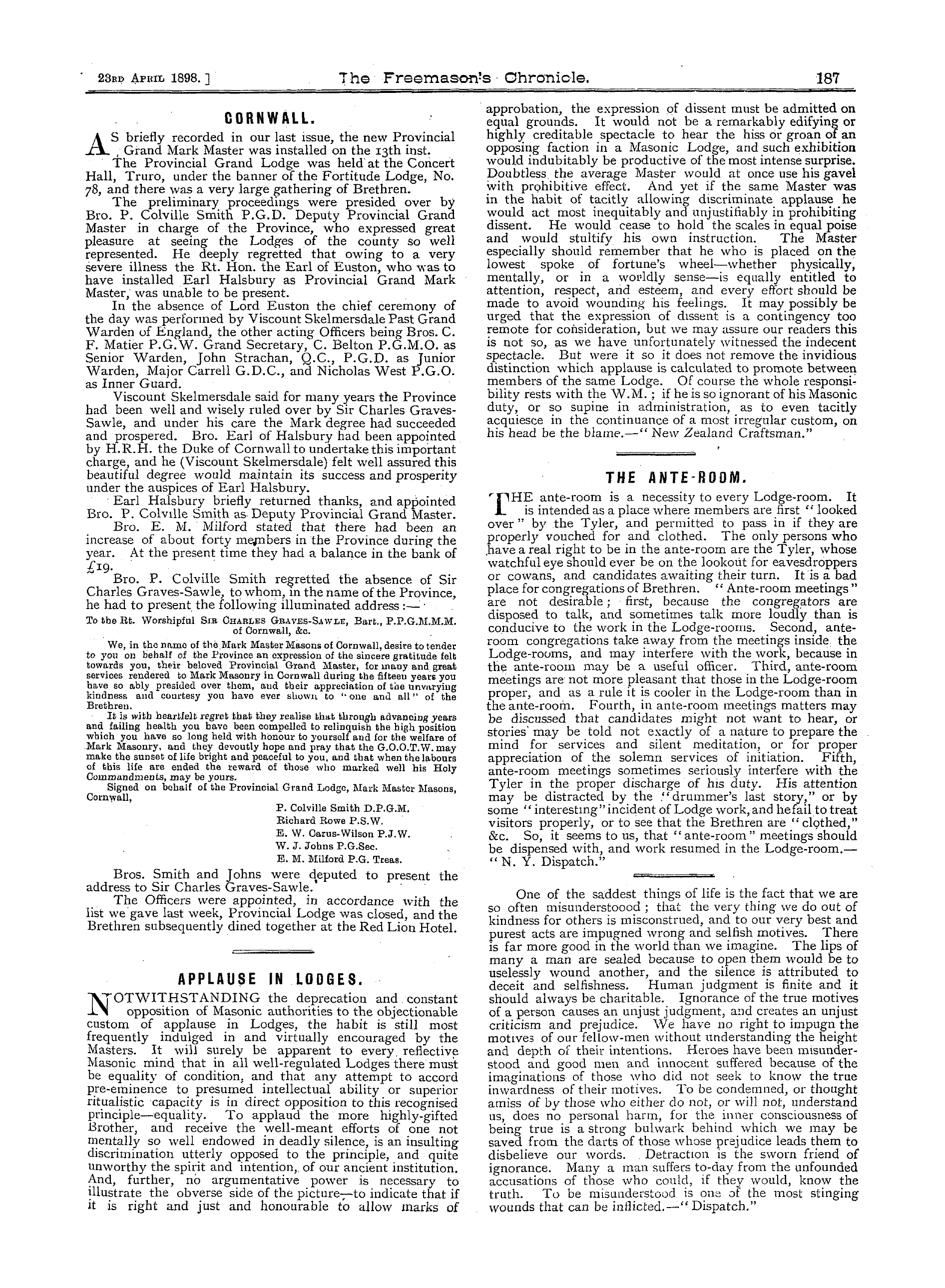
rpHE following letter was addressed to the Editor of the JL " New Zealand Craftsman . " SIB , —A short time ago I was asked to give reasons why the chairs of the three principal Officers of the Lodge to wnich I have the honour to belong were cushioned with blue , purple , and crimson respectively , and I have since been requested to give the substance of my reply to you . I mention this to excuse my occupying your valuable space . The question at issue was the
correct arrangement and appropriate selection of the colours . These old and royal colours—blue , purple , and crimson—were brought out of Egypt by the Israelites ( the Egyptians were famous for their wonderfully rich dyes ) and adopted for the decoration of the Tabernacle in the wilderness and afterwards of the magnificent Veil of the Temple at Jerusalem . Originally , with white , they represented the four elements—white , the colour of the fine linen ( made from flax ) being referred to the earth : blue , the colour of the
sky ( the atmosphere ) , air ; purple , in reference to the fish murex from which the dye of this colour was obtained , the sea or water ; and crimson to the regeneration and purification of souls , as illustrative of the great principle — fire . The moral lessons they teach are —( 1 ) Blue—Brotherly love and benevolence , which should be as extensive as the blue vault of Heaven ; ( 2 ) Purple—Union and harmony—this colour being the harmonious union of blue and crimson ; ( 3 ) Crimson—Zeal and ardour , for what is more zealous
A Novel Point.
or ardent in nature than fire . The colours are referable to the three degrees , the three steps , and the three principal Officers , viz . —( 1 ) Youth—Blue signifies the air or Divine breath , the great cause of all birth ; ( 2 ) Manhsod —Purple—The intermediate stage between birth and death—viz ., lifesignifying a Brother ' s life during his search after truth and perfection ; and ( 3 ) Old age and death—Crimson— -Immortality , or the result of the
regeneration and purification of the soul . These colours are the colours of Ancient York Masonry , the first threo degrees being blue , hence so called , blue Lodges . The degrees of Mark Master , Past Master , and Excellent Master , purple ; while the Boyal Arch , with the three degrees attached to the three principal Officers , are crimson . Hence they may appropriately and symbolically be relegated for the purposes of Lodge decorations to the J . W ., S . W ., and the W . M . respectively . Fraternally yours , & c , UNANIMITY .
Is Masonry A Religion?
IS MASONRY A RELIGION ?
rjTHE following was addressed to the Editor of the JL " Kansas Freemason : " I have been greatly interested in the views expressed by the " Brothers " as to whether or not Masonry is a religion ; albeit I find that their individual views upon the subject are widely divergent and almost hopelessly varied . I have read many statements bearing upon this question , and have been permitted upon several occasions to hear it discussed , and found that the views of the average Brother are somewhat influenced by his church creed .
For instance ; The Baptist insisted that Masonry was very much hi evidence when Moses led the Israelites over Jordan , saying that they " marched across as a Masonic Lodge ; while Pnaroah and his hosts received the only kind of baptism they were entitled to . " The Brother whose creed was of Calvanistic blue , readily agreed that " Masonry bore the marks of his kind of religion , since the ' elect' only were entitled to it . " Thus emboldened he had adopted no church creed , boldly
asserted that " the light oi God ' s word , transmitted through the centuries of time via tho Hebrews , was the only revelation of God to man , and was the light of speculative Masonry , while the rest of the world walked in darkness . " Wnen I asked them what Masonry was , that I , too , might think intelligently upon it , they looked upon one another and said : " Verily , it is a progressive science ; " whicli I thought at the time was a very wide and safe diagnosis . It was as though they had waved their arms out over all creation , saying ,
' •. Here it is , now investigate and compare . " So I asked them to define religion , but they all " with ono consent began to make excuses . " I told them that . vith my very uncertain knowledge of Masonry , and their ( seemingly ) limited knowledge of religion , we ought to strike a fair average , and they advised me to try it , so here . I am with an unlimited subject , and limited space , which require me to eliminate all lost motion . ( By the way , life is full of lost motion . )
All science means knowledge , classified knowledge ; and all science shows but one Fo _ . ce , one Universal Cause ; there is no other . There are laws , but , as some one has aptly said : " Law cannot execute itself , it is not self-imposed , it refers to an author , an agent . " In short , law never governed anything ; it is only the statement of the way in which things are governed .
Masonry being a " progressive science , presumably recognises no particular form of church creed , no particular form of church doctrine , no particular church , and no particular religion ( not being confined within the boundaries of the" Christian Religion " ) so that Masonry is then a universal as well as a " progressive science . "
Religion is also universal , it being by no means confined to what we know as the Christian religion ; it is necessarily progressive , and it is a science of high degree , for although it recognises creeds and doctrines as adjuncts , it is in no wise dependent upon them for its being , for it lived before they did ; it is the science of divine things ; take the word theology ; from Theos God , and Logos doctrine , and it means a classified science of our supposed knowledge of God ; and progressive scientific theology says that " truth is infinite . "
The word religion , from " relogare , " meaning to bind fast . In its practical application it moans fellowship with God , "that obligation we feel in our minds from the relation in which we stand to some superior power . " lt is well known that the first religion was natural or rational , having for its principal the author of nature . The pagans searched nature for their divinity , but the Hebrew looked into his own soul ; the one worshipped force , the other worshipped righteousness ; the one built temples no the supposed
representative of that force , the other built one temple to the living God . Wfien we consider that " the Kingaoin of Nature and the Kingdom , of God have the same laws "—for the Kingdom of Nature is within the Kingdom of God—•' we will find that they were not very widely separated , for both Kingdoms have the same truth , the one operating ou a business , scientific-, or geometrical level ; and the other on a hign spiritual plane . This , in
rational theology , by the exercise of rational faculties , its physical operations explained by symbols before the lessons are universally understood , find the Supreme Force , governing the Kingdom of Nature . " Its spiritual application is purely speculative ; it is religion ; and the dividing line is found in the statement : — " The light shone in the darkness , and the darkness comprehended it not . "
Perhaps we can trace some similarity between " progressive science and religion on a scientific basis ( remembering that we are not discussing the practice of religion , or forms of chuch worship ) . Bacon says : Science is the interpretation of nature as defined by rational thought and reason ; reason being that intellectual power by which we apprehend and discover truth . Tnus science is but a partial copy of the intellectual svstem , co-extensive with the material universe , and he who seeks
truth will lay aside his own narrow views and adopt the thoughts of the Infinite Thinker . " Lot us suppose light and truth to be interchangable terms , or rather let us suppose light to bo the word of God , and religion to be the worship of God " in spirit and in truth , " and we Und that light and truth are inseparable . He who searches for light will find truth ; it is the one eternal principle through which light radiates ; who finds one finds the other , and in the quest of light , or in the search for truth , we arc actually seeking
to discover the mind of God . It is hardly possible to " find and adopt the thoughts of God , without thinking in harmony with the divine mind , " If he is a Mason who reaches this plane ; , I Uncy he has found the spiritual interpretation of this " progressive science , " and seeing the light reflected in his own soul , will realise what , the Master meant when he said "The Kingdom of Heaven is within you , " and the fettois of earthly woven creeds falls from him . When he who is searcning for truth , reaches this height , he stands upright , and walks with God . Both have found that the truth hay < j