-
Articles/Ads
Article PROV. GRAND LODGE OF CHESHIRE. ← Page 2 of 2 Article PROV. GRAND LODGE OF CHESHIRE. Page 2 of 2 Article PROV. GRAND LODGE OF CORNWALL. Page 1 of 2 →
Note: This text has been automatically extracted via Optical Character Recognition (OCR) software.
Prov. Grand Lodge Of Cheshire.
along St . Petersgate , through the Market-place , to the Parish Church . There was a large crowd of spectators along the route , and the procession was of au interesting character , the whole of the brethren wearing their handsome regalia . The body of tho Church was reserved iov
the members of the Craft , and the gallery and side aisles wore set apart for the public , of which there was a large attendance . The ordinary Evensong service was gone through , and , in addition , an anthem was efficiently given by the Parish Church choir , conducted by Mr . C . Swain ,
Organist at the Church . Bro . the Rev . Arthur Symonds , Rector of S . Thomas ' s , Stockport , preached the sermon , basing his discourse on the 37 th verse of the 37 th Psalm , " Mark tho perfect man , and behold the upright : for tho end of that man is peace . " In the course of his sermon ,
the rev . gentleman reminded those present that thoir alms that day would be divided between the Benevolent Fund of the Masonic Order and the Stockport lufirmary T both deserving objects . The occasion upon which they wore assembled , he observed , was a remarkable one . Some
people might ask why was the visit a remarkable one , and in reply he would ask if the very existence of the Society itself was not a fact sufficiently remarkable to make every general gathering of its members an event worthy of notice and record . If they considered the antiquity of the Society ,
its origin lost in the dim record of the past , its system extending and reaching from one end of the world to the other , its objects the mutual welfare and improvement of its members , they could not but be impressed by the very fact of its existence . They could not fail to recognise what
an important part the Society must o { necessity play in fche welding together of mankind in general , and English people in particular , in one common bond of brotherhood . He said of English people in particular , because hero in onr own realm aud in all English speaking realms the Society had
rooted itself more deeply , perhaps , than in other countries . Must they not recognise the immense value of such a Society as theirs in softening the differences which always must exist between men even of tho same nation ? How was it that men did not understand one another—wh y did
nofc men of the same country , of the same town , understand one another better ? Why did they so often think evil of one another , think badly of one another ' s opinions ? Was it not because—very often because—they did not know one another personally ? Was ifc not a fact thafc tho meeting
together of men of the most different phases of politics and religion , men holding diverging objects in life , men of different classes iu society , on neutral ground , showed a tendency to exchange the harshness and bad feeling which so often existed into mutual respect and good feeling . Men
might still continue to diner as to the means and ways in which tho end they wero both intent upon were to be maintained , but why should they fail to recognise that those from whom they differed might be honest and consciencious , which is so common in public and private life ? Thafc was
ono way m which Masonry was valuable , to say nothing of the great work of charity that was carried out by the Societ y , and by which tho Society was chiefly known to the world , aud from which the Society chietly received its character from the world . Mi ght fchey not also recognise
sue correspondence which existed between the aims and objects of the Society and the aims and objects of the Church of Christ ? Ifc was the duty of the Church to interest itself in the religious and moral welfare , in the advancement of mankind , and that conld nofc be efficiently done unless the Church interested itself in the whole life of
"' an . The object of the Masonic Order is to make right the whole of man ' s life . The moral and reli gious life could not be separated from the daily or social life . If such a divorce took place , and the existence of tho religions life consisted of the mere outward observance of worshin . and
iJ'Q keeping of certain rules , then Ruskin would have been J , 'g ht when he said that " England is superficially religious sti'd at heart entirel y infidel , cowardly and dishonest . " God J *•rbid that those words should ever come true of our land , unless our religion was real , and unless we tried to make
oar reli gion the real thing in our life , we conld onl y look : orward to such a state of things as Ruskin spoke of . The influence of religion must make itself felt over man by the threefold aspect—body , soul , and spirit One could not be
separated from the other . The physical , intellectual , and spiritual parts of man must all be subjected to tbe Divine ^ "l , and while each did much good in their own sphere 01 action , yet it was only through the medium of the Physical and intellectual powers that the spiritual life J
Prov. Grand Lodge Of Cheshire.
must bo made known to the outside world . In other words , the whole life of- man must he guided by the Spirit if it was to bring forth any fruit at all . Here then the Church found in Masonry an ally of her work . The Society was sometimes merely regarded as a social institution ,
excellent in its way , but nothing more . Could anything be more contracted , nofc to say false , than that ? It was true thafc the social side of life was not disregarded by the Society , and would that the Church itself paid more attention to the social side of man ' s life , for they must not
believe it was owing to the fact that the Church had neglected the social side of man's life thafc religion was lost to so greafc an extent . What conld be more important , more valuable , than that high standard of morality based upon the sanction of God ' s Word ? What could be
more valuable than the high standard which was set before a Mason as the rule of his life—truth , honesty , purity of life , temperance , charity , courtesy , and all the other moral virtues ? Were not these the very life of Masonry ? Did they not clearly recognise that without these no man could
be a good Mason ? Truly then the Church must welcome that greafc Society as a living power in a world none too moral , in a nation none too observant of any of those virtues . The banquet was held in fche Pendlebury Orphanage , and was presided over by Bro . Salmon P . G . S . W . The catering
of Mrs . Firth , of the Warren Bulkeley Arms Hotel , gave the highest satisfaction . The Loyal and Masonic toasts were duly honoured . The musical arrangements were under the direction of Bro . Robert Baker P . G . Organist , and the vocalists were Bros . Mark Stafford P . M ., William Alcock , aud W . Dumville P . M . P . P . G . D . C .
Prov. Grand Lodge Of Cornwall.
PROV . GRAND LODGE OF CORNWALL .
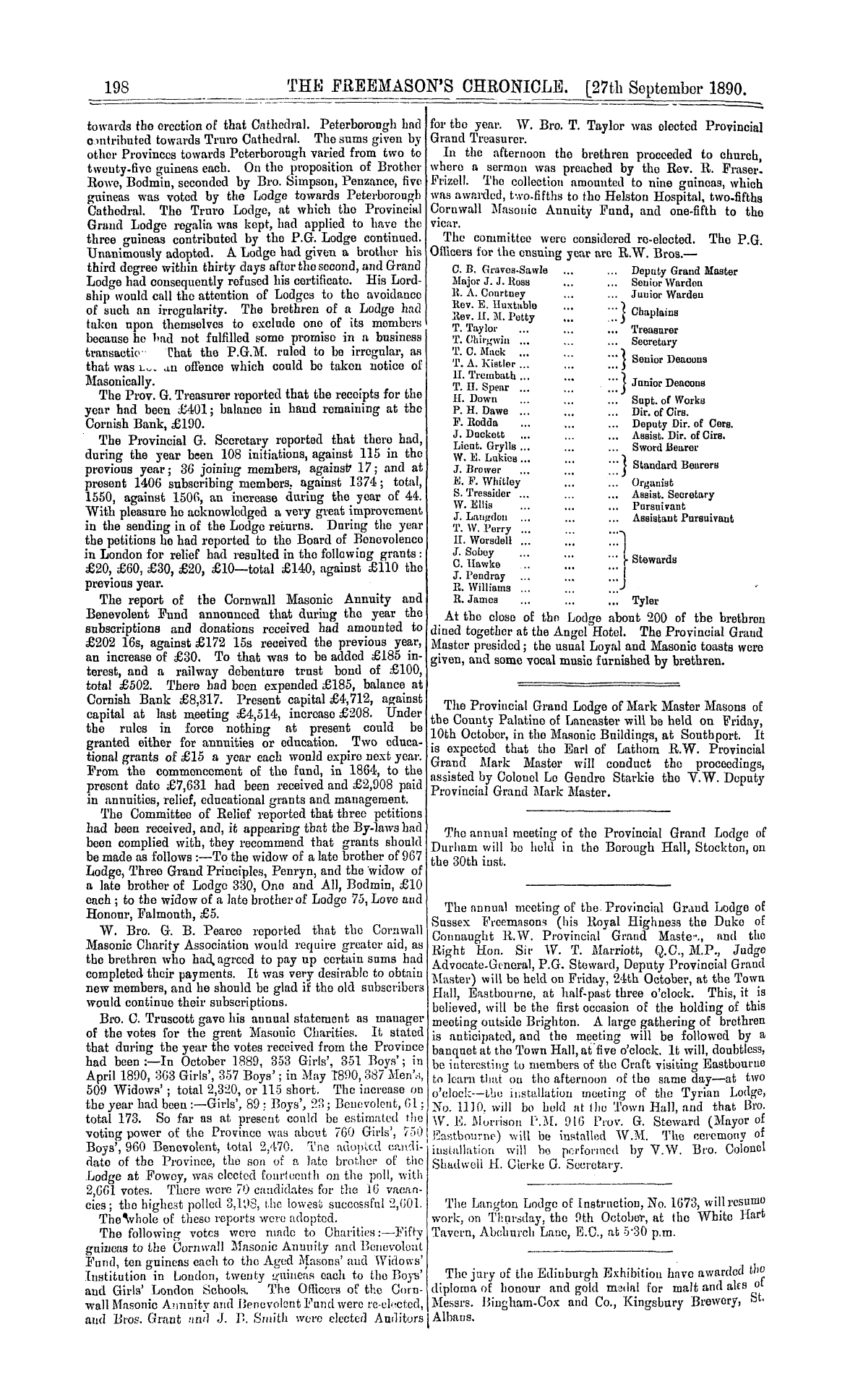
fl ^ HE annual Provincial Grand Lodge of the Free-JL masons of Cornwall was held on the 23 rd instant , afc the Godolphin Hotel , Helstoa . The town was gaily decorated iu recognition of the event . Helstou contained a Freemasons' Lodge over a centuxy and a half since , bufc 1 a Provincial Grand Lodsre had not been hsid there since
18 G 9 . Then it also had not any railway . On the present occasion there was , therefore , an unusually large influx of strangers . The Provincial Grand Lodge was opened by fche Right Worshipfnl Bro . fche Earl of Mount Edgcumbe Provincial Grand Master , who was supported by nearly all
the Provincial Officers of the year . On fche roll of Lodges being called , all were found to bo represented . Before proceeding to discuss the agenda of the business , tho
P . G . M . said the Grand Lodge of Cornwall had , with the other Provincial Grand Lodges , received an intimation of the decease of the M . W . Bro . the Right Hon . the Earl of Carnarvon Pro Graud Master . The Earl of Carnarvon
had been an intimate friend of his at college , and under the auspices of that nobleman he had beon initiated into Masonry , and subsequently installed W . M . of Sincerity Lodge 189 , Stonehonse , Devon . For nine years the Earl of Carnarvon had filled the high office of Pro Grand Master ,
und during a long career had been a zealous and highlyesteemed Mason . He felt sure that the Lodge , along with himself , regretted much his decease , and he proposed that a letter of condolence and sympathy should be sent by the
Lodge to Lady Carnarvon . That he thought would be a better course than thafc of Lodges sending separate letters . His Lordship ' s proposition was adopted . The P . G . M . said ho had received several letters , which he proposed to read first . He had received invitations from St . Austell
aud Salfcash for holding tho Provincial Grand Lodge afc either place next year . He thought ifc was best nofc to make any promise afc present , but brethren might be assured tha usual conrso would be followed to hold the next annual meeting in East Cornwall . Bro . Hughan , he regretted to
say , through ill-health was unable to continue editing the Provincial Directory as hitherto , but would continue to superintend it . Bro . T . Gill , Penryn , had kindly consented to undertake the labour part of that office . There were 144 lights in the windows of the Girls' School , aud ifc was
proposed to glaze them with tinted glass containing coats of arms . Each light would cost £ 13 , and Cornwall was asked to fill one wifch the arms of the county . He proposed the
Lodge should contribute ten guineas , and himself be allowed to contribute tho rest of the money required . Thafc proposition was unanimously adopted . A letter was received from Peterborough asking for a contribution





Note: This text has been automatically extracted via Optical Character Recognition (OCR) software.
Prov. Grand Lodge Of Cheshire.
along St . Petersgate , through the Market-place , to the Parish Church . There was a large crowd of spectators along the route , and the procession was of au interesting character , the whole of the brethren wearing their handsome regalia . The body of tho Church was reserved iov
the members of the Craft , and the gallery and side aisles wore set apart for the public , of which there was a large attendance . The ordinary Evensong service was gone through , and , in addition , an anthem was efficiently given by the Parish Church choir , conducted by Mr . C . Swain ,
Organist at the Church . Bro . the Rev . Arthur Symonds , Rector of S . Thomas ' s , Stockport , preached the sermon , basing his discourse on the 37 th verse of the 37 th Psalm , " Mark tho perfect man , and behold the upright : for tho end of that man is peace . " In the course of his sermon ,
the rev . gentleman reminded those present that thoir alms that day would be divided between the Benevolent Fund of the Masonic Order and the Stockport lufirmary T both deserving objects . The occasion upon which they wore assembled , he observed , was a remarkable one . Some
people might ask why was the visit a remarkable one , and in reply he would ask if the very existence of the Society itself was not a fact sufficiently remarkable to make every general gathering of its members an event worthy of notice and record . If they considered the antiquity of the Society ,
its origin lost in the dim record of the past , its system extending and reaching from one end of the world to the other , its objects the mutual welfare and improvement of its members , they could not but be impressed by the very fact of its existence . They could not fail to recognise what
an important part the Society must o { necessity play in fche welding together of mankind in general , and English people in particular , in one common bond of brotherhood . He said of English people in particular , because hero in onr own realm aud in all English speaking realms the Society had
rooted itself more deeply , perhaps , than in other countries . Must they not recognise the immense value of such a Society as theirs in softening the differences which always must exist between men even of tho same nation ? How was it that men did not understand one another—wh y did
nofc men of the same country , of the same town , understand one another better ? Why did they so often think evil of one another , think badly of one another ' s opinions ? Was it not because—very often because—they did not know one another personally ? Was ifc not a fact thafc tho meeting
together of men of the most different phases of politics and religion , men holding diverging objects in life , men of different classes iu society , on neutral ground , showed a tendency to exchange the harshness and bad feeling which so often existed into mutual respect and good feeling . Men
might still continue to diner as to the means and ways in which tho end they wero both intent upon were to be maintained , but why should they fail to recognise that those from whom they differed might be honest and consciencious , which is so common in public and private life ? Thafc was
ono way m which Masonry was valuable , to say nothing of the great work of charity that was carried out by the Societ y , and by which tho Society was chiefly known to the world , aud from which the Society chietly received its character from the world . Mi ght fchey not also recognise
sue correspondence which existed between the aims and objects of the Society and the aims and objects of the Church of Christ ? Ifc was the duty of the Church to interest itself in the religious and moral welfare , in the advancement of mankind , and that conld nofc be efficiently done unless the Church interested itself in the whole life of
"' an . The object of the Masonic Order is to make right the whole of man ' s life . The moral and reli gious life could not be separated from the daily or social life . If such a divorce took place , and the existence of tho religions life consisted of the mere outward observance of worshin . and
iJ'Q keeping of certain rules , then Ruskin would have been J , 'g ht when he said that " England is superficially religious sti'd at heart entirel y infidel , cowardly and dishonest . " God J *•rbid that those words should ever come true of our land , unless our religion was real , and unless we tried to make
oar reli gion the real thing in our life , we conld onl y look : orward to such a state of things as Ruskin spoke of . The influence of religion must make itself felt over man by the threefold aspect—body , soul , and spirit One could not be
separated from the other . The physical , intellectual , and spiritual parts of man must all be subjected to tbe Divine ^ "l , and while each did much good in their own sphere 01 action , yet it was only through the medium of the Physical and intellectual powers that the spiritual life J
Prov. Grand Lodge Of Cheshire.
must bo made known to the outside world . In other words , the whole life of- man must he guided by the Spirit if it was to bring forth any fruit at all . Here then the Church found in Masonry an ally of her work . The Society was sometimes merely regarded as a social institution ,
excellent in its way , but nothing more . Could anything be more contracted , nofc to say false , than that ? It was true thafc the social side of life was not disregarded by the Society , and would that the Church itself paid more attention to the social side of man ' s life , for they must not
believe it was owing to the fact that the Church had neglected the social side of man's life thafc religion was lost to so greafc an extent . What conld be more important , more valuable , than that high standard of morality based upon the sanction of God ' s Word ? What could be
more valuable than the high standard which was set before a Mason as the rule of his life—truth , honesty , purity of life , temperance , charity , courtesy , and all the other moral virtues ? Were not these the very life of Masonry ? Did they not clearly recognise that without these no man could
be a good Mason ? Truly then the Church must welcome that greafc Society as a living power in a world none too moral , in a nation none too observant of any of those virtues . The banquet was held in fche Pendlebury Orphanage , and was presided over by Bro . Salmon P . G . S . W . The catering
of Mrs . Firth , of the Warren Bulkeley Arms Hotel , gave the highest satisfaction . The Loyal and Masonic toasts were duly honoured . The musical arrangements were under the direction of Bro . Robert Baker P . G . Organist , and the vocalists were Bros . Mark Stafford P . M ., William Alcock , aud W . Dumville P . M . P . P . G . D . C .
Prov. Grand Lodge Of Cornwall.
PROV . GRAND LODGE OF CORNWALL .
fl ^ HE annual Provincial Grand Lodge of the Free-JL masons of Cornwall was held on the 23 rd instant , afc the Godolphin Hotel , Helstoa . The town was gaily decorated iu recognition of the event . Helstou contained a Freemasons' Lodge over a centuxy and a half since , bufc 1 a Provincial Grand Lodsre had not been hsid there since
18 G 9 . Then it also had not any railway . On the present occasion there was , therefore , an unusually large influx of strangers . The Provincial Grand Lodge was opened by fche Right Worshipfnl Bro . fche Earl of Mount Edgcumbe Provincial Grand Master , who was supported by nearly all
the Provincial Officers of the year . On fche roll of Lodges being called , all were found to bo represented . Before proceeding to discuss the agenda of the business , tho
P . G . M . said the Grand Lodge of Cornwall had , with the other Provincial Grand Lodges , received an intimation of the decease of the M . W . Bro . the Right Hon . the Earl of Carnarvon Pro Graud Master . The Earl of Carnarvon
had been an intimate friend of his at college , and under the auspices of that nobleman he had beon initiated into Masonry , and subsequently installed W . M . of Sincerity Lodge 189 , Stonehonse , Devon . For nine years the Earl of Carnarvon had filled the high office of Pro Grand Master ,
und during a long career had been a zealous and highlyesteemed Mason . He felt sure that the Lodge , along with himself , regretted much his decease , and he proposed that a letter of condolence and sympathy should be sent by the
Lodge to Lady Carnarvon . That he thought would be a better course than thafc of Lodges sending separate letters . His Lordship ' s proposition was adopted . The P . G . M . said ho had received several letters , which he proposed to read first . He had received invitations from St . Austell
aud Salfcash for holding tho Provincial Grand Lodge afc either place next year . He thought ifc was best nofc to make any promise afc present , but brethren might be assured tha usual conrso would be followed to hold the next annual meeting in East Cornwall . Bro . Hughan , he regretted to
say , through ill-health was unable to continue editing the Provincial Directory as hitherto , but would continue to superintend it . Bro . T . Gill , Penryn , had kindly consented to undertake the labour part of that office . There were 144 lights in the windows of the Girls' School , aud ifc was
proposed to glaze them with tinted glass containing coats of arms . Each light would cost £ 13 , and Cornwall was asked to fill one wifch the arms of the county . He proposed the
Lodge should contribute ten guineas , and himself be allowed to contribute tho rest of the money required . Thafc proposition was unanimously adopted . A letter was received from Peterborough asking for a contribution