-
Articles/Ads
Article WHY ROME BANS ENGLISH MASONRY. Page 1 of 1 Article WHY ROME BANS ENGLISH MASONRY. Page 1 of 1 Article PROVINCIAL GRAND LODGE OF WORCESTERSHIRE . Page 1 of 1
Note: This text has been automatically extracted via Optical Character Recognition (OCR) software.
Why Rome Bans English Masonry.
WHY ROME BANS ENGLISH MASONRY .
AN INTERVIEW WITH CANON MOYSE . ( Front the Westminster Gazette ) . Though the controversy is old , and its issues have been fought out again and agni " , and never more fiercely than when the Marquis of Ripon resigned to the Pi ince of Wales his place at the head of English Masonry because he had been converted to the side of the Vatican , there is still a perpetual
wonder in England at the excommunication which Rome levels at the head of every member of ths Masonic body . When English Masons are not engaged in the rites of good-fellowship , they are , as they think , promoting works ol Charity ; why , then , should they be delivered over to Satan for their souls' health ? Since Father Luke Rivington wrote to us in strong condemnation of the mistaken people who were given over to Masonry , we have
received many letters urging us to get to the bottom of this mystery . Accordingly a representative of The Westminster Gazette betook himself to the Archbishop ' s house in the Vauxhall Bridge-road , there to see Canon Moyse , of the Archbishop ' s house , whose learning and authority are well known to English Catholics . During a long conversation ( writes our representative ) which ranged over many top ' -cs , from the repudiation by Gregory the Great
of universal bishopric to the Council of Whitby , and from letters written by Offa , Kins of Mercia , to the arguments of Sir William Harcourt in the last great Ritual controversy , Canon Moyse seemed to b 2 repressing the eagerness of his intellectual flow . I am afraid I bored him by some ' of my ignorant questions , but 1 found it difficult to get away from so cultivated and so ready a conversationalist , who " wore his weight of learning lightly like a flower . "
Having mentioned Father Rivington s letter in The Westminster on " Rome and the Freemasons , " I began : " Now what I come to ask is why the Church condemns what most ( of us regard in England as innocuous if not " " Beneficent , " interruped Canon Moyse , supplying the very word I was about to use . " Surely , " he continued , " it is not difficult to answer the
question . English Masons remain on terms of communion with Continental Masons . They form one body . There is at least mutual recognition . Now , though English Freemasons may not be active against the Church , yet if we may trust the leaders of Continental Freemasonry—if we may take their books and accept their journals as expressing their opinions—if we may judge by their actions—they are hostile—bitterly hostile to the Church ; and those who are friends of theirs must be enemies of the Lord . "
' * But you have made your peace with the French Republic , which you may , perhaps , regard as Atheistic . The French Republic is the creation in a great degree of those revolutionary influences which you say are fostered by Continental Freemasonry , Why , having accepted the Republic , do you ban those who , ex hypothesi , helped to create it ? " ' There is a distinction easily made , I should think , between method and
result . Church has no hostility to—no prejudice even against—any particular form of government . It accepted the mediaeval Italian Republics —V » nice , and Padua , and Florence , and so forth ; it has no sort of objection to the Republic of the United States . Why should it not make friends with the French Republic , as in a sense it made friends with Germany which worked the Kuliurkampf after Bismark hid gone to Canossa ? "
" But you a-e still bantvng the Freemasons who made the French Republic !" " We are ready to accept an established fact ; but we are not bound to approve the methods . We may approve and desire Home Rule , yet condemn with all our hearts the Clan-na-Gael . "
" That , " said I , " brings me to the point . There must be a wider reason for the excommunicating of Freemasons than the hostility to the Church displayed by the Continental Lodges . The Clan-na-Gael and Masonry come under one condemnation , do they not ? And neither is condemned because it is against the Church , or because it is political .- both are condemned , good or bad , became both arc secret . "
" Quite so . Gregory XVI . put his ban on secret societies , and it is maintained . " " But why must there bs no secrecy ? Is it because a secret society might come , so to speak , into competition with the Church , or because secrecy would be a bar to full auricular confession ? "
" For neither reason ; but for the reason that the Church regards as immoral any oath made binding to any other obedience than to the law of the Church and the individual conscience . " " What about the Jesuits , then ? Are ihsy not bound to psrfect , unquestioning obedience to the General of their Order ? "
Canon Moyse thought for a moment , and refrained his answer several times , and 1 am not quite certain now that I have got to his meaning . He drew a distinction between an oath and a vow , though he did not insist upon it too rigidly , and almost admitted that it was too fine for ordinary every-day use ; the Jesuit's vow , at all events , was not the Masonic oath .
" But the essence of both oath and vow , " I objected , "is surely the calling upon God to witness ? You will need a clever professor of casuistry to get out of that . " " Yes ; but the Jeu tsand all who lake vows within the Church are bound to do nothing under their obligation which is contrary to the law of God , the law of the Church , and the commands of their own consciences . The
Jesuit is subordinate to the Church . Oaths of secrecy , on the other hand , enable people to work wickedly in the dark , may prevent confession of sin , and can serve no really good object . Of course , there must always be secrecy of some kind . Every family has a right to privacy . Every mercantile house must trust its confidence to its members , and they dare not betray them . Every Government has its secrets . But the oath is what the Church condemns , because it may give a man ' s conscience to the keeping of another .
To sum up the Church can permit no hostile society beside , nor tolerate any association between , its friends and its enemies . That is the first point . You can ' t serve two misters . In the second place , the oath of secracy is immoral . In the third place , even in this country the ceremonial of Masonry is a relig iois rite . Nov , there can b * no communion in religious matters b twecn aCathilic and a non-Catholic . Rites and ceremonies belong to the Church . " " In short , you and I cannot ' . wo-ship God together ? "
" I f h ) u ! d not put it so ; I should rather say that we simply cannot have religious communion ; andso far as Freemasonry establishes such communion in matters of religion , between the members of the Church and those who are wilhout the pale , it is condemned . The Freemason is excommunicate . "
Why Rome Bans English Masonry.
The conversation at this point ran off on other questions of controversy , and ranged from Ritualism to the authority of the Canon Law ; but in th ; course of it Canon Moyse pointed out one thing for which Freemasons should be grateful . An excommunication was at one time a compl-ite boycott . N j excommunicated person could be served by one of the true faith . He wis left untended and alone . " In these days , " said Dr . Moyse , quietly , " the Church has dropped that portion of her punishment . " And Freemasons perhaps , are ready to brave the other portion .
Provincial Grand Lodge Of Worcestershire .
PROVINCIAL GRAND LODGE OF WORCESTERSHIRE .
The annual Provincial Grand Lodge for the Province of Worcestershire was held at Malvern , on Wednesday , the 26 th ult ., under the banner of the Royds Lodge , No . 1204 . It is many years since a similir meeting was luld in Malvern , and consequently a greater amount of local interest was
manifested on the occasion . The brethren assembled to the number of two or three hundred , and , having arrived early in the day , were hospitably entertained at luncheon by the Master and officers of the Royds Lodge at the Imperial Hotel .
The meeting was held at the Malvern College , where the spacious rooms afforded every convenience . The Royds Lodge was opened by the W . Master ( Bro . Dr . Thelwell Pike ) assisted by his officers , ready for the reception of the Provincial Grand Master , Bro . Sir Edmund A . H . Lechmere Bart .,
M . P ., who with his officials and members of Prov . Grand Lodge entered the lodge to the strains of the organ presided over by Bro . W . Haynes , P . P . G . O . The roll of lodges was called , and it was found that every lodge in the province was well represented , the brethren from the distant parts of the province—Dudley , Kidderminster , & c , attending in large numbers .
After the transaction of a considerable amount of _ Masonic business , the Provincial Grand Master appointed and invested his officers for the year as follows :
Bro . Thelwell Pike , 1204 ... ... ... Prov . S . G . W . „ James Stevens , 2034 ... ... ... Prov . J . G . W . „ Rev . G . F . Hough , 280 ... ... - \ pr G Chaos „ Rev . A . Gray Maitland , 252 ... ... j ^ rov % ^ ^ haps ' „ T . Vale , 560 ... ... ... Prov . G . Reg . „ T . R . Arter , 2034 ... ... ... Prov . G . Treas . „ George Taylor , 1874 ... ... ... Prov . G . Sec . „ A . B . Rowe , 280 ... ... ... Prov . S . G . D . „ W . T . Page , 529 ... ... ... Prov . J . G . D . „ H . M . Jackson , 573 ... ... ... Prov . G . S . of W . „ J . W . Roberts , 498 ... ... ... Prov . G . D . C . „ G . B . Butlery , 2385 ... ... ... Prov . A . G . D . C . „ Jas . Warham , 252 ... ... ... Prov . G . S . B . " irn A S n ^ V , n , } Prov . G . Std . Brs . „ John A . Daggs , 10 97 ... ... ... ) „ Walter F . Newton , 1204 ... ... Prov . G . Org . „ Alfred Cotton , 377 .. ... ... Prov . G . Purst . „ T . Robinson , 564 ... ... ... Prov . A . G . Purst . ,, Frank Everill , 120 4 „ G . H . T . Foster , 120 4 ... „ J . W . Hinings . 1204 LProv . G . Stwds . „ J . Hargreaves , 120 4 ... ... ... j ' « " • - " •" ,, F . A . Moerschell , 120 4 ... „ J . Wilson , 120 4
The brethren were then called off from business to attend a special service at the Priory Church , whither they went in procession . An eloquent sermon was preached by Bro . the Rev . G . F . HOUGH , M . A ., Prov . G . Chap . The anthem deserves special mention , as the composition contains some beautiful choruses . Mr . Brown , of the Priory Church Choir , rendered his bass solos with fine effect .
After an offertory for local charitable purposes , and the Benediction , the brethren returned in procession to the College , whsre other Masonic business was conducted , and the Prov . Grand Lodge closed . The brethren afterwards adjourned to the Imperial Hotel to a banquet . The following toasts were proposed : " The Queen and the Craft , " "H . R . H . the Prince of Wales , M . W . G . M . ; " "The M . W . Pro G . M ., the Right Hon . the Earl of Lathom ; the R . W . Deputy G . M ., the Right
Hon . the Earl of Mount Edgcumbe ; and the rest of the Grand Officers , Present and Past ; " " The R . W . Prov . Grand Master , Bro . Sir E . A . H . Lechmere , Bart ., M . P . ; " " The V . W . Deputy Prov . Grand Master , Bro . A . F . Godson , M . P ., and the rest of the Prov . G , Officers , Present and Past ;" " The Visitors j" "The W . M . and Brethren of the Royds Lodge , No . 1204 ;" " The Masonic Charities ; " " The Provincial Grand Stewards j " and the Tyler ' s toast .
A special late train from Great Malvern conveyed the brethren to their distant homes after the banquet . The f-. Ho wing Prov . G . Officers were present :
Bros . Sir E . Lechmere , P . G . Master ; A . V . Godson , M . P ., Dep . P . G . M . ; John Joseland , P . S . G . W . ; Abraham Green , G . Purst . Eng . ; W . Waldron , S . Smith , G . R . Godson , H . Wilson , and R . P . Hill , P . P . S . G . Wardens ; the Rev . G . F . Hough , W . M . 280 , P . G . Chap . ; T . R . Arter , P . G . Treas . ; W . Walker , P . M . 252 , P . G . Russell , and R . Stevenson , P . M . 252 , P . P . G . Registrars ; G . Tay lor , P . G . Sec ; F . H . Pinkett , I . P . M . 229 , P . J . G . Deacon ; Dr . Thelwell Pike , W . M . and P . M . 1204 , and N . C . Smith Carington , I . P . M . 1204 , P . M . 280 , P-PS . G . Deacons j the Rev . Charles Black , P . P . G . Chap . ; R . Clarke , P . G . S . of W . ; T . E . Lucy , P . P . G . S . of W . ; W . Wood and W . T . Page , P . P . G . Directors of Ceremonies ; A . H . Green , P . M . 1204 , P . G . S . Bs . ; T . Vale , P . M . 560 , A-
O . Fraser , P . M . 1204 , and T . Chambers , 252 , Past Provincial Grand SA ^ -i W . C . Box , 529 , P . G . Org . ; H . M . Jackson , P . M . 573 , and W . Haynes , P . P- - Organists : and J . Millington , 529 , and W . E . Williams , 529 . P-G . Stewards . Among the visitors present were—Bros . J . M . McLeod , P . P . S . G . W . Derby , Sec . R . M . I . B . ; F . R . W . Hedges , P . G . S . B ., Sec . R . M . I . G . ; R . M . Worlock , P . P . G . PGloucestershire ; Wm . Manton , P . M . 725 , P . P . G . S . B . Warwick ; H . Sweet , toy , G . Gainwell , 262 ; A . Bond , P . M . 270 , P . P . G . Chap , Gloucester ; H . Vale , and F . W . Beck .

Note: This text has been automatically extracted via Optical Character Recognition (OCR) software.
Why Rome Bans English Masonry.
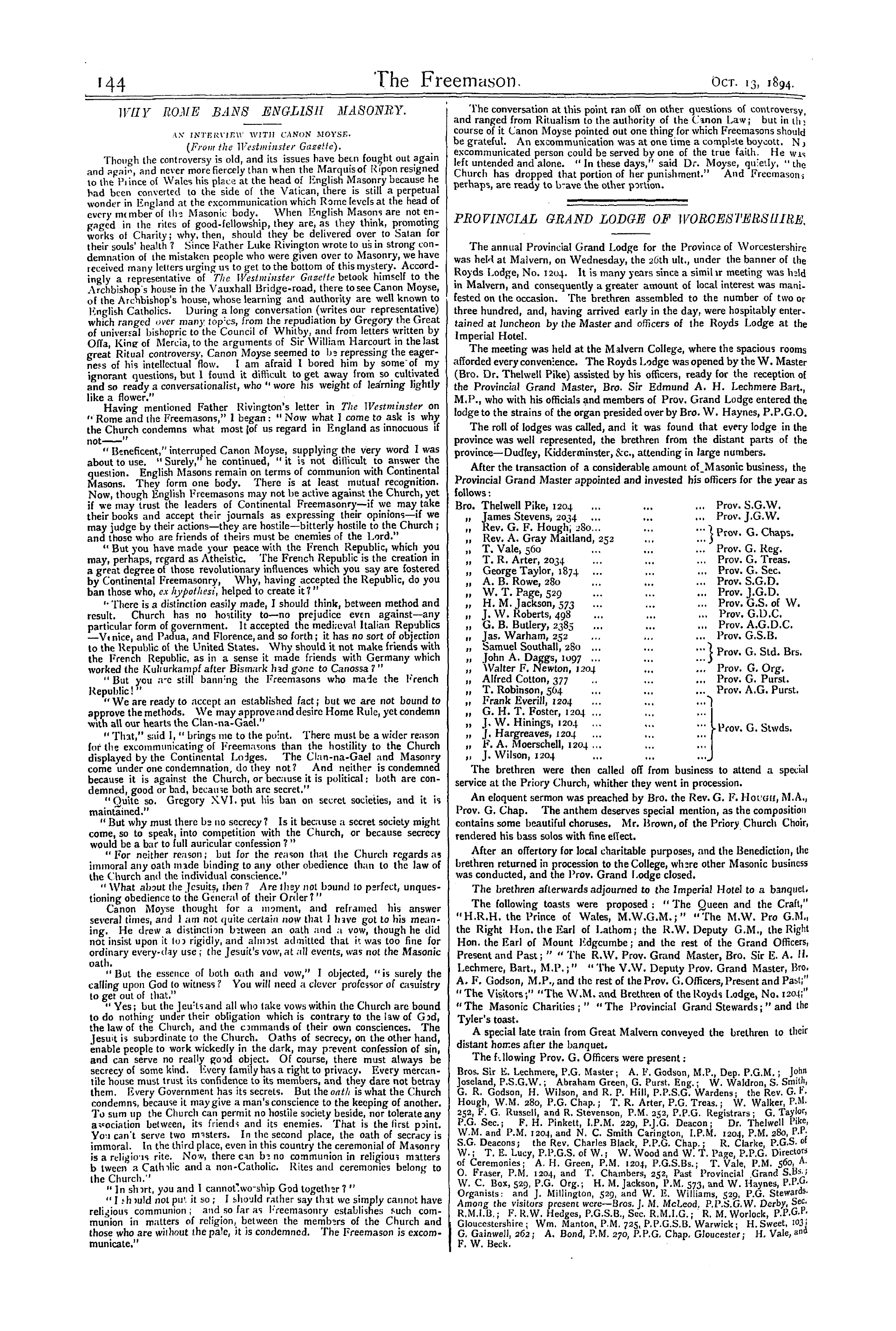
WHY ROME BANS ENGLISH MASONRY .
AN INTERVIEW WITH CANON MOYSE . ( Front the Westminster Gazette ) . Though the controversy is old , and its issues have been fought out again and agni " , and never more fiercely than when the Marquis of Ripon resigned to the Pi ince of Wales his place at the head of English Masonry because he had been converted to the side of the Vatican , there is still a perpetual
wonder in England at the excommunication which Rome levels at the head of every member of ths Masonic body . When English Masons are not engaged in the rites of good-fellowship , they are , as they think , promoting works ol Charity ; why , then , should they be delivered over to Satan for their souls' health ? Since Father Luke Rivington wrote to us in strong condemnation of the mistaken people who were given over to Masonry , we have
received many letters urging us to get to the bottom of this mystery . Accordingly a representative of The Westminster Gazette betook himself to the Archbishop ' s house in the Vauxhall Bridge-road , there to see Canon Moyse , of the Archbishop ' s house , whose learning and authority are well known to English Catholics . During a long conversation ( writes our representative ) which ranged over many top ' -cs , from the repudiation by Gregory the Great
of universal bishopric to the Council of Whitby , and from letters written by Offa , Kins of Mercia , to the arguments of Sir William Harcourt in the last great Ritual controversy , Canon Moyse seemed to b 2 repressing the eagerness of his intellectual flow . I am afraid I bored him by some ' of my ignorant questions , but 1 found it difficult to get away from so cultivated and so ready a conversationalist , who " wore his weight of learning lightly like a flower . "
Having mentioned Father Rivington s letter in The Westminster on " Rome and the Freemasons , " I began : " Now what I come to ask is why the Church condemns what most ( of us regard in England as innocuous if not " " Beneficent , " interruped Canon Moyse , supplying the very word I was about to use . " Surely , " he continued , " it is not difficult to answer the
question . English Masons remain on terms of communion with Continental Masons . They form one body . There is at least mutual recognition . Now , though English Freemasons may not be active against the Church , yet if we may trust the leaders of Continental Freemasonry—if we may take their books and accept their journals as expressing their opinions—if we may judge by their actions—they are hostile—bitterly hostile to the Church ; and those who are friends of theirs must be enemies of the Lord . "
' * But you have made your peace with the French Republic , which you may , perhaps , regard as Atheistic . The French Republic is the creation in a great degree of those revolutionary influences which you say are fostered by Continental Freemasonry , Why , having accepted the Republic , do you ban those who , ex hypothesi , helped to create it ? " ' There is a distinction easily made , I should think , between method and
result . Church has no hostility to—no prejudice even against—any particular form of government . It accepted the mediaeval Italian Republics —V » nice , and Padua , and Florence , and so forth ; it has no sort of objection to the Republic of the United States . Why should it not make friends with the French Republic , as in a sense it made friends with Germany which worked the Kuliurkampf after Bismark hid gone to Canossa ? "
" But you a-e still bantvng the Freemasons who made the French Republic !" " We are ready to accept an established fact ; but we are not bound to approve the methods . We may approve and desire Home Rule , yet condemn with all our hearts the Clan-na-Gael . "
" That , " said I , " brings me to the point . There must be a wider reason for the excommunicating of Freemasons than the hostility to the Church displayed by the Continental Lodges . The Clan-na-Gael and Masonry come under one condemnation , do they not ? And neither is condemned because it is against the Church , or because it is political .- both are condemned , good or bad , became both arc secret . "
" Quite so . Gregory XVI . put his ban on secret societies , and it is maintained . " " But why must there bs no secrecy ? Is it because a secret society might come , so to speak , into competition with the Church , or because secrecy would be a bar to full auricular confession ? "
" For neither reason ; but for the reason that the Church regards as immoral any oath made binding to any other obedience than to the law of the Church and the individual conscience . " " What about the Jesuits , then ? Are ihsy not bound to psrfect , unquestioning obedience to the General of their Order ? "
Canon Moyse thought for a moment , and refrained his answer several times , and 1 am not quite certain now that I have got to his meaning . He drew a distinction between an oath and a vow , though he did not insist upon it too rigidly , and almost admitted that it was too fine for ordinary every-day use ; the Jesuit's vow , at all events , was not the Masonic oath .
" But the essence of both oath and vow , " I objected , "is surely the calling upon God to witness ? You will need a clever professor of casuistry to get out of that . " " Yes ; but the Jeu tsand all who lake vows within the Church are bound to do nothing under their obligation which is contrary to the law of God , the law of the Church , and the commands of their own consciences . The
Jesuit is subordinate to the Church . Oaths of secrecy , on the other hand , enable people to work wickedly in the dark , may prevent confession of sin , and can serve no really good object . Of course , there must always be secrecy of some kind . Every family has a right to privacy . Every mercantile house must trust its confidence to its members , and they dare not betray them . Every Government has its secrets . But the oath is what the Church condemns , because it may give a man ' s conscience to the keeping of another .
To sum up the Church can permit no hostile society beside , nor tolerate any association between , its friends and its enemies . That is the first point . You can ' t serve two misters . In the second place , the oath of secracy is immoral . In the third place , even in this country the ceremonial of Masonry is a relig iois rite . Nov , there can b * no communion in religious matters b twecn aCathilic and a non-Catholic . Rites and ceremonies belong to the Church . " " In short , you and I cannot ' . wo-ship God together ? "
" I f h ) u ! d not put it so ; I should rather say that we simply cannot have religious communion ; andso far as Freemasonry establishes such communion in matters of religion , between the members of the Church and those who are wilhout the pale , it is condemned . The Freemason is excommunicate . "
Why Rome Bans English Masonry.
The conversation at this point ran off on other questions of controversy , and ranged from Ritualism to the authority of the Canon Law ; but in th ; course of it Canon Moyse pointed out one thing for which Freemasons should be grateful . An excommunication was at one time a compl-ite boycott . N j excommunicated person could be served by one of the true faith . He wis left untended and alone . " In these days , " said Dr . Moyse , quietly , " the Church has dropped that portion of her punishment . " And Freemasons perhaps , are ready to brave the other portion .
Provincial Grand Lodge Of Worcestershire .
PROVINCIAL GRAND LODGE OF WORCESTERSHIRE .
The annual Provincial Grand Lodge for the Province of Worcestershire was held at Malvern , on Wednesday , the 26 th ult ., under the banner of the Royds Lodge , No . 1204 . It is many years since a similir meeting was luld in Malvern , and consequently a greater amount of local interest was
manifested on the occasion . The brethren assembled to the number of two or three hundred , and , having arrived early in the day , were hospitably entertained at luncheon by the Master and officers of the Royds Lodge at the Imperial Hotel .
The meeting was held at the Malvern College , where the spacious rooms afforded every convenience . The Royds Lodge was opened by the W . Master ( Bro . Dr . Thelwell Pike ) assisted by his officers , ready for the reception of the Provincial Grand Master , Bro . Sir Edmund A . H . Lechmere Bart .,
M . P ., who with his officials and members of Prov . Grand Lodge entered the lodge to the strains of the organ presided over by Bro . W . Haynes , P . P . G . O . The roll of lodges was called , and it was found that every lodge in the province was well represented , the brethren from the distant parts of the province—Dudley , Kidderminster , & c , attending in large numbers .
After the transaction of a considerable amount of _ Masonic business , the Provincial Grand Master appointed and invested his officers for the year as follows :
Bro . Thelwell Pike , 1204 ... ... ... Prov . S . G . W . „ James Stevens , 2034 ... ... ... Prov . J . G . W . „ Rev . G . F . Hough , 280 ... ... - \ pr G Chaos „ Rev . A . Gray Maitland , 252 ... ... j ^ rov % ^ ^ haps ' „ T . Vale , 560 ... ... ... Prov . G . Reg . „ T . R . Arter , 2034 ... ... ... Prov . G . Treas . „ George Taylor , 1874 ... ... ... Prov . G . Sec . „ A . B . Rowe , 280 ... ... ... Prov . S . G . D . „ W . T . Page , 529 ... ... ... Prov . J . G . D . „ H . M . Jackson , 573 ... ... ... Prov . G . S . of W . „ J . W . Roberts , 498 ... ... ... Prov . G . D . C . „ G . B . Butlery , 2385 ... ... ... Prov . A . G . D . C . „ Jas . Warham , 252 ... ... ... Prov . G . S . B . " irn A S n ^ V , n , } Prov . G . Std . Brs . „ John A . Daggs , 10 97 ... ... ... ) „ Walter F . Newton , 1204 ... ... Prov . G . Org . „ Alfred Cotton , 377 .. ... ... Prov . G . Purst . „ T . Robinson , 564 ... ... ... Prov . A . G . Purst . ,, Frank Everill , 120 4 „ G . H . T . Foster , 120 4 ... „ J . W . Hinings . 1204 LProv . G . Stwds . „ J . Hargreaves , 120 4 ... ... ... j ' « " • - " •" ,, F . A . Moerschell , 120 4 ... „ J . Wilson , 120 4
The brethren were then called off from business to attend a special service at the Priory Church , whither they went in procession . An eloquent sermon was preached by Bro . the Rev . G . F . HOUGH , M . A ., Prov . G . Chap . The anthem deserves special mention , as the composition contains some beautiful choruses . Mr . Brown , of the Priory Church Choir , rendered his bass solos with fine effect .
After an offertory for local charitable purposes , and the Benediction , the brethren returned in procession to the College , whsre other Masonic business was conducted , and the Prov . Grand Lodge closed . The brethren afterwards adjourned to the Imperial Hotel to a banquet . The following toasts were proposed : " The Queen and the Craft , " "H . R . H . the Prince of Wales , M . W . G . M . ; " "The M . W . Pro G . M ., the Right Hon . the Earl of Lathom ; the R . W . Deputy G . M ., the Right
Hon . the Earl of Mount Edgcumbe ; and the rest of the Grand Officers , Present and Past ; " " The R . W . Prov . Grand Master , Bro . Sir E . A . H . Lechmere , Bart ., M . P . ; " " The V . W . Deputy Prov . Grand Master , Bro . A . F . Godson , M . P ., and the rest of the Prov . G , Officers , Present and Past ;" " The Visitors j" "The W . M . and Brethren of the Royds Lodge , No . 1204 ;" " The Masonic Charities ; " " The Provincial Grand Stewards j " and the Tyler ' s toast .
A special late train from Great Malvern conveyed the brethren to their distant homes after the banquet . The f-. Ho wing Prov . G . Officers were present :
Bros . Sir E . Lechmere , P . G . Master ; A . V . Godson , M . P ., Dep . P . G . M . ; John Joseland , P . S . G . W . ; Abraham Green , G . Purst . Eng . ; W . Waldron , S . Smith , G . R . Godson , H . Wilson , and R . P . Hill , P . P . S . G . Wardens ; the Rev . G . F . Hough , W . M . 280 , P . G . Chap . ; T . R . Arter , P . G . Treas . ; W . Walker , P . M . 252 , P . G . Russell , and R . Stevenson , P . M . 252 , P . P . G . Registrars ; G . Tay lor , P . G . Sec ; F . H . Pinkett , I . P . M . 229 , P . J . G . Deacon ; Dr . Thelwell Pike , W . M . and P . M . 1204 , and N . C . Smith Carington , I . P . M . 1204 , P . M . 280 , P-PS . G . Deacons j the Rev . Charles Black , P . P . G . Chap . ; R . Clarke , P . G . S . of W . ; T . E . Lucy , P . P . G . S . of W . ; W . Wood and W . T . Page , P . P . G . Directors of Ceremonies ; A . H . Green , P . M . 1204 , P . G . S . Bs . ; T . Vale , P . M . 560 , A-
O . Fraser , P . M . 1204 , and T . Chambers , 252 , Past Provincial Grand SA ^ -i W . C . Box , 529 , P . G . Org . ; H . M . Jackson , P . M . 573 , and W . Haynes , P . P- - Organists : and J . Millington , 529 , and W . E . Williams , 529 . P-G . Stewards . Among the visitors present were—Bros . J . M . McLeod , P . P . S . G . W . Derby , Sec . R . M . I . B . ; F . R . W . Hedges , P . G . S . B ., Sec . R . M . I . G . ; R . M . Worlock , P . P . G . PGloucestershire ; Wm . Manton , P . M . 725 , P . P . G . S . B . Warwick ; H . Sweet , toy , G . Gainwell , 262 ; A . Bond , P . M . 270 , P . P . G . Chap , Gloucester ; H . Vale , and F . W . Beck .