-
Articles/Ads
Article Correspondence. Page 1 of 1 Article MASONRY AND SOCIAL LIFE. Page 1 of 1 Article MASONRY AND SOCIAL LIFE. Page 1 of 1 Article DISTRICT GRAND LODGE OF OTAGO AND SOUTHLAND (N.Z.) Page 1 of 2 →
Note: This text has been automatically extracted via Optical Character Recognition (OCR) software.
Correspondence.
Correspondence .
We do not hold ourselves responsible for the opinions expressed by our correspondents , but we wish , in a spirit of fair play to all , to permit—within certain necessary limitsfree discussion .
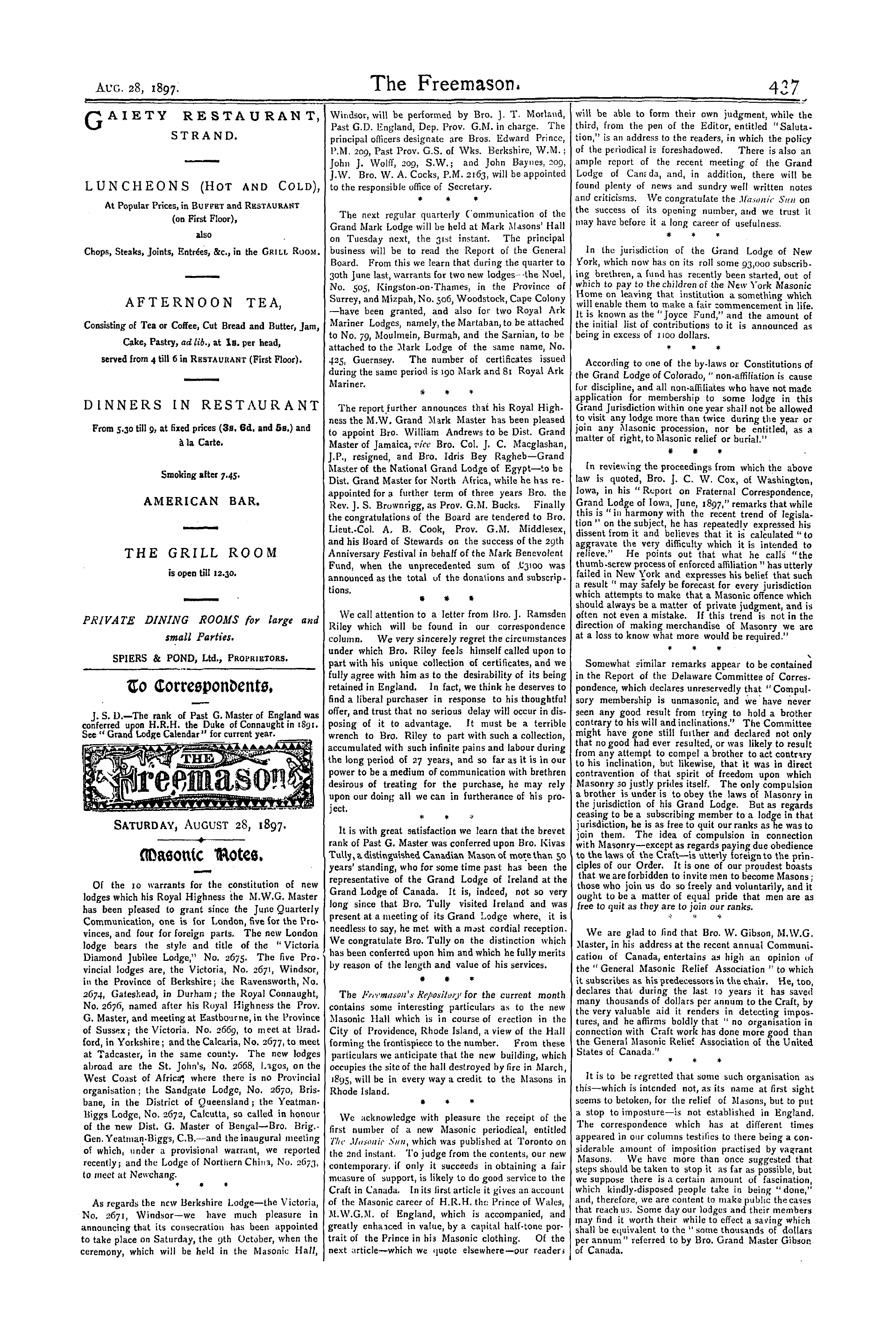
UNIQUE COLLECTION OF CERTIFICATES FOR SALE . To thc Editor of ihe "Freemason . " Dear Sir and Brother , You will be glad to learn that my autographs were at once distributed . Now I have another matter to bring forward less pleasant—at least to me , As I am expecting to be able to arrange to join a small party going to the Klondyke goldfields , being absolutely sick for want of employment , I regret
being at last compelled to part with nearly all my certificates * selected during the past 27 years . I may mention that a number of these documents , given to me under special conditions , have already been returned to former owners , but there still remains a very fine and , including the facsimiles taken by myself at various times , an unique collection . Many of the originals arc the finest known of their kind , and these alone would form a basis on which even a novice might ( with my work occasionally in his hands ) build up as complete a set as is possible at this day .
My chief object , however , at present is to state that , having been advised to place the lot in the hands of well-known London auctioneers for sale , I do not feel ( and I believe my Masonic antecedents sufficiently prove that in Craft matters Masonic objects have always been paramount in my mind ) , that such a course ought to be the outcome of my labour in this particular field of research , and , besides , I think the collection should remain in England .
Therefore I want it to be known amongst Masons that I am willing to treat privately for its purchase , either as an important foundation on which to raise a lodge collection , or add to the value of an already established Masonic Museum . As is well-known my exact size facsimiles are in high repute , both at home and abroad ; these for the most part fill blanks otherwise unattainable , but they need not be included , whereas the originals cannot be separated but must be purchased in one lot . Thc latter include Nos . i < , 17 , 18 , iq , 20 , 24 , 25 , 26 , 27 , 28 , 29 , 30 ,
3 i , 32 , 33 . 34 , 35 , 36 , 38 , 40 , 4 ' . 42 , 43 , 44 , 45 , 46 , and 47 of my list ( AQC . Vol . VIII ., p . 49 ) . Nos . 39 , 48 , 49 , and 50 being issued during the rule of H . R . H . the Prince of Wales as M . W . G . M ., are the easiest of any to add . The facsimiles include Nos . 2 , 5 , 6 , 8 , 10 , 11 , 14 , 16 , and others , while Nos . 1 , 3 , and 13 are absolutely unknown . Excepting the three last-named I could supply facsimiles of the few missing numbers if required . Trusting this matter is of Craft interest sufficient to warrant my taking up your space , for which privilege I thank you in advance . — I am , dear Sir and Brother , yours fraternally ,
J . RAMSDEN RILEY . 25 , Grey-road , Walton , Liverpool . * Some intended for Grand Lodge and my own parchments only excepted
Masonry And Social Life.
MASONRY AND SOCIAL LIFE .
A healthy , well-developed mind always finds pleasure in social life , whilst , on the other hand , the shunning of society is a well-known sign of eccentricity and disease . But this natural desire of society is too much limited in our social life . In the first place , there are what are called the conventionalities , to which we are in bondage , and because of which some people will travel side by side all day long without exchanging a word , because they have not been introduced to each other . There are further separating
barriers of rank and wealth and race and of religion . The titled hold aloof from the untitled , the rich from the poor , the European from the Asiastic . The Englishman shuns the Frenchman , the Christian shuns the Jew and the Mohammedan , the Protests nt shuns the Catholic , and the Churchman sometimes passes by on the other side when the Nonconformist appears . Hence , it comes that men who should dwell together in unity are separated from one another and divided into sets and sects and classes and masses ,
and in extreme cases men are isolated—standing , like savages , alone , or in families . There are , however , powerful influences at work counteracting these dissociating forces . Most important of these influences that favour social life are those arising from business relations and the associations of religion . The immediate objects of business and religion are , of course , material and
spiritual advancement , but incidentally they both give the greatest help to society . Men ' s sympathies naturally go out to those with whom they work and worship , and though antipathies and antagonisms are sometimes developed in work and worship , there still remains a large balance in favour of the social principle . For example , it sometimes happens that social life is narrowed down to the members of some religious sect or party , and call it by what name you will , a church that fails to bind
men together is not a true church but only a sect . But it is , after all , within the limits even of the narrow churches that scope has been found for thc social instinct . Happily , in our day there is a noticeable tendency in the churches to broaden their sympathies and draw together the people who , a generation ago , agreed at best to tolerate each other , and who , two generations ago , where driven by what they called their consciences to bitter controversy and strife .
The influence of Masonry in binding men together in sympathy and Charity is well-known and highly prized amongst Masons . It can never be too highly prized or loo carefully cultivated , for in some important respects there is nothing lo take its place . Men of all creeds who believe in God , and in His will revealed to men and in the eternal awards of vice and virtue , arc brought to dwell together in unity . The prince , the noble , and the millionaire stand together as brethren with the peasant , and the mechanic , and acknowledge the bonds of brotherly love , relief , and tru ' . h .
It has been objected that , whilst this may be true of Masons in their feeling and conduct towards each other , it is not true of Masons towards non-Masons . The objection is founded on ignorance of the ancient charges of Masonry , which inculcate the duty of universal benevolence , and impress it upon every member of the Order . The objection is also foundsd on ignorance of human nature , since a habit of mind once formed tends naturally to spread its influence over the whole life . Kindness and helpfulness cultivated in thc family and amongst children naturally extends beyond
Masonry And Social Life.
the family into all social , business , political , and religious relations . If there are men who are kind only to their own , and careless or unkind to others , it can never be supposed that their kindness to some is the cause of their unkindness to others , or that they would be better neighbours and citiz ms if they were worse husbands and fathers . Even so . the generous regard for others cultivated in Masonic fellowship would naturally extend to all the world , even if it were not required to do so by Masonic teaching .
Again , it can be said of Masonry that it affords to most men the best and safest occasions for the exercise and satisfaction of the social instinct .
Our Anglo-Saxon race is domestic rather than social . This may be accounted for to a great extent from the influences of climate . We must dwell under our roofs and by our firesides during a large part of the year . Hence the long culture and the rare excellence of our people in the home life . The nations of lhe sunny south , on the other hand , may live out of doors for a large part of the year , and hence their superiority over us in the
development of the social qualities . On the whole we are well content with our ways , and would not exchange our northern homes for the cafes and boulevards ol the south . But all men amongst us are not blesssed with homes and as the next best thing some must find satisfaction in social life . Moreover , men who are devoted to their homes have also a relish for social enjoyment . Exceptions there are no doubt—men who care for no
society but that of the home , and cannot understand how other irfen crave social as well as domestic life . They wonder at it much as we may imagine sober , barnyard fowl to wonder at the perverse desire of ducks to leave the solid earth and disport themselves in the water . Now , it is the aim of Masonry to have the company of the lodge select —composed of worthy men and of such only . And though it cannot be
claimed that there are no men in the lodge who do not at times tax the patience of the brethren , yet , as a rule , the brethren meet in their lodges better company than the average , and oftener better company than they meet anywhere else . Of late years the tendency has been to improve more and more the social tone of the lodges , and to suppress and exclude all that
would offend good taste , whilst at the same time free scope is left for all that would improve good fellowship . It is to be hoped that this tendency will continue till even the outer world will learn to distinguish between good Masons and bad , and allow for those occasional failings that " may be found in the best regulated families . "
In conclusion , another side of this familiar subject may be noted . It has been feared that the social life of Masonic gatherings involves a loss to the domestic life . There is some danger of this especially in the case of officers of the lodge during their term of office , but on the whole the home life does not lose ; it rather gains from the social life of Masonry . One evening in the month is commonly given to the lodge with all its duties of
business and Charity as well as social intercourse . Now , just as an outing of a few days usually makes a man all the better pleased with his own home , so those few days of Masonic work and fellowshi p do not lessen , but rather increase the enjoyment of the quiet domestic life . If there are exceptions to this rule the reason is to be found in something wrong in the home quite as
often as in something wrong in the lodge . There is much good-natured chaff sometimes between the Craftsman and his wife and daughters , but the Mason knows that his Craft is a great safeguard of his home , and the wife is happy who has no further trouble from her husband than his provoking silence and tantalising humour as to the mysteries of Masonry .
CHAPLAIN . St . Andrew's Lodge , Toronto . —The Masonic Suit .
District Grand Lodge Of Otago And Southland (N.Z.)
DISTRICT GRAND LODGE OF OTAGO AND SOUTHLAND ( N . Z . )
The annual meeting was held within the portals of the Lodge of Otago , No . 844 , E . G ., on the 9 th June , in the presence of a numerous assemblage of the Craft . The District Grand Lodge was opened by the D . G . Master , Bro . T . S . Graham , assisted By Bro . S . James , D . D . G . M ., and the rest of the Grand Officers .
After the transaction of the routine business of the meeting , the report from the Board of General Purposes was read by the President , Bro . C . de L . Graham , P . D . G . S . W . The D . G . Master then appointed and invested the ofiicers for the current year as follows : Hro . Sydney James , P . D . D . G . M . ... acting D . D . G . M . „ J . H . Hancock ... ... . ... D . S . G . W .
, „ J . S . Evans ... ... ... D . J . G . W . „ Thomas Cole ... ... ... D . G . Chap . „ H . B . Smith ... ... ... D . G . Treas . ,, J . Johnson ... ... ... ... D . G . Rfg . „ Charles de Longueville Graham ... ... Pres . B . Gen . Pur . „ Sydney James ... ... ... D . G . Sec . „ D . C . Sharpe ... ... ... D . S . G . D .
„ G . Barclay ... ... ... ... D . J . G . D . „ A . Bagley ... ... ... ... D . G . Supt . of Wks . „ J . H . Moir ... ... ... ... D . G . D . C . „ F . Foote ... ... ... ... P . G . S . B . ,, A . F . Robertshaw ... ... ... D . G . Org .
„ W . S . Barnard ... ... ,,. D . G . Purst . ,, Bicnkinsopp ... ... ~ ) „ Oxley ... ... ... I ;:feir:::::::::\»«.*«*. „ Hastie ,,, ... ... | ., Kugg ... - ... J „ H . Meyer ... ... ... ... D . G . Tyler .
Bro . HANCOCK , D . S . G . W ., 011 behalf of the oilicers , returned thanks in appropriate terms . ' The Board of General Purposes is composed of tha President ( Bro . Charles de Longueville Graham ) , Bros . Hancock , Evans , Green , Cameron , and H . Smith , P . Ms ., the D . G . M . and Deputy being ex officio members . The Board of Benevolence comprises Bros . Charles de Longueville Graham , Hancock , Evans , and Green , Bros . H . B . Smith and James being ex officio members .

Note: This text has been automatically extracted via Optical Character Recognition (OCR) software.
Correspondence.
Correspondence .
We do not hold ourselves responsible for the opinions expressed by our correspondents , but we wish , in a spirit of fair play to all , to permit—within certain necessary limitsfree discussion .
UNIQUE COLLECTION OF CERTIFICATES FOR SALE . To thc Editor of ihe "Freemason . " Dear Sir and Brother , You will be glad to learn that my autographs were at once distributed . Now I have another matter to bring forward less pleasant—at least to me , As I am expecting to be able to arrange to join a small party going to the Klondyke goldfields , being absolutely sick for want of employment , I regret
being at last compelled to part with nearly all my certificates * selected during the past 27 years . I may mention that a number of these documents , given to me under special conditions , have already been returned to former owners , but there still remains a very fine and , including the facsimiles taken by myself at various times , an unique collection . Many of the originals arc the finest known of their kind , and these alone would form a basis on which even a novice might ( with my work occasionally in his hands ) build up as complete a set as is possible at this day .
My chief object , however , at present is to state that , having been advised to place the lot in the hands of well-known London auctioneers for sale , I do not feel ( and I believe my Masonic antecedents sufficiently prove that in Craft matters Masonic objects have always been paramount in my mind ) , that such a course ought to be the outcome of my labour in this particular field of research , and , besides , I think the collection should remain in England .
Therefore I want it to be known amongst Masons that I am willing to treat privately for its purchase , either as an important foundation on which to raise a lodge collection , or add to the value of an already established Masonic Museum . As is well-known my exact size facsimiles are in high repute , both at home and abroad ; these for the most part fill blanks otherwise unattainable , but they need not be included , whereas the originals cannot be separated but must be purchased in one lot . Thc latter include Nos . i < , 17 , 18 , iq , 20 , 24 , 25 , 26 , 27 , 28 , 29 , 30 ,
3 i , 32 , 33 . 34 , 35 , 36 , 38 , 40 , 4 ' . 42 , 43 , 44 , 45 , 46 , and 47 of my list ( AQC . Vol . VIII ., p . 49 ) . Nos . 39 , 48 , 49 , and 50 being issued during the rule of H . R . H . the Prince of Wales as M . W . G . M ., are the easiest of any to add . The facsimiles include Nos . 2 , 5 , 6 , 8 , 10 , 11 , 14 , 16 , and others , while Nos . 1 , 3 , and 13 are absolutely unknown . Excepting the three last-named I could supply facsimiles of the few missing numbers if required . Trusting this matter is of Craft interest sufficient to warrant my taking up your space , for which privilege I thank you in advance . — I am , dear Sir and Brother , yours fraternally ,
J . RAMSDEN RILEY . 25 , Grey-road , Walton , Liverpool . * Some intended for Grand Lodge and my own parchments only excepted
Masonry And Social Life.
MASONRY AND SOCIAL LIFE .
A healthy , well-developed mind always finds pleasure in social life , whilst , on the other hand , the shunning of society is a well-known sign of eccentricity and disease . But this natural desire of society is too much limited in our social life . In the first place , there are what are called the conventionalities , to which we are in bondage , and because of which some people will travel side by side all day long without exchanging a word , because they have not been introduced to each other . There are further separating
barriers of rank and wealth and race and of religion . The titled hold aloof from the untitled , the rich from the poor , the European from the Asiastic . The Englishman shuns the Frenchman , the Christian shuns the Jew and the Mohammedan , the Protests nt shuns the Catholic , and the Churchman sometimes passes by on the other side when the Nonconformist appears . Hence , it comes that men who should dwell together in unity are separated from one another and divided into sets and sects and classes and masses ,
and in extreme cases men are isolated—standing , like savages , alone , or in families . There are , however , powerful influences at work counteracting these dissociating forces . Most important of these influences that favour social life are those arising from business relations and the associations of religion . The immediate objects of business and religion are , of course , material and
spiritual advancement , but incidentally they both give the greatest help to society . Men ' s sympathies naturally go out to those with whom they work and worship , and though antipathies and antagonisms are sometimes developed in work and worship , there still remains a large balance in favour of the social principle . For example , it sometimes happens that social life is narrowed down to the members of some religious sect or party , and call it by what name you will , a church that fails to bind
men together is not a true church but only a sect . But it is , after all , within the limits even of the narrow churches that scope has been found for thc social instinct . Happily , in our day there is a noticeable tendency in the churches to broaden their sympathies and draw together the people who , a generation ago , agreed at best to tolerate each other , and who , two generations ago , where driven by what they called their consciences to bitter controversy and strife .
The influence of Masonry in binding men together in sympathy and Charity is well-known and highly prized amongst Masons . It can never be too highly prized or loo carefully cultivated , for in some important respects there is nothing lo take its place . Men of all creeds who believe in God , and in His will revealed to men and in the eternal awards of vice and virtue , arc brought to dwell together in unity . The prince , the noble , and the millionaire stand together as brethren with the peasant , and the mechanic , and acknowledge the bonds of brotherly love , relief , and tru ' . h .
It has been objected that , whilst this may be true of Masons in their feeling and conduct towards each other , it is not true of Masons towards non-Masons . The objection is founded on ignorance of the ancient charges of Masonry , which inculcate the duty of universal benevolence , and impress it upon every member of the Order . The objection is also foundsd on ignorance of human nature , since a habit of mind once formed tends naturally to spread its influence over the whole life . Kindness and helpfulness cultivated in thc family and amongst children naturally extends beyond
Masonry And Social Life.
the family into all social , business , political , and religious relations . If there are men who are kind only to their own , and careless or unkind to others , it can never be supposed that their kindness to some is the cause of their unkindness to others , or that they would be better neighbours and citiz ms if they were worse husbands and fathers . Even so . the generous regard for others cultivated in Masonic fellowship would naturally extend to all the world , even if it were not required to do so by Masonic teaching .
Again , it can be said of Masonry that it affords to most men the best and safest occasions for the exercise and satisfaction of the social instinct .
Our Anglo-Saxon race is domestic rather than social . This may be accounted for to a great extent from the influences of climate . We must dwell under our roofs and by our firesides during a large part of the year . Hence the long culture and the rare excellence of our people in the home life . The nations of lhe sunny south , on the other hand , may live out of doors for a large part of the year , and hence their superiority over us in the
development of the social qualities . On the whole we are well content with our ways , and would not exchange our northern homes for the cafes and boulevards ol the south . But all men amongst us are not blesssed with homes and as the next best thing some must find satisfaction in social life . Moreover , men who are devoted to their homes have also a relish for social enjoyment . Exceptions there are no doubt—men who care for no
society but that of the home , and cannot understand how other irfen crave social as well as domestic life . They wonder at it much as we may imagine sober , barnyard fowl to wonder at the perverse desire of ducks to leave the solid earth and disport themselves in the water . Now , it is the aim of Masonry to have the company of the lodge select —composed of worthy men and of such only . And though it cannot be
claimed that there are no men in the lodge who do not at times tax the patience of the brethren , yet , as a rule , the brethren meet in their lodges better company than the average , and oftener better company than they meet anywhere else . Of late years the tendency has been to improve more and more the social tone of the lodges , and to suppress and exclude all that
would offend good taste , whilst at the same time free scope is left for all that would improve good fellowship . It is to be hoped that this tendency will continue till even the outer world will learn to distinguish between good Masons and bad , and allow for those occasional failings that " may be found in the best regulated families . "
In conclusion , another side of this familiar subject may be noted . It has been feared that the social life of Masonic gatherings involves a loss to the domestic life . There is some danger of this especially in the case of officers of the lodge during their term of office , but on the whole the home life does not lose ; it rather gains from the social life of Masonry . One evening in the month is commonly given to the lodge with all its duties of
business and Charity as well as social intercourse . Now , just as an outing of a few days usually makes a man all the better pleased with his own home , so those few days of Masonic work and fellowshi p do not lessen , but rather increase the enjoyment of the quiet domestic life . If there are exceptions to this rule the reason is to be found in something wrong in the home quite as
often as in something wrong in the lodge . There is much good-natured chaff sometimes between the Craftsman and his wife and daughters , but the Mason knows that his Craft is a great safeguard of his home , and the wife is happy who has no further trouble from her husband than his provoking silence and tantalising humour as to the mysteries of Masonry .
CHAPLAIN . St . Andrew's Lodge , Toronto . —The Masonic Suit .
District Grand Lodge Of Otago And Southland (N.Z.)
DISTRICT GRAND LODGE OF OTAGO AND SOUTHLAND ( N . Z . )
The annual meeting was held within the portals of the Lodge of Otago , No . 844 , E . G ., on the 9 th June , in the presence of a numerous assemblage of the Craft . The District Grand Lodge was opened by the D . G . Master , Bro . T . S . Graham , assisted By Bro . S . James , D . D . G . M ., and the rest of the Grand Officers .
After the transaction of the routine business of the meeting , the report from the Board of General Purposes was read by the President , Bro . C . de L . Graham , P . D . G . S . W . The D . G . Master then appointed and invested the ofiicers for the current year as follows : Hro . Sydney James , P . D . D . G . M . ... acting D . D . G . M . „ J . H . Hancock ... ... . ... D . S . G . W .
, „ J . S . Evans ... ... ... D . J . G . W . „ Thomas Cole ... ... ... D . G . Chap . „ H . B . Smith ... ... ... D . G . Treas . ,, J . Johnson ... ... ... ... D . G . Rfg . „ Charles de Longueville Graham ... ... Pres . B . Gen . Pur . „ Sydney James ... ... ... D . G . Sec . „ D . C . Sharpe ... ... ... D . S . G . D .
„ G . Barclay ... ... ... ... D . J . G . D . „ A . Bagley ... ... ... ... D . G . Supt . of Wks . „ J . H . Moir ... ... ... ... D . G . D . C . „ F . Foote ... ... ... ... P . G . S . B . ,, A . F . Robertshaw ... ... ... D . G . Org .
„ W . S . Barnard ... ... ,,. D . G . Purst . ,, Bicnkinsopp ... ... ~ ) „ Oxley ... ... ... I ;:feir:::::::::\»«.*«*. „ Hastie ,,, ... ... | ., Kugg ... - ... J „ H . Meyer ... ... ... ... D . G . Tyler .
Bro . HANCOCK , D . S . G . W ., 011 behalf of the oilicers , returned thanks in appropriate terms . ' The Board of General Purposes is composed of tha President ( Bro . Charles de Longueville Graham ) , Bros . Hancock , Evans , Green , Cameron , and H . Smith , P . Ms ., the D . G . M . and Deputy being ex officio members . The Board of Benevolence comprises Bros . Charles de Longueville Graham , Hancock , Evans , and Green , Bros . H . B . Smith and James being ex officio members .