-
Articles/Ads
Article Untitled ← Page 2 of 2 Article OLD MASONIC WORKINGS. Page 1 of 1 Article OLD MASONIC WORKINGS. Page 1 of 1
Note: This text has been automatically extracted via Optical Character Recognition (OCR) software.
Ar00200
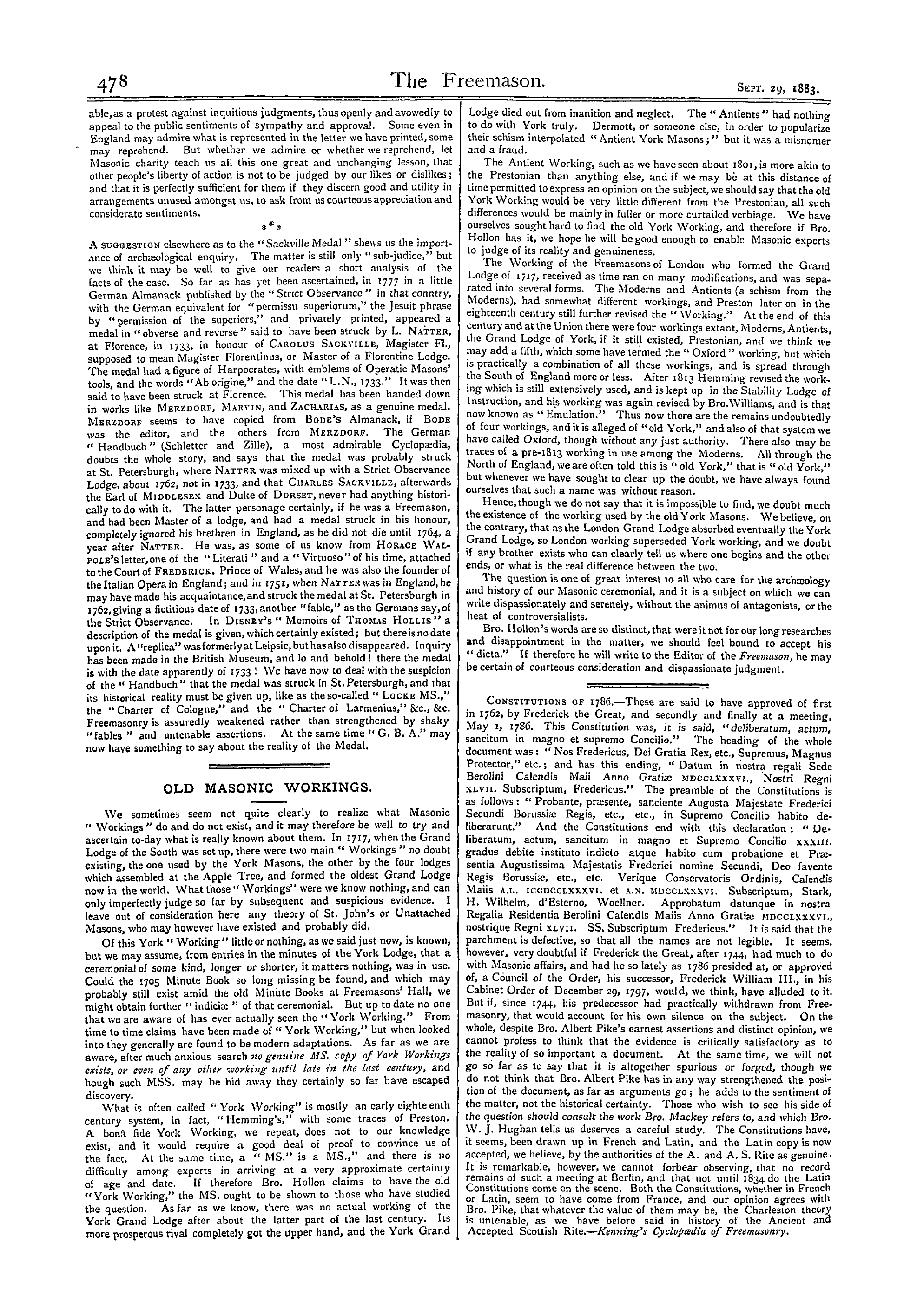
able , as a protest against inquitious judgments , thus openly and avowedly to appeal to the public sentiments of sympathy and approval . Some even in England may admire what is represented in the letter we have printed , some may reprehend . But whether we admire or whether we reprehend , let
Masonic charity teach us all this one great and unchanging lesson , that other people ' s liberty of action is not to be judged by our likes or dislikes ; and that it is perfectly sufficient for them if they discern good and utility in arrangements unused amongst us , to ask from us courteous appreciation and considerate sentiments .
* A SUGGESTION elsewhere as to the " Sackville Medal " shews us the importance of archaeological enquiry . The matter is still only " sub-judice , " but we think it may be well to give our readers a short analysis of the facts of the case . So far as has yet been ascertained , in 1777 in a little
German Almanack published by the "Strict Observance in that conntry , with the German equivalent for " permissu superiorum , " the Jesuit phrase by " permission of the superiors , " and privately printed , appeared a medal in " obverse and reverse" said to have been struck by L . NATTER , at Florence , in 1733 , in honour of CAROLUS SACKVILLE , Magister FI .,
supposed to mean Magister Florentinus , or Master of a Florentine Lodge . The medal had a figure of Harpocrates , with emblems of Operatic Masons ' tools , and the words " Ab origine , " and the date " L . N ., 1733 . " It was then said to have been struck at Florence . This medal has been handed down in works like M ERZDORF , MARVIN , and ZACHARIAS , as a genuine medal .
MERZDORF seems to have copied from BODE ' S Almanack , if BODE was the editor , and the others from MERZDORF . The German " Handbuch" ( Schletter and Zille ) , a most admirable Cyclopaedia , doubts the whole story , and says that the medal was probably struck at St . Petersburgh , where NATTER was mixed up with a Strict Observance
Lodge , about 1762 , not in 1733 , and that CHARLES SACKVILLE , afterwards the Earl of MIDDLESEX and Duke of DORSET , never had anything historically to do with it . The latter personage certainly , if he was a Freemason , and had been Master of a lodge , and had a medal struck in his honour , completely ignored his brethren in England , as he did not die until 1764 , a
year after N ATTER . He was , as some of us know from HORACE WALPOLE ' S letter , one of the " Literati " and a "Virtuoso"of his time , attached to the Court of FREDERICK , Prince of Wales , and he was also the founder of the Italian Opera in England ; and in 1751 , when NATTER was in England , he may have made his acquaintance , and struck the medal at St . Petersburgh in
1762 , giving a fictitious date of 1733 , another "fable , as the Germans say , of the Strict Observance . In D ISNEY ' S " Memoirs of THOMAS HOLLIS" a description of the medal is given , which certainly existed ; but there is no date upon it . A " replica" was formerlyat Leipsic , but hasalso disappeared . Inquiry has been made in the British Museum , and lo and behold ! there the medal
is with the date apparently of 1733 ! We have now to deal with the suspicion of the " Handbuch " that the medal was struck in St . Petersburgh , and that its historical reality must be given up , like as the so-called " LOCKE MS ., "
the " Charter of Cologne , " and the " Charter of Larmenius , " & c , & c . Freemasonry is assuredly weakened rather than strengthened by shaky "fables " and untenable assertions . At the same time ** G . B . A . " may now have something to say about the reality of the Medal .
Old Masonic Workings.
OLD MASONIC WORKINGS .
We sometimes seem not quite clearly to realize what Masonic " Workings " do and do not exist , and it may therefore be well to try and ascertain to-day what is really known about them . In 1717 , when the Grand Lodge of the South was set up , there were two main " Workings " no doubt existing , the one used by the York Masons , the other by the four lodges
which assembled at the Apple Tree , and formed the oldest Grand Lodge now in the world . What those " Workings" were we know nothing , and can only imperfectly judge so lar by subsequent and suspicious evidence . I leave out of consideration here any theory of St . John ' s or Unattached Masons , who may however have existed and probably did .
Of this York " Working " little or nothing , as we said just now , is known , but we may assume , from entries in the minutes of the York Lodge , that a ceremonial of some kind , longer or shorter , it matters nothing , was in use . Could the 1705 Minute Book so long missing be found , and which may probably still exist amid the old Minute Books at Freemasons' Hall , we might obtain further ** indicix " of that ceremonial . But up to date no one
that we are aware of has ever actually seen the " York Working . " From time to time claims have been made of " York Working , " but when looked into they generally are found to be modern adaptations . As far as we are aware , after much anxious search no genuine MS . copy of York Workings exists , or even of any other working until late in the last century , and hough such MSS . may be hid away they certainly so far have escaped
discovery . What is often called " York Working" is mostly an early eighte enth century system , in fact , " Hemming ' s , " with some traces of Preston . A bona fide York Working , we repeat , does not to our knowledge exist , and it would require a good deal of proof to convince us of the fact . At the same time , a " MS . " is a MS ., " and there is no
difficulty among experts in arriving at a very approximate certainty of age and date . If therefore Bro . Hollon claims to have the old "York Working , " the MS . ought to be shown to those who have studied the question . As far as we know , there was no actual working of the York Grand Lodge after about the latter part of the last century . Its more prosperous rival completely got the upper hand , and the York Grand
Old Masonic Workings.
Lodge died out from inanition and neglect . The " Antients " had nothing to do with York truly . Dermott , or someone else , in order to popularize their schism interpolated "Antient York Masons ; " but it was a misnomer and a fraud . The Antient Working , such as we have seen about i 8 oi , is more akin to
the Prestonian than anything else , and if we may be at this distance of time permitted to express an opinion on the subject , we should say that the old York Working would be very little different from the Prestonian , all such
differences would be mainly in fuller or more curtailed verbiage . We have ourselves sought hard to find the old York Working , and therefore if Bro . Hollon has it , we hope he will be good enough to enable Masonic experts to judge of its reality and genuineness .
The Working of the Freemasons of London who formed the Grand Lodge of 1717 , received as time ran on many modifications , and was separated into several forms . The Moderns and Antients ( a schism from the Moderns ) , had somewhat different workings , and Preston later on in the eighteenth century still further revised the " Working . " At the end of this
century and at the Union there were four workings extant , Moderns , Antients , the Grand Lodge of York , if it still existed , Prestonian , and we think we may add a fifth , which some have termed the " Oxford " working , but which is practically a combination of all these workings , and is spread through the South of England more or less . After 1813 Hemming revised the
working which is still extensively used , and is kept up in the Stability Lodge of Instruction , and his working was again revised by Bro . Williams , and is that now known as " Emulation . " Thus now there are the remains undoubtedly of four workings , and it is alleged of " old York , " and also of that system we
have called Oxford , though without any just authority . There also may be traces of a pTe-1813 working in use among the Moderns . AU through the North of England , we are of ten told this is " old York , " that is " old York , " but whenever we have sought to clear up the doubt , we have always found ourselves that such a name was without reason .
Hence , though we do not say that it is impossible to find , we doubt much the existence of the working used by the old York Masons . We believe , on the contrary , that as the London Grand Lodge absorbed eventually the York Grand Lodge , so London working superseded York working , and we doubt if any brother exists who can clearly tell us where one begins and the other ends , or what is the real difference between the two .
The question is one of great interest to all who care for the archaeology and history of our Masonic ceremonial , and it is a subject on which we can write dispassionately and serenely , without the animus of antagonists , or the heat of controversialists .
Bro . Hollon ' s words are so distinct , that were it not for our long researches and disappointment in the matter , we should feel bound to accept his " dicta . " If therefore he will write to the Editor of the Freemason , he may be certain of courteous consideration and dispassionate judgment .
Protector , " etc . ; and has this ending , " Datum in nostra regali Sede Berolini Calendis Maii Anno Gratia ; MDCCLXXXVI ., Nostri Regni XLVII . Subscriptum , Fredericus . " The preamble of the Constitutions is as follows : " Probante , prajsente , sanciente Augusta Majestate Frederic ! Secundi Borussiai Regis , etc ., etc ., in Supremo Concilio habito
de-CONSTITUTIONS OF 1786 . —These are said to have approved of first in 1762 , by Frederick the Great , and secondly and finally at a meeting , May 1 , 1786 . This Constitution was , it is said , " deliberaturo , actum , sancitum in magno et supremo Concilio . " The heading of the whole document was : " Nos Fredericus , Dei Gratia Rex , etc ., Supremus , Magnus
ltberarunt . " And the Constitutions end with this declaration : " Deliberatum , actum , sancitum in magno et Supremo Concilio xxxm . gradus debite instituto indicto atque habito cum probatione et Praesentia Augustissima Majestatis Frederici nomine Secundi , Deo favente Regis Borussia ; , etc ., etc . Verique Conservatoris Ordinis , Calendis
Mans A . L . ICCDCCLXXXVI . et A . N . MDCCLXXXVI . Subscriptum , Stark , H . Wilhelm , d'Esterno , Woellner . Approbatum datunque in nostra Regalia Residentia Berolini Calendis Maiis Anno Gratia ? MDCCLXXXVI ., nostrique Regni XLVII . SS . Subscriptum Fredericus . " It is said that the parchment is defective , so that all the names are not legible . It seems ,
however , very doubtful if Frederick the Great , after 1744 , had much to do with Masonic affairs , and had he so lately as 1786 presided at , or approved of , a Council of the Order , his successor , Frederick William III ., in his Cabinet Order of December 29 , 1797 , would , we think , have alluded to it . But if , since 1744 , his predecessor had practically withdrawn from
Freemasonry , that would account for his own silence on the subject . On the whole , despite Bro . Albert Pike ' s earnest assertions and distinct opinion , we cannot profess to think that the evidence is critically satisfactory as to the reality of so important a document . At the same time , we will not go so far as to say that it is altogether spurious or forged , though we
do not think that Bro . Albert Pike has in any way strengthened the position of the document , as far as arguments go ; he adds to the sentiment of the matter , not the historical certainty . Those who wish to see his side of the question should consult the work Bro . Mackey refers to , and which Bro . W . J . Hughan tells us deserves a careful study . The Constitutions have ,
it seems , been drawn up in French and Latin , and the Latin copy is now accepted , we believe , by the authorities of the A . and A . S . Rite as genuine . It is remarkable , however , we cannot forbear observing , that no record remains of such a meeting at Berlin , and that not until 1834 do the Latin
Constitutions come on the scene . Both the Constitutions , whether in French or Latin , seem to have come from France , and our opinion agrees with Bro . Pike , that whatever the value of them may be , the Charleston theory is untenable , as we have belore said in history of the Ancient and Accepted Scottish Rite . —Kenning's Cyclopedia of Freemasonry .



Note: This text has been automatically extracted via Optical Character Recognition (OCR) software.
Ar00200
able , as a protest against inquitious judgments , thus openly and avowedly to appeal to the public sentiments of sympathy and approval . Some even in England may admire what is represented in the letter we have printed , some may reprehend . But whether we admire or whether we reprehend , let
Masonic charity teach us all this one great and unchanging lesson , that other people ' s liberty of action is not to be judged by our likes or dislikes ; and that it is perfectly sufficient for them if they discern good and utility in arrangements unused amongst us , to ask from us courteous appreciation and considerate sentiments .
* A SUGGESTION elsewhere as to the " Sackville Medal " shews us the importance of archaeological enquiry . The matter is still only " sub-judice , " but we think it may be well to give our readers a short analysis of the facts of the case . So far as has yet been ascertained , in 1777 in a little
German Almanack published by the "Strict Observance in that conntry , with the German equivalent for " permissu superiorum , " the Jesuit phrase by " permission of the superiors , " and privately printed , appeared a medal in " obverse and reverse" said to have been struck by L . NATTER , at Florence , in 1733 , in honour of CAROLUS SACKVILLE , Magister FI .,
supposed to mean Magister Florentinus , or Master of a Florentine Lodge . The medal had a figure of Harpocrates , with emblems of Operatic Masons ' tools , and the words " Ab origine , " and the date " L . N ., 1733 . " It was then said to have been struck at Florence . This medal has been handed down in works like M ERZDORF , MARVIN , and ZACHARIAS , as a genuine medal .
MERZDORF seems to have copied from BODE ' S Almanack , if BODE was the editor , and the others from MERZDORF . The German " Handbuch" ( Schletter and Zille ) , a most admirable Cyclopaedia , doubts the whole story , and says that the medal was probably struck at St . Petersburgh , where NATTER was mixed up with a Strict Observance
Lodge , about 1762 , not in 1733 , and that CHARLES SACKVILLE , afterwards the Earl of MIDDLESEX and Duke of DORSET , never had anything historically to do with it . The latter personage certainly , if he was a Freemason , and had been Master of a lodge , and had a medal struck in his honour , completely ignored his brethren in England , as he did not die until 1764 , a
year after N ATTER . He was , as some of us know from HORACE WALPOLE ' S letter , one of the " Literati " and a "Virtuoso"of his time , attached to the Court of FREDERICK , Prince of Wales , and he was also the founder of the Italian Opera in England ; and in 1751 , when NATTER was in England , he may have made his acquaintance , and struck the medal at St . Petersburgh in
1762 , giving a fictitious date of 1733 , another "fable , as the Germans say , of the Strict Observance . In D ISNEY ' S " Memoirs of THOMAS HOLLIS" a description of the medal is given , which certainly existed ; but there is no date upon it . A " replica" was formerlyat Leipsic , but hasalso disappeared . Inquiry has been made in the British Museum , and lo and behold ! there the medal
is with the date apparently of 1733 ! We have now to deal with the suspicion of the " Handbuch " that the medal was struck in St . Petersburgh , and that its historical reality must be given up , like as the so-called " LOCKE MS ., "
the " Charter of Cologne , " and the " Charter of Larmenius , " & c , & c . Freemasonry is assuredly weakened rather than strengthened by shaky "fables " and untenable assertions . At the same time ** G . B . A . " may now have something to say about the reality of the Medal .
Old Masonic Workings.
OLD MASONIC WORKINGS .
We sometimes seem not quite clearly to realize what Masonic " Workings " do and do not exist , and it may therefore be well to try and ascertain to-day what is really known about them . In 1717 , when the Grand Lodge of the South was set up , there were two main " Workings " no doubt existing , the one used by the York Masons , the other by the four lodges
which assembled at the Apple Tree , and formed the oldest Grand Lodge now in the world . What those " Workings" were we know nothing , and can only imperfectly judge so lar by subsequent and suspicious evidence . I leave out of consideration here any theory of St . John ' s or Unattached Masons , who may however have existed and probably did .
Of this York " Working " little or nothing , as we said just now , is known , but we may assume , from entries in the minutes of the York Lodge , that a ceremonial of some kind , longer or shorter , it matters nothing , was in use . Could the 1705 Minute Book so long missing be found , and which may probably still exist amid the old Minute Books at Freemasons' Hall , we might obtain further ** indicix " of that ceremonial . But up to date no one
that we are aware of has ever actually seen the " York Working . " From time to time claims have been made of " York Working , " but when looked into they generally are found to be modern adaptations . As far as we are aware , after much anxious search no genuine MS . copy of York Workings exists , or even of any other working until late in the last century , and hough such MSS . may be hid away they certainly so far have escaped
discovery . What is often called " York Working" is mostly an early eighte enth century system , in fact , " Hemming ' s , " with some traces of Preston . A bona fide York Working , we repeat , does not to our knowledge exist , and it would require a good deal of proof to convince us of the fact . At the same time , a " MS . " is a MS ., " and there is no
difficulty among experts in arriving at a very approximate certainty of age and date . If therefore Bro . Hollon claims to have the old "York Working , " the MS . ought to be shown to those who have studied the question . As far as we know , there was no actual working of the York Grand Lodge after about the latter part of the last century . Its more prosperous rival completely got the upper hand , and the York Grand
Old Masonic Workings.
Lodge died out from inanition and neglect . The " Antients " had nothing to do with York truly . Dermott , or someone else , in order to popularize their schism interpolated "Antient York Masons ; " but it was a misnomer and a fraud . The Antient Working , such as we have seen about i 8 oi , is more akin to
the Prestonian than anything else , and if we may be at this distance of time permitted to express an opinion on the subject , we should say that the old York Working would be very little different from the Prestonian , all such
differences would be mainly in fuller or more curtailed verbiage . We have ourselves sought hard to find the old York Working , and therefore if Bro . Hollon has it , we hope he will be good enough to enable Masonic experts to judge of its reality and genuineness .
The Working of the Freemasons of London who formed the Grand Lodge of 1717 , received as time ran on many modifications , and was separated into several forms . The Moderns and Antients ( a schism from the Moderns ) , had somewhat different workings , and Preston later on in the eighteenth century still further revised the " Working . " At the end of this
century and at the Union there were four workings extant , Moderns , Antients , the Grand Lodge of York , if it still existed , Prestonian , and we think we may add a fifth , which some have termed the " Oxford " working , but which is practically a combination of all these workings , and is spread through the South of England more or less . After 1813 Hemming revised the
working which is still extensively used , and is kept up in the Stability Lodge of Instruction , and his working was again revised by Bro . Williams , and is that now known as " Emulation . " Thus now there are the remains undoubtedly of four workings , and it is alleged of " old York , " and also of that system we
have called Oxford , though without any just authority . There also may be traces of a pTe-1813 working in use among the Moderns . AU through the North of England , we are of ten told this is " old York , " that is " old York , " but whenever we have sought to clear up the doubt , we have always found ourselves that such a name was without reason .
Hence , though we do not say that it is impossible to find , we doubt much the existence of the working used by the old York Masons . We believe , on the contrary , that as the London Grand Lodge absorbed eventually the York Grand Lodge , so London working superseded York working , and we doubt if any brother exists who can clearly tell us where one begins and the other ends , or what is the real difference between the two .
The question is one of great interest to all who care for the archaeology and history of our Masonic ceremonial , and it is a subject on which we can write dispassionately and serenely , without the animus of antagonists , or the heat of controversialists .
Bro . Hollon ' s words are so distinct , that were it not for our long researches and disappointment in the matter , we should feel bound to accept his " dicta . " If therefore he will write to the Editor of the Freemason , he may be certain of courteous consideration and dispassionate judgment .
Protector , " etc . ; and has this ending , " Datum in nostra regali Sede Berolini Calendis Maii Anno Gratia ; MDCCLXXXVI ., Nostri Regni XLVII . Subscriptum , Fredericus . " The preamble of the Constitutions is as follows : " Probante , prajsente , sanciente Augusta Majestate Frederic ! Secundi Borussiai Regis , etc ., etc ., in Supremo Concilio habito
de-CONSTITUTIONS OF 1786 . —These are said to have approved of first in 1762 , by Frederick the Great , and secondly and finally at a meeting , May 1 , 1786 . This Constitution was , it is said , " deliberaturo , actum , sancitum in magno et supremo Concilio . " The heading of the whole document was : " Nos Fredericus , Dei Gratia Rex , etc ., Supremus , Magnus
ltberarunt . " And the Constitutions end with this declaration : " Deliberatum , actum , sancitum in magno et Supremo Concilio xxxm . gradus debite instituto indicto atque habito cum probatione et Praesentia Augustissima Majestatis Frederici nomine Secundi , Deo favente Regis Borussia ; , etc ., etc . Verique Conservatoris Ordinis , Calendis
Mans A . L . ICCDCCLXXXVI . et A . N . MDCCLXXXVI . Subscriptum , Stark , H . Wilhelm , d'Esterno , Woellner . Approbatum datunque in nostra Regalia Residentia Berolini Calendis Maiis Anno Gratia ? MDCCLXXXVI ., nostrique Regni XLVII . SS . Subscriptum Fredericus . " It is said that the parchment is defective , so that all the names are not legible . It seems ,
however , very doubtful if Frederick the Great , after 1744 , had much to do with Masonic affairs , and had he so lately as 1786 presided at , or approved of , a Council of the Order , his successor , Frederick William III ., in his Cabinet Order of December 29 , 1797 , would , we think , have alluded to it . But if , since 1744 , his predecessor had practically withdrawn from
Freemasonry , that would account for his own silence on the subject . On the whole , despite Bro . Albert Pike ' s earnest assertions and distinct opinion , we cannot profess to think that the evidence is critically satisfactory as to the reality of so important a document . At the same time , we will not go so far as to say that it is altogether spurious or forged , though we
do not think that Bro . Albert Pike has in any way strengthened the position of the document , as far as arguments go ; he adds to the sentiment of the matter , not the historical certainty . Those who wish to see his side of the question should consult the work Bro . Mackey refers to , and which Bro . W . J . Hughan tells us deserves a careful study . The Constitutions have ,
it seems , been drawn up in French and Latin , and the Latin copy is now accepted , we believe , by the authorities of the A . and A . S . Rite as genuine . It is remarkable , however , we cannot forbear observing , that no record remains of such a meeting at Berlin , and that not until 1834 do the Latin
Constitutions come on the scene . Both the Constitutions , whether in French or Latin , seem to have come from France , and our opinion agrees with Bro . Pike , that whatever the value of them may be , the Charleston theory is untenable , as we have belore said in history of the Ancient and Accepted Scottish Rite . —Kenning's Cyclopedia of Freemasonry .