-
Articles/Ads
Article SUCCESS; HOW IT MAY BE CHECKED. Page 1 of 1 Article SUCCESS; HOW IT MAY BE CHECKED. Page 1 of 1
Note: This text has been automatically extracted via Optical Character Recognition (OCR) software.
Success; How It May Be Checked.
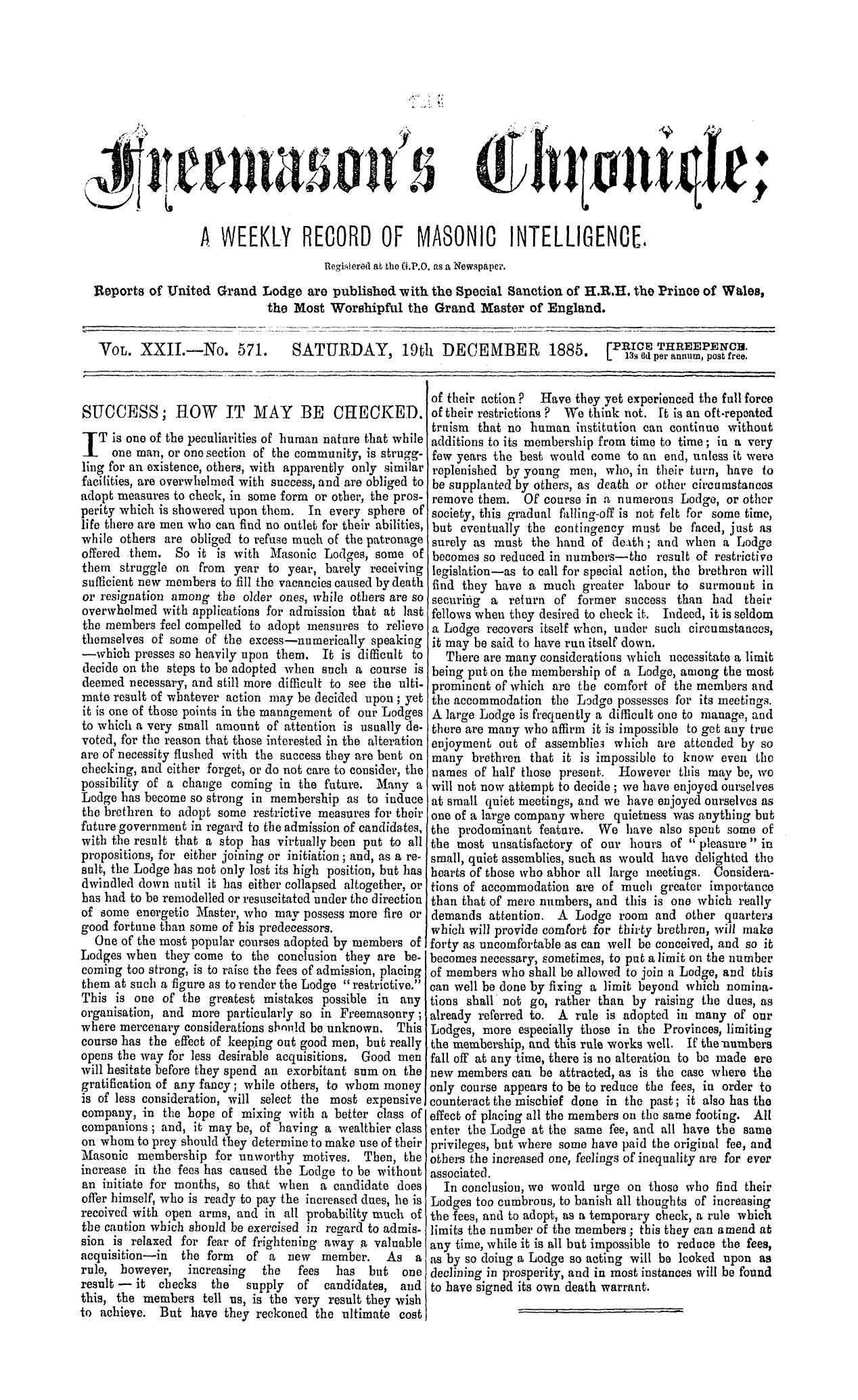
SUCCESS ; HOW IT MAY BE CHECKED .
IT is one of the peculiarities of human nature that while one man , or ono section of the community , is struggling for an existence , others , -with apparently only similar facilities , are overwhelmed with success , and are obliged to adopt measures to check , in some form or other , the
prosperity which is showered upon them . In every sphere of life there are men who can find no outlet for their abilities , while others are obliged to refuse much of the patronage offered them . So it is with Masonic Lodges , some of
them struggle on from year to year , barely receiving sufficient new members to fill the vacancies caused by death or resignation among the older ones , while others are so overwhelmed with applications for admission that at last the members feel compelled to adopt measures to relieve
themselves of some of the excess—numerically speaking
—which presses so heavily upon them . It is difficult to decide on the steps to be adopted when such a course is
deemed necessary , and still more difficult to see the ulti
mate result of whatever action may be decided upon ; yet it is one of those points in the management of our Lodges to which a very small amount of attention is usually devoted , for the reason that those interested in the alteration
are of necessity flushed with the success they are bent on checking , and either forget , or do not care to consider , the possibility of a change coming in the future . Many a
Lodge has become so strong in membership as to induce the brethren to adopt some restrictive measures for their future government in regard to the admission of candidates ,
with the result that a stop has virtually been put to all
propositions , for either joining or initiation ; and , as a result , the Lodge has not only lost its high position , but has dwindled down until it has either collapsed altogether , or has had to be remodelled or resuscitated under the direction of some energetic Master , who niav possess more fire or
good fortune than some of his predecessors . One of the most popular courses adopted by members of
Lodges when they come to the conclusion they are becoming too strong , is to raise the fees of admission , placing them at such a figure as to render the Lodge " restrictive . " This is one of the greatest mistakes possible in any organisation , and more particularly so in Freemasonry ;
where mercenary considerations should be unknown . This course has the effect of keeping out good men , but really opens the way for less desirable acquisitions . Good men will hesitate before they spend an exorbitant sum on the gratification of any fancy ; while others , to whom money is of less consideration , will select the most expensive
company , in the hope of mixing with a better class of companions ; and , it may be , of having a wealthier class on whom to prey should they determine to make use of their Masonic membership for unworthy motives . Then , the
increase in the fees has caused the Lodge to be without an initiate for months , so that when a candidate does offer himself , who is ready to pay the increased dues , he is
received with open arms , and in all probability much of the caution which should be exercised in regard to admission is relaxed for fear of frightening away a valuable acquisition—in the form of a new member . As a
rule , however , increasing the fees has but one result — it checks the supply of candidates , and this , the members tell us , is the very result they wish to achieve . But have they reckoned the ultimate cost
Success; How It May Be Checked.
of their action ? Have they yet experienced the full force of their restrictions ? We think not . It is an oft-repeated truism that no human institution can continue without additions to its membership from time to time ; in a very few years the best would come to an end , unless it were
replenished by young men , who , in their turn , have to be supplanted by others , as death or other circurastancos remove them . Of course in a numerous Lodge , or other
society , this gradual falling-off is not felt for some time , but eventually the contingency must be faced , just as surely as must the hand of death ; and when a Lodge becomes so reduced in numbers— 'tho result of restrictive
legislation—as to call for special action , tho brethren will find they have a much greater labour to surmonut in securing a return of former success than had their
fellows when they desired to check it . Indeed , it is seldom
a Lodge recovers itself when , under such circumstances , it may be said to have run itself down . There are many considerations which necessitate a limit being put on the membership of a Lodge , among the most prominent of which are the comfort of the members and
the accommodation the Lodge possesses for its meetings . A large Lodge is frequently a difficult one to manage , and
there are many who affirm it is impossible to get any true enjoyment out of assemblies which are attended by so many brethren that it is impossible to know even the
names of half those present . However this may bo , wo will not now attempt to decide ; we have enjoyed ourselves at small quiet meetings , and we have enjoyed ourselves as one of a large company where quietness was anything but
the prodominant feature . We have also spent some of the most unsatisfactory of our hours of " pleasure " in small , quiet assemblies , such as would have delighted the
hearts of those who abhor all large meetings . Considerations of accommodation are of much greater importance than that of mere numbers , and this is one which really demands attention . A Lodge room and other quarters
which will provide comfort for thirty brethren , will make forty as uncomfortable as can well be conceived , and so ifc becomes necessary , sometimes , to put a limit on the number
of members who shall be allowed to join a Lodge , and this can well be done by fixing a limit beyond which nominations shall not go , rather than by raising the dues , as
already referred to . A rule is adopted m many of our Lodges , more especially those in the Provinces , limiting the membership , and this rule works well . If the "numbers fall off at any time , there is no alteration to be made ere new members can be attracted , a 3 is the case where the
only course appears to be to reduce the fees , in order to counteract the mischief done in the past ; it also has the effect of placing all the members on the same footing . All
enter the Lodge at the same fee , and all have the same privileges , but where some have paid the original fee , and others the increased one , feelings of inequality are for ever associated .
In conclusion , we would urge on thoso who find their Lodges too cumbrous , to banish all thoughts of increasing tbe fees , and to adopt , as a temporary check , a rule which
limits the number of the members ; this they can amend at any time , while it is all but impossible to reduce the fees , as by so doing a Lodge so acting will be looked upon as declining in prosperity , and in most instances will be found to have signed its own death warrant .




Note: This text has been automatically extracted via Optical Character Recognition (OCR) software.
Success; How It May Be Checked.
SUCCESS ; HOW IT MAY BE CHECKED .
IT is one of the peculiarities of human nature that while one man , or ono section of the community , is struggling for an existence , others , -with apparently only similar facilities , are overwhelmed with success , and are obliged to adopt measures to check , in some form or other , the
prosperity which is showered upon them . In every sphere of life there are men who can find no outlet for their abilities , while others are obliged to refuse much of the patronage offered them . So it is with Masonic Lodges , some of
them struggle on from year to year , barely receiving sufficient new members to fill the vacancies caused by death or resignation among the older ones , while others are so overwhelmed with applications for admission that at last the members feel compelled to adopt measures to relieve
themselves of some of the excess—numerically speaking
—which presses so heavily upon them . It is difficult to decide on the steps to be adopted when such a course is
deemed necessary , and still more difficult to see the ulti
mate result of whatever action may be decided upon ; yet it is one of those points in the management of our Lodges to which a very small amount of attention is usually devoted , for the reason that those interested in the alteration
are of necessity flushed with the success they are bent on checking , and either forget , or do not care to consider , the possibility of a change coming in the future . Many a
Lodge has become so strong in membership as to induce the brethren to adopt some restrictive measures for their future government in regard to the admission of candidates ,
with the result that a stop has virtually been put to all
propositions , for either joining or initiation ; and , as a result , the Lodge has not only lost its high position , but has dwindled down until it has either collapsed altogether , or has had to be remodelled or resuscitated under the direction of some energetic Master , who niav possess more fire or
good fortune than some of his predecessors . One of the most popular courses adopted by members of
Lodges when they come to the conclusion they are becoming too strong , is to raise the fees of admission , placing them at such a figure as to render the Lodge " restrictive . " This is one of the greatest mistakes possible in any organisation , and more particularly so in Freemasonry ;
where mercenary considerations should be unknown . This course has the effect of keeping out good men , but really opens the way for less desirable acquisitions . Good men will hesitate before they spend an exorbitant sum on the gratification of any fancy ; while others , to whom money is of less consideration , will select the most expensive
company , in the hope of mixing with a better class of companions ; and , it may be , of having a wealthier class on whom to prey should they determine to make use of their Masonic membership for unworthy motives . Then , the
increase in the fees has caused the Lodge to be without an initiate for months , so that when a candidate does offer himself , who is ready to pay the increased dues , he is
received with open arms , and in all probability much of the caution which should be exercised in regard to admission is relaxed for fear of frightening away a valuable acquisition—in the form of a new member . As a
rule , however , increasing the fees has but one result — it checks the supply of candidates , and this , the members tell us , is the very result they wish to achieve . But have they reckoned the ultimate cost
Success; How It May Be Checked.
of their action ? Have they yet experienced the full force of their restrictions ? We think not . It is an oft-repeated truism that no human institution can continue without additions to its membership from time to time ; in a very few years the best would come to an end , unless it were
replenished by young men , who , in their turn , have to be supplanted by others , as death or other circurastancos remove them . Of course in a numerous Lodge , or other
society , this gradual falling-off is not felt for some time , but eventually the contingency must be faced , just as surely as must the hand of death ; and when a Lodge becomes so reduced in numbers— 'tho result of restrictive
legislation—as to call for special action , tho brethren will find they have a much greater labour to surmonut in securing a return of former success than had their
fellows when they desired to check it . Indeed , it is seldom
a Lodge recovers itself when , under such circumstances , it may be said to have run itself down . There are many considerations which necessitate a limit being put on the membership of a Lodge , among the most prominent of which are the comfort of the members and
the accommodation the Lodge possesses for its meetings . A large Lodge is frequently a difficult one to manage , and
there are many who affirm it is impossible to get any true enjoyment out of assemblies which are attended by so many brethren that it is impossible to know even the
names of half those present . However this may bo , wo will not now attempt to decide ; we have enjoyed ourselves at small quiet meetings , and we have enjoyed ourselves as one of a large company where quietness was anything but
the prodominant feature . We have also spent some of the most unsatisfactory of our hours of " pleasure " in small , quiet assemblies , such as would have delighted the
hearts of those who abhor all large meetings . Considerations of accommodation are of much greater importance than that of mere numbers , and this is one which really demands attention . A Lodge room and other quarters
which will provide comfort for thirty brethren , will make forty as uncomfortable as can well be conceived , and so ifc becomes necessary , sometimes , to put a limit on the number
of members who shall be allowed to join a Lodge , and this can well be done by fixing a limit beyond which nominations shall not go , rather than by raising the dues , as
already referred to . A rule is adopted m many of our Lodges , more especially those in the Provinces , limiting the membership , and this rule works well . If the "numbers fall off at any time , there is no alteration to be made ere new members can be attracted , a 3 is the case where the
only course appears to be to reduce the fees , in order to counteract the mischief done in the past ; it also has the effect of placing all the members on the same footing . All
enter the Lodge at the same fee , and all have the same privileges , but where some have paid the original fee , and others the increased one , feelings of inequality are for ever associated .
In conclusion , we would urge on thoso who find their Lodges too cumbrous , to banish all thoughts of increasing tbe fees , and to adopt , as a temporary check , a rule which
limits the number of the members ; this they can amend at any time , while it is all but impossible to reduce the fees , as by so doing a Lodge so acting will be looked upon as declining in prosperity , and in most instances will be found to have signed its own death warrant .