-
Articles/Ads
Article IS MASONRY A RELIGION? Page 1 of 2 Article IS MASONRY A RELIGION? Page 1 of 2 →
Note: This text has been automatically extracted via Optical Character Recognition (OCR) software.
Is Masonry A Religion?
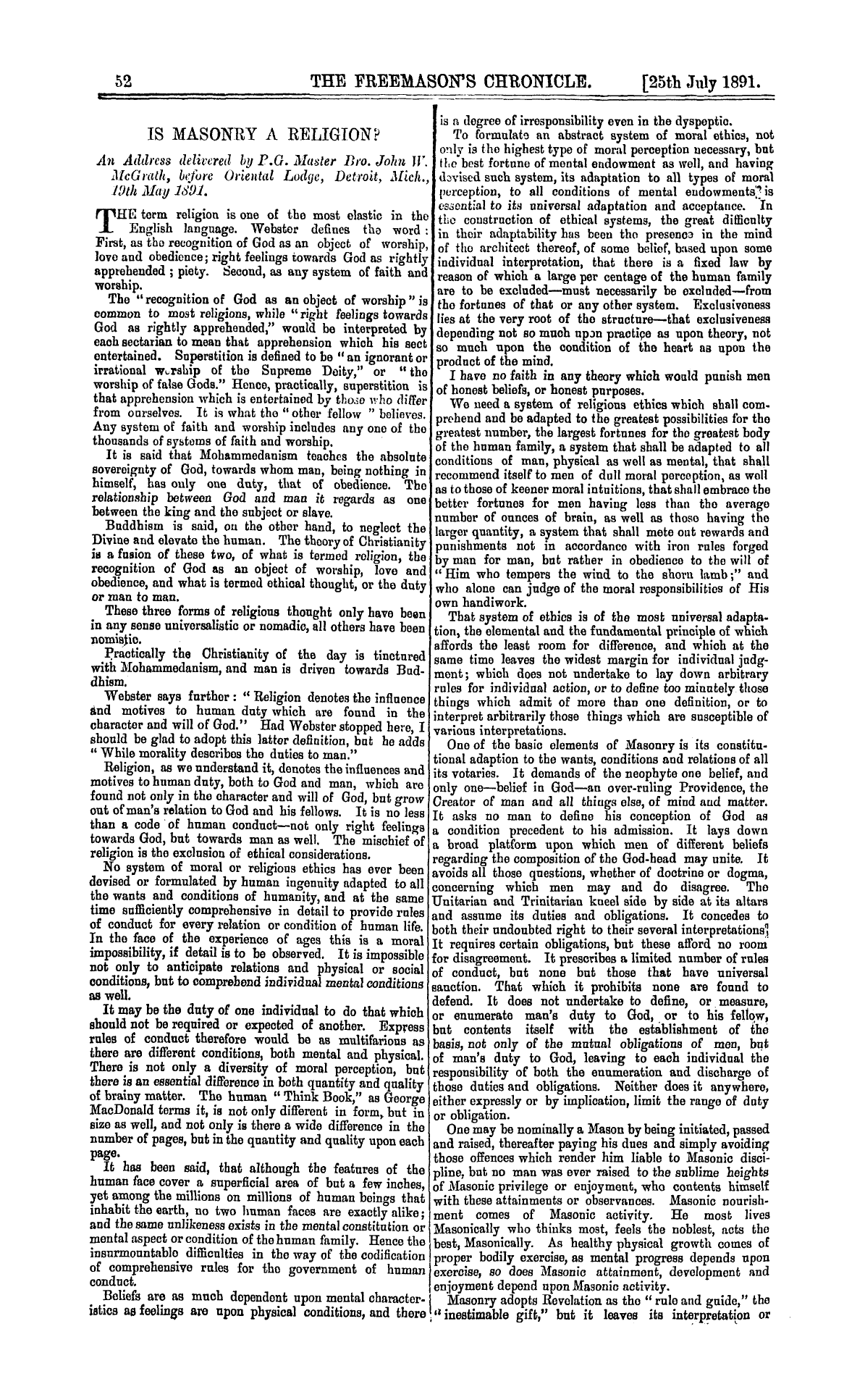
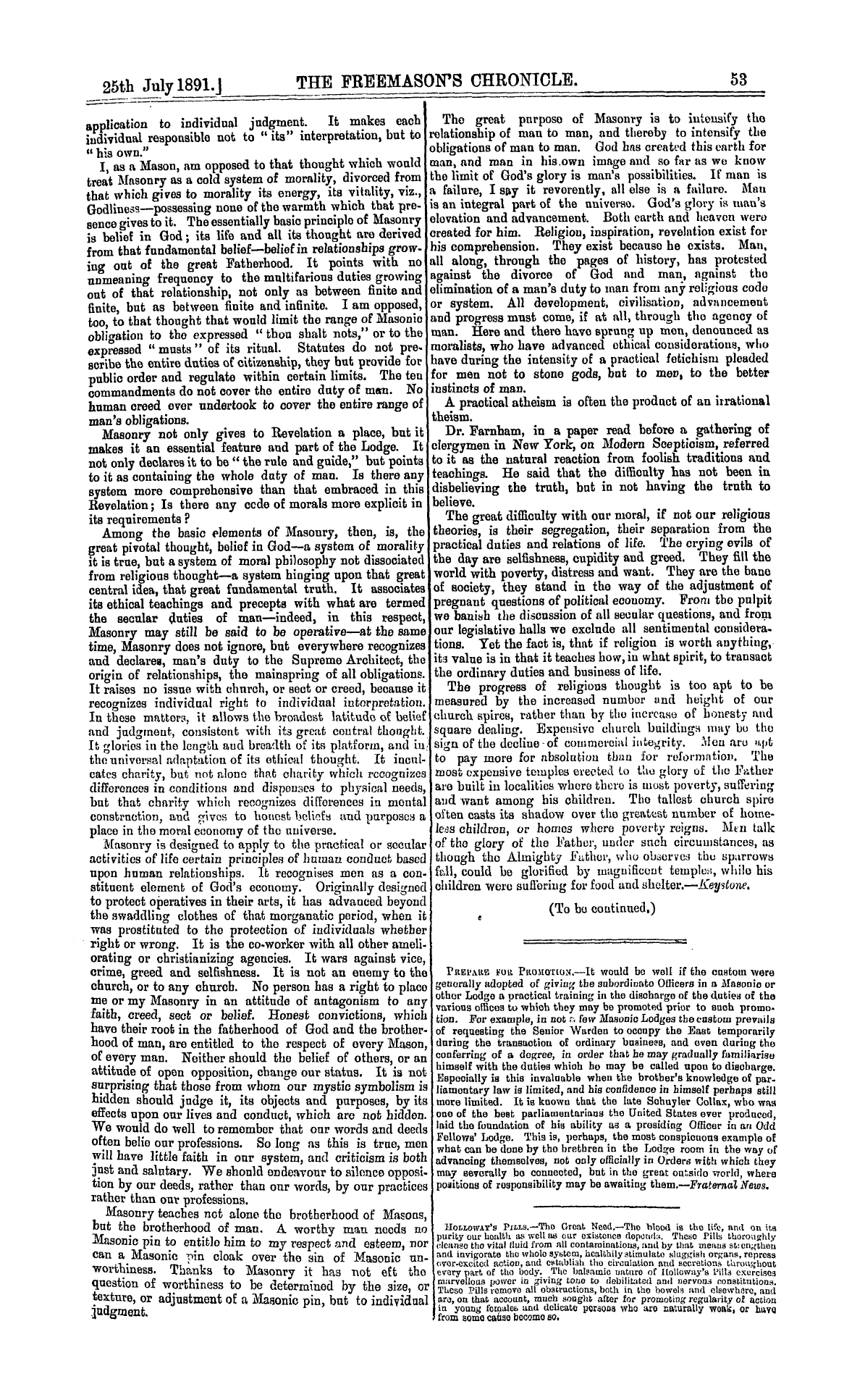
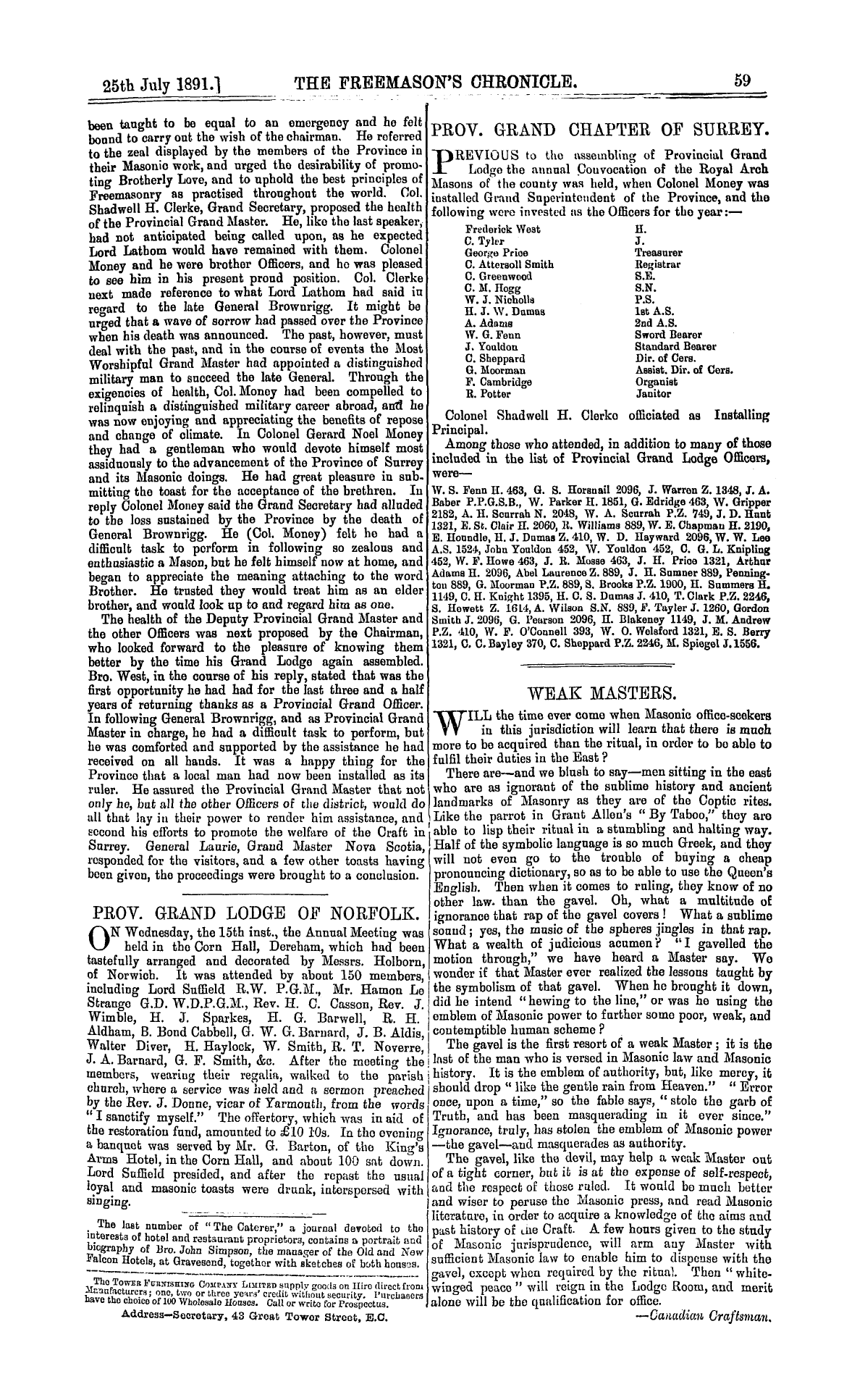
IS MASONRY A RELIGION ?
An Address delivered by P . G . Master Bro . John JF . McGralh , before Oriental Lodge , Detroit , Mich ., 19 th May 1891 .
THE term religion is one of the most elastic in the English language . Webster defines tho word First , as the recognition of God as an object of worship , love and obedience ; right feelings towards God as rightly apprehended ; piety . Second , as any system of faith and worship .
The " recognition of God as an object of worship "is common to most religions , while " right feelings towards God as rightly apprehended , " would be interpreted by each sectarian to mean that apprehension whioh his sect
entertained . Superstition is defined to be " an ignorant or irrational worship of the Supreme Deity , " or " tho worship of false Gods . " Hence , practically , superstition is that apprehension which is entertained by tho .-: o who differ from onrselvos . It is whafc tho " other fellow " believes .
Any system ot faith and worship includes any ono of tho thousands of systems of faith and worship . It is said thafc Mohammedanism teaches the absolute
sovereignty of God , towards whom man , being nothing in himself , has only oue duty , that of obedience . Tho relationship between God and man ifc regards as one between the king and fche subject or slave .
Buddhism is said , on the other hand , to neglect the Divine and elevate the human . The theory of Christianity ia a fusion of these two , of whafc is termed religion , the recognition of God as an object of worship , love and obedience , and what is termed ethical thought , or the duty or man to man .
These three forms of religious thought only have been in any sense univorsalistic or nomadic , all others have been nomiajio . Practically the Christianity of the day is tinctured with Mohammedanism , and man is driven towards Buddhism .
Webster says further : " Religion denotes the influence ftnd motives to human duty which are found in the character and will of God . " Had Webster stopped here , I should be glad to adopt this latter definition , bufc he adds " While morality describes the duties to man . "
Religion , as we understand it , denotes the influences aud motives to human duty , both to God and man , which aro found nofc only in the character and will of God , but grow
out of man s relation to God and his fellows . It is no less than a code of hnman conduct—not only right feelings towards God , but towards man as well . The mischief of religion is the exclusion of ethical considerations .
No system of moral or religious ethics has ever been devised or formulated by human ingenuity adapted to all the wants and conditions of humanity , and at the same time sufficiently comprehensive in detail to provide rules of conduct for every relation or condition of human life . In the face of the experience of ages this is a moral
rules of conduct therefore would be as multifarious as there are different conditions , both mental and physical . There is not only a diversity of moral perception , but there is an essential difference in both quantifcv and oualitv
impossibility , if detail is to be observed . It is impossible nofc only to anticipate relations and physical or social conditions , but to comprehend individual mental conditions as well . It may be the duty of one individual to do that which should not be required or expected of another . Express
of brainy matter . The human " Think Book , " as George MacDonald terms it , is not only different in form , but in size as well , and not only is there a wide difference in the number of pages , but in the quantity and quality upon each page .
It has been said , tbat although the features of the human face cover a superficial area of but a few inches , yet among the millions on millions of human beings that inhabit the earth , no two human faces are exactlv alike :
and the same unlikeness exists in the mental constitution or mental aspect or condition of the human family . Hence the insurmountable difficulties in the way of the codification of comprehensive rules for tho government of human conduct . Beliefs are as much dependent upon mental characteristics as feelings are upon physical conditions , and there
Is Masonry A Religion?
is a degree of irresponsibility even in the dyspeptic . To formulate an abstract system of moral ethics , not only is the highest type of moral perception necessary , but the best fortune of mental endowment as well , and having dsvised such system , its adaptation to all types of moral
perception , to all conditions of mental endowments' ^ is essential to its universal adaptation and acceptance . In the construction of ethical systems , the great difficulty in thoir adaptability has been tho presenca in the mind of tho architect thereof , of some belief , based upon some
individual interpretation , that there is a fixed law by reason of which a large per centage of the human family are to be excluded—must necessarily be excluded—from tho fortunes of that or any other system . Exclasivoness
lies at the very root of tho structure—that exclusiveness depending not so much upon practice as upon theory , not so much upon the condition of the heart as upon the product of the mind .
I have no faith in any theory which would punish men of honest beliefs , or honest purposes . We need a system of religious ethics whioh shall comprehend and be adapted to the greatest possibilities for the greatest number , the largest fortunes for tho greatest body
of the human family , a system that shall be adapted to all conditions of man , physical as well as mental , that shall recommend itself to men of dull moral perception , as well as to those of keener moral intuitions , that shall embrace the better fortunes for men having less than tho average
number of ounces of brain , as well as thoso having the larger quantity , a system that shall mete oat rewards and punishments not in accordance with iron rules forged
by man for man , but rather in obedience to tho will of " Him who tempers the wind to the shorn lamb ; " and who alone can judge of the moral responsibilities of His own handiwork .
Thafc system of ethics is of the most universal adaptation , the elemental and the fundamental principle of which affords the least room for difference , and whioh at the same time leaves the widest margin for individual
judgment ; which does not undertake to lay down arbitrary rules for individual action , or to define too minutely those things which admit of more than one definition , or to interpret arbitrarily those things which are susceptible of various interpretations .
One of the basic elements of Masonry is its constitutional adaption to the wants , conditions and relations of all its votaries . It demands of the neophyte one belief , and only one—belief in God—an over-ruling Providence , the Creator of man and all things else , of mind and matter .
It asks no man fco define his conception of God as a condition precedent to his admission . It lays down a broad platform upon which men of different beliefs regarding the composition of the God-head may unite . It avoids all those questions , whether of doctrine or dogma ,
concerning which men may and do disagree . Tho Unitarian and Trinitarian kneel side by side at its altars and assume its duties and obligations . It concedes to both their undoubted right to their several interpretations " It requires certain obligations , but these afford no room
for disagreement . It prescribes a limited number of rules of conduct , but none but those that have universal sanction . That which it prohibits none are found to defend . It does not undertake to define , or measure , or enumerate man ' s duty to God , or to his fellow ,
but contents itself with the establishment of the basis , nofc only of the mutual obligations of men , bnfc of man ' s duty to God , leaving to each individual the
responsibility of both the enumeration and discharge of those duties and obligations . Neither does it anywhere , either expressly or by implication , limit the range of dnfcy or obligation .
One may be nominally a Mason by being initiated , passed and raised , thereafter paying his dues and simply avoiding those offences which render him liable to Masonic
discipline , but no man was ever raised to the sublime heights of Masonic privilege or enjoyment , who contents himself with these attainments or observances . Masonic nourishment comes of Masonic activity . He most lives
Masonically who thinks most , feels the noblest , acts the best , Masonically . As healthy physical growth comes of proper bodily exercise , as mental progress depends upon exercise , so does Masonic attainment , development and enjoyment depend npon Masonic activity . Masonry adopts Revelation as tho " rule and guide , " the " inestimable giffc , " bufc it leaves its interpretation or


Note: This text has been automatically extracted via Optical Character Recognition (OCR) software.
Is Masonry A Religion?
IS MASONRY A RELIGION ?
An Address delivered by P . G . Master Bro . John JF . McGralh , before Oriental Lodge , Detroit , Mich ., 19 th May 1891 .
THE term religion is one of the most elastic in the English language . Webster defines tho word First , as the recognition of God as an object of worship , love and obedience ; right feelings towards God as rightly apprehended ; piety . Second , as any system of faith and worship .
The " recognition of God as an object of worship "is common to most religions , while " right feelings towards God as rightly apprehended , " would be interpreted by each sectarian to mean that apprehension whioh his sect
entertained . Superstition is defined to be " an ignorant or irrational worship of the Supreme Deity , " or " tho worship of false Gods . " Hence , practically , superstition is that apprehension which is entertained by tho .-: o who differ from onrselvos . It is whafc tho " other fellow " believes .
Any system ot faith and worship includes any ono of tho thousands of systems of faith and worship . It is said thafc Mohammedanism teaches the absolute
sovereignty of God , towards whom man , being nothing in himself , has only oue duty , that of obedience . Tho relationship between God and man ifc regards as one between the king and fche subject or slave .
Buddhism is said , on the other hand , to neglect the Divine and elevate the human . The theory of Christianity ia a fusion of these two , of whafc is termed religion , the recognition of God as an object of worship , love and obedience , and what is termed ethical thought , or the duty or man to man .
These three forms of religious thought only have been in any sense univorsalistic or nomadic , all others have been nomiajio . Practically the Christianity of the day is tinctured with Mohammedanism , and man is driven towards Buddhism .
Webster says further : " Religion denotes the influence ftnd motives to human duty which are found in the character and will of God . " Had Webster stopped here , I should be glad to adopt this latter definition , bufc he adds " While morality describes the duties to man . "
Religion , as we understand it , denotes the influences aud motives to human duty , both to God and man , which aro found nofc only in the character and will of God , but grow
out of man s relation to God and his fellows . It is no less than a code of hnman conduct—not only right feelings towards God , but towards man as well . The mischief of religion is the exclusion of ethical considerations .
No system of moral or religious ethics has ever been devised or formulated by human ingenuity adapted to all the wants and conditions of humanity , and at the same time sufficiently comprehensive in detail to provide rules of conduct for every relation or condition of human life . In the face of the experience of ages this is a moral
rules of conduct therefore would be as multifarious as there are different conditions , both mental and physical . There is not only a diversity of moral perception , but there is an essential difference in both quantifcv and oualitv
impossibility , if detail is to be observed . It is impossible nofc only to anticipate relations and physical or social conditions , but to comprehend individual mental conditions as well . It may be the duty of one individual to do that which should not be required or expected of another . Express
of brainy matter . The human " Think Book , " as George MacDonald terms it , is not only different in form , but in size as well , and not only is there a wide difference in the number of pages , but in the quantity and quality upon each page .
It has been said , tbat although the features of the human face cover a superficial area of but a few inches , yet among the millions on millions of human beings that inhabit the earth , no two human faces are exactlv alike :
and the same unlikeness exists in the mental constitution or mental aspect or condition of the human family . Hence the insurmountable difficulties in the way of the codification of comprehensive rules for tho government of human conduct . Beliefs are as much dependent upon mental characteristics as feelings are upon physical conditions , and there
Is Masonry A Religion?
is a degree of irresponsibility even in the dyspeptic . To formulate an abstract system of moral ethics , not only is the highest type of moral perception necessary , but the best fortune of mental endowment as well , and having dsvised such system , its adaptation to all types of moral
perception , to all conditions of mental endowments' ^ is essential to its universal adaptation and acceptance . In the construction of ethical systems , the great difficulty in thoir adaptability has been tho presenca in the mind of tho architect thereof , of some belief , based upon some
individual interpretation , that there is a fixed law by reason of which a large per centage of the human family are to be excluded—must necessarily be excluded—from tho fortunes of that or any other system . Exclasivoness
lies at the very root of tho structure—that exclusiveness depending not so much upon practice as upon theory , not so much upon the condition of the heart as upon the product of the mind .
I have no faith in any theory which would punish men of honest beliefs , or honest purposes . We need a system of religious ethics whioh shall comprehend and be adapted to the greatest possibilities for the greatest number , the largest fortunes for tho greatest body
of the human family , a system that shall be adapted to all conditions of man , physical as well as mental , that shall recommend itself to men of dull moral perception , as well as to those of keener moral intuitions , that shall embrace the better fortunes for men having less than tho average
number of ounces of brain , as well as thoso having the larger quantity , a system that shall mete oat rewards and punishments not in accordance with iron rules forged
by man for man , but rather in obedience to tho will of " Him who tempers the wind to the shorn lamb ; " and who alone can judge of the moral responsibilities of His own handiwork .
Thafc system of ethics is of the most universal adaptation , the elemental and the fundamental principle of which affords the least room for difference , and whioh at the same time leaves the widest margin for individual
judgment ; which does not undertake to lay down arbitrary rules for individual action , or to define too minutely those things which admit of more than one definition , or to interpret arbitrarily those things which are susceptible of various interpretations .
One of the basic elements of Masonry is its constitutional adaption to the wants , conditions and relations of all its votaries . It demands of the neophyte one belief , and only one—belief in God—an over-ruling Providence , the Creator of man and all things else , of mind and matter .
It asks no man fco define his conception of God as a condition precedent to his admission . It lays down a broad platform upon which men of different beliefs regarding the composition of the God-head may unite . It avoids all those questions , whether of doctrine or dogma ,
concerning which men may and do disagree . Tho Unitarian and Trinitarian kneel side by side at its altars and assume its duties and obligations . It concedes to both their undoubted right to their several interpretations " It requires certain obligations , but these afford no room
for disagreement . It prescribes a limited number of rules of conduct , but none but those that have universal sanction . That which it prohibits none are found to defend . It does not undertake to define , or measure , or enumerate man ' s duty to God , or to his fellow ,
but contents itself with the establishment of the basis , nofc only of the mutual obligations of men , bnfc of man ' s duty to God , leaving to each individual the
responsibility of both the enumeration and discharge of those duties and obligations . Neither does it anywhere , either expressly or by implication , limit the range of dnfcy or obligation .
One may be nominally a Mason by being initiated , passed and raised , thereafter paying his dues and simply avoiding those offences which render him liable to Masonic
discipline , but no man was ever raised to the sublime heights of Masonic privilege or enjoyment , who contents himself with these attainments or observances . Masonic nourishment comes of Masonic activity . He most lives
Masonically who thinks most , feels the noblest , acts the best , Masonically . As healthy physical growth comes of proper bodily exercise , as mental progress depends upon exercise , so does Masonic attainment , development and enjoyment depend npon Masonic activity . Masonry adopts Revelation as tho " rule and guide , " the " inestimable giffc , " bufc it leaves its interpretation or