-
Articles/Ads
Article CORRESPONDENCE. Page 1 of 2 Article CORRESPONDENCE. Page 1 of 2 →
Note: This text has been automatically extracted via Optical Character Recognition (OCR) software.
Correspondence.
CORRESPONDENCE .
We do not hold ourselves responsible for the opinions of ow Cor . respondents . All Letters must bear the name anl address of the Writer , not necestarily for publication , but as a guarantee of good faith . We cannot undertake to return rejected communications .
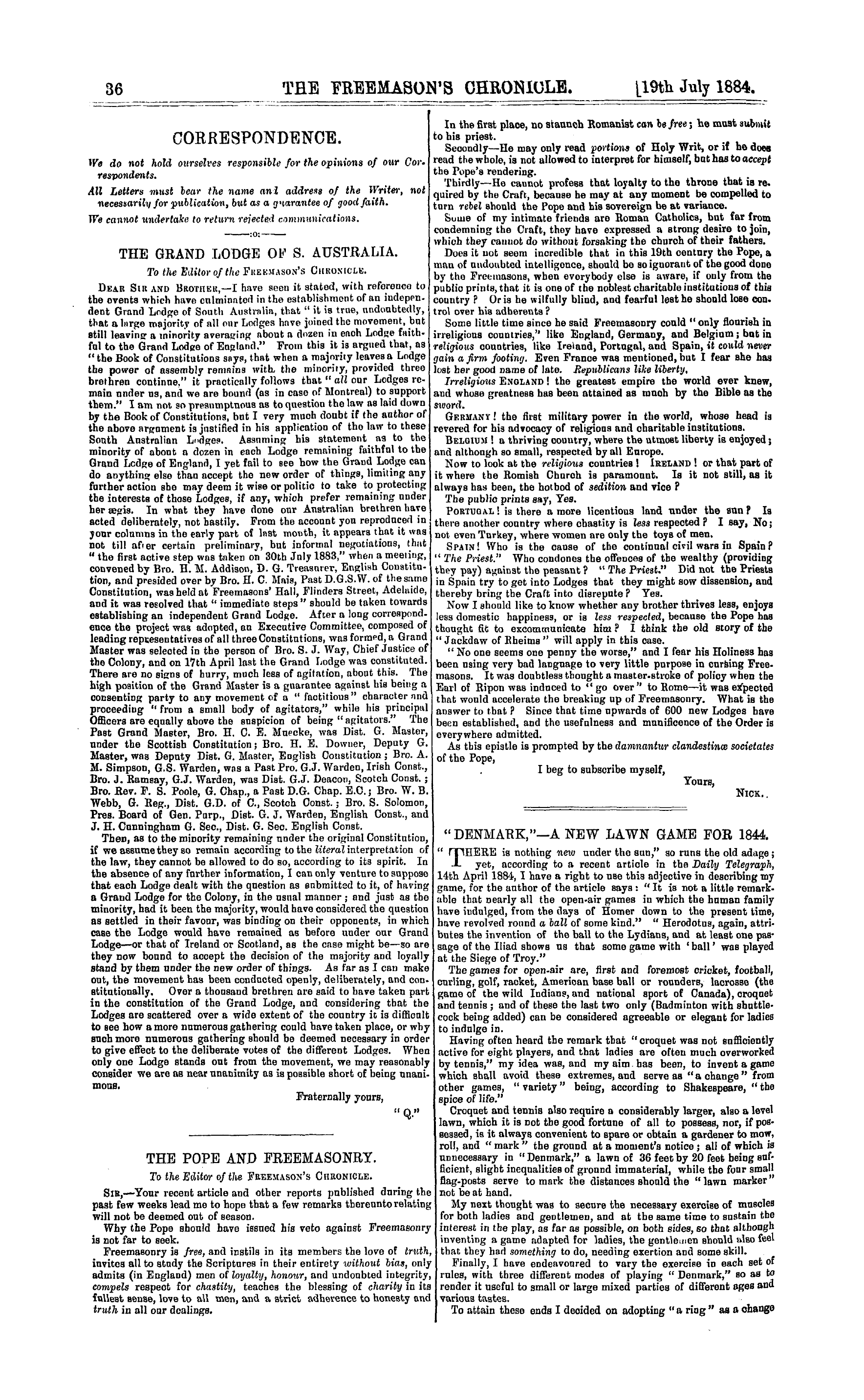
THE GRAND LODGE OF S . AUSTRALIA . To the Editor of the F KEEMASON ' S CHRONICLE . DEAR SIR AND BROTHER , —I have seen it stated , with reference to the events which have culminated in the establishment of an indepen . dent Grand Lodge of South Australia , that " it is true , undoubtedly , that alnrge majority of all onr Lodges have joined the movement , but still leaving a minority averaging about a dozen in each Lodge
faithful to the Grand Lodge of England . " From this it is argued that , as " the Book of Constitutions soys , that when a majority leaves a Lodge the power of assembly remains with the minoriry , provided three brethren continue , " it practically follows that " all our Lodges remain under us , and we are bound ( as in case of Montreal ) to support them . " I am not so presumptuous as to question the law as laid down
by the Book of Constitutions , but I very much doubt if the author of the above argument is justified in his application of tho law to these South Australian Ledges . Assuming his statement as to the minority of about a dozen in each Lodge remaining faithful to the Grand Ledge of England , I yet fail to see how the Grand Lodge can do anything else than accept the new order of things , limiting any
further action she may deem it wise or politic to take to protecting the interests of those Lodges , if any , which prefer remaining under her regis . In what they have done our Australian brethren have acted deliberately , not hastily . From the account yon reproduced in jour columns in the early part of Inst mouth , it appears that it vvas not till after certain preliminary , but informal negotiations , that
" the first active step was taken on 30 th July 1883 , " when a meeting , convened by Bro . H . M . Addison , D . G . Treasurer , English Constitution , and presided over by Bro . H . C . Mais , Past D . G . S . W . of the same Constitution , was held at Freemasons' Hall , Flinders Street , Adelaide , and it was resolved that " immediate steps " should be taken towards establishing an independent Grand Lodge . After a long correspond .
ence the project was adopted , an Executive Committee , composed of leading repsesentatives of all three Constitutions , was formed , a Grand Master was selected in the person of Bro . S . J . Way , Chief Justice of the Colony , and on 17 th April last the Grand Lodge was constituted There are no signs of hurry , much less of agitation , about this . The high position of the Grand Master is a guarantee against his being a
consenting party to any movement of a " factitious " character nnd proceeding "from a small body of agitators , " while his principal Officers are equally above the suspicion of being " agitators . " The Past Grand Master , Bro . H . C . E . Muecke , was Dist . G . Master , under the Scottish Constitution ; Bro . H . E . Downer , Deputy G . Master , was Deputy Dist . G . Master , English Constitution ; Bro . A .
M . Simpson , G . S . Warden , was a Past Pro . G . J . Warden , Irish Const ., Bro . J . Ramsay , G . J . Warden , was Dist . G . J . Deacon , Scotch Const . ; Bro . Rev . F . S . Poole , G . Chap ., a Past D . G . Chap . E . C . ; Bro . W . B . Webb , G . Keg ., Dist . G . D . of C , Scotch Const . ; Bro . S . Solomon , Pres . Board of Gen . Purp ., Dist . G . J . Warden , English Const ., and J . H . Cunningham G . Sec , Dist . G . Seo . English Const .
Then , as to tbe minority remaining under the original Constitution , if w © assume they so remain according to the literal interpretation of the law , they cannot be allowed to do so , according to its spirit . In the absence of any further information , I can only venture to suppose that each Lodge dealt with the question as enbmitted to it , of having a Grand Lodge for the Colony , in the usual manner ; and just as the
minority , had it been the majority , would have considered the question as settled in their favour , was binding on their opponents , in which case the Lodge would have remained as before under our Grand Lodge—or that of Ireland or Scotland , as the case might be—so are they now bound to accept the decision of the majority and loyally stand by them under the new order of things . As far as I can make out , tbe movement has been conducted openly , deliberately , and
constitutionally . Over a thousand brethren are said to have taken part in the constitution of the Grand Lodge , and considering that the Lodges are scattered over a wide extent of the conntry it is difficult to see how a more numerous gathering could have taken place , or why such more numerous gathering should be deemed necessary in order to give effect to the deliberate votes of the different Lodges . When only one Lodge stands out from the movement , we may reasonably consider we are as near unanimity as is possible short of being
unanimous . Fraternally yours , " Q . "
THE POPE AND FREEMASONRY . To the Editor of the FKEEMASON ' S CHRONICLE . SIB , —Your recent article and other reports published during the pasfc few weeks lead me to hope that a few remarks thereunto relating will not be deemed ont of season . Why the Pope should have issued his veto against Freemasonry is not far to seek .
Freemasonry is free , and instils in its members the love of truth , invites all to study the Scriptures in their entirety without bias , only admits ( in England ) men of loyalty , honour , and undoubted integrity , compels respect for chastity , teaches the blessing of charity in its f uUest . sense , love to all men , and a strict adherence to honesty and truth in all our dealings .
Correspondence.
In the first place , no staunch Romanist con he free 3 he must submit to his priest . Secondly—He may only read portions of Holy Writ , or if ho does read the whole , is not allowed to interpret for himself , bat has to accept the Pope ' s rendering .
Thirdly—He cannot profess that loyalty to the throne that ia re . quired by the Craft , because he may at any moment be compelled to turn rebel should the Pope and his sovereign be at variance . Suine of my intimate friends are Boman Catholics , but far from condemning the Craft , they have expressed a strong desire to join , which they cannot do without forsaking the chnroh of their fathers .
Does it uot seem incredible that in this 19 th centnry the Pope , a man of undoubted intelligence , should be so ignorant of the good done by the Freemasons , when everybody else is aware , if only from the public prints , that it is one of the noblest charitable institutions of this country ? Oris he wilfully blind , and fearful lest he shonld lose con . trol over his adherents ?
Some little time since he said Freemasonry could " only flourish in irreligious countries , " like England , Germany , and Belgium ; bat in religious countries , like Ireland , Portugal , and Spain , it could never gain a firm footing . Even France was mentioned , but I fear she has lost her good name of late . Republicans like liberty . Irreligious ENGLAND ! the greatest empire the world ever knew
and whose greatness has been attained as mnoh by the Bible as the sxuord . GERMANY ! the first military power in the world , whose head is revered for his advocacy of religious and charitable institutions . BELGIUM ! a thriving country , where the utmost liberty is enjoyed 5 and although so small , respected by all Europe .
Now to look at the religious countries ! IRELAND ' . or thafc part of ifc where the Romish Church is paramount . Is it not still , aa it always has been , tbe hotbod of sedition and vice P The public prints say , Yes . PORTUGAL ! is there a more licentious land under the sun ? Is there another country where chastity is less respected ? I say , No ;
not even Turkey , where women are only the toys of men . SPAIN ! Who is the cause of the continual civil wars in Spain ? " The Priest . " Who condones the offences of the wealthy ( providing they pay ) against the peasant ? " The Priest . " Did not the Priests in Spain try to get into Lodges that they might sow dissension , and thereby bring the Craft into disrepute ? Yes .
Now I should like to know whether any brother thrives less , enjoys less domestic happiness , or is less respected , because the Pope has thought fit to excommunicate him ? I think the old story of fche " Jackdaw of Rheims " will apply in this case . " No one seems one penny the worse , " and I fear his Holiness has been using very bad language to very little purpose in cursing Freemasons . It was doubtless thonght a master-stroke of policy when the
Earl of Ripon was induced to " go over" to Rome—it was expected that would accelerate the breaking up of Freemasonry . What is the answer to that ? Since that time upwards of 600 new Lodges bave been established , and the usefulness and munificence of the Order is
everywhere admitted . As this epistle is prompted by the damnantur clandestine societates of the Pope , I beg to subscribe myself , Yours , NICK . .
" DENMARK , "—ANEW LAWN GAME FOR 1844 . " nPHERE is nothing new under the sun , " so runs the old adage ; J- yet , according to a recent article in the Daily Telegraph , 14 th April 1884 , 1 have a right to use this adjective in describing my game , for the author of the article says : " It is not a little remarkable that nearly all the open-air games in which the human family have indulged , from the days of Homer down to the present time , have revolved round a ball of some kind . " " Herodotus , again ,
attributes the invention of the ball to the Lydians , and at least one passage of the Iliad shows ns that some game with ' ball' was played at the Siege of Troy . " The games for open-air are , first and foremost cricket , football , curling , golf , racket , American base ball or rounders , lacrosse ( the game of the wild Indians , and national sport of Canada ) , croquet
and tennis ; and of these the last two only ( Badminton with shuttlecock being added ) can be considered agreeable or elegant for ladies to indulge in . Having often heard the remark that " croquet was not sufficiently active for eight players , and that ladies are often much overworked by tennis , " my idea was , and my aim . has been , to invent a game
whioh shall avoid these extremes , and serve aa " a change " from other games , " variety" being , according to Shakespeare , " the spice of life . " Croquet and tennis also require a considerably larger , also a level lawn , which it is not the good fortune of all to possess , nor , if
possessed , is it always convenient to spare or obtain a gardener to mow , roil , and " mark " the ground at a moment ' s notice ; all of which is unnecessary in " Denmark , " a lawn of 36 feet by 20 feet being sufficient , slight inequalities of ground immaterial , while the four small flag-posts serve to mark fche distances should the " lawn marker " not beat hand .
My next thought was to secure the necessary exercise of muscles for both ladies and gentlemen , and at the same time to sustain the interest in the play , as far as possible , on both sides , so that although inventing a game adapted for ladies , tbe gentlemen should also feel that they had something to do , needing exertion and some skill .
Finally , I have endeavoured to vary the exercise in each set of rules , with three different modes of playing " Denmark , " so as to render it useful to small or large mixed parties of different ages and various tastes . To attain these ends I decided on adopting " a ring " as a change






Note: This text has been automatically extracted via Optical Character Recognition (OCR) software.
Correspondence.
CORRESPONDENCE .
We do not hold ourselves responsible for the opinions of ow Cor . respondents . All Letters must bear the name anl address of the Writer , not necestarily for publication , but as a guarantee of good faith . We cannot undertake to return rejected communications .
THE GRAND LODGE OF S . AUSTRALIA . To the Editor of the F KEEMASON ' S CHRONICLE . DEAR SIR AND BROTHER , —I have seen it stated , with reference to the events which have culminated in the establishment of an indepen . dent Grand Lodge of South Australia , that " it is true , undoubtedly , that alnrge majority of all onr Lodges have joined the movement , but still leaving a minority averaging about a dozen in each Lodge
faithful to the Grand Lodge of England . " From this it is argued that , as " the Book of Constitutions soys , that when a majority leaves a Lodge the power of assembly remains with the minoriry , provided three brethren continue , " it practically follows that " all our Lodges remain under us , and we are bound ( as in case of Montreal ) to support them . " I am not so presumptuous as to question the law as laid down
by the Book of Constitutions , but I very much doubt if the author of the above argument is justified in his application of tho law to these South Australian Ledges . Assuming his statement as to the minority of about a dozen in each Lodge remaining faithful to the Grand Ledge of England , I yet fail to see how the Grand Lodge can do anything else than accept the new order of things , limiting any
further action she may deem it wise or politic to take to protecting the interests of those Lodges , if any , which prefer remaining under her regis . In what they have done our Australian brethren have acted deliberately , not hastily . From the account yon reproduced in jour columns in the early part of Inst mouth , it appears that it vvas not till after certain preliminary , but informal negotiations , that
" the first active step was taken on 30 th July 1883 , " when a meeting , convened by Bro . H . M . Addison , D . G . Treasurer , English Constitution , and presided over by Bro . H . C . Mais , Past D . G . S . W . of the same Constitution , was held at Freemasons' Hall , Flinders Street , Adelaide , and it was resolved that " immediate steps " should be taken towards establishing an independent Grand Lodge . After a long correspond .
ence the project was adopted , an Executive Committee , composed of leading repsesentatives of all three Constitutions , was formed , a Grand Master was selected in the person of Bro . S . J . Way , Chief Justice of the Colony , and on 17 th April last the Grand Lodge was constituted There are no signs of hurry , much less of agitation , about this . The high position of the Grand Master is a guarantee against his being a
consenting party to any movement of a " factitious " character nnd proceeding "from a small body of agitators , " while his principal Officers are equally above the suspicion of being " agitators . " The Past Grand Master , Bro . H . C . E . Muecke , was Dist . G . Master , under the Scottish Constitution ; Bro . H . E . Downer , Deputy G . Master , was Deputy Dist . G . Master , English Constitution ; Bro . A .
M . Simpson , G . S . Warden , was a Past Pro . G . J . Warden , Irish Const ., Bro . J . Ramsay , G . J . Warden , was Dist . G . J . Deacon , Scotch Const . ; Bro . Rev . F . S . Poole , G . Chap ., a Past D . G . Chap . E . C . ; Bro . W . B . Webb , G . Keg ., Dist . G . D . of C , Scotch Const . ; Bro . S . Solomon , Pres . Board of Gen . Purp ., Dist . G . J . Warden , English Const ., and J . H . Cunningham G . Sec , Dist . G . Seo . English Const .
Then , as to tbe minority remaining under the original Constitution , if w © assume they so remain according to the literal interpretation of the law , they cannot be allowed to do so , according to its spirit . In the absence of any further information , I can only venture to suppose that each Lodge dealt with the question as enbmitted to it , of having a Grand Lodge for the Colony , in the usual manner ; and just as the
minority , had it been the majority , would have considered the question as settled in their favour , was binding on their opponents , in which case the Lodge would have remained as before under our Grand Lodge—or that of Ireland or Scotland , as the case might be—so are they now bound to accept the decision of the majority and loyally stand by them under the new order of things . As far as I can make out , tbe movement has been conducted openly , deliberately , and
constitutionally . Over a thousand brethren are said to have taken part in the constitution of the Grand Lodge , and considering that the Lodges are scattered over a wide extent of the conntry it is difficult to see how a more numerous gathering could have taken place , or why such more numerous gathering should be deemed necessary in order to give effect to the deliberate votes of the different Lodges . When only one Lodge stands out from the movement , we may reasonably consider we are as near unanimity as is possible short of being
unanimous . Fraternally yours , " Q . "
THE POPE AND FREEMASONRY . To the Editor of the FKEEMASON ' S CHRONICLE . SIB , —Your recent article and other reports published during the pasfc few weeks lead me to hope that a few remarks thereunto relating will not be deemed ont of season . Why the Pope should have issued his veto against Freemasonry is not far to seek .
Freemasonry is free , and instils in its members the love of truth , invites all to study the Scriptures in their entirety without bias , only admits ( in England ) men of loyalty , honour , and undoubted integrity , compels respect for chastity , teaches the blessing of charity in its f uUest . sense , love to all men , and a strict adherence to honesty and truth in all our dealings .
Correspondence.
In the first place , no staunch Romanist con he free 3 he must submit to his priest . Secondly—He may only read portions of Holy Writ , or if ho does read the whole , is not allowed to interpret for himself , bat has to accept the Pope ' s rendering .
Thirdly—He cannot profess that loyalty to the throne that ia re . quired by the Craft , because he may at any moment be compelled to turn rebel should the Pope and his sovereign be at variance . Suine of my intimate friends are Boman Catholics , but far from condemning the Craft , they have expressed a strong desire to join , which they cannot do without forsaking the chnroh of their fathers .
Does it uot seem incredible that in this 19 th centnry the Pope , a man of undoubted intelligence , should be so ignorant of the good done by the Freemasons , when everybody else is aware , if only from the public prints , that it is one of the noblest charitable institutions of this country ? Oris he wilfully blind , and fearful lest he shonld lose con . trol over his adherents ?
Some little time since he said Freemasonry could " only flourish in irreligious countries , " like England , Germany , and Belgium ; bat in religious countries , like Ireland , Portugal , and Spain , it could never gain a firm footing . Even France was mentioned , but I fear she has lost her good name of late . Republicans like liberty . Irreligious ENGLAND ! the greatest empire the world ever knew
and whose greatness has been attained as mnoh by the Bible as the sxuord . GERMANY ! the first military power in the world , whose head is revered for his advocacy of religious and charitable institutions . BELGIUM ! a thriving country , where the utmost liberty is enjoyed 5 and although so small , respected by all Europe .
Now to look at the religious countries ! IRELAND ' . or thafc part of ifc where the Romish Church is paramount . Is it not still , aa it always has been , tbe hotbod of sedition and vice P The public prints say , Yes . PORTUGAL ! is there a more licentious land under the sun ? Is there another country where chastity is less respected ? I say , No ;
not even Turkey , where women are only the toys of men . SPAIN ! Who is the cause of the continual civil wars in Spain ? " The Priest . " Who condones the offences of the wealthy ( providing they pay ) against the peasant ? " The Priest . " Did not the Priests in Spain try to get into Lodges that they might sow dissension , and thereby bring the Craft into disrepute ? Yes .
Now I should like to know whether any brother thrives less , enjoys less domestic happiness , or is less respected , because the Pope has thought fit to excommunicate him ? I think the old story of fche " Jackdaw of Rheims " will apply in this case . " No one seems one penny the worse , " and I fear his Holiness has been using very bad language to very little purpose in cursing Freemasons . It was doubtless thonght a master-stroke of policy when the
Earl of Ripon was induced to " go over" to Rome—it was expected that would accelerate the breaking up of Freemasonry . What is the answer to that ? Since that time upwards of 600 new Lodges bave been established , and the usefulness and munificence of the Order is
everywhere admitted . As this epistle is prompted by the damnantur clandestine societates of the Pope , I beg to subscribe myself , Yours , NICK . .
" DENMARK , "—ANEW LAWN GAME FOR 1844 . " nPHERE is nothing new under the sun , " so runs the old adage ; J- yet , according to a recent article in the Daily Telegraph , 14 th April 1884 , 1 have a right to use this adjective in describing my game , for the author of the article says : " It is not a little remarkable that nearly all the open-air games in which the human family have indulged , from the days of Homer down to the present time , have revolved round a ball of some kind . " " Herodotus , again ,
attributes the invention of the ball to the Lydians , and at least one passage of the Iliad shows ns that some game with ' ball' was played at the Siege of Troy . " The games for open-air are , first and foremost cricket , football , curling , golf , racket , American base ball or rounders , lacrosse ( the game of the wild Indians , and national sport of Canada ) , croquet
and tennis ; and of these the last two only ( Badminton with shuttlecock being added ) can be considered agreeable or elegant for ladies to indulge in . Having often heard the remark that " croquet was not sufficiently active for eight players , and that ladies are often much overworked by tennis , " my idea was , and my aim . has been , to invent a game
whioh shall avoid these extremes , and serve aa " a change " from other games , " variety" being , according to Shakespeare , " the spice of life . " Croquet and tennis also require a considerably larger , also a level lawn , which it is not the good fortune of all to possess , nor , if
possessed , is it always convenient to spare or obtain a gardener to mow , roil , and " mark " the ground at a moment ' s notice ; all of which is unnecessary in " Denmark , " a lawn of 36 feet by 20 feet being sufficient , slight inequalities of ground immaterial , while the four small flag-posts serve to mark fche distances should the " lawn marker " not beat hand .
My next thought was to secure the necessary exercise of muscles for both ladies and gentlemen , and at the same time to sustain the interest in the play , as far as possible , on both sides , so that although inventing a game adapted for ladies , tbe gentlemen should also feel that they had something to do , needing exertion and some skill .
Finally , I have endeavoured to vary the exercise in each set of rules , with three different modes of playing " Denmark , " so as to render it useful to small or large mixed parties of different ages and various tastes . To attain these ends I decided on adopting " a ring " as a change