-
Articles/Ads
Article THE LODGE ROOM. ← Page 2 of 2 Article THE LODGE ROOM. Page 2 of 2 Article FREEMASONRY IN FAVERSHAM. Page 1 of 2 →
Note: This text has been automatically extracted via Optical Character Recognition (OCR) software.
The Lodge Room.
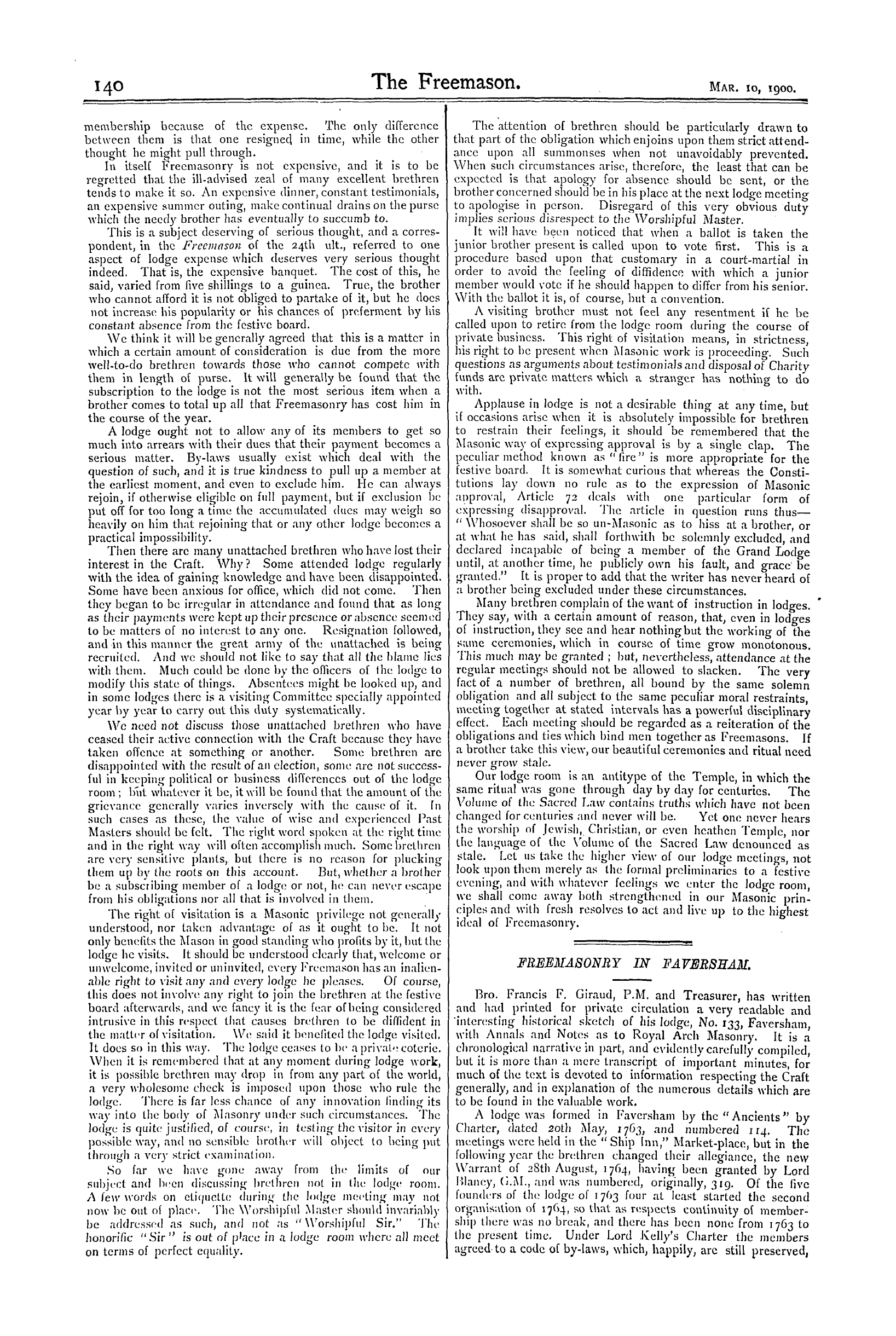
membership because of thc expense . The only difference between them is that one resigned in time , while the other thought he might pull through . In itself Freemasonry is not expensive , and it is to be
regretted that the ill-advised zeal of many excellent brethren tends to make it so . An expensive dinner , constant testimonials , an expensive summer outing , make continual drains on the purse which the needy brother has eventually to succumb to .
This is a subject deserving of serious thought , and a correspondent , in the Freemason of the 24 th ult ., referred to one aspect of lodge expense which deserves very serious thought indeed . That is , the expensive banquet . The cost of this , he
said , varied from five shillings to a guinea . True , the brother who cannot afford it is not obliged to partake of it , but he docs not increase his popularity or his chances of preferment by His constant absence from the festive board .
We think it will be generally agreed that this is a matter in which a certain amount of consideration is due from the more well-to-do brethren towards those who cannot compete with
them in length of purse . It will generally be found that thc subscription to the lodge is not the most serious item when a brother comes to total up all that Freemasonry has cost him in the course of the year .
A lodge ought not to allow any of its members to get so much into arrears with their dues that their payment becomes a serious matter . By-laws usually exist which deal with the question of such , and it is true kindness to pull up a member at
the earliest moment , and even to exclude him . He can always rejoin , if otherwise elig ible on full payment , but if exclusion be put off for too long a time the accumulated dues may weigh so heavily on him that rejoining that or any other lodge becomes a practical impossibility .
Then there are many unattached brethren who have lost their interest in the Craft . Why ? Some attended lodge regularly with the idea of gaining knowledge and have been disappointed . Some have been anxious for office , which did not come . Then they began to be irregular in attendance and found that as long
as their payments were kept up their presence or absence seemed to be matters of no interest to any one . Resignation followed , and in this manner the great army of the unattached is being recruited . And we should not like to say that all the blame lies
with them . Much could be done by the officers of the lodge to modify this state of things . Absentees might be looked up , and in some lodges there is a visiting Committee specially appointed year by year to carry out this duty systematically .
We need not discuss those unattached brethren who have ceased their active connection with the Craft because they have taken offence at something or another . Some brethren are disappointed with the result of an election , some are not successful in keeping political or business differences out of the lodge
room ; but whatever it be , it will be found that the amount of the grievance generally varies inversely with the cause of it . In such cases as these , the value of wise and experienced Past Masters should be felt . The right word spoken at the right time
and in the right way will often accomplish much . Some brethren arc very sensitive plants , but there is no reason for plucking them up by tlie roots on this account . But , whether a brother be a subscribing member of a lodge or not , he can never escape from his obligations nor all that is involved in them .
The riglit ot visitation is a Masonic privilege not generally understood , nor taken advantage of as it ought to be . It not only benefits the Mason in good standing who profits by it , but the lodge he visits . It should be understood clearly that , welcome or unwelcome , invited or uninvited , every Freemason has an
inalienable right to visit any and every lodge lie pleases . Of course , this does not involve any right to join the brethren at the festive board afterwards , and wc fancy it is thc fear of being considered intrusive in this respect that causes brethren to be diffident in the matter ol visitation . We said it benefited the lodge visited .
It does so in this way . The lodge ceases to be a private coterie . When it is remembered that at any moment during lodge work , it is possible brethren may drop in from any part of the world , a very wholesome check is imposed upon those who rule the
lodge . There is far less chance of any innovation finding its way into the body of Masonry under such circumstances . The lodge is quite justified , of course , in testing the visitor in every possible way , and no sensible brother will object to being put through a very strict examination .
So far we have gone away from the limits of our subject and been discussing brethren not in the lodge room . A few words on etiquette during thc lodge meeting mav not
now be out of place . The Worshipful Master should invariabl y be addressed as such , and not as " Worshipful Sir . " The honorific "Sir" is out of p ' ace in a lodge room where all meet on terms of perfect equality .
The Lodge Room.
The attention of brethren should be particularly drawn to that part of the obligation which enjoins upon them strict attendance upon all summonses when not unavoidably prevented . When such circumstances arise , therefore , the least that can be
expected is that apology for absence should be sent , or the brother concerned should be in his place at the next lodge meeting to apologise in person . Disregard of this very obvious duty implies serious disrespect to the Worshipful Master . It will have been noticed that when a ballot is taken the
junior brother present is called upon to vote first . This is a procedure based upon that customary in a court-martial in order to avoid thc feeling of diffidence with which a junior member would vote if he should happen to differ from his senior . With the ballot it is , of course , but a convention .
A visiting brother must not feel any resentment if he be called upon to retire from the lodge room during the course of private business . This right of visitation means , in strictness ,
his right to be present when Masonic work is proceeding . Such questions as arguments about testimonials and disposal of Charity funds arc private matters which a stranger has nothing to do with .
Applause in lodge is not a desirable thing at any time , but if occasions arise when it is absolutel y impossible for brethren to restrain their feelings , it should be remembered that the Masonic way of expressing approval is by a single clap . The peculiar method known as "fire" is more appropriate for the festive board . It is somewhat curious that whereas the
Constitutions lay down no rule as to the expression of Masonic approval , Article 72 deals with one particular form of expressing disapproval . The article in question runs thus" Whosoever shall be so un-Masonic as to hiss at a brother , or
at what he has said , shall forthwith be solemnly excluded , and declared incapable of being a member of the Grand Lodge until , at another time , he publicly own his fault , and grace be granted . " It is proper to add that the writer has never heard of a brother being excluded under these circumstances .
Many brethren complain of the want of instruction in lodges . They say , with a certain amount of reason , that , even in lodges of instruction , they see and hear nothing but the working of the same ceremonies , which in course of time grow monotonous . This much may be granted ; but , nevertheless , attendance at the
regular meetings should not be allowed to slacken . The very fact of a number of brethren , all bound b y the same solemn obligation and all subject to the same peculiar moral restraints , meeting together at stated intervals has a powerful disciplinary
effect . Each meeting should be regarded as a reiteration of the obligations and ties which bind men together as Freemasons . If a brother take this view , our beautiful ceremonies and ritual need never grow stale .
Our lodge room is an antitype of thc Temple , in which the same ritual was gone through day by day for centuries . The Volume of the Sacred Law contains truths which have not been changed for centuries and never will be . Yet one never hears the worship of Jewish , Christian , or even heathen Temple , nor
the language of thc Volume of thc Sacred Law denounced as stale . Let us take the higher view of our lodge meetings , not look upon them mere ! ) ' as the formal preliminaries to a festive
evening , and with whatever feelings wc enter the lodge room , we shall come away both strengthened in our Masonic principles and with fresh resolves to act and live up to the hi ghest ideal of Freemasonry .
Freemasonry In Faversham.
FREEMASONRY IN FAVERSHAM .
Bro . Francis I \ Giraud , P . M . and Treasurer , has written and had printed for private circulation a very readable and interesting historical sketch of his lodge , No . 133 , Faversham with Annals and Notes as to Royal Arch Masonry . It is a
chronological narrative m part , and evidently carefully compiled , but it is more than a mere transcript of important minutes , for much of the text is devoted to information respecting the Craft generally , and in explanation of the numerous details which are to be found in the valuable work .
A lodge was formed in Faversham by the " Ancients" by Charter , dated 20 th May , 17 6 3 , and numbered 114 . Tlie meetings were held in the "Ship Inn , " Market-place , but in the following year the brethren changed their allegiance , the new Warrant of 28 th August , 1764 , having been granted by Lord
Blaney , ( I . M ., and was numbered , originally , 319 . Of the five founders of the lodge of 1 703 four at least started the second organisation of 17 G 4 , so that as respects continuity of membership there was no break , and there has been none from 176 3 to the present time . Under Lord Kell y ' s Charter the members agreed to a code of by-laws , which , happily , are still preserved ,




Note: This text has been automatically extracted via Optical Character Recognition (OCR) software.
The Lodge Room.
membership because of thc expense . The only difference between them is that one resigned in time , while the other thought he might pull through . In itself Freemasonry is not expensive , and it is to be
regretted that the ill-advised zeal of many excellent brethren tends to make it so . An expensive dinner , constant testimonials , an expensive summer outing , make continual drains on the purse which the needy brother has eventually to succumb to .
This is a subject deserving of serious thought , and a correspondent , in the Freemason of the 24 th ult ., referred to one aspect of lodge expense which deserves very serious thought indeed . That is , the expensive banquet . The cost of this , he
said , varied from five shillings to a guinea . True , the brother who cannot afford it is not obliged to partake of it , but he docs not increase his popularity or his chances of preferment by His constant absence from the festive board .
We think it will be generally agreed that this is a matter in which a certain amount of consideration is due from the more well-to-do brethren towards those who cannot compete with
them in length of purse . It will generally be found that thc subscription to the lodge is not the most serious item when a brother comes to total up all that Freemasonry has cost him in the course of the year .
A lodge ought not to allow any of its members to get so much into arrears with their dues that their payment becomes a serious matter . By-laws usually exist which deal with the question of such , and it is true kindness to pull up a member at
the earliest moment , and even to exclude him . He can always rejoin , if otherwise elig ible on full payment , but if exclusion be put off for too long a time the accumulated dues may weigh so heavily on him that rejoining that or any other lodge becomes a practical impossibility .
Then there are many unattached brethren who have lost their interest in the Craft . Why ? Some attended lodge regularly with the idea of gaining knowledge and have been disappointed . Some have been anxious for office , which did not come . Then they began to be irregular in attendance and found that as long
as their payments were kept up their presence or absence seemed to be matters of no interest to any one . Resignation followed , and in this manner the great army of the unattached is being recruited . And we should not like to say that all the blame lies
with them . Much could be done by the officers of the lodge to modify this state of things . Absentees might be looked up , and in some lodges there is a visiting Committee specially appointed year by year to carry out this duty systematically .
We need not discuss those unattached brethren who have ceased their active connection with the Craft because they have taken offence at something or another . Some brethren are disappointed with the result of an election , some are not successful in keeping political or business differences out of the lodge
room ; but whatever it be , it will be found that the amount of the grievance generally varies inversely with the cause of it . In such cases as these , the value of wise and experienced Past Masters should be felt . The right word spoken at the right time
and in the right way will often accomplish much . Some brethren arc very sensitive plants , but there is no reason for plucking them up by tlie roots on this account . But , whether a brother be a subscribing member of a lodge or not , he can never escape from his obligations nor all that is involved in them .
The riglit ot visitation is a Masonic privilege not generally understood , nor taken advantage of as it ought to be . It not only benefits the Mason in good standing who profits by it , but the lodge he visits . It should be understood clearly that , welcome or unwelcome , invited or uninvited , every Freemason has an
inalienable right to visit any and every lodge lie pleases . Of course , this does not involve any right to join the brethren at the festive board afterwards , and wc fancy it is thc fear of being considered intrusive in this respect that causes brethren to be diffident in the matter ol visitation . We said it benefited the lodge visited .
It does so in this way . The lodge ceases to be a private coterie . When it is remembered that at any moment during lodge work , it is possible brethren may drop in from any part of the world , a very wholesome check is imposed upon those who rule the
lodge . There is far less chance of any innovation finding its way into the body of Masonry under such circumstances . The lodge is quite justified , of course , in testing the visitor in every possible way , and no sensible brother will object to being put through a very strict examination .
So far we have gone away from the limits of our subject and been discussing brethren not in the lodge room . A few words on etiquette during thc lodge meeting mav not
now be out of place . The Worshipful Master should invariabl y be addressed as such , and not as " Worshipful Sir . " The honorific "Sir" is out of p ' ace in a lodge room where all meet on terms of perfect equality .
The Lodge Room.
The attention of brethren should be particularly drawn to that part of the obligation which enjoins upon them strict attendance upon all summonses when not unavoidably prevented . When such circumstances arise , therefore , the least that can be
expected is that apology for absence should be sent , or the brother concerned should be in his place at the next lodge meeting to apologise in person . Disregard of this very obvious duty implies serious disrespect to the Worshipful Master . It will have been noticed that when a ballot is taken the
junior brother present is called upon to vote first . This is a procedure based upon that customary in a court-martial in order to avoid thc feeling of diffidence with which a junior member would vote if he should happen to differ from his senior . With the ballot it is , of course , but a convention .
A visiting brother must not feel any resentment if he be called upon to retire from the lodge room during the course of private business . This right of visitation means , in strictness ,
his right to be present when Masonic work is proceeding . Such questions as arguments about testimonials and disposal of Charity funds arc private matters which a stranger has nothing to do with .
Applause in lodge is not a desirable thing at any time , but if occasions arise when it is absolutel y impossible for brethren to restrain their feelings , it should be remembered that the Masonic way of expressing approval is by a single clap . The peculiar method known as "fire" is more appropriate for the festive board . It is somewhat curious that whereas the
Constitutions lay down no rule as to the expression of Masonic approval , Article 72 deals with one particular form of expressing disapproval . The article in question runs thus" Whosoever shall be so un-Masonic as to hiss at a brother , or
at what he has said , shall forthwith be solemnly excluded , and declared incapable of being a member of the Grand Lodge until , at another time , he publicly own his fault , and grace be granted . " It is proper to add that the writer has never heard of a brother being excluded under these circumstances .
Many brethren complain of the want of instruction in lodges . They say , with a certain amount of reason , that , even in lodges of instruction , they see and hear nothing but the working of the same ceremonies , which in course of time grow monotonous . This much may be granted ; but , nevertheless , attendance at the
regular meetings should not be allowed to slacken . The very fact of a number of brethren , all bound b y the same solemn obligation and all subject to the same peculiar moral restraints , meeting together at stated intervals has a powerful disciplinary
effect . Each meeting should be regarded as a reiteration of the obligations and ties which bind men together as Freemasons . If a brother take this view , our beautiful ceremonies and ritual need never grow stale .
Our lodge room is an antitype of thc Temple , in which the same ritual was gone through day by day for centuries . The Volume of the Sacred Law contains truths which have not been changed for centuries and never will be . Yet one never hears the worship of Jewish , Christian , or even heathen Temple , nor
the language of thc Volume of thc Sacred Law denounced as stale . Let us take the higher view of our lodge meetings , not look upon them mere ! ) ' as the formal preliminaries to a festive
evening , and with whatever feelings wc enter the lodge room , we shall come away both strengthened in our Masonic principles and with fresh resolves to act and live up to the hi ghest ideal of Freemasonry .
Freemasonry In Faversham.
FREEMASONRY IN FAVERSHAM .
Bro . Francis I \ Giraud , P . M . and Treasurer , has written and had printed for private circulation a very readable and interesting historical sketch of his lodge , No . 133 , Faversham with Annals and Notes as to Royal Arch Masonry . It is a
chronological narrative m part , and evidently carefully compiled , but it is more than a mere transcript of important minutes , for much of the text is devoted to information respecting the Craft generally , and in explanation of the numerous details which are to be found in the valuable work .
A lodge was formed in Faversham by the " Ancients" by Charter , dated 20 th May , 17 6 3 , and numbered 114 . Tlie meetings were held in the "Ship Inn , " Market-place , but in the following year the brethren changed their allegiance , the new Warrant of 28 th August , 1764 , having been granted by Lord
Blaney , ( I . M ., and was numbered , originally , 319 . Of the five founders of the lodge of 1 703 four at least started the second organisation of 17 G 4 , so that as respects continuity of membership there was no break , and there has been none from 176 3 to the present time . Under Lord Kell y ' s Charter the members agreed to a code of by-laws , which , happily , are still preserved ,