-
Articles/Ads
Article Correspondence. Page 1 of 1 Article ANNUAL FESTIVAL OF THE EMULATION LODGE OF IMPROVEMENT. Page 1 of 2 Article ANNUAL FESTIVAL OF THE EMULATION LODGE OF IMPROVEMENT. Page 1 of 2 →
Note: This text has been automatically extracted via Optical Character Recognition (OCR) software.
Correspondence.
Correspondence .
We do not hold ourselves responsible for the opinions expressed by our correspondents , but we wish , in a spirit of fair play to all , to permit—within certain necessary limitsree discussion .
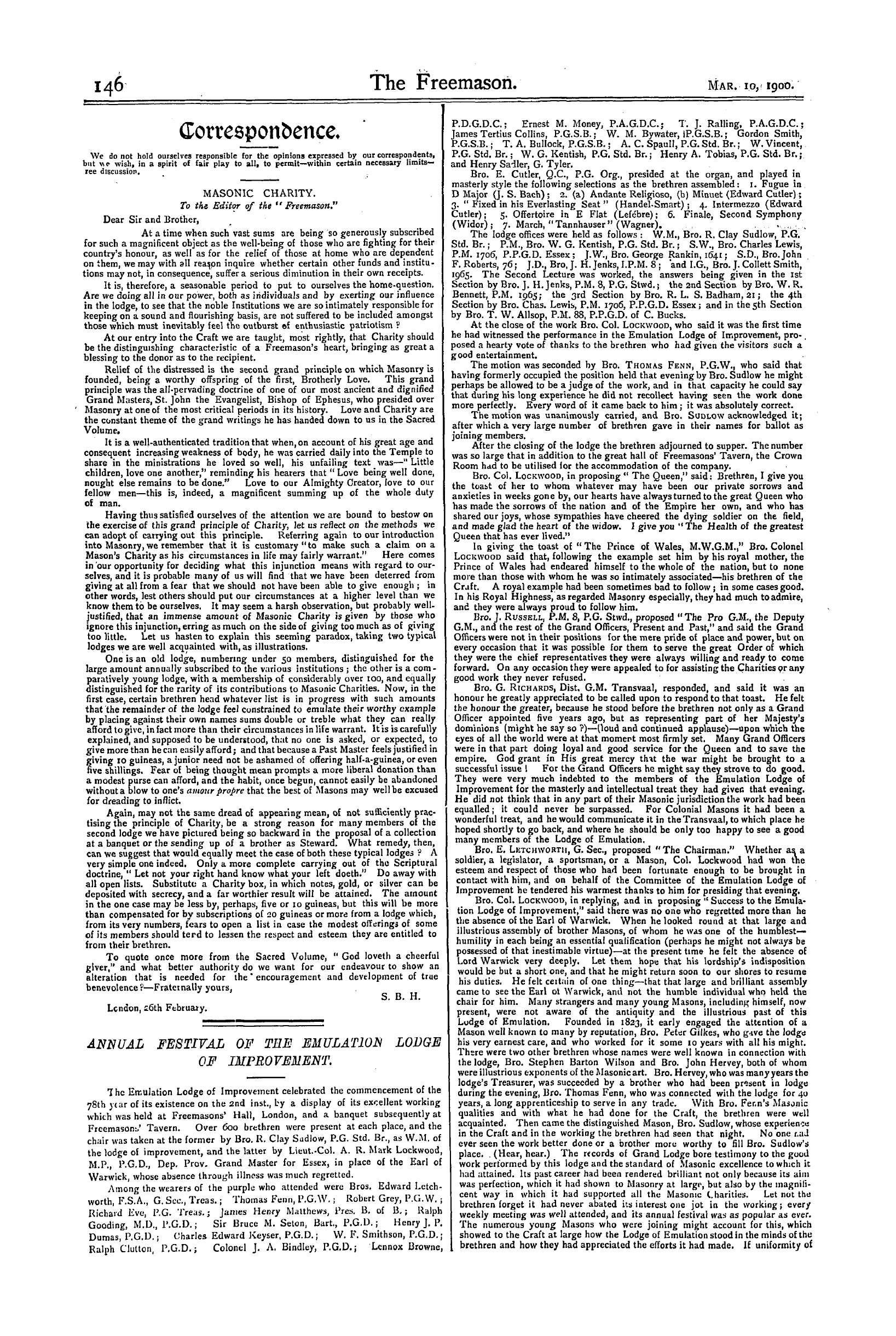
MASONIC CHARITY . To the Editor of the "Freemason . " Dear Sir and Brother , At a time when such vast sums are being so generously subscribed for such a magnificent object as the well-being of those who are fighting for their country ' s honour , as well as for the relief of those at home who are dependent on them , we may with all reason inquire whether certain other funds and institutions may not , in consequence , suffer a serious diminution in their own receipts .
It is , therefore , a seasonable period to put to ourselves the home-question . Are we doing all in our power , both as individuals and by exerting our influence in the lodge , to see that the noble Institutions we are so intimately responsible for keeping on a sound and flourishing basis , are not suffered to be included amongst those which must inevitably feel the outburst ef enthusiastic patriotism ?
At our entry into the Craft we are taught , most rightly , that Charity should be the distinguishing characteristic of a Freemason's heart , bringing as great a blessing to the donor as to the recipient . Relief of the distressed is the second grand principle on which Masonry is founded , being a worthy offspring of the first , Brotherly Love . This grand
principle was the all-pervading doctrine of one of our most ancient and dignified Grand Masters , St . John the Evangelist , Bishop of Ephesus , who presided over Masonry at one of the most critical periods in its history . Love and Charity are the constant theme of the grand writings he has handed down to us in the Sacred Volume .
It is a well-authenticated tradition that when , on account of his great age and consequent increasing weakness of body , he was carried daily into the Temple to share in the ministrations he loved so well , his unfailing text was— " Little children , love one another , " reminding his hearers that " Love being well done , nought else remains to be done . " Love to our Almighty Creator , love to our fellow men—this is , indeed , a magnificent summing up of the whole duty of man .
Having thus satisfied ourselves of the attention we are bound to bestow on the exercise of this grand principle of Charity , let us reflect on the methods we can adopt of carrying out this princip le . Referring again to our introduction into Masonry , we remember that it is customary " to make such a claim on a Mason's Charity as his circumstances in life may fairly warrant . " Here comes in our opportunity for deciding what this injunction means with regard to ourselves , and it is probable many of us will find that we have been deterred from
giving at all from a fear that we should not have been able to give enough ; in other words , lest others should put our circumstances at a higher level than we know them to be ourselves . It may seem a harsh observation , but probably welljustified , that an immense amount of Masonic Charity is given by those who ignore this injunction , erring as much on the side of giving too much as of giving too little . Let us hasten to explain this seeming paradox , taking two typical lodges we are well acquainted with , as illustrations .
One is an old lodge , numbering under 50 members , distinguished for the large amount annually subscribed to the various institutions ; the other is a comparatively young lodge , with a membership of considerably over 100 , and equally distinguished for the rarity of its contributions to Masonic Charities . Now , in the first case , certain brethren head whatever list is in progress with such amounts that the remainder of the lodge feel constrained to emulate their worthy example by placing against their own names sums double or treble what they can really
afford to give , in fact more than their circumstances in life warrant . It is is carefully explained , and supposed to be understood , that no one is asked , or expected , to give more than he can easily afford ; and that because a Past Master feels justified in giving 10 guineas , a junior need not be ashamed of offering half-a-guinea , or even five shillings . Fear of being thought mean prompts a more liberal donation than a modest purse can afford , and the habit , once begun , cannot easily be abandoned without a blow to one ' s amour propre that the best of Masons may well be excused for dreading to inflict .
Again , may not the same dread of appearing mean , of not sufficiently practising the principle of Charity , be a strong reason for many members of the second lodge we have pictured being so backward in the proposal of a collection at a banquet or the sending up of a brother as Steward . What remedy , then , can we suggest that would equally meet the case of both these typical lodges ? A very simple one indeed . Only a more complete carrying out of tho Scriptural doctrine , " Let not your right hand know what your left doeth . " Do away with
all open lists . Substitute a Charity box , in which notes , gold , or silver can be deposited with secrecy , and a far worthier result will be attained . The amount in the one case may be less by , perhaps , five or 10 guineas , but this will be more than compensated for by subscriptions of 20 guineas or more from a lodge which , from its very numbers , fears to open a list in case the modest offerings of some of its members should terd to lessen the respect and esteem they are entitled to from their brethren .
To quote once more from the Sacred Volume , " God loveth a cheerful giver , " and what better authority do we want for our endeavour to show an alteration that is needed for the * encouragement and development of true benevolence?—Fraternally yours , S . B . H . Lendon , £ 6 th February .
Annual Festival Of The Emulation Lodge Of Improvement.
ANNUAL FESTIVAL OF THE EMULATION LODGE OF IMPROVEMENT .
The Emulation Lodge of Improvement celebrated the commencement of the 78 th year of its existence on the 2 nd inst ., by a display of its excellent working which was held at Freemasons' Hall , London , and a banquet subsequently at Freemason :. ' Tavern . Over 600 brethren were present at each place , and the chair was taken at the former by Bro . R . Clay Sudlow , P . G . Std . Br ., as W . M . of the lodge of improvement , and the latter by Lieut .-Col . A . R . Mark Lockwood , M . P ., P . G . D ., Dep . Prov . Grand Master for Essex , in place of the Earl of Warwick , whose absence through illness was much regretted .
Among the wearers of the purple who attended were Bros . Edward Letchworth , F . S . A ., G . Sec , Treas . ; Thomas Fenn , P . G . W . ; Robert Grey , P . G . W . ; Richard Eve , P . G . Treas . ; James Henry Matthews , Pres . B . of B . ; Ralph Gooding , M . D ., P . G . D . ; Sir Bruce M . Seton , Bart ., P . G . D . ; Henry J . P . Dumas , P . G . D . ; Charles Edward Keyser , P . G . D . ; W . F . Smithson , P . G . D . ; Ralp h Clutton , P . G . D . ; Colonel J . A . Bindley , P . G . D . ; Lennox Browne ,
Annual Festival Of The Emulation Lodge Of Improvement.
P . D . G . D . C ; Ernest M . Money , P . A . G . D . C ; T . J . Railing , P . A . G . D . C : James Tertius Collins , P . G . S . B . ; W . M . Bywater , IP . G . S . B . ; Gordon Smith , P . G . S . B . ; T . A . Bullock , P . G . S . B . ; A . C . Spaull , P . G . Std . Br . ; W . Vincent , P . G . Std . Br . ; W . G . Kentish , P . G . Std . Br . ; Henry A . Tobias , P . G . Std . Br . ; and Henry Sadler , G . Tyler .
Bro . E . Cutler , Q . C , P . G . Org ., presided at the organ , and played in masterly style the following selections as the brethren assembled : I . Fugue in D Major ( J . S . Bach ) ; 2 . ( a ) Andante Religiose , ( b ) Minuet ( Edward Cutler ); 3 . " Fixed in his Everlasting Seat " ( Handel-Smart ) ; 4 . Intermezzo ( Edward Cutler ); 5 . Offertoire in E Flat ( Lefebre ); 6 . Finale , Second Symphony ( Widor ) ; 7 . March , "Tannhauser" ( Wagner ) . ... ...... . .
The lodge offices were held as follows : W . M ., Bro . R . Clay Sudlow , P . G . Std . Br . ; P . M ., Bro . W . G . Kentish , P . G . Std . Br . ; S . W ., Bro . Charles Lewis , P . M . 1706 , P . P . G . D . Essex ; J . W ., Bro . George Rankin , 1641 ; S . D ., Bro . John F . Roberts , 7 6 ; J . D ., Bro , J . H . Jenks , I . P . M . 8 ; and I . G ., Bro . J . Collett Smith , 1965 . The Second Lecture was worked , the answers being given in the 1 st Section by Bro . J . H . Jenks , P . M . 8 , P . G . Stwd . ; the 2 nd Section by Bro . W . R , Bennett , P . M . 1965 ; the 3 rd Section by Bro . R . L . S . Badham , 21 ; the 4 th Section by Bro . Chas . Lewis , P . M . 1706 , P . P . G . D . Essex ; and in the 5 th Section by Bro . T . W . Allsop , P . M . 88 , P . P . G . D . of C . Bucks .
At the close of the work Bro . Col . LOCKWOOD , who said it was the first time he had witnessed the performance in the Emulation Lodge of Improvement , proposed a hearty vote of thanks to the brethren who had given the visitors such a good entertainment . The motion was seconded by Bro . THOMAS FENN , P . G . W ., who said that having formerly occupied the position held that evening by Bro . Sudlow he might perhaps be allowed to be a judge of the work , and in that capacity he could say that during his long experience he did not recollect having seen the work done more perfectly . Every word of it came back to him ; it was absolutely correct .
The motion was unanimously carried , and Bro . SUDLOW acknowledged it ; after which a very large number of brethren gave in their names for ballot as joining members . After the closing of the lodge the brethren adjourned to supper . The number was so large that in addition to the great hall of Freemasons' Tavern , the Crown Room had to be utilised for the accommodation of the company .
Bro . Col . LOCKWOOD , in proposing " The Queen , " said : Brethren , I give you the toast of her to whom whatever may have been our private sorrows and anxieties in weeks gone by , our hearts have always turned to the great Queen who has made the sorrows of the nation and of the Empire her own , and who has shared our joys , whose sympathies have cheered the dying soldier on the field , and made glad the heart of the widow . I give you " The Health of the greatest Queen that has ever lived . "
In giving the toast of " The Prince of Wales , M . W . G . M ., " Bro . Colonel LOCKWOOD said that , following the example set him by his royal mother , the Prince of Wales had endeared himself to the whole of the nation , but to none more than those with whom he was so intimately associated—his brethren of the Craft . A royal example had been sometimes bad to follow ; in some cases good . In his Royal Highness , as regarded Masonry especially , they had much to admire , and they were always proud to follow him .
Bro . J . RUSSELL , P . M . 8 , P . G . Stwd ., proposed "The Pro G . M ., the Deputy G . M ,, and the rest of the Grand Officers , Present and Past , " and said the Grand Officers were not in their positions for the mere pride of place and power , but on every occasion that it was possible for them to serve the great Order of which they were the chief representatives they were always willing and ready to come forward . On any occasion they were appealed to for assisting the Charities qr any good work they never refused .
Bro . G . RICHARDS , Dist . G . M . Transvaal , responded , and said it was an honour he greatly appreciated to be called upon to respond to that toast . He felt the honour the greater , because he stood before the brethren not only as a Grand Officer appointed five years ago , but as representing part of her Majesty ' s dominions ( might he say so ?)—( loud and continued applause)—upon which the eyes of all the world were at that moment most firmly set . Many Grand Officers were in that part doing loyal and good service for the Queen and to save the empire . God grant in His great mercy thit the war might be brought to a
successful issue I For the Grand Officers he might say they strove to do good . They were very much indebted to the members of the Emulation Lodge of Improvement for the masterly and intellectual treat they had g iver , that evening . He did not think that in any part of their Masonic jurisdiction the work had been equalled ; it could never be surpassed . For Colonial Masons it had been a wonderful treat , and he would communicate it in the Transvaal , to which place he hoped shortly to go back , and where he should be only too happy to see a good many members of the Lodge of Emulation .
Bro . E . LETCHWORTH , G . Sec , proposed "The Chairman . " Whether as a soldier , a legislator , a sportsman , or a Mason , Col . Lockwood had won tne esteem and respect of those who had been fortunate enough to be brought in contact with him , and on behalf of the Committee of the Emulation Lodge of Improvement he tendered his warmest thanks to him for presiding that evening . Bro . Col . LOCKWOOD , in replying , and in proposing " Success to the Emulation Lodge of Improvement , " said there was no one who regretted more than he
the absence of the Earl of Warwick . When he looked round at that large and illustrious assembly of brother Masons , of whom he was one of the humblesthumility in each being an essential qualification ( perhaps he might not always be possessed of that inestimable virtue)—at the present time he felt the absence of Lord Warwick very deeply . Let them hope that his lordship ' s indisposition would be but a short one , and that he might return soon to our shores to resume his duties . He felt ceitain of one thing—that that large and brilliant assembly
came to see the Earl ot Warwick , and not the humble individual who held the chair for him . Many strangers and many young Masons , including himself , now present , were not aware of the antiquity and the illustrious past of this Lodge of Emulation . Founded in 1823 , it early engaged the attention of a Mason well known to many by reputation , Bro . Peter Gilkes , who give the lodge his very earnest care , and who worked for it some 10 years with all his might . There were two other brethren whose names were well known in connection with
the lodge , Bro . Stephen Barton Wilson and Bro . John Hervey , both of whom were illustrious exponents of the Masonic art . Bro . Hervey , who was many years the lodge ' s Treasurer , was succeeded by a brother who had been present in lodge during the evening , Bro . Thomas Fenn , who was connected with the lodge for 40 years , a long apprenticeship to serve in any trade . With Bro . Fer . n ' s Masjnic qualities and with what he had done for the Craft , the brethren were well acquainted . Then came the distinguished Mason , Bro . Sudlow , whose experience
in the Craft and in the working the brethren had seen that night . No one r . aJ ever seen the work better done or a brother more worthy to fill Bro . Sudlow ' s place . . ( Hear , hear . ) The records of Grand Lodge bore testimony to the good work performed by this lodge and the standard of Masonic excellence to which it had attained . Its past career had been rendered brilliant not only because its aim was perfection , which it had shown to Masonry at largo , but also by the
magnificent way in which it had supported all the Masonic Charities . Let not the brethren forget it had never abated its interest one jot in the working ; every weekly meeting was well attended , and its annual festival was as popular as ever . The numerous young Masons who were joining might account for this , which showed to the Craft at large how the Lodge of Emulation stood in the minds of the brethren and how they had appreciated the efforts it had made . If uniformity of




Note: This text has been automatically extracted via Optical Character Recognition (OCR) software.
Correspondence.
Correspondence .
We do not hold ourselves responsible for the opinions expressed by our correspondents , but we wish , in a spirit of fair play to all , to permit—within certain necessary limitsree discussion .
MASONIC CHARITY . To the Editor of the "Freemason . " Dear Sir and Brother , At a time when such vast sums are being so generously subscribed for such a magnificent object as the well-being of those who are fighting for their country ' s honour , as well as for the relief of those at home who are dependent on them , we may with all reason inquire whether certain other funds and institutions may not , in consequence , suffer a serious diminution in their own receipts .
It is , therefore , a seasonable period to put to ourselves the home-question . Are we doing all in our power , both as individuals and by exerting our influence in the lodge , to see that the noble Institutions we are so intimately responsible for keeping on a sound and flourishing basis , are not suffered to be included amongst those which must inevitably feel the outburst ef enthusiastic patriotism ?
At our entry into the Craft we are taught , most rightly , that Charity should be the distinguishing characteristic of a Freemason's heart , bringing as great a blessing to the donor as to the recipient . Relief of the distressed is the second grand principle on which Masonry is founded , being a worthy offspring of the first , Brotherly Love . This grand
principle was the all-pervading doctrine of one of our most ancient and dignified Grand Masters , St . John the Evangelist , Bishop of Ephesus , who presided over Masonry at one of the most critical periods in its history . Love and Charity are the constant theme of the grand writings he has handed down to us in the Sacred Volume .
It is a well-authenticated tradition that when , on account of his great age and consequent increasing weakness of body , he was carried daily into the Temple to share in the ministrations he loved so well , his unfailing text was— " Little children , love one another , " reminding his hearers that " Love being well done , nought else remains to be done . " Love to our Almighty Creator , love to our fellow men—this is , indeed , a magnificent summing up of the whole duty of man .
Having thus satisfied ourselves of the attention we are bound to bestow on the exercise of this grand principle of Charity , let us reflect on the methods we can adopt of carrying out this princip le . Referring again to our introduction into Masonry , we remember that it is customary " to make such a claim on a Mason's Charity as his circumstances in life may fairly warrant . " Here comes in our opportunity for deciding what this injunction means with regard to ourselves , and it is probable many of us will find that we have been deterred from
giving at all from a fear that we should not have been able to give enough ; in other words , lest others should put our circumstances at a higher level than we know them to be ourselves . It may seem a harsh observation , but probably welljustified , that an immense amount of Masonic Charity is given by those who ignore this injunction , erring as much on the side of giving too much as of giving too little . Let us hasten to explain this seeming paradox , taking two typical lodges we are well acquainted with , as illustrations .
One is an old lodge , numbering under 50 members , distinguished for the large amount annually subscribed to the various institutions ; the other is a comparatively young lodge , with a membership of considerably over 100 , and equally distinguished for the rarity of its contributions to Masonic Charities . Now , in the first case , certain brethren head whatever list is in progress with such amounts that the remainder of the lodge feel constrained to emulate their worthy example by placing against their own names sums double or treble what they can really
afford to give , in fact more than their circumstances in life warrant . It is is carefully explained , and supposed to be understood , that no one is asked , or expected , to give more than he can easily afford ; and that because a Past Master feels justified in giving 10 guineas , a junior need not be ashamed of offering half-a-guinea , or even five shillings . Fear of being thought mean prompts a more liberal donation than a modest purse can afford , and the habit , once begun , cannot easily be abandoned without a blow to one ' s amour propre that the best of Masons may well be excused for dreading to inflict .
Again , may not the same dread of appearing mean , of not sufficiently practising the principle of Charity , be a strong reason for many members of the second lodge we have pictured being so backward in the proposal of a collection at a banquet or the sending up of a brother as Steward . What remedy , then , can we suggest that would equally meet the case of both these typical lodges ? A very simple one indeed . Only a more complete carrying out of tho Scriptural doctrine , " Let not your right hand know what your left doeth . " Do away with
all open lists . Substitute a Charity box , in which notes , gold , or silver can be deposited with secrecy , and a far worthier result will be attained . The amount in the one case may be less by , perhaps , five or 10 guineas , but this will be more than compensated for by subscriptions of 20 guineas or more from a lodge which , from its very numbers , fears to open a list in case the modest offerings of some of its members should terd to lessen the respect and esteem they are entitled to from their brethren .
To quote once more from the Sacred Volume , " God loveth a cheerful giver , " and what better authority do we want for our endeavour to show an alteration that is needed for the * encouragement and development of true benevolence?—Fraternally yours , S . B . H . Lendon , £ 6 th February .
Annual Festival Of The Emulation Lodge Of Improvement.
ANNUAL FESTIVAL OF THE EMULATION LODGE OF IMPROVEMENT .
The Emulation Lodge of Improvement celebrated the commencement of the 78 th year of its existence on the 2 nd inst ., by a display of its excellent working which was held at Freemasons' Hall , London , and a banquet subsequently at Freemason :. ' Tavern . Over 600 brethren were present at each place , and the chair was taken at the former by Bro . R . Clay Sudlow , P . G . Std . Br ., as W . M . of the lodge of improvement , and the latter by Lieut .-Col . A . R . Mark Lockwood , M . P ., P . G . D ., Dep . Prov . Grand Master for Essex , in place of the Earl of Warwick , whose absence through illness was much regretted .
Among the wearers of the purple who attended were Bros . Edward Letchworth , F . S . A ., G . Sec , Treas . ; Thomas Fenn , P . G . W . ; Robert Grey , P . G . W . ; Richard Eve , P . G . Treas . ; James Henry Matthews , Pres . B . of B . ; Ralph Gooding , M . D ., P . G . D . ; Sir Bruce M . Seton , Bart ., P . G . D . ; Henry J . P . Dumas , P . G . D . ; Charles Edward Keyser , P . G . D . ; W . F . Smithson , P . G . D . ; Ralp h Clutton , P . G . D . ; Colonel J . A . Bindley , P . G . D . ; Lennox Browne ,
Annual Festival Of The Emulation Lodge Of Improvement.
P . D . G . D . C ; Ernest M . Money , P . A . G . D . C ; T . J . Railing , P . A . G . D . C : James Tertius Collins , P . G . S . B . ; W . M . Bywater , IP . G . S . B . ; Gordon Smith , P . G . S . B . ; T . A . Bullock , P . G . S . B . ; A . C . Spaull , P . G . Std . Br . ; W . Vincent , P . G . Std . Br . ; W . G . Kentish , P . G . Std . Br . ; Henry A . Tobias , P . G . Std . Br . ; and Henry Sadler , G . Tyler .
Bro . E . Cutler , Q . C , P . G . Org ., presided at the organ , and played in masterly style the following selections as the brethren assembled : I . Fugue in D Major ( J . S . Bach ) ; 2 . ( a ) Andante Religiose , ( b ) Minuet ( Edward Cutler ); 3 . " Fixed in his Everlasting Seat " ( Handel-Smart ) ; 4 . Intermezzo ( Edward Cutler ); 5 . Offertoire in E Flat ( Lefebre ); 6 . Finale , Second Symphony ( Widor ) ; 7 . March , "Tannhauser" ( Wagner ) . ... ...... . .
The lodge offices were held as follows : W . M ., Bro . R . Clay Sudlow , P . G . Std . Br . ; P . M ., Bro . W . G . Kentish , P . G . Std . Br . ; S . W ., Bro . Charles Lewis , P . M . 1706 , P . P . G . D . Essex ; J . W ., Bro . George Rankin , 1641 ; S . D ., Bro . John F . Roberts , 7 6 ; J . D ., Bro , J . H . Jenks , I . P . M . 8 ; and I . G ., Bro . J . Collett Smith , 1965 . The Second Lecture was worked , the answers being given in the 1 st Section by Bro . J . H . Jenks , P . M . 8 , P . G . Stwd . ; the 2 nd Section by Bro . W . R , Bennett , P . M . 1965 ; the 3 rd Section by Bro . R . L . S . Badham , 21 ; the 4 th Section by Bro . Chas . Lewis , P . M . 1706 , P . P . G . D . Essex ; and in the 5 th Section by Bro . T . W . Allsop , P . M . 88 , P . P . G . D . of C . Bucks .
At the close of the work Bro . Col . LOCKWOOD , who said it was the first time he had witnessed the performance in the Emulation Lodge of Improvement , proposed a hearty vote of thanks to the brethren who had given the visitors such a good entertainment . The motion was seconded by Bro . THOMAS FENN , P . G . W ., who said that having formerly occupied the position held that evening by Bro . Sudlow he might perhaps be allowed to be a judge of the work , and in that capacity he could say that during his long experience he did not recollect having seen the work done more perfectly . Every word of it came back to him ; it was absolutely correct .
The motion was unanimously carried , and Bro . SUDLOW acknowledged it ; after which a very large number of brethren gave in their names for ballot as joining members . After the closing of the lodge the brethren adjourned to supper . The number was so large that in addition to the great hall of Freemasons' Tavern , the Crown Room had to be utilised for the accommodation of the company .
Bro . Col . LOCKWOOD , in proposing " The Queen , " said : Brethren , I give you the toast of her to whom whatever may have been our private sorrows and anxieties in weeks gone by , our hearts have always turned to the great Queen who has made the sorrows of the nation and of the Empire her own , and who has shared our joys , whose sympathies have cheered the dying soldier on the field , and made glad the heart of the widow . I give you " The Health of the greatest Queen that has ever lived . "
In giving the toast of " The Prince of Wales , M . W . G . M ., " Bro . Colonel LOCKWOOD said that , following the example set him by his royal mother , the Prince of Wales had endeared himself to the whole of the nation , but to none more than those with whom he was so intimately associated—his brethren of the Craft . A royal example had been sometimes bad to follow ; in some cases good . In his Royal Highness , as regarded Masonry especially , they had much to admire , and they were always proud to follow him .
Bro . J . RUSSELL , P . M . 8 , P . G . Stwd ., proposed "The Pro G . M ., the Deputy G . M ,, and the rest of the Grand Officers , Present and Past , " and said the Grand Officers were not in their positions for the mere pride of place and power , but on every occasion that it was possible for them to serve the great Order of which they were the chief representatives they were always willing and ready to come forward . On any occasion they were appealed to for assisting the Charities qr any good work they never refused .
Bro . G . RICHARDS , Dist . G . M . Transvaal , responded , and said it was an honour he greatly appreciated to be called upon to respond to that toast . He felt the honour the greater , because he stood before the brethren not only as a Grand Officer appointed five years ago , but as representing part of her Majesty ' s dominions ( might he say so ?)—( loud and continued applause)—upon which the eyes of all the world were at that moment most firmly set . Many Grand Officers were in that part doing loyal and good service for the Queen and to save the empire . God grant in His great mercy thit the war might be brought to a
successful issue I For the Grand Officers he might say they strove to do good . They were very much indebted to the members of the Emulation Lodge of Improvement for the masterly and intellectual treat they had g iver , that evening . He did not think that in any part of their Masonic jurisdiction the work had been equalled ; it could never be surpassed . For Colonial Masons it had been a wonderful treat , and he would communicate it in the Transvaal , to which place he hoped shortly to go back , and where he should be only too happy to see a good many members of the Lodge of Emulation .
Bro . E . LETCHWORTH , G . Sec , proposed "The Chairman . " Whether as a soldier , a legislator , a sportsman , or a Mason , Col . Lockwood had won tne esteem and respect of those who had been fortunate enough to be brought in contact with him , and on behalf of the Committee of the Emulation Lodge of Improvement he tendered his warmest thanks to him for presiding that evening . Bro . Col . LOCKWOOD , in replying , and in proposing " Success to the Emulation Lodge of Improvement , " said there was no one who regretted more than he
the absence of the Earl of Warwick . When he looked round at that large and illustrious assembly of brother Masons , of whom he was one of the humblesthumility in each being an essential qualification ( perhaps he might not always be possessed of that inestimable virtue)—at the present time he felt the absence of Lord Warwick very deeply . Let them hope that his lordship ' s indisposition would be but a short one , and that he might return soon to our shores to resume his duties . He felt ceitain of one thing—that that large and brilliant assembly
came to see the Earl ot Warwick , and not the humble individual who held the chair for him . Many strangers and many young Masons , including himself , now present , were not aware of the antiquity and the illustrious past of this Lodge of Emulation . Founded in 1823 , it early engaged the attention of a Mason well known to many by reputation , Bro . Peter Gilkes , who give the lodge his very earnest care , and who worked for it some 10 years with all his might . There were two other brethren whose names were well known in connection with
the lodge , Bro . Stephen Barton Wilson and Bro . John Hervey , both of whom were illustrious exponents of the Masonic art . Bro . Hervey , who was many years the lodge ' s Treasurer , was succeeded by a brother who had been present in lodge during the evening , Bro . Thomas Fenn , who was connected with the lodge for 40 years , a long apprenticeship to serve in any trade . With Bro . Fer . n ' s Masjnic qualities and with what he had done for the Craft , the brethren were well acquainted . Then came the distinguished Mason , Bro . Sudlow , whose experience
in the Craft and in the working the brethren had seen that night . No one r . aJ ever seen the work better done or a brother more worthy to fill Bro . Sudlow ' s place . . ( Hear , hear . ) The records of Grand Lodge bore testimony to the good work performed by this lodge and the standard of Masonic excellence to which it had attained . Its past career had been rendered brilliant not only because its aim was perfection , which it had shown to Masonry at largo , but also by the
magnificent way in which it had supported all the Masonic Charities . Let not the brethren forget it had never abated its interest one jot in the working ; every weekly meeting was well attended , and its annual festival was as popular as ever . The numerous young Masons who were joining might account for this , which showed to the Craft at large how the Lodge of Emulation stood in the minds of the brethren and how they had appreciated the efforts it had made . If uniformity of