-
Articles/Ads
Article THE PROPOSED CHANGES IN THE CONSTITUTIONS. ← Page 2 of 2 Article THE PROPOSED CHANGES IN THE CONSTITUTIONS. Page 2 of 2 Article BRO. HENRY SMITH, DEPUTY PROV. G.M. OF WEST YORKSHIRE. Page 1 of 1 Article WOMAN AND MASONRY. Page 1 of 2 →
Note: This text has been automatically extracted via Optical Character Recognition (OCR) software.
The Proposed Changes In The Constitutions.
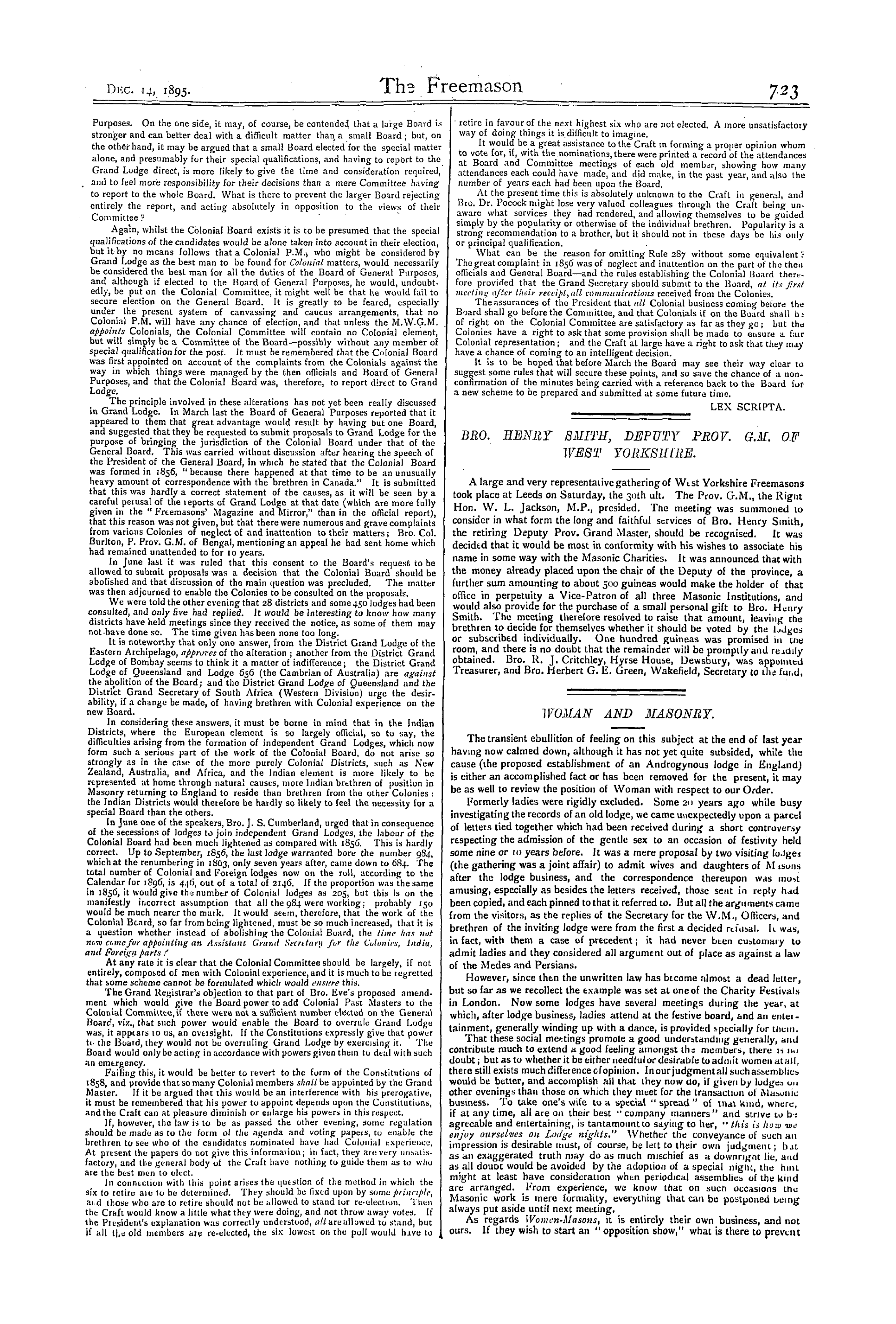
Purposes . On the one side , it may , of course , be contended that a large Board is
stronger and can better deal with a difficult matter than a small Board ; but , on the other hand , it may be argued that a small Board elected for the special matter alone , and presumably for their special qualifications , and having to report to the Grand Lodge direct , is more likely to give the time and consideration required , and to feel more responsibility for their decisions than a mere Committee havingto report to the whole Board . What is there to prevent the larger Board rejecting entirely the report , and acting absolutely in opposition to the views of their Committee ?
Again , whilst the Colonial Board exists it is to be presumed that the special qualifications of the candidates would be alone taken into account in their election , but it by no means follows that a Colonial P . M .-, who might be considered by Grand Lodge as the best man to be found for Colonial matters , would necessarily be considered the best man for all the duties of the Board of General Purposes , and although if elected to the Board of General Purposes , he would , undoubtedly , be put on the Colonial Committee , it might well be that he would fail to secure election on the General Board . It is greatly to be feared , especially
under the present system of canvassing and caucus arrangements , that no Colonial P . M . will have any chance of election , and that unless the M . W . G . M . appoints Colonials , the Colonial Committee will contain no Colonial element , but will simply be a Committee of the Board—possibly without any member ol special qualification for the post . It must be remembered that the Colonial Board was first appointed on account of the complaints from the Colonials against the way in which things were managed by the then officials and Board of General Purposes , and that the Colonial Board was , therefore , to report direct to Grand Lodge .
The principle involved in these alterations has not yet been really discussed in Grand Lodge . In March last the Board of General Purposes reported that it appeared to them that great advantage would result by having but one Board , and suggested that they be requested to submit proposals to Grand Lodge for the purpose of bringing the jurisdiction of the Colonial Board under that of the General Board . This was carried without discussion after hearing the speech of the President of the General Board , in which he stated that the Colonial Board was formed in 18 56 , "because there happened at that time to be an unusuallv
heavy amount of correspondence with the brethren in Canada . " It is submitted that this was hardly a correct statement of the causes , as it will be seen by a careful perusal of the teports of Grand Lodge at that date ( which are more fully given in the " Freemasons' Magazine and Mirror , " than in the official report ) , that this reason was not given , but that there were numerous and grave complaints from various Colonies of neglect of and inattention to their matters ; Bro . Col . Burlton , P . Prov . G . M . of Bengal , mentioning an appeal he had sent home which had remained unattended to for 10 years .
In June last it was ruled that this consent to the Board ' s request to be allowed to submit proposals was a decision that the Colonial Board should be abolished and that discussion of the main question was precluded . The matter was then adjourned to enable the Colonies to be consulted on the proposals , We were told the other evening that 28 districts and some 450 lodges had been consulted , and only five had replied . It would be interesting to know how many districts have held meetings since they received the notice , as some of them may not have done so . The time given has been none too long .
It is noteworthy that only one answer , from the District Grand Lodge of the Eastern Archipelago , approves of the alteration ; another from the District Grand Lodge of Bombay seems to think it a matter of indifference ; the District Grand Lodge of Queensland and Lodge 656 ( the Cambrian of Australia ) are against the abolition of the Board ; and the District Grand Lodjje of Queensland and the District Grand Secretary of South Africa ( Western Division ) urge the desirability , if a change be made , of having brethren with Colonial experience on the new Board .
In considering these answers , it must be borne in mind that in the Indian Districts , where the European element is so largely official , so to say , the difficulties arising from the formation of independent Grand Lodges , which now form such a serious part of the work of the Colonial Board , do not arise so strongly as in the case of the more purely Colonial Districts , such as New
Zealand , Australia , and Africa , and the Indian element is more likely to be represented at home through natural causes , more Indian brethren of position in Masonry returning to England to reside than brethren from the other Colonies : the Indian Districts would therefore be hardly so likely to feel the necessity for a special Board than the others .
In June one of the speakers , Bro . J . S . Cumberland , urged that in consequence of the secessions of lodges to join independent Grand Lodges , the labour of the Colonial Board had been much lightened as compared with 1856 . This is hardly correct . Up to September , 1856 , the last lodge warranted bore the number 984 , which at the renumbering in 1863 , only seven years after , came down to 684 . The total number of Colonial and Foreign lodges now on the roll , according to the Calendar for 1896 , is 446 , out of a total of 2146 . If the proportion was the same
in 1856 , it would give the number of Colonial lodges as 205 , but this is on the manifestly incorrect assumption that all the 9 84 were working ; probably 150 would be much nearer the mark . It would seem , therefore , that the work of the Colonial Beard , so far from being lightened , must be so much increased , that it is a question whether instead of abolishing the Colonial Board , the time has not now ci . mc for appointing an Assistant Grand Secntary for the Colonics , India , and Foreign parts f
At any rate it is clear that the Colonial Committee should be largely , if not entirely , composed of men with Colonial experience , and it is much to be regretted that some scheme cannot be formulated whic . ' i would ensure this . The Grand Registrar's objection to that part of Bro . Eve ' s proposed amendment which would give the Board power to add Colonial Past Masters to the
Colonial Committee , if there wtve not a sufficient number elected on the General Board , viz ., that such power would enable the Board to overrule Grand Lodge was , it apptars 10 us , an ovtisight . If the Constitutions expressly give that power t < . the Board , they would not be overruling Grand Lodge by exercising it . The Board would only be acting in accordance with powers given them to dtal wilh such an emergency .
Failing this , it would be better to revert to the form of the Constitutions of 1858 , and provide that so many Colonial members shall be appointed by the Grand Master . If it be argued that this would be an interference with his prerogative , it must be remembered that his power to appoint depends upon the Constitutions , and the Cralt can at pleasure diminish or enlarge his powers in this respect .
If , however , the law is to be as passed the other evening , some regulation should be made as to the form ol the agenda and voting papers , to enable the brethren to see who of the candidates nominated have had Colonial experience , At present the papers do r . ot give this information ; in fact , they are very unsatisfactory , and the general body ot the Craft have nothing to guide them as to who are the best men to elect .
In connection with this point arises the question of the method in which the six to retire are to be determined . They should be fixed upon by some principle , aid those who are to retire should not be allowed to stand lor re-election . Then the Craft would know a little what they were doing , and not throw away votes . If the President ' s explanation was correctly understood , 0 // are all awed to stand , but if all tl . e old members are re-elected , the six lowest on the poll would hive to
The Proposed Changes In The Constitutions.
retire in favour of the n « xt highest six who are not elected . A more unsatisfactory way of doing things it is difficult to imagine . It would be a great assistance to the Craft in forming a proper opinion whom to vote for , if , with the nominations , there were printed a record of the attendances at Board and Committee meetings of each ojd member , showing- how many attendances each could have made , and did make , in the past year , and also the number of years each had been upon the Board .
At the present time this is absolutely unknown to the Craft in general , and Bro . Dr . Pocock might lose very valued colleagues through the Craft being unaware what services they had rendered , and allowing themselves to be guided simply by the popularity or otherwise of the individual brethren . Popularity is a strong recommendation to a brother , but it should not in these days be his only or principal qualification .
What can be the reason for omitting Rule 28 7 without some equivalent ' The great com plaint in 1856 was of neglect and inattention on the part of the then officials and General Board—and the rules establishing the Colonial Board therefore provided that the Grand Secretary should submit to the Board , at its first meeting after their receipt , all communications received from the Colonies .
The assurances of the President that all Colonial business coming beiore the Board shall go before the Committee , and that Colonials if on the Board shall b : of right on the Colonial Committee are satisfactory as far as they go ; but the Colonies have a right to ask that some provision shall be made to ensure a fair Colonial representation ; and the Craft at large have a right to ask that they may have a chance of coming to an intelligent decision .
It is to be hoped that before March the Board may see their way clear to suggest some rules that will secure these points , and so save the chance of a ironconfirmation of the minutes being carried with a reference back to the Board for a new scheme to be prepared and submitted at some future time . LEX SCRIPTA .
Bro. Henry Smith, Deputy Prov. G.M. Of West Yorkshire.
BRO . HENRY SMITH , DEPUTY PROV . G . M . OF WEST YORKSHIRE .
A large and very representative gathering of West Yorkshire Freemasons took place at Leeds on Saturday , the 30 th ult . The Prov . G . M ., the Rignt Hon . W . L . Jackson , M . P ., presided . The meeting was summoned to consider in what form the long and faithful services of Bro . Henry Smith , the retiring Deputy Prov . Grand Master , should be recognised . It was decided that it would be most in conformity wilh his wishes to associate his
name in some way with the Masonic Charities . It was announced that with the money already placed upon the chair of the Deputy of the province , a further sum amounting to about 500 guineas would make the holder of that office in perpetuity a Vice-Patron of all three Masonic Institutions , and would also provide for the purchase of a small personal gift to Bro . Henry
Smith . I he meeting therefore resolved to raise that amount , leaving the brethren to decide for themselves whether it should be voted by the lodges or subscribed individually . One hundred guineas was promised in tne room , and there is no doubt that the remainder will be promptly and reitlil y obtained . Bro . R . J . Critchley , Hyrse House , Dewsbury , was appointed Treasurer , and Bro . Herbert G . E . Green , Wakefield , Secretary to ihs fur . d .
Woman And Masonry.
WOMAN AND MASONRY
The transient ebullition of feeling on this subject at the end of last year having now calmed down , although it has not yet quite subsided , while the cause ( the proposed establishment of an Androgynous lodge in England ) is either an accomplished fact or has been removed for the present , it may be as well to review the position of Woman with respect to our Order .
Formerly ladies were rigidly excluded . Some 20 years ago while busy investigating the records of an old lodge , we came unexpectedly upon a parcel of letters tied together which had been received during a short controversy respecting the admission of the gentle sex to an occasion of festivity held some nine or 10 years before . It was a mere proposal by two visiting lo . lges ( the gathering was a joint affair ) to admit wives and daughters of M tsons after the lodge business , and the correspondence thereupon was most
amusing , especially as besides the letters received , those sent in reply had been copied , and each pinned to that it referred to . But all the arguments came from the visitors , as the replies of the Secretary for the W . M ., Officers , and brethren of the inviting lodge were from the first a decided refusal . It was , in fact , with them a case of precedent ; it had never bten customary to admit ladies and they considered all argument out of place as against a law of the Medes and Persians .
However , since then the unwritten law has become almost a dead letter , but so far as we recollect the example was set at one of the Charity Festivals in London . Now some lodges have several meetings during the year , at which , after lodge business , ladies attend at the festive board , and an enter - tainment , generally winding up with a dance , is provided specially for them . That these social meetings promote a good understanding generally , and
contribute much to extend a good feeling amongst ihs members , there is mi doubt ; but as to whether it be either needtulor desirable to admit women atall , there still exists much difference of opinion . In our judgmental ! such assemblies would be better , and accomplish all that they now Uo , if given by lodges on other evenings than those on which they meet for the transaction of Masonic business . To take one ' s wife to a special " spread " of tnal kind , wnere ,
if at any time , all are on their best " company manners " and strive to b-j agreeable and entertaining , is tantamount 10 saying to her , " this is hoiv -we enjoy ourselves on Lodge nights , " Whether the conveyance of such an impression is desirable must , of course , be lelt to their own judgment ; bat as an exaggerated truth may do as much mischief as a downright lie , and
as all douot would be avoided by the adoption of a special nighi , the hint might at least have consideration when periodical assemblies of the kind are arranged . From experience , wc know that on such occasions the Masonic work is mere formality , everything that can be postponed being always put aside until next meeting . As regards Women-Masons , it is entirely their own business , and not ours . If they wish to start an " opposition show , " what is there to prevent






Note: This text has been automatically extracted via Optical Character Recognition (OCR) software.
The Proposed Changes In The Constitutions.
Purposes . On the one side , it may , of course , be contended that a large Board is
stronger and can better deal with a difficult matter than a small Board ; but , on the other hand , it may be argued that a small Board elected for the special matter alone , and presumably for their special qualifications , and having to report to the Grand Lodge direct , is more likely to give the time and consideration required , and to feel more responsibility for their decisions than a mere Committee havingto report to the whole Board . What is there to prevent the larger Board rejecting entirely the report , and acting absolutely in opposition to the views of their Committee ?
Again , whilst the Colonial Board exists it is to be presumed that the special qualifications of the candidates would be alone taken into account in their election , but it by no means follows that a Colonial P . M .-, who might be considered by Grand Lodge as the best man to be found for Colonial matters , would necessarily be considered the best man for all the duties of the Board of General Purposes , and although if elected to the Board of General Purposes , he would , undoubtedly , be put on the Colonial Committee , it might well be that he would fail to secure election on the General Board . It is greatly to be feared , especially
under the present system of canvassing and caucus arrangements , that no Colonial P . M . will have any chance of election , and that unless the M . W . G . M . appoints Colonials , the Colonial Committee will contain no Colonial element , but will simply be a Committee of the Board—possibly without any member ol special qualification for the post . It must be remembered that the Colonial Board was first appointed on account of the complaints from the Colonials against the way in which things were managed by the then officials and Board of General Purposes , and that the Colonial Board was , therefore , to report direct to Grand Lodge .
The principle involved in these alterations has not yet been really discussed in Grand Lodge . In March last the Board of General Purposes reported that it appeared to them that great advantage would result by having but one Board , and suggested that they be requested to submit proposals to Grand Lodge for the purpose of bringing the jurisdiction of the Colonial Board under that of the General Board . This was carried without discussion after hearing the speech of the President of the General Board , in which he stated that the Colonial Board was formed in 18 56 , "because there happened at that time to be an unusuallv
heavy amount of correspondence with the brethren in Canada . " It is submitted that this was hardly a correct statement of the causes , as it will be seen by a careful perusal of the teports of Grand Lodge at that date ( which are more fully given in the " Freemasons' Magazine and Mirror , " than in the official report ) , that this reason was not given , but that there were numerous and grave complaints from various Colonies of neglect of and inattention to their matters ; Bro . Col . Burlton , P . Prov . G . M . of Bengal , mentioning an appeal he had sent home which had remained unattended to for 10 years .
In June last it was ruled that this consent to the Board ' s request to be allowed to submit proposals was a decision that the Colonial Board should be abolished and that discussion of the main question was precluded . The matter was then adjourned to enable the Colonies to be consulted on the proposals , We were told the other evening that 28 districts and some 450 lodges had been consulted , and only five had replied . It would be interesting to know how many districts have held meetings since they received the notice , as some of them may not have done so . The time given has been none too long .
It is noteworthy that only one answer , from the District Grand Lodge of the Eastern Archipelago , approves of the alteration ; another from the District Grand Lodge of Bombay seems to think it a matter of indifference ; the District Grand Lodge of Queensland and Lodge 656 ( the Cambrian of Australia ) are against the abolition of the Board ; and the District Grand Lodjje of Queensland and the District Grand Secretary of South Africa ( Western Division ) urge the desirability , if a change be made , of having brethren with Colonial experience on the new Board .
In considering these answers , it must be borne in mind that in the Indian Districts , where the European element is so largely official , so to say , the difficulties arising from the formation of independent Grand Lodges , which now form such a serious part of the work of the Colonial Board , do not arise so strongly as in the case of the more purely Colonial Districts , such as New
Zealand , Australia , and Africa , and the Indian element is more likely to be represented at home through natural causes , more Indian brethren of position in Masonry returning to England to reside than brethren from the other Colonies : the Indian Districts would therefore be hardly so likely to feel the necessity for a special Board than the others .
In June one of the speakers , Bro . J . S . Cumberland , urged that in consequence of the secessions of lodges to join independent Grand Lodges , the labour of the Colonial Board had been much lightened as compared with 1856 . This is hardly correct . Up to September , 1856 , the last lodge warranted bore the number 984 , which at the renumbering in 1863 , only seven years after , came down to 684 . The total number of Colonial and Foreign lodges now on the roll , according to the Calendar for 1896 , is 446 , out of a total of 2146 . If the proportion was the same
in 1856 , it would give the number of Colonial lodges as 205 , but this is on the manifestly incorrect assumption that all the 9 84 were working ; probably 150 would be much nearer the mark . It would seem , therefore , that the work of the Colonial Beard , so far from being lightened , must be so much increased , that it is a question whether instead of abolishing the Colonial Board , the time has not now ci . mc for appointing an Assistant Grand Secntary for the Colonics , India , and Foreign parts f
At any rate it is clear that the Colonial Committee should be largely , if not entirely , composed of men with Colonial experience , and it is much to be regretted that some scheme cannot be formulated whic . ' i would ensure this . The Grand Registrar's objection to that part of Bro . Eve ' s proposed amendment which would give the Board power to add Colonial Past Masters to the
Colonial Committee , if there wtve not a sufficient number elected on the General Board , viz ., that such power would enable the Board to overrule Grand Lodge was , it apptars 10 us , an ovtisight . If the Constitutions expressly give that power t < . the Board , they would not be overruling Grand Lodge by exercising it . The Board would only be acting in accordance with powers given them to dtal wilh such an emergency .
Failing this , it would be better to revert to the form of the Constitutions of 1858 , and provide that so many Colonial members shall be appointed by the Grand Master . If it be argued that this would be an interference with his prerogative , it must be remembered that his power to appoint depends upon the Constitutions , and the Cralt can at pleasure diminish or enlarge his powers in this respect .
If , however , the law is to be as passed the other evening , some regulation should be made as to the form ol the agenda and voting papers , to enable the brethren to see who of the candidates nominated have had Colonial experience , At present the papers do r . ot give this information ; in fact , they are very unsatisfactory , and the general body ot the Craft have nothing to guide them as to who are the best men to elect .
In connection with this point arises the question of the method in which the six to retire are to be determined . They should be fixed upon by some principle , aid those who are to retire should not be allowed to stand lor re-election . Then the Craft would know a little what they were doing , and not throw away votes . If the President ' s explanation was correctly understood , 0 // are all awed to stand , but if all tl . e old members are re-elected , the six lowest on the poll would hive to
The Proposed Changes In The Constitutions.
retire in favour of the n « xt highest six who are not elected . A more unsatisfactory way of doing things it is difficult to imagine . It would be a great assistance to the Craft in forming a proper opinion whom to vote for , if , with the nominations , there were printed a record of the attendances at Board and Committee meetings of each ojd member , showing- how many attendances each could have made , and did make , in the past year , and also the number of years each had been upon the Board .
At the present time this is absolutely unknown to the Craft in general , and Bro . Dr . Pocock might lose very valued colleagues through the Craft being unaware what services they had rendered , and allowing themselves to be guided simply by the popularity or otherwise of the individual brethren . Popularity is a strong recommendation to a brother , but it should not in these days be his only or principal qualification .
What can be the reason for omitting Rule 28 7 without some equivalent ' The great com plaint in 1856 was of neglect and inattention on the part of the then officials and General Board—and the rules establishing the Colonial Board therefore provided that the Grand Secretary should submit to the Board , at its first meeting after their receipt , all communications received from the Colonies .
The assurances of the President that all Colonial business coming beiore the Board shall go before the Committee , and that Colonials if on the Board shall b : of right on the Colonial Committee are satisfactory as far as they go ; but the Colonies have a right to ask that some provision shall be made to ensure a fair Colonial representation ; and the Craft at large have a right to ask that they may have a chance of coming to an intelligent decision .
It is to be hoped that before March the Board may see their way clear to suggest some rules that will secure these points , and so save the chance of a ironconfirmation of the minutes being carried with a reference back to the Board for a new scheme to be prepared and submitted at some future time . LEX SCRIPTA .
Bro. Henry Smith, Deputy Prov. G.M. Of West Yorkshire.
BRO . HENRY SMITH , DEPUTY PROV . G . M . OF WEST YORKSHIRE .
A large and very representative gathering of West Yorkshire Freemasons took place at Leeds on Saturday , the 30 th ult . The Prov . G . M ., the Rignt Hon . W . L . Jackson , M . P ., presided . The meeting was summoned to consider in what form the long and faithful services of Bro . Henry Smith , the retiring Deputy Prov . Grand Master , should be recognised . It was decided that it would be most in conformity wilh his wishes to associate his
name in some way with the Masonic Charities . It was announced that with the money already placed upon the chair of the Deputy of the province , a further sum amounting to about 500 guineas would make the holder of that office in perpetuity a Vice-Patron of all three Masonic Institutions , and would also provide for the purchase of a small personal gift to Bro . Henry
Smith . I he meeting therefore resolved to raise that amount , leaving the brethren to decide for themselves whether it should be voted by the lodges or subscribed individually . One hundred guineas was promised in tne room , and there is no doubt that the remainder will be promptly and reitlil y obtained . Bro . R . J . Critchley , Hyrse House , Dewsbury , was appointed Treasurer , and Bro . Herbert G . E . Green , Wakefield , Secretary to ihs fur . d .
Woman And Masonry.
WOMAN AND MASONRY
The transient ebullition of feeling on this subject at the end of last year having now calmed down , although it has not yet quite subsided , while the cause ( the proposed establishment of an Androgynous lodge in England ) is either an accomplished fact or has been removed for the present , it may be as well to review the position of Woman with respect to our Order .
Formerly ladies were rigidly excluded . Some 20 years ago while busy investigating the records of an old lodge , we came unexpectedly upon a parcel of letters tied together which had been received during a short controversy respecting the admission of the gentle sex to an occasion of festivity held some nine or 10 years before . It was a mere proposal by two visiting lo . lges ( the gathering was a joint affair ) to admit wives and daughters of M tsons after the lodge business , and the correspondence thereupon was most
amusing , especially as besides the letters received , those sent in reply had been copied , and each pinned to that it referred to . But all the arguments came from the visitors , as the replies of the Secretary for the W . M ., Officers , and brethren of the inviting lodge were from the first a decided refusal . It was , in fact , with them a case of precedent ; it had never bten customary to admit ladies and they considered all argument out of place as against a law of the Medes and Persians .
However , since then the unwritten law has become almost a dead letter , but so far as we recollect the example was set at one of the Charity Festivals in London . Now some lodges have several meetings during the year , at which , after lodge business , ladies attend at the festive board , and an enter - tainment , generally winding up with a dance , is provided specially for them . That these social meetings promote a good understanding generally , and
contribute much to extend a good feeling amongst ihs members , there is mi doubt ; but as to whether it be either needtulor desirable to admit women atall , there still exists much difference of opinion . In our judgmental ! such assemblies would be better , and accomplish all that they now Uo , if given by lodges on other evenings than those on which they meet for the transaction of Masonic business . To take one ' s wife to a special " spread " of tnal kind , wnere ,
if at any time , all are on their best " company manners " and strive to b-j agreeable and entertaining , is tantamount 10 saying to her , " this is hoiv -we enjoy ourselves on Lodge nights , " Whether the conveyance of such an impression is desirable must , of course , be lelt to their own judgment ; bat as an exaggerated truth may do as much mischief as a downright lie , and
as all douot would be avoided by the adoption of a special nighi , the hint might at least have consideration when periodical assemblies of the kind are arranged . From experience , wc know that on such occasions the Masonic work is mere formality , everything that can be postponed being always put aside until next meeting . As regards Women-Masons , it is entirely their own business , and not ours . If they wish to start an " opposition show , " what is there to prevent