-
Articles/Ads
Article CONSECRATION OF THE SCOTS LODGE, No. 2319. ← Page 2 of 4 Article CONSECRATION OF THE SCOTS LODGE, No. 2319. Page 2 of 4 →
Note: This text has been automatically extracted via Optical Character Recognition (OCR) software.
Consecration Of The Scots Lodge, No. 2319.
Bro . Col . S HADWELL H . CLERKE next said that the occasion on which the breden were met was one of very great Masonic importance , and he was sure that , | l 0 se who were present would be gratified in future years to think and remember ? hat they took part in the meeting . He had on many similar occasions pointed out the fact that there were a very large number of lodges at present in London , and it was a difficult matter to get a warrant for a new lodge unless good and valid be shown for the existence of such lod
reason could new ge . The reason for the yc ' ts Lodge was a unique one ; it was because it had been considered b y numerous , llKl various brethren who hailed from the sister kingdom of Scotland who were resident in London that it would further their unit y if they had a lodge to meet in , and have a local habitat where they could meet each other and where they could make brethren of their fellow countrymen , as they had a great number of
distinguished Scotchmen in London . Such being the case , they put the matter before the ° M . G . M ., and his Royal Highness having considered it he thought their case was such a strong one that he had no hesitation in granting the prayer of their petition . Therefore they were met to consecrate the Scots Lodge of London , and the Eng lish Masons as Englishmen felt very pleased that they should have another tie if one were wanting , between themselves and the Masons of the north . The
lodge was fortunate m having obtained the services of an illustrious nobleman and a distinguished Mason . His lordship ' s services in Freemasonry were so well known to everybody who was a Mason that he thought the lod ge was most fortunate in having him as their first W . M ., and he was sure that under such guidance , and with the assistance of such excellent brethren as those who had got this lodo-e up , it would succeed . They would be careful not to be in a hurry to increase their
numbers . They would study its welfare m every way , and they would find their reward in the end . The ceremony was then proceeded with . Bro . the Rev . G . W . W ELDON , P . G . C , in delivering the oration , said : Consecrating Master and Brethren , —Allow me to ask your kind indul gence for about five or six minutes while I endeavour to put before you , as suggested in the
programme of our proceedings , something on the nature and principles of our Order , and that I may make my remarks as definite as possible I have selected for our consideration on this occasion the symbolic teaching of Masonry . The entire system of Freemasonry is intimatel y associated with what is commonly termed symbolism . In order rightly to understand the true meaning of that mode of instruction it is necessary that we should be accurately acquainted with the facts signified by the symbols . By the term
symbol is simply meant the outward and visible sign of an inward and spiritual truth . To use the impressive words of the ritual of our Craft—Masonry is " a system of morality veiled in allegory and illustrated by symbol . " Nations which have been separated -from each other by continents and b y
centuries , diverse in their habits , and alien in race , have adopted this mode of communicating their ideas , especially in the rites and ceremonies connected with the worship of a Supreme Being . This fact may be clearly traced in the outward emblems , by means of which the people of the old world as
well as of the new have endeavoured to embody the yearnings of their relig ious instincts . This symbolism was a kind of universal language , well understood by the initiated , into whatever country they might wander , even though they were ignorant of the ordinary language spoken by the people . The sign or symbol used in these religious ceremonies plainly
expressed to them the truth signified by it . This mode of communicating ideas has been handed down to us from periods of very remote antiquity . For example , look at the symbolic writing as seen in the sacred but mysterious characters called hieroglyphics on the ancient monuments of Egypt . On carefully examining the curious inscriptions on the outer
coverings of the mummy cases you may frequently notice the symbol of a bird just in the act of taking wing . By this symbol it was meant to convey the idea , that while the body , elaborately wrapped up in the cerements of death , was mouldering away amid
the rags and the rubbish within that coffin , the soul of the deceased had already entered upon its long a-rial fli ght towards distant and unknown regions of space . You may notice , also , another symbol , which we ourselves have adopted—namely , that of the winged circle , the circle denoting Eternity , without beginning or ending , and the wings the perpetual flig ht of time . i f ) 0 "A f ^ * -f Vi * i »• l-triAl .. J M » . M ^ I ^ n * - Vtt [¦(¦ Arir ir / M i m'Jir i ! Pf lt UlCl / l \ cllllwilll * iiiti
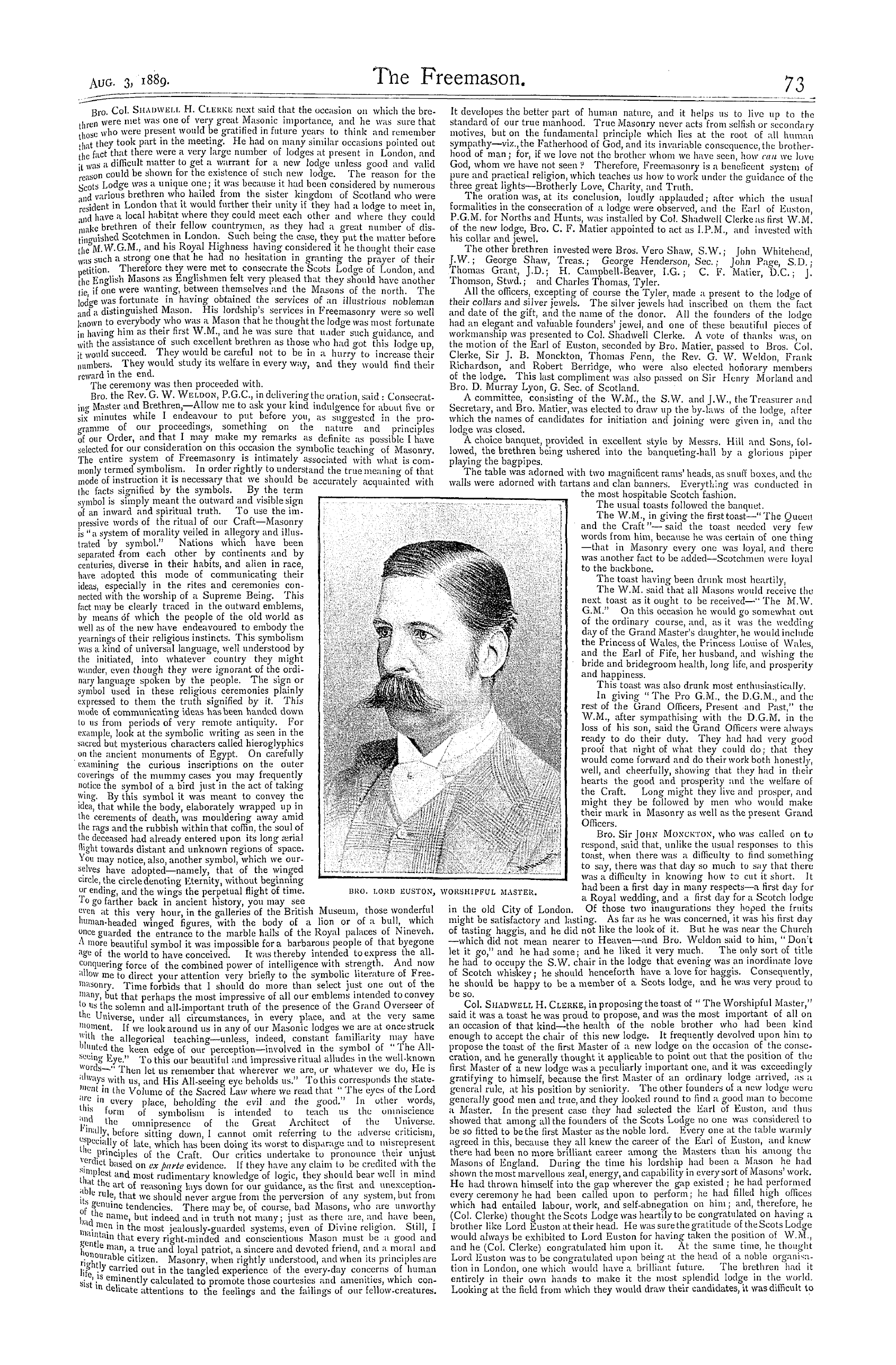
BRO . LORD EUSTON , WORSHIPFUL MASTER .
£ jv « LcU-. Ill ^ IIIOIVIJ } J- * - -. * - j- J * . "' "'en at this very hour , in the galleries of the British Museum , those wonderful human-headed winged figures , with the body of a lion or of a bull ^ which once guarded the entrance to the marble halls of the Royal palaces of Nineveh .
A more beautiful symbol it was impossible for a barbarous people of that byegone : l gc of the world to have conceived . It was thereby intended to express the allconquering force of the combined power of intelligence with strength . And now allow me to direct your attention very briefly to the symbolic literature of Freemasonry . Time forbids that 1 should do more than select just one out of the
many , but that perhaps the most impressive of all our emblems intended to convey '? « s the solemn and all-important truth of the presence of the Grand Overseer of the Universe , under all circumstances , in every place , and at the very same moment . If we look around us in any of our Masonic lodges we are at once struck with the allegorical teaching—unless , indeed , constant familiarity may have blunted
, the keen edge of our perception—involved in the symbol of " The Allseeing Eye . " To this our beautiful and impressive ritual alludes in the well-known words— " Then let us remember that wherever we are , or whatever we do , He is a ™ ays with us , and His All-seeing eye beholds us . " To this corresponds the statement in the Volume of the Sacred Law where we read that " The eyes of the Lord ire
¦ in ever y pJace | beholding the evil and the good . " In other words , Ulll j form of symbolism is intended to teach us thc omniscience ' , '" " the omnipresence of the Great Architect of the Universe . ' mall y , before sitting down , 1 cannot omit referring to the adverse criticism , ^ speciall y of late , which has been doing its worst to disparage and to misrepresent llu princi ples of the Craft . Our critics undertake to pronounce their unjust
s - . Dase d on ex parte evidence . If they have any claim to be credited with the j 'jmplest and most rudimentary knowledge of logic , they should bear well in mind . [ I tne art of reasoning lays down for our guidance , as the first and unexceptionj ' c rule , that we should never argue from the perversion of any system , but from of s genuine tendencies . There may be , of course , bad Masons , who are unworthy bil name > but indeed and in truth not many ; just as there are , and have been , hy' T " '" " le most jealously-guarded systems , even of Divine religion . Still , I ¦ rc ' i'll tlUlt eVely right-minded and conscientious Mason must be a good and ho m : " ' a true < lncl ' ° yal patriot , a sincere and devoted friend , and a moral and r - ? ° J Ir ; l hle citizen . Masonry , when rightly understood , and when its principles are life - ca r ' ' > n the tangled experience of the every-day concerns of human sist ' ' t j . ment | y calculated to promote those courtesies and amenities , which con"" " ' e'icate attentions to the feelings and the failings of our fellow-creatures .
Consecration Of The Scots Lodge, No. 2319.
It developes the better part of human nature , and it helps us to live up to the standard of our true manhood . True Masonry never acts from selfish or secondary motives , but on the fundamental principle which lies at the root of all human sympathy—viz ., theFatherhood of God , and its invariable consequence , the brotherhood of man ; for , if we love not the brother whom we have seen , how can we love God , whom we have not seen ? Therefore , Freemasonry is a beneficent system of pure and practical reli gion , which teaches us how to work under the guidance of tho three great li ghts—Brotherl y Love , Charity , and Truth .
The oration was , at its conclusion , loudly applauded ; after which the usual formalities in the consecration of a lodge were observed , and the Earl of Euston , P . G . M . for Norths and Hunts , was installed b y Col . Shadwell Clerke as first W . M . of the new lodge , Bro . C . F . Matier appointed to act as I . P . M ., and invested with his collar and jewel .
The other brethren invested were Bros . Vero Shaw , S . W . ; John Whitehead , J . W . ; George Shaw , Treas . ; George Henderson , Sec ; John Page , S . D . ; Thomas Grant , J . D . ; H . Campbell-Beaver , I . G . ; C . F . Matier , D . C ; j . Thomson , Stwd . ; and Charles Thomas , Tyler . All the officers , excepting of course the T yler , made a present to the lodge of their collars and silver jewels . The silver jewels had inscribed on them the fact and date of the gift , and the name of the donor . All the founders of the lodge
had an elegant and valuable founders' jewel , and one of these beautiful pieces of workmanship was presented to Col . Shadwell Clerke . A vote of thanks was , on the motion of the Earl of Euston , seconded by Bro . Matier , passed to Bros . Col . Clerke , Sir J . B . Monckton , Thomas Fenn , the Rev . G . W . Weldon , Frank Richardson , and Robert Berridge , who were also elected honorary members of the lodge . This last compliment was also passed on Sir Henry Morland and Bro . D . Murray Lyon , G . Sec . of Scotland .
A committee , consisting ofthe W . M ., the S . W . and J . W ., the Treasurer and Secretary , and Bro . Matier , was elected to draw up the by-laws of the lodge , after which the names of candidates for initiation and joining were given in , and tho lodge was closed . A choice banquet , provided in excellent style by Messrs . Hill and Sons , followed , the brethren being ushered into the banqueting-hall by a glorious piper playing the bagpipes . The table was adorned with two magnificent rams' heads , as snuff boxes , and thc walls were adorned with tartans and clan banners . Everything was conducted in
the most hospitable Scotch fashion . The usual toasts followed the banquet . The W . M ., in giving the first toast— - "The Queen and the Craft "— said the toast needed very few words from him , because he was certain of one thing —that in Masonry every one was loyal , and there
was another fact to be added—Scotchmen were loyal to the backbone . The toast having been drunk most heartily , The W . M . said that all Masons would receive thc next toast as it ought to be received— " The M . W . G . M . " On this occasion he would cm somewhat out
of the ordinary course , and , as it was the wedding day of the Grand Master ' s daughter , he would include the Princess of Wales , the Princess Louise , of Wales , and the Earl of Fife , her husband , and wishing the bride and bridegroom health , long life , and prosperity and happiness . This toast was also drunk most enthusiastically .
In giving " The Pro G . M ., the D . G . M ., and the rest of the Grand Officers , Present and Past , " thc W . M ., after sympathising with the D . G . M . in the loss of his son , said the Grand Officers were always ready to do their duty . They had had very good proof that night of what they could do ; that they
would come forward and do their work both honestly , well , and cheerfully , showing that they had in their hearts the good and prosperity and the welfare of the Craft . Long might they live and prosper , and might they be followed by men who would make their mark in Masonry as well as the present Grand Officers .
Bro . Sir J MONCKTON , who was called on to respond , said that , unlike the usual responses to this toast , when there was a difficulty to find something to say , there was that day so much to say that there was a difficulty in knowing how to cut it short . It had been a first day in many respects—a first day for a Royal wedding , and a first day for a Scotch lodge
in the old City of London . Of those two inaugurations they hoped the truits might be satisfactory and lasting . As far as he was concerned , it was his first day of tasting haggis , and he did not like the look of it . But he was near the Church —which did not mean nearer to Heaven—and Bro . Weldon said to him , " Don ' t let it go , " and he had some ; and he liked it very much . The only sort of title
he had to occupy the S . W . chair in the lodge that evening was an inordinate love of Scotch whiskey ; he should henceforth have a love for haggis . Consequently , he should be happy to be a member of a Scots lodge , and he was very proud to be so . Col . SHADWELL H . CLERKE , in proposing the toast of " The Worshipful Master , " said it was a toast he was proud to propose , and was the most important of all on
an occasion of that kind—the health ofthe noble brother who had been kind enough to accept the chair of this new lodge . It frequently devolved upon him to propose the toast of the first Master of a new lodge on the occasion of the consecration , and he generally thought it applicable to point out that the position of the first Master of a new lodge was a peculiarly important one , and it was exceedingly gratif ying to himself , because the first Master of an ordinary lodge arrived , as a
general rule , at his position by seniority . The other founders of a new lodge were generally good men and true , and they looked round to find a good man to become a Master . In the present case they had selected the Earl of Euston , and thus showed that among all the founders of the Scots Lodge no one was considered to be so fitted to be the first Master as the noble lord . Every one at the table warmly agreed in this , because they all knew the career of the Earl of Euston , and knew
there had been no more brilliant career among the Masters than nis among tne Masons of England . During the time his lordship had been a Mason he had shown the most marvellous zeal , energy , and capability in every sort of Masons' work . He had thrown himself into the gap wherever the gap existed ; he had performed every ceremony he had been called upon to perform ; he had filled high offices which had entailed labour , work , and self-abnegation on him ; and , therefore , he ( Col . Clerke ) thought the Scots Lodge was heartily to be congratulated on having a
brother like Lord Euston at their head . He was sure the gratitude of the Scots Lodge would always be exhibited to Lord Euston for having taken the position of W . M ., and he ( Col . Clerke ) congratulated him upon it . At the same time , he thought Lord Euston was to be congratulated upon being at the head of a noble organisation in London , one which would have a brilliant future . The brethren had it entirel y in their own hands to make it the most splendid lodge in the world . Looking at the field from which they would draw their candidates , it was difficult to

Note: This text has been automatically extracted via Optical Character Recognition (OCR) software.
Consecration Of The Scots Lodge, No. 2319.
Bro . Col . S HADWELL H . CLERKE next said that the occasion on which the breden were met was one of very great Masonic importance , and he was sure that , | l 0 se who were present would be gratified in future years to think and remember ? hat they took part in the meeting . He had on many similar occasions pointed out the fact that there were a very large number of lodges at present in London , and it was a difficult matter to get a warrant for a new lodge unless good and valid be shown for the existence of such lod
reason could new ge . The reason for the yc ' ts Lodge was a unique one ; it was because it had been considered b y numerous , llKl various brethren who hailed from the sister kingdom of Scotland who were resident in London that it would further their unit y if they had a lodge to meet in , and have a local habitat where they could meet each other and where they could make brethren of their fellow countrymen , as they had a great number of
distinguished Scotchmen in London . Such being the case , they put the matter before the ° M . G . M ., and his Royal Highness having considered it he thought their case was such a strong one that he had no hesitation in granting the prayer of their petition . Therefore they were met to consecrate the Scots Lodge of London , and the Eng lish Masons as Englishmen felt very pleased that they should have another tie if one were wanting , between themselves and the Masons of the north . The
lodge was fortunate m having obtained the services of an illustrious nobleman and a distinguished Mason . His lordship ' s services in Freemasonry were so well known to everybody who was a Mason that he thought the lod ge was most fortunate in having him as their first W . M ., and he was sure that under such guidance , and with the assistance of such excellent brethren as those who had got this lodo-e up , it would succeed . They would be careful not to be in a hurry to increase their
numbers . They would study its welfare m every way , and they would find their reward in the end . The ceremony was then proceeded with . Bro . the Rev . G . W . W ELDON , P . G . C , in delivering the oration , said : Consecrating Master and Brethren , —Allow me to ask your kind indul gence for about five or six minutes while I endeavour to put before you , as suggested in the
programme of our proceedings , something on the nature and principles of our Order , and that I may make my remarks as definite as possible I have selected for our consideration on this occasion the symbolic teaching of Masonry . The entire system of Freemasonry is intimatel y associated with what is commonly termed symbolism . In order rightly to understand the true meaning of that mode of instruction it is necessary that we should be accurately acquainted with the facts signified by the symbols . By the term
symbol is simply meant the outward and visible sign of an inward and spiritual truth . To use the impressive words of the ritual of our Craft—Masonry is " a system of morality veiled in allegory and illustrated by symbol . " Nations which have been separated -from each other by continents and b y
centuries , diverse in their habits , and alien in race , have adopted this mode of communicating their ideas , especially in the rites and ceremonies connected with the worship of a Supreme Being . This fact may be clearly traced in the outward emblems , by means of which the people of the old world as
well as of the new have endeavoured to embody the yearnings of their relig ious instincts . This symbolism was a kind of universal language , well understood by the initiated , into whatever country they might wander , even though they were ignorant of the ordinary language spoken by the people . The sign or symbol used in these religious ceremonies plainly
expressed to them the truth signified by it . This mode of communicating ideas has been handed down to us from periods of very remote antiquity . For example , look at the symbolic writing as seen in the sacred but mysterious characters called hieroglyphics on the ancient monuments of Egypt . On carefully examining the curious inscriptions on the outer
coverings of the mummy cases you may frequently notice the symbol of a bird just in the act of taking wing . By this symbol it was meant to convey the idea , that while the body , elaborately wrapped up in the cerements of death , was mouldering away amid
the rags and the rubbish within that coffin , the soul of the deceased had already entered upon its long a-rial fli ght towards distant and unknown regions of space . You may notice , also , another symbol , which we ourselves have adopted—namely , that of the winged circle , the circle denoting Eternity , without beginning or ending , and the wings the perpetual flig ht of time . i f ) 0 "A f ^ * -f Vi * i »• l-triAl .. J M » . M ^ I ^ n * - Vtt [¦(¦ Arir ir / M i m'Jir i ! Pf lt UlCl / l \ cllllwilll * iiiti
BRO . LORD EUSTON , WORSHIPFUL MASTER .
£ jv « LcU-. Ill ^ IIIOIVIJ } J- * - -. * - j- J * . "' "'en at this very hour , in the galleries of the British Museum , those wonderful human-headed winged figures , with the body of a lion or of a bull ^ which once guarded the entrance to the marble halls of the Royal palaces of Nineveh .
A more beautiful symbol it was impossible for a barbarous people of that byegone : l gc of the world to have conceived . It was thereby intended to express the allconquering force of the combined power of intelligence with strength . And now allow me to direct your attention very briefly to the symbolic literature of Freemasonry . Time forbids that 1 should do more than select just one out of the
many , but that perhaps the most impressive of all our emblems intended to convey '? « s the solemn and all-important truth of the presence of the Grand Overseer of the Universe , under all circumstances , in every place , and at the very same moment . If we look around us in any of our Masonic lodges we are at once struck with the allegorical teaching—unless , indeed , constant familiarity may have blunted
, the keen edge of our perception—involved in the symbol of " The Allseeing Eye . " To this our beautiful and impressive ritual alludes in the well-known words— " Then let us remember that wherever we are , or whatever we do , He is a ™ ays with us , and His All-seeing eye beholds us . " To this corresponds the statement in the Volume of the Sacred Law where we read that " The eyes of the Lord ire
¦ in ever y pJace | beholding the evil and the good . " In other words , Ulll j form of symbolism is intended to teach us thc omniscience ' , '" " the omnipresence of the Great Architect of the Universe . ' mall y , before sitting down , 1 cannot omit referring to the adverse criticism , ^ speciall y of late , which has been doing its worst to disparage and to misrepresent llu princi ples of the Craft . Our critics undertake to pronounce their unjust
s - . Dase d on ex parte evidence . If they have any claim to be credited with the j 'jmplest and most rudimentary knowledge of logic , they should bear well in mind . [ I tne art of reasoning lays down for our guidance , as the first and unexceptionj ' c rule , that we should never argue from the perversion of any system , but from of s genuine tendencies . There may be , of course , bad Masons , who are unworthy bil name > but indeed and in truth not many ; just as there are , and have been , hy' T " '" " le most jealously-guarded systems , even of Divine religion . Still , I ¦ rc ' i'll tlUlt eVely right-minded and conscientious Mason must be a good and ho m : " ' a true < lncl ' ° yal patriot , a sincere and devoted friend , and a moral and r - ? ° J Ir ; l hle citizen . Masonry , when rightly understood , and when its principles are life - ca r ' ' > n the tangled experience of the every-day concerns of human sist ' ' t j . ment | y calculated to promote those courtesies and amenities , which con"" " ' e'icate attentions to the feelings and the failings of our fellow-creatures .
Consecration Of The Scots Lodge, No. 2319.
It developes the better part of human nature , and it helps us to live up to the standard of our true manhood . True Masonry never acts from selfish or secondary motives , but on the fundamental principle which lies at the root of all human sympathy—viz ., theFatherhood of God , and its invariable consequence , the brotherhood of man ; for , if we love not the brother whom we have seen , how can we love God , whom we have not seen ? Therefore , Freemasonry is a beneficent system of pure and practical reli gion , which teaches us how to work under the guidance of tho three great li ghts—Brotherl y Love , Charity , and Truth .
The oration was , at its conclusion , loudly applauded ; after which the usual formalities in the consecration of a lodge were observed , and the Earl of Euston , P . G . M . for Norths and Hunts , was installed b y Col . Shadwell Clerke as first W . M . of the new lodge , Bro . C . F . Matier appointed to act as I . P . M ., and invested with his collar and jewel .
The other brethren invested were Bros . Vero Shaw , S . W . ; John Whitehead , J . W . ; George Shaw , Treas . ; George Henderson , Sec ; John Page , S . D . ; Thomas Grant , J . D . ; H . Campbell-Beaver , I . G . ; C . F . Matier , D . C ; j . Thomson , Stwd . ; and Charles Thomas , Tyler . All the officers , excepting of course the T yler , made a present to the lodge of their collars and silver jewels . The silver jewels had inscribed on them the fact and date of the gift , and the name of the donor . All the founders of the lodge
had an elegant and valuable founders' jewel , and one of these beautiful pieces of workmanship was presented to Col . Shadwell Clerke . A vote of thanks was , on the motion of the Earl of Euston , seconded by Bro . Matier , passed to Bros . Col . Clerke , Sir J . B . Monckton , Thomas Fenn , the Rev . G . W . Weldon , Frank Richardson , and Robert Berridge , who were also elected honorary members of the lodge . This last compliment was also passed on Sir Henry Morland and Bro . D . Murray Lyon , G . Sec . of Scotland .
A committee , consisting ofthe W . M ., the S . W . and J . W ., the Treasurer and Secretary , and Bro . Matier , was elected to draw up the by-laws of the lodge , after which the names of candidates for initiation and joining were given in , and tho lodge was closed . A choice banquet , provided in excellent style by Messrs . Hill and Sons , followed , the brethren being ushered into the banqueting-hall by a glorious piper playing the bagpipes . The table was adorned with two magnificent rams' heads , as snuff boxes , and thc walls were adorned with tartans and clan banners . Everything was conducted in
the most hospitable Scotch fashion . The usual toasts followed the banquet . The W . M ., in giving the first toast— - "The Queen and the Craft "— said the toast needed very few words from him , because he was certain of one thing —that in Masonry every one was loyal , and there
was another fact to be added—Scotchmen were loyal to the backbone . The toast having been drunk most heartily , The W . M . said that all Masons would receive thc next toast as it ought to be received— " The M . W . G . M . " On this occasion he would cm somewhat out
of the ordinary course , and , as it was the wedding day of the Grand Master ' s daughter , he would include the Princess of Wales , the Princess Louise , of Wales , and the Earl of Fife , her husband , and wishing the bride and bridegroom health , long life , and prosperity and happiness . This toast was also drunk most enthusiastically .
In giving " The Pro G . M ., the D . G . M ., and the rest of the Grand Officers , Present and Past , " thc W . M ., after sympathising with the D . G . M . in the loss of his son , said the Grand Officers were always ready to do their duty . They had had very good proof that night of what they could do ; that they
would come forward and do their work both honestly , well , and cheerfully , showing that they had in their hearts the good and prosperity and the welfare of the Craft . Long might they live and prosper , and might they be followed by men who would make their mark in Masonry as well as the present Grand Officers .
Bro . Sir J MONCKTON , who was called on to respond , said that , unlike the usual responses to this toast , when there was a difficulty to find something to say , there was that day so much to say that there was a difficulty in knowing how to cut it short . It had been a first day in many respects—a first day for a Royal wedding , and a first day for a Scotch lodge
in the old City of London . Of those two inaugurations they hoped the truits might be satisfactory and lasting . As far as he was concerned , it was his first day of tasting haggis , and he did not like the look of it . But he was near the Church —which did not mean nearer to Heaven—and Bro . Weldon said to him , " Don ' t let it go , " and he had some ; and he liked it very much . The only sort of title
he had to occupy the S . W . chair in the lodge that evening was an inordinate love of Scotch whiskey ; he should henceforth have a love for haggis . Consequently , he should be happy to be a member of a Scots lodge , and he was very proud to be so . Col . SHADWELL H . CLERKE , in proposing the toast of " The Worshipful Master , " said it was a toast he was proud to propose , and was the most important of all on
an occasion of that kind—the health ofthe noble brother who had been kind enough to accept the chair of this new lodge . It frequently devolved upon him to propose the toast of the first Master of a new lodge on the occasion of the consecration , and he generally thought it applicable to point out that the position of the first Master of a new lodge was a peculiarly important one , and it was exceedingly gratif ying to himself , because the first Master of an ordinary lodge arrived , as a
general rule , at his position by seniority . The other founders of a new lodge were generally good men and true , and they looked round to find a good man to become a Master . In the present case they had selected the Earl of Euston , and thus showed that among all the founders of the Scots Lodge no one was considered to be so fitted to be the first Master as the noble lord . Every one at the table warmly agreed in this , because they all knew the career of the Earl of Euston , and knew
there had been no more brilliant career among the Masters than nis among tne Masons of England . During the time his lordship had been a Mason he had shown the most marvellous zeal , energy , and capability in every sort of Masons' work . He had thrown himself into the gap wherever the gap existed ; he had performed every ceremony he had been called upon to perform ; he had filled high offices which had entailed labour , work , and self-abnegation on him ; and , therefore , he ( Col . Clerke ) thought the Scots Lodge was heartily to be congratulated on having a
brother like Lord Euston at their head . He was sure the gratitude of the Scots Lodge would always be exhibited to Lord Euston for having taken the position of W . M ., and he ( Col . Clerke ) congratulated him upon it . At the same time , he thought Lord Euston was to be congratulated upon being at the head of a noble organisation in London , one which would have a brilliant future . The brethren had it entirel y in their own hands to make it the most splendid lodge in the world . Looking at the field from which they would draw their candidates , it was difficult to