-
Articles/Ads
Article CONSECRATION OF THE SCOTS LODGE, No. 2319. ← Page 3 of 4 Article CONSECRATION OF THE SCOTS LODGE, No. 2319. Page 3 of 4 →
Note: This text has been automatically extracted via Optical Character Recognition (OCR) software.
Consecration Of The Scots Lodge, No. 2319.
say what the future of the Scots Lodge would be ; but hc was sure that in the hands of its first Master , and in the hands of those who at present constituted it , the success of the lodge was assured . He requested them to drink most heartily and sincerely the health of the W . M ., wishing him a happy , pleasant , and prosperous year of office .
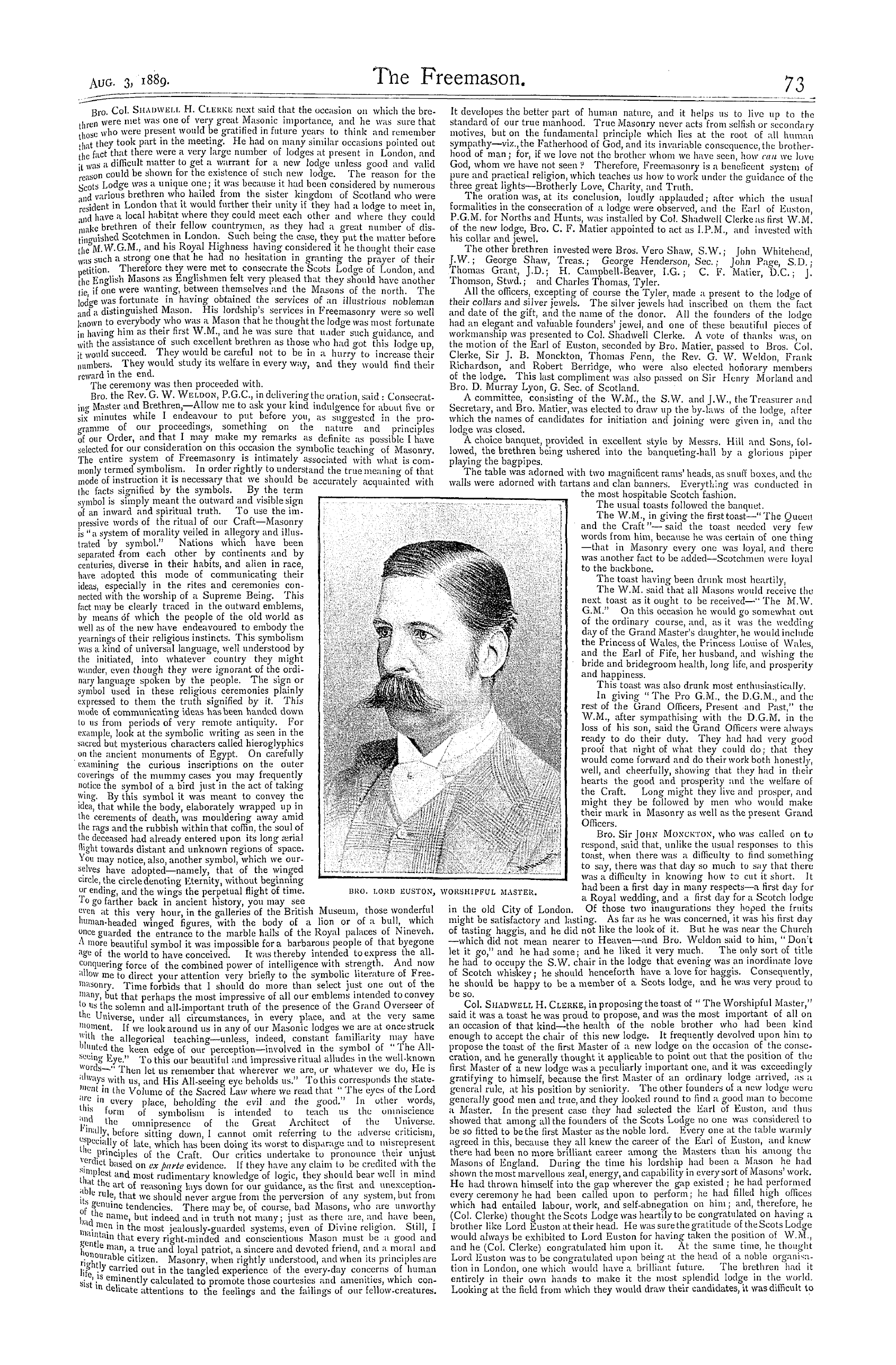
Bro . the Earl of EUSTON , in reply , said as he looked back on a very short Masonic career he could say this much—that he had been very lucky , and he hoped he would not be one of those who started well and did not run Ions ' . He could assure
the brethren that he would strive to do his best for the good of Masonry . The Craft was their first consideration , and the Grand Lodge of England , of course , in this country was their first consideration . That nig ht they had a brother of the Grand Lodge of Scotland , a brother who was most distinguished in that Grand Lodge . The Scots Lodge might call themselves a Scotch lodge , but they were a Scotch lodge under the laws and institutions of the Grand Lodge of England .
Although he was only half Scotch himself , the brethren welcomed him among them , and he thanked them for the great honour they had done him in choosing him for their W . M ., and for the honour they had done him by placing him in the chair of this lodge , and for placing him at the head of them when there were so many who were much more worthy and senior to himself , and who had done more work in Masonry . Although he had been a short time in Masonry , he could honestly say
he had done his best . It was an honour when he was asked if he would accept the office of first Master of this lodge , and when Bro . Matier spoke to him about it , he replied he would take any office they wished him to take , but he thought there were other brethren who were more Scotch than he , and possessed more right to be in that noble position . But the brethren had placed him in that position , and he thanked them for it from the bottom of his heart . He would prove it to them by
performing his duty , and working to the best of his ability in the Scots Lodge . He would be present whenever he could , and he believed their first meeting would be in August . August was a bad month for some persons , and they wanted to get some members who wanted to come in , and it was proposed to him that they should have an emergency on the 29 th . If that clay was fixed he would be most happy to be there and do any work . He
was sure the brethren he had had the pleasure of investing as officers that evening would back him up , as they had placed him at their head . When a man was placed at the head he might do what he liked , but unless he was backed up by his officers he was as nothing . If the brethren would back him up , and work with him with the same fraternal feeling that he felt towards them , he was certain they could by degrees make this Scots Lodge one of the first in London . If he had health
to do so he should give his best endeavours to the work . Before sitting down he had a toast to bring to the notice of the brethren , which was that of " The Con . -secrating Oflicers . " Col . Shadwell H . Clerke , who was the chief Consecrating Officer , had spoken far too kindly about himst'lf ( Lord Euston ) , but the brethren knew that whenever they wanted anything in Freemasonry they had only to go to Freem isons' Hall , and ask to see Col . Shadwell H . Clerke , and they would receive
that welcome and assistance which was so encouraging to them . His treatment of M . isons showed he had Masonry at heart . Of the remaining Grand Officers who assisted him , it was well known that they were all able and sound in their work , and well up in the noble science . They had proved it that evening by the way they aided in the consecration of the lodge , and for the services they had all performed that evening . He trusted the brethren would drink this toast most warmly .
Bro . Col . SHADWELL H . CLERKE , in reply , said that in the name of his distinguished colleagues and himself he acknowled ged the toast and expressed their gratitude f jr thc kind expressions just used . So far as his experience went they were always most deli ghted to put their hands lo thc plough and to do anything they possibly could to advance English Freemasonry . He never had any difficulty when he had the honour of being appointed by the Grand Master to consecrate a lodge in
getting most distinguished brethren to g ive up their private engagements in order lo assist him . That night he had been unusuall y fortunate , for , as the brethren would acknowledge , hc had had a most illustrious band of brothers who could not be surpassed . Bro . Sir John Monckton and Bro . Fenn had a world-wide reputation , and there could be no more distinguished brethren to assist him . Then Bro . Weldon , with his silvery tongue , had given them the most beautiful , true , and purely Masonic remarks , that had gone deeply into the heart of every brother
present . Bro . Prank Richardson was a veritable expert at these works , and the whole affair , with his assistance , ran like clockwork . Bro . Berridge , in a lower office , was good enough to act as Inner Guard . With the valuable assistance of all these brethren he hoped the work went fairly well , and that the brethren were satisfied . All his colleagues and himself were deli ghted to perform their duties , and they had done so that ni ght in the firm belief and assurance that they had taken part in the foundation of a lodge which ought—and if it did not it was their own fault—in a few years to be one of the leading lodges in London .
Bro . C . F . MATIER said he had been honoured b y being asked to propose the next toast , and it was in all cases a very large amount of pleasure to a brother to know when he proposed a toast that that toast was the most acceptable one that could possibly be proposed to those who were asked to drink it . The toast was one that would never be neglected in a lodge of kindly Scots—it was thc- toastof " The Grand Lodge of Scotland . " If the Grand Lodge of Scotland was not the oldest
or mother Grand Lodge in the world , she certainly ran a very good second , and several of her daughter lodges , one of which he belonged to himself—the ancient lodge of Edinburgh , Mary ' s Chapel , No . 1—the minutes of which were dated 1676 , lung before the establishment of Grand Lodge of England in 1713 . The members of the Scots Lodge knew what the Grand Lod ge of Scotland was capable of in years gone by ; and were he not a Past Grand Officer of that Grand Loelge he mio-ht
perhaps , say a great deal more than he was going to do . But they had present a brother who was one of the bri ght and shining examples of what the Grand Lodge of Scotland was capable of sending out to our colonies and dependencies . They were honoured that evening by the presence of their brother , Sir Henry Morland . the G . M . of all Scots Masonry in India , who had for manyyears carried the banner of Scots P reemasonry , and had made everyone respect the banner , whether he was a Parsee , a Mahomedan , a Hindoo , English , or Scotch . Sir H . Morland had had the honour of having two Past Dist . G . Masters of Bombay and the present Dist G . Master of Bombay , and the Duke of Connaught made Past G . Masters under his jurisdiction . That was a great record for any brother , and the Scots Lod ^ e , that night y had a reasonable pride in having him as an honorary member of their lodge . He asked the brethren to drink health and prosperity to the Grand Lodce of Scotland and Sir Henry Morland . °
Bro . Sir HENRY MORLAND , in acknowled ging the toast , said he hoped the brethren would believe him when he said that he rose with considerable diffidence to return thanks , and to endeavour to respond to the very warm and eulogistic terms in which the Grand Lod ge of Scotland had been proposed by Bro . Matier He was not aware when he came to the lod ge that he was to take any prominent posit . on or that he was to be responsible for the toast of the Grand Lodge of Scotland . It was not until they heard in the lodge the letter from the Grand Secretary o Scotland that the Grand Lodge would be represented by him ( Bro . Sir Henry Morland ) , that he was aware that the honour was showered on him of bein ^ there in that capacity . The few thoughts that passed through his mind on coming were that it was possible he mi ght have to make some remarks in the course of the
evening ; and when he told them that the few Hitting ideas that came to his mind tor the moment had been forestalled by Sir John Monckton , with regard to the Koyal Wedding that day , he wished to say that the day had been fittingly finished after the Roya ! nuptials in the morning , by the wedding of thc Scots brethren and the English Constitution that evening . He wished now to echo the remarks of bir John Monckton , wishing that the fruits of that double union mi ght be doubl y
Consecration Of The Scots Lodge, No. 2319.
sanctified , that they mi g ht meet with the best results , and that it might be nierelv the forerunner of establishing brother and sister Constitutions under the other Grand Lodges . Mig ht they see a companion of brotherhoods of the English Con stitution uniting under the Scottish Grand Lodge , and might they be knit closer ii Freemasonry by a common band . It had been his great aim during the many years he had been associated with Scotch PYeemasonry in India to unite the twi
Constitutions , and to work together in brotherly love and harmony . In Inrji ; . which was a vast province and an extensive continent , they worked together , sidd by side , in harmony and with every characteristic that should unite Freemasons - they had the pleasure of welcoming English brethren at the meetings of tin ! Scotch lodges and the English lodges welcomed the Scotch . On n 1 ( , occasion of his Royal Hi g hness the Duke of Connaught' being j „ .
stalled as District Grand Master of Bombay , he ( Sir H . Morland ) had the honour and pleasure of investing him with the badge of an honorary Past Grand Master under the Scotch Grand Lodge . The Duke of Connaught had not had tht opportunity of having the hospitality returned which the Scotch brethren enjoyed that day , but he hoped that on St . Andrew ' s-day next he would welcome H . R . H . itl Bombay' under the banner of the Grand Lodge of Scotland , and show how they appro
ciated his hospitality and the kind brotherly feeling that he and his oflicers showed lu them for years past . He would congratulate the Scotchmen who formed the Scots Lodge on coming together and uniting to show that no factious opposition existed —that they had the same objects in view , whether they were the Constitutions of England , Scotland , and Ireland , or Scotland , England , and Ireland , or Ireland Scotland , and England . Take them in what order they might , the glorious
principles were the same that weighed with Freemasons ; they would unite them and so united they were determined to carry on those objects to the best of their power . The brethren would excuse him for paying one tribute to the grand Charities of English Freemasonry . He had had recently a record before him of the noble Charities of the Order , and the noble contributions in money which tho English Freemasons had made towards Charity in the last few years—should he
say the last six years—when hc believed no less a sum than , £ 320 , 000 had been contributed by the English Freemasons towards Charity . Much as he admired this he believed the Grand Lodge of Scotland was walking in the footsteps of the Grand Lodge of England ; it was endeavouring to establish its own Masonic Charities , which , though they would not vie with , would be worthy to succeed to the English ones , and therefore he said that between the two Constitutions there never
should be rivalry ; let there be only emulation . This had been the banner throughout his career in Freemasonry . Although an Englishman himself , it was his fortune to be initiated under the Scotch Constitution , and he was loyal to it . He believed every Englishman would have been the same who was worthy of the name of Mason . But , although he said that , his sympathies were as true to England as to Scotland , and ever would be so . One word more upon this theme of Charity . He
admired their English Freemasonry , their noble Institutions , and their providing money for Charity ; but let him tell them this , he looked in his experience on ; i grander offspring of Masonry—the kind heart which induced them to look with gentleness on the backslidings and shortcomings of men , to look forward to a common aim , the general good of the human race , and distributing the benefits of the Craft as widely as in their sphere lay . He did
not look merely on the pecuniary side of Charity , but on something more deep in the human heart , unity and sympathy , which were something more than offerings of money . It had been his aim to distribute as far as he possibly could the grand objects of Masonry among the races of India . Under his banner he had llie pleasure to see natives of every class , and of every belief , and the Grand Lodge of England had the same pleasure . These races had their own peculiarities of belief ,
of religion , of observances , of moral and of social forms ; but he believed Freemasonry to be the great civiliser , and to have been the greatest eiviliser that it had been possible to introduce ; it broke down all the carriers of caste in its one belief . He could dwell longer on this theme , but felt the brethren ' s patience was exhausted . He had trespassed too long on their kindness , but let him at once assure them of his appreciation of the kindly welcome they had extended to him , and of the good feeling of the Scotch brotherhood in London , which joined them together lo
celebrate the rituals and the rites of Freemasonry under the Constitution of the Grand Lodge of England . It would be a pleasure and a pride to him to see this grand system extended in every sphere of the universe under the two Constitutions , reciprocating brotherl y love aud friendship in the true spirit that it had been exhibited that evening . He thanked them again for their hospitality , and for the very kind and cordial reception the Grand Lodge of Scotland had had , and for thc honour they had conferred upon him by enrolling him as an honorary member of the lodge .
The Earl of EUSTON next said he was certain the groove he was now going lo start would be well received , because every Freemason , from the time of his initiation , was taught to extend a welcome to any stranger who came among them—not as strangers , he would say , but as sojourners in a strange land— -visitors . They came among us , as we travelling in foreign lands hoped to go among them , and he hoped the brethren would join him in drinking a most hearty welcome to visitors
who were present . In Masonry visitors were a great advantage , because occasionally—particularly when they were visitors from a foreign clime or visitors from another adjacent province or lodge—they helped to bring them all together , and this union gave them ideas of what their brethren were doing in other lodges and other provinces . As they went through life they should not be narrow-minded , ¦ mil should not say , " VVe do this thing well , or that thing well ; we are a first-class lodge . " It might be so . The Scots Lodge mig ht be a lirst-class lodge—he hope " it would be ; but still they should never be above taking a wrinkle , an idea , from other lodges to their own benefit , and he quite thought that in receiving visitors from other lodges and countries they very , often heard things they would not hear il they did not have those visitors among them . That nig ht they were the youngest lodge in Great Britain , and he and the brethren would try to make it a great
success . 1 hey had that evening most illustrious visitors , and he trusted the bretmu of the lodge would give this toast a hearty welcome . There were several Grand Officers present , several from other countries , and he only hoped this would not be the last occasion when they would give them the pleasure of their presence He would ask three brethren to respond—Bro . Letchworth , Bro . Femvick , District Grand Secretary of Queensland , and Bro . Tilden , from America . Bro . Letchworth was always most ready to do whatever work came to his hand , and when it came to his hand he did it in an admirable manner . Bro . Femvick waij District Grand Secretary of Queensland , one of those colonies which were stil ^ under the Grand Lodge of England . They did not object to their forming " ^ Grand Lodges , and they only wished them success in every endeavour they niadi- '' He thought he could speak with some experience , not as a Mason , but as a colon' * '
because he spent six years in Australia , that there were no more loyal or more hospitable people , no kinder race of Englishmen who lived in our colonies , tha " those who lived in Australia . Bro . Tilden , according to his own account , was Jvery young Mason , but he seemed to have gone into many Degrees , because nt ' was present the other ni ght at one of the Degrees not acknowledged in the LW —the Royal and Select Masters . He asked the brethren to welcome the vislt " * who were present from all parts of the globe , and when they referred back to 11 initiation of any man who went into Freemasonry , they found they j ^ told that Freemasonry spread its branches over every quarter of the g ' and therefore they welcomed as brethren and Masons those who came froiu ° J part of the earth , whether Americans , Englishmen , Scotchmen , or Irishmen- ^ could not call those from the colonies of Australia anything else but Eng lish ' " ^ They had come forward and fought for us , and he believed also that America w" ^ never see England going down without giving her a helping hand to keep h er u l'

Note: This text has been automatically extracted via Optical Character Recognition (OCR) software.
Consecration Of The Scots Lodge, No. 2319.
say what the future of the Scots Lodge would be ; but hc was sure that in the hands of its first Master , and in the hands of those who at present constituted it , the success of the lodge was assured . He requested them to drink most heartily and sincerely the health of the W . M ., wishing him a happy , pleasant , and prosperous year of office .
Bro . the Earl of EUSTON , in reply , said as he looked back on a very short Masonic career he could say this much—that he had been very lucky , and he hoped he would not be one of those who started well and did not run Ions ' . He could assure
the brethren that he would strive to do his best for the good of Masonry . The Craft was their first consideration , and the Grand Lodge of England , of course , in this country was their first consideration . That nig ht they had a brother of the Grand Lodge of Scotland , a brother who was most distinguished in that Grand Lodge . The Scots Lodge might call themselves a Scotch lodge , but they were a Scotch lodge under the laws and institutions of the Grand Lodge of England .
Although he was only half Scotch himself , the brethren welcomed him among them , and he thanked them for the great honour they had done him in choosing him for their W . M ., and for the honour they had done him by placing him in the chair of this lodge , and for placing him at the head of them when there were so many who were much more worthy and senior to himself , and who had done more work in Masonry . Although he had been a short time in Masonry , he could honestly say
he had done his best . It was an honour when he was asked if he would accept the office of first Master of this lodge , and when Bro . Matier spoke to him about it , he replied he would take any office they wished him to take , but he thought there were other brethren who were more Scotch than he , and possessed more right to be in that noble position . But the brethren had placed him in that position , and he thanked them for it from the bottom of his heart . He would prove it to them by
performing his duty , and working to the best of his ability in the Scots Lodge . He would be present whenever he could , and he believed their first meeting would be in August . August was a bad month for some persons , and they wanted to get some members who wanted to come in , and it was proposed to him that they should have an emergency on the 29 th . If that clay was fixed he would be most happy to be there and do any work . He
was sure the brethren he had had the pleasure of investing as officers that evening would back him up , as they had placed him at their head . When a man was placed at the head he might do what he liked , but unless he was backed up by his officers he was as nothing . If the brethren would back him up , and work with him with the same fraternal feeling that he felt towards them , he was certain they could by degrees make this Scots Lodge one of the first in London . If he had health
to do so he should give his best endeavours to the work . Before sitting down he had a toast to bring to the notice of the brethren , which was that of " The Con . -secrating Oflicers . " Col . Shadwell H . Clerke , who was the chief Consecrating Officer , had spoken far too kindly about himst'lf ( Lord Euston ) , but the brethren knew that whenever they wanted anything in Freemasonry they had only to go to Freem isons' Hall , and ask to see Col . Shadwell H . Clerke , and they would receive
that welcome and assistance which was so encouraging to them . His treatment of M . isons showed he had Masonry at heart . Of the remaining Grand Officers who assisted him , it was well known that they were all able and sound in their work , and well up in the noble science . They had proved it that evening by the way they aided in the consecration of the lodge , and for the services they had all performed that evening . He trusted the brethren would drink this toast most warmly .
Bro . Col . SHADWELL H . CLERKE , in reply , said that in the name of his distinguished colleagues and himself he acknowled ged the toast and expressed their gratitude f jr thc kind expressions just used . So far as his experience went they were always most deli ghted to put their hands lo thc plough and to do anything they possibly could to advance English Freemasonry . He never had any difficulty when he had the honour of being appointed by the Grand Master to consecrate a lodge in
getting most distinguished brethren to g ive up their private engagements in order lo assist him . That night he had been unusuall y fortunate , for , as the brethren would acknowledge , hc had had a most illustrious band of brothers who could not be surpassed . Bro . Sir John Monckton and Bro . Fenn had a world-wide reputation , and there could be no more distinguished brethren to assist him . Then Bro . Weldon , with his silvery tongue , had given them the most beautiful , true , and purely Masonic remarks , that had gone deeply into the heart of every brother
present . Bro . Prank Richardson was a veritable expert at these works , and the whole affair , with his assistance , ran like clockwork . Bro . Berridge , in a lower office , was good enough to act as Inner Guard . With the valuable assistance of all these brethren he hoped the work went fairly well , and that the brethren were satisfied . All his colleagues and himself were deli ghted to perform their duties , and they had done so that ni ght in the firm belief and assurance that they had taken part in the foundation of a lodge which ought—and if it did not it was their own fault—in a few years to be one of the leading lodges in London .
Bro . C . F . MATIER said he had been honoured b y being asked to propose the next toast , and it was in all cases a very large amount of pleasure to a brother to know when he proposed a toast that that toast was the most acceptable one that could possibly be proposed to those who were asked to drink it . The toast was one that would never be neglected in a lodge of kindly Scots—it was thc- toastof " The Grand Lodge of Scotland . " If the Grand Lodge of Scotland was not the oldest
or mother Grand Lodge in the world , she certainly ran a very good second , and several of her daughter lodges , one of which he belonged to himself—the ancient lodge of Edinburgh , Mary ' s Chapel , No . 1—the minutes of which were dated 1676 , lung before the establishment of Grand Lodge of England in 1713 . The members of the Scots Lodge knew what the Grand Lod ge of Scotland was capable of in years gone by ; and were he not a Past Grand Officer of that Grand Loelge he mio-ht
perhaps , say a great deal more than he was going to do . But they had present a brother who was one of the bri ght and shining examples of what the Grand Lodge of Scotland was capable of sending out to our colonies and dependencies . They were honoured that evening by the presence of their brother , Sir Henry Morland . the G . M . of all Scots Masonry in India , who had for manyyears carried the banner of Scots P reemasonry , and had made everyone respect the banner , whether he was a Parsee , a Mahomedan , a Hindoo , English , or Scotch . Sir H . Morland had had the honour of having two Past Dist . G . Masters of Bombay and the present Dist G . Master of Bombay , and the Duke of Connaught made Past G . Masters under his jurisdiction . That was a great record for any brother , and the Scots Lod ^ e , that night y had a reasonable pride in having him as an honorary member of their lodge . He asked the brethren to drink health and prosperity to the Grand Lodce of Scotland and Sir Henry Morland . °
Bro . Sir HENRY MORLAND , in acknowled ging the toast , said he hoped the brethren would believe him when he said that he rose with considerable diffidence to return thanks , and to endeavour to respond to the very warm and eulogistic terms in which the Grand Lod ge of Scotland had been proposed by Bro . Matier He was not aware when he came to the lod ge that he was to take any prominent posit . on or that he was to be responsible for the toast of the Grand Lodge of Scotland . It was not until they heard in the lodge the letter from the Grand Secretary o Scotland that the Grand Lodge would be represented by him ( Bro . Sir Henry Morland ) , that he was aware that the honour was showered on him of bein ^ there in that capacity . The few thoughts that passed through his mind on coming were that it was possible he mi ght have to make some remarks in the course of the
evening ; and when he told them that the few Hitting ideas that came to his mind tor the moment had been forestalled by Sir John Monckton , with regard to the Koyal Wedding that day , he wished to say that the day had been fittingly finished after the Roya ! nuptials in the morning , by the wedding of thc Scots brethren and the English Constitution that evening . He wished now to echo the remarks of bir John Monckton , wishing that the fruits of that double union mi ght be doubl y
Consecration Of The Scots Lodge, No. 2319.
sanctified , that they mi g ht meet with the best results , and that it might be nierelv the forerunner of establishing brother and sister Constitutions under the other Grand Lodges . Mig ht they see a companion of brotherhoods of the English Con stitution uniting under the Scottish Grand Lodge , and might they be knit closer ii Freemasonry by a common band . It had been his great aim during the many years he had been associated with Scotch PYeemasonry in India to unite the twi
Constitutions , and to work together in brotherly love and harmony . In Inrji ; . which was a vast province and an extensive continent , they worked together , sidd by side , in harmony and with every characteristic that should unite Freemasons - they had the pleasure of welcoming English brethren at the meetings of tin ! Scotch lodges and the English lodges welcomed the Scotch . On n 1 ( , occasion of his Royal Hi g hness the Duke of Connaught' being j „ .
stalled as District Grand Master of Bombay , he ( Sir H . Morland ) had the honour and pleasure of investing him with the badge of an honorary Past Grand Master under the Scotch Grand Lodge . The Duke of Connaught had not had tht opportunity of having the hospitality returned which the Scotch brethren enjoyed that day , but he hoped that on St . Andrew ' s-day next he would welcome H . R . H . itl Bombay' under the banner of the Grand Lodge of Scotland , and show how they appro
ciated his hospitality and the kind brotherly feeling that he and his oflicers showed lu them for years past . He would congratulate the Scotchmen who formed the Scots Lodge on coming together and uniting to show that no factious opposition existed —that they had the same objects in view , whether they were the Constitutions of England , Scotland , and Ireland , or Scotland , England , and Ireland , or Ireland Scotland , and England . Take them in what order they might , the glorious
principles were the same that weighed with Freemasons ; they would unite them and so united they were determined to carry on those objects to the best of their power . The brethren would excuse him for paying one tribute to the grand Charities of English Freemasonry . He had had recently a record before him of the noble Charities of the Order , and the noble contributions in money which tho English Freemasons had made towards Charity in the last few years—should he
say the last six years—when hc believed no less a sum than , £ 320 , 000 had been contributed by the English Freemasons towards Charity . Much as he admired this he believed the Grand Lodge of Scotland was walking in the footsteps of the Grand Lodge of England ; it was endeavouring to establish its own Masonic Charities , which , though they would not vie with , would be worthy to succeed to the English ones , and therefore he said that between the two Constitutions there never
should be rivalry ; let there be only emulation . This had been the banner throughout his career in Freemasonry . Although an Englishman himself , it was his fortune to be initiated under the Scotch Constitution , and he was loyal to it . He believed every Englishman would have been the same who was worthy of the name of Mason . But , although he said that , his sympathies were as true to England as to Scotland , and ever would be so . One word more upon this theme of Charity . He
admired their English Freemasonry , their noble Institutions , and their providing money for Charity ; but let him tell them this , he looked in his experience on ; i grander offspring of Masonry—the kind heart which induced them to look with gentleness on the backslidings and shortcomings of men , to look forward to a common aim , the general good of the human race , and distributing the benefits of the Craft as widely as in their sphere lay . He did
not look merely on the pecuniary side of Charity , but on something more deep in the human heart , unity and sympathy , which were something more than offerings of money . It had been his aim to distribute as far as he possibly could the grand objects of Masonry among the races of India . Under his banner he had llie pleasure to see natives of every class , and of every belief , and the Grand Lodge of England had the same pleasure . These races had their own peculiarities of belief ,
of religion , of observances , of moral and of social forms ; but he believed Freemasonry to be the great civiliser , and to have been the greatest eiviliser that it had been possible to introduce ; it broke down all the carriers of caste in its one belief . He could dwell longer on this theme , but felt the brethren ' s patience was exhausted . He had trespassed too long on their kindness , but let him at once assure them of his appreciation of the kindly welcome they had extended to him , and of the good feeling of the Scotch brotherhood in London , which joined them together lo
celebrate the rituals and the rites of Freemasonry under the Constitution of the Grand Lodge of England . It would be a pleasure and a pride to him to see this grand system extended in every sphere of the universe under the two Constitutions , reciprocating brotherl y love aud friendship in the true spirit that it had been exhibited that evening . He thanked them again for their hospitality , and for the very kind and cordial reception the Grand Lodge of Scotland had had , and for thc honour they had conferred upon him by enrolling him as an honorary member of the lodge .
The Earl of EUSTON next said he was certain the groove he was now going lo start would be well received , because every Freemason , from the time of his initiation , was taught to extend a welcome to any stranger who came among them—not as strangers , he would say , but as sojourners in a strange land— -visitors . They came among us , as we travelling in foreign lands hoped to go among them , and he hoped the brethren would join him in drinking a most hearty welcome to visitors
who were present . In Masonry visitors were a great advantage , because occasionally—particularly when they were visitors from a foreign clime or visitors from another adjacent province or lodge—they helped to bring them all together , and this union gave them ideas of what their brethren were doing in other lodges and other provinces . As they went through life they should not be narrow-minded , ¦ mil should not say , " VVe do this thing well , or that thing well ; we are a first-class lodge . " It might be so . The Scots Lodge mig ht be a lirst-class lodge—he hope " it would be ; but still they should never be above taking a wrinkle , an idea , from other lodges to their own benefit , and he quite thought that in receiving visitors from other lodges and countries they very , often heard things they would not hear il they did not have those visitors among them . That nig ht they were the youngest lodge in Great Britain , and he and the brethren would try to make it a great
success . 1 hey had that evening most illustrious visitors , and he trusted the bretmu of the lodge would give this toast a hearty welcome . There were several Grand Officers present , several from other countries , and he only hoped this would not be the last occasion when they would give them the pleasure of their presence He would ask three brethren to respond—Bro . Letchworth , Bro . Femvick , District Grand Secretary of Queensland , and Bro . Tilden , from America . Bro . Letchworth was always most ready to do whatever work came to his hand , and when it came to his hand he did it in an admirable manner . Bro . Femvick waij District Grand Secretary of Queensland , one of those colonies which were stil ^ under the Grand Lodge of England . They did not object to their forming " ^ Grand Lodges , and they only wished them success in every endeavour they niadi- '' He thought he could speak with some experience , not as a Mason , but as a colon' * '
because he spent six years in Australia , that there were no more loyal or more hospitable people , no kinder race of Englishmen who lived in our colonies , tha " those who lived in Australia . Bro . Tilden , according to his own account , was Jvery young Mason , but he seemed to have gone into many Degrees , because nt ' was present the other ni ght at one of the Degrees not acknowledged in the LW —the Royal and Select Masters . He asked the brethren to welcome the vislt " * who were present from all parts of the globe , and when they referred back to 11 initiation of any man who went into Freemasonry , they found they j ^ told that Freemasonry spread its branches over every quarter of the g ' and therefore they welcomed as brethren and Masons those who came froiu ° J part of the earth , whether Americans , Englishmen , Scotchmen , or Irishmen- ^ could not call those from the colonies of Australia anything else but Eng lish ' " ^ They had come forward and fought for us , and he believed also that America w" ^ never see England going down without giving her a helping hand to keep h er u l'